Cold Calling for Higher Education Vendors: Who Picks Up
Who a published campus number really reaches, what university purchasing pages permit a sales call to do, the quiet period around a bid, and when a campus can talk.
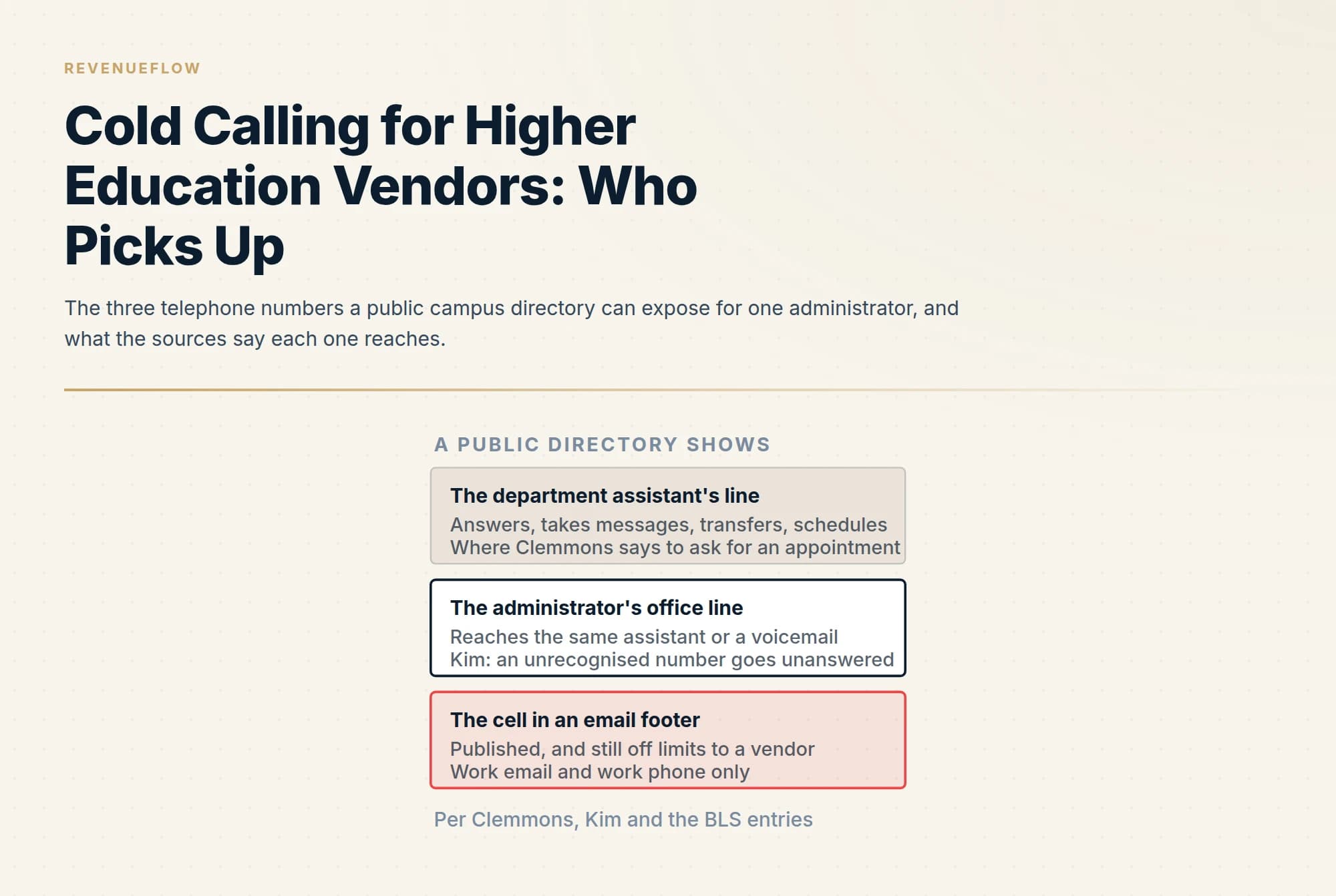
A cold call into a university reaches a department assistant whose published job is to route, and the university's own purchasing pages ask a vendor to make the first call to purchasing. Once a solicitation is posted a quiet period can disqualify the caller's bid. Call outside term starts and exam weeks, and take the first no as the answer.
Key takeaways
- Five university purchasing pages read on 21 September 2026 (Arizona, UAB, UTHSC, Clemson, UConn) route a vendor's first contact to purchasing; UTHSC allows routine department contact after that, and UConn says unsolicited calls are not encouraged.
- Kansas State's Cone of Silence bars supplier communication on a bid from the day the solicitation is posted until a purchase order is released, a contract is executed or all bids are rejected, and says a breach may disqualify the bid.
- At Cornell, New York State Finance Law 139-k requires anyone contacted by a supplier during the restricted period on a state-funded purchase to record the contact.
- Higher ed IT leaders wrote in print that unknown numbers go unanswered, cell numbers found in email footers are off limits, and a polite no is the end of the call.
Reviewed and updated September 21, 2026
A former college chief information officer wrote down, for every vendor that would listen, exactly how her phone number reached them. "Because higher ed institutions often publish public directories, it's easy to find contact information for CIOs", Raechelle Clemmons wrote on LinkedIn on 24 March 2020, in a series she addressed to vendors. Then the sentence that matters for a caller: "I used to include my cell phone in my email footer, for example, but this does not give salespeople license to call it." (Raechelle Clemmons, #DearVendor: Those Cold Calls, Though, read 21 September 2026.)
This guide is for a vendor whose people phone colleges and universities: software, equipment, services, research supplies. Calling a school district is a different building with a different front office, and cold calling for edtech companies covers that call. Which purchase route a sale goes through is in outbound sales for higher education vendors, what a booked campus meeting can become is in appointment setting for higher education vendors, and the federal rules on any business call are in what cold calling is and which rules apply. What follows is what the campus itself changes about the phone: who a published number reaches, what the university's own purchasing pages permit a sales call to do, the quiet period that can disqualify a bid, when anyone can talk, and what the people being called have said in print.
The directory is public, and that is the problem
A university is one of the few buyers that prints its org chart with telephone numbers, and the number shown for an administrator is usually an office line. The Bureau of Labor Statistics describes who answers it. Secretaries and administrative assistants, in the BLS entry read on 21 September 2026, "Answer telephones and take messages or transfer calls" and "Schedule appointments and update event calendars" (BLS Occupational Outlook Handbook, Secretaries and Administrative Assistants). Clemmons gives the same person a role in a vendor's call: "If you really want to get an appointment with an IT leader, contact their administrative assistant."
The BLS entry for postsecondary education administrators, read the same day, describes the people behind those assistants. Provosts "help college presidents develop academic policies, participate in making faculty appointments and tenure decisions, and manage budgets." Academic deans "coordinate the activities of the individual colleges or schools." And the entry warns against assuming a title exists: "Small schools often have small staffs that take on many different responsibilities, but larger schools may have different offices for each of these functions." (BLS Occupational Outlook Handbook, Postsecondary Education Administrators.) A list built from one large university's directory will not map onto a small college, where one person may hold three of its titles.
The third line a directory can expose is the cell number in an email footer. Clemmons's rule is plain: "Respect boundaries and contact your higher ed constituents through work-related venues (work email and phone), unless given specific instructions or permission otherwise."
What the university's own pages say a sales call may do
Universities publish their rules for vendor contact. Five of them, read on 21 September 2026, give five versions of one instruction: the first call goes to purchasing.
The University of Arizona's procurement policy on contact with sales representatives, effective 1 February 1996 and last revised 1 August 2006, says: "Purchasing instructs sales representatives to call and make an appointment if they want to contact a University department about their products." It also tells its own staff what to do with an uninvited caller: "University personnel who are approached by sales representatives should remind them to contact the Purchasing office if they haven't already." (University of Arizona, PPM 4.1 Contact with Sales Representatives.)
UAB's vendor visitation policy is one sentence: "All visits and/or sales calls must be coordinated with a representative of either University Purchasing or Hospital Purchasing." (UAB Financial Affairs, Vendor Visitation Policy.)
UTHSC draws a line between a first contact and the rest. "Vendor representatives calling on the campus for the first time should make an appointment with a purchasing agent in Purchasing Services prior to making sales calls on departments." After that, "Other routine visits and contacts with campus departments can be made directly without going through Purchasing Services." It adds: "individual departments on campus may have vendor sales call policies with which you need to comply." (UTHSC Procurement Services, Vendors and Suppliers.)
Clemson University explains the reason: "To eliminate unnecessary interruptions to the University staff, it is University practice to receive vendor sales representatives at Procurement Services." (Clemson University, Supplier-Related Policies and Procedures.)
The University of Connecticut is the most welcoming of the five and still asks for the same courtesy. Its vendor guide says that "marketing contacts are recognized as a necessary part of educating users on the capabilities and varieties of products in the marketplace." Then: "Unexpected or unsolicited calls are not encouraged." (University of Connecticut Procurement, Vendor Guide.)
Together the five pages answer a question a cold caller rarely asks: who at the institution has agreed to take a vendor's call. Purchasing has. Departments have, at some institutions, by appointment. Nobody has agreed to take an unannounced one.
| University page | What it says about the call |
|---|---|
| Arizona, PPM 4.1 | Purchasing instructs sales representatives to call and make an appointment before contacting a department |
| UAB, vendor visitation | All visits and sales calls must be coordinated with University or Hospital Purchasing |
| UTHSC, vendors page | First contact goes to a purchasing agent; routine contact with departments may follow directly |
| Clemson, supplier policies | Sales representatives are received at Procurement Services to spare staff interruptions |
| UConn, vendor guide | Marketing contacts to departments are recognised; unsolicited calls are not encouraged |
The quiet period a caller can walk into
The rule that can cost a vendor a contract starts the day a solicitation is posted. Kansas State University calls it the Cone of Silence: "The Cone of Silence prohibits supplier communication regarding a bid solicitation after the solicitation has been posted and advertised on the Kansas State University Bid Portal." The consequence is stated on the same page: "Should unauthorized communication occur between university personnel and a potential supplier during this process, the supplier's bid may be disqualified and the entire bid process canceled." And the end of it: "The Cone of Silence is terminated once a purchase order has been released, a contract has been fully executed or all bids have been rejected." (Kansas State University Purchasing, For Suppliers.)
At a public university in New York the quiet period is state law and the person who picks up your call must report it. Cornell's procurement page explains: "If New York State appropriated funds are being used to request a purchase, and an Invitation to Bid has been issued, New York State Finance Law, 139-k (6), requires that anyone who is contacted by one of the suppliers during the restricted period" must record the contact, and it links a form for doing so. (Cornell University Division of Financial Services, NYS Restricted Period Supplier Contact.)
The practical rule follows. Before a list is dialled, check the institution's open solicitations in your category; the pages above post them. If one is open, the department is inside the cone, the only permitted channel is the one the solicitation names, and a call could be logged against your own bid. This describes what those pages say, is not legal advice, and each institution's policy is the one that binds.
When a campus can talk
Two published calendars decide whether anyone is at the desk.
The first is the term, and the registrar's office is the place to read it. The BLS entry says registrars' "duties vary throughout the school year" and gives the busy weeks: "During registration and at the beginning of the academic term, for example, they help students sign up for, drop, and add courses." Penn State's 2026-27 academic calendar, read on 21 September 2026, puts dates on that shape: fall classes begin on Monday 24 August 2026 and end on Friday 11 December, final exams run from Monday 14 to Friday 18 December, and spring classes begin on Monday 11 January 2027 with spring break from 7 to 13 March. (Penn State Office of the University Registrar, 2026-27 Academic Calendar.) Every institution publishes its own version; in the weeks around a term start the assistant is doing the job the BLS describes for students, not for you, and the exam weeks and breaks are on the same published page.
The second calendar is the budget year. The argument that institutions set budgets for a year that has not started, so that a vendor absent from the budget build is absent for the year, is made in lead generation in education. For a caller the consequence is short: a call that lands after the budget is set is a call about next year, and should say so.
What the people being called have said
The objections in this market are documented, because the buyers wrote them down for vendors to read.
Joshua Kim's Inside Higher Ed column of 11 April 2017 is addressed to edtech sales professionals and describes the volume from the receiving end: "Anyone who works in a leadership or decision-making role in higher ed IT knows about the relentless rate of cold calls from technology sales persons." "The worst are the relentless phone calls", he writes, and a number he does not recognise goes unanswered. What he asks for instead is patience on the institution's clock, "We think in decades, if not longer", and an understanding of how a decision travels: "Ideas need to be socialized throughout the organization, so taking the long view is necessary to play in this edtech world." (Joshua Kim, Inside Higher Ed, read 21 September 2026.)
Clemmons's list of tactics, "ones that higher ed IT leaders say they particularly dislike", is a published objection guide read in reverse. Escalating follow-ups: "In the case of cold calling/emailing, silence isn't consent". Uninvited calendar invitations. Calls to a cell. LinkedIn: "Most higher ed IT leaders will not accept invitations to connect on LinkedIn from people they don't directly know and/or have done business with, unless that person is also in a college or university IT role." Her closing instruction: "Take 'no' or 'not now' for an answer." And why it matters beyond one call: "CIOs openly share their experiences with each other, and what you do at one institution will impact your ability to sell into another, either positively or negatively."
The comments under her post are the objections in the buyers' own voices. One IT leader describes ending a call politely and being asked, as she hung up, "Would you mind telling me why?" Another writes that after a polite no, "some continue to push". The first refusal is the end of the call, and the caller who accepts it is remembered for it.
Named as disliked
- Escalating follow-ups after silence
- Calendar invitations nobody asked for
- Calls to a cell found in a footer
- Connection requests from strangers
- Pushing after a polite no
What a calling programme does instead
- One call, then silence is read as no interest
- Ask the assistant for an appointment
- Work phone and work email only
- No LinkedIn request after an ignored call
- Take no or not now as the answer
Three openers, each tied to a page above
Each opener rests on one source above, names no real person and claims no result.
To purchasing, grounded in the UTHSC and Arizona pages.
Good morning, this is {{name}} at {{company}}. It's a vendor call, and your procurement page asks vendors to come to purchasing before calling departments, so this is the first call we're making. We sell {{category}}. Who is the purchasing agent for that commodity, and how do they prefer to be sent a one-page introduction?
The institution's own page asked for exactly this call, and it asks for a route rather than a meeting.
To a department assistant, grounded in the BLS entry and the Clemmons post.
Hello, this is {{name}} at {{company}}, a vendor. We've already introduced ourselves to purchasing. We're trying to find out whether {{category}} sits with your office or with central IT, and whether the right person takes vendor appointments. Could you tell us who that is, and the best week to ask?
Routing and scheduling are the published duties of the person who answered, and it asks about a process before it asks for time.
To a department, grounded in the UConn vendor guide.
This is {{name}} at {{company}}. Your procurement office says marketing contacts to departments are a recognised part of learning what's in the marketplace, and that unsolicited calls aren't encouraged, so this is a call to book one rather than to make one. Is there a slot in the week after term starts, and is there an open solicitation for {{category}} we should know about first?
It quotes the institution's own position back to it and asks the quiet-period question first.
When the phone is the wrong play
The sources point away from the cold call as a first contact with a decision maker. Kim does not answer numbers he does not recognise, the leaders in Clemmons's thread do not want to be pushed, five purchasing pages route a first contact to purchasing, and two describe a period in which any call can be logged against a bid.
The phone still earns three uses on a campus: the introduction to purchasing the institution's page invites, the routing question to an assistant whose job is to route, and a conversation with someone who already knows you. It is the wrong play during an open solicitation in your category, in the weeks around a term start, and as a volume tactic against IT leaders whose stated policy is to delete.
Where the phone sits next to writing is a position, not a result. RevenueFlow runs email and LinkedIn for clients and does not run phone outreach. Our doctrine is one message per campaign, no bumps behind it, and a new campaign only when the institution's own calendar gives a new reason to write, which on a campus it does every term. If you want a list built by institution with its purchasing policy, open solicitations and term dates attached, see what a first campaign looks like.
The short version
A campus directory makes a vendor's call easy to place and the institution's own pages make it hard to justify. Purchasing is the first call at Arizona, UAB, UTHSC and Clemson, and a courtesy at UConn. From the day a solicitation is posted a department is inside a quiet period that can disqualify the caller's bid, and in New York the person answering must record the contact. The term calendar decides whether an assistant has time to route you; the budget calendar decides whether the call is about this year. The work that makes a campus call land happens before it is placed: the purchasing appointment, the solicitation check, and a reason drawn from the institution's own dates.
Every page quoted above was read on 21 September 2026 from stored snapshots. Policies differ by institution and change; read the current policy of the institution you are calling. Nothing here is legal advice.
Frequently asked questions.
Frequently asked questions- Can a vendor cold call a university department directly?
- The universities' own pages answer differently, so read the one you are calling. Arizona instructs sales representatives to make an appointment with Purchasing before contacting a department, UAB requires every sales call to be coordinated with purchasing, and UTHSC asks for a purchasing appointment on the first contact and allows routine department contact afterwards. UConn recognises marketing contacts to departments and still says unsolicited calls are not encouraged.
- What is a cone of silence at a university and why does it matter to a caller?
- It is the quiet period around an open solicitation. Kansas State's page prohibits supplier communication about a bid once it is posted on the bid portal, routes questions through the portal, and says unauthorised communication may disqualify the supplier's bid and cancel the process. It ends when a purchase order is released, a contract is executed or all bids are rejected. Check open solicitations before dialling a department.
- When is the best time to call a college or university?
- Outside the weeks the registrar's year is busiest. The BLS says registrars' duties peak during registration and at the start of the academic term, and each institution publishes its dates. Penn State's 2026-27 calendar, for example, starts fall classes on 24 August with finals from 14 to 18 December and spring classes on 11 January. Budgets are set for a year that has not started, so a late call is a call about next year.
- Why do higher ed IT leaders say cold calling does not work on them?
- Because they have said so in print. Joshua Kim wrote in Inside Higher Ed that the phone calls are relentless and that decisions are socialised through the organisation on a slow clock. Raechelle Clemmons listed escalating follow-ups, uninvited calendar invitations, calls to a cell found in a footer and connection requests from strangers as the behaviours IT leaders dislike, and asked vendors to take no or not now for an answer.
About the author.

B2B cold email experts helping companies generate qualified leads through done-for-you outreach campaigns.
RevenueFlow Team
Explore more.
Ready to scale your outreach?
We build GTM engines that book real meetings. See the receipts.
Related articles.
Cold Calling Scripts for Higher Education Vendors: Six Calls
Six scripts for a vendor calling a campus: the department assistant, the purchasing agent, the chair, the IT leader, the open-solicitation check and the voicemail.
Cold Calling for Consulting Firms: The Partner's Hour
Cold calling for a consulting firm: who it dials and who picks up, why partner-led economics argue against the phone, the client's fiscal year, and when to skip it.
Cold Calling for Chemical Companies: Who Picks Up
A chemical cold call rarely arrives first. It reaches a formulator who has already been comparing suppliers on a screen, for one of three published reasons.
Cold Calling for Manufacturers: The Desk and the Floor
Cold calling for a manufacturer calling plants and OEMs: who answers the main line, the buyer's desk against the floor, the show calendar, the channel map, the limits.
Cold Calling for PPC Agencies: What You Can See First
A paid media prospect is partly readable before the call and has already been told by the platform what to do when a stranger rings about its ads.
Cold Calling for Telecom Companies: A Carrier's Own Rules
What only a telecom company meets on the phone: the FTC exemption that stops at its contractor, the verified carrier change, and the CPNI limit on lists.