Cold Calling Scripts for Higher Education Vendors: Six Calls
Six scripts for a vendor calling a campus: the department assistant, the purchasing agent, the chair, the IT leader, the open-solicitation check and the voicemail.
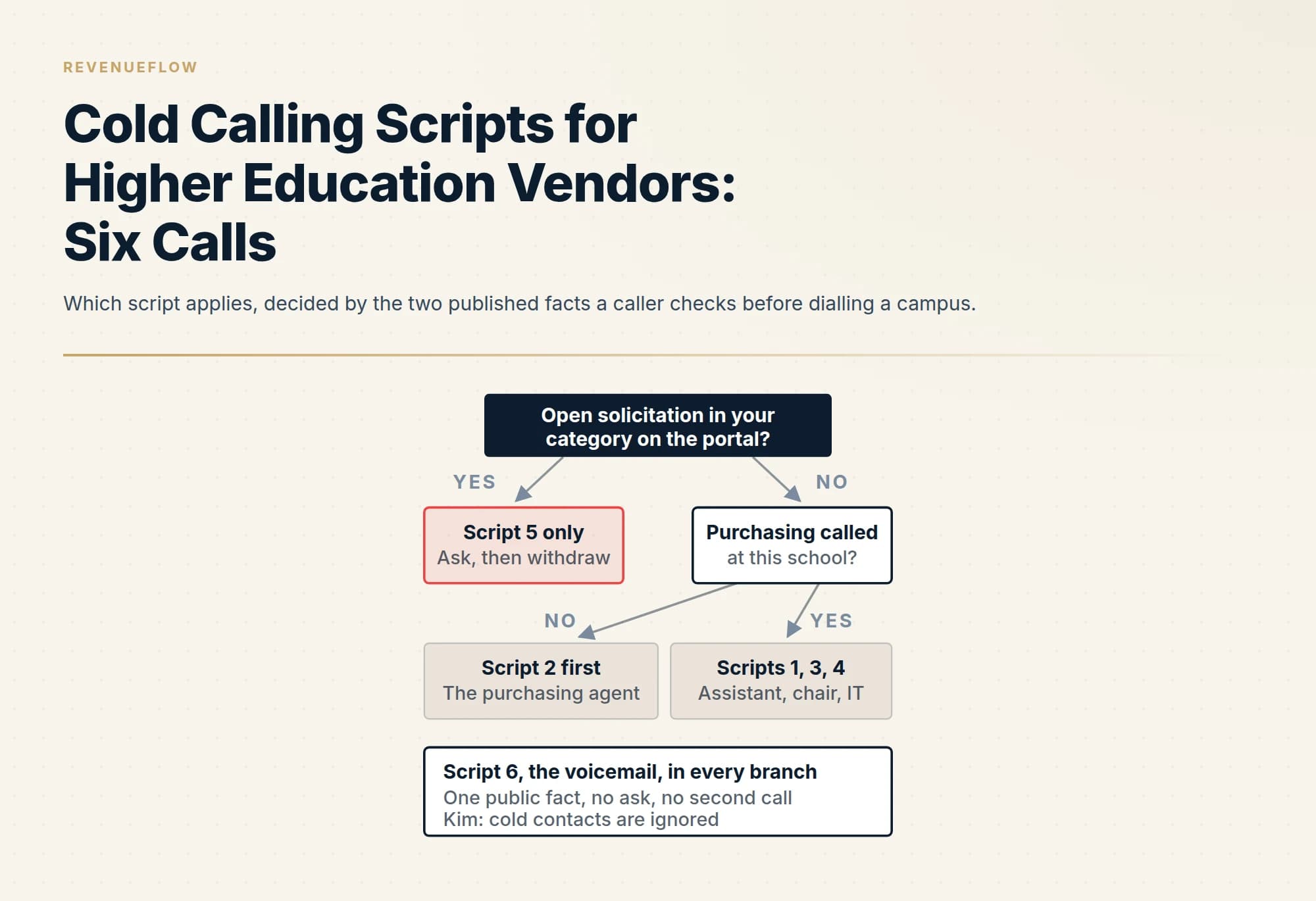
A vendor calling a campus needs six scripts: one for the department assistant who schedules appointments, one for the purchasing agent the university's page says to call first, one for a department chair, one for an IT leader who picked up, one that ends the call when a solicitation is open, and a voicemail that asks for nothing.
Key takeaways
- UTHSC's vendor page asks representatives calling the campus for the first time to make an appointment with a purchasing agent before making sales calls on departments, so the purchasing script is read before any department script.
- Kansas State's Cone of Silence routes every question about a posted solicitation through the bid portal, and Cornell records supplier contact during a New York restricted period, so the open-solicitation script exists only to end the call.
- Raechelle Clemmons, a former college CIO, told vendors to contact an IT leader's administrative assistant for an appointment, to be clear and transparent on a call, and to take no or not now for an answer.
- Joshua Kim wrote in Inside Higher Ed that cold contacts will be ignored, so the voicemail script states one published fact, asks for nothing and promises no second call.
Reviewed and updated September 21, 2026
"Please stop contacting me." That is the first line of a column Joshua Kim, a higher education technology leader, addressed to edtech sales professionals in Inside Higher Ed on 11 April 2017, and the second line tells the caller what will happen if they do not: "Your cold contacts will be ignored." (Joshua Kim, Inside Higher Ed, read 21 September 2026.) A script written for a campus has to be written for a buyer who has already published that sentence.
This page is scripts for a vendor calling colleges and universities: software, equipment, services, research supplies. It is not scripts for an institution calling prospective students, which is the other sense of the phrase and a different profession, described by one search result for this phrase and not by this page. The K-12 version of the vendor call, with a front office and a district purchasing desk, is in cold calling for edtech companies. The dollar thresholds that decide what a campus meeting can become are in appointment setting for higher education vendors, and the federal rules on a business call are in is cold calling against the law. Every source below was read on 21 September 2026, nothing here is legal advice, and every name inside a script is a placeholder.
Two facts a caller checks before any script is read
The universities publish both, and both change which script applies.
The first is whether purchasing has been called yet. The University of Tennessee Health Science Center's vendor page says: "Vendor representatives calling on the campus for the first time should make an appointment with a purchasing agent in Purchasing Services prior to making sales calls on departments." (UTHSC Procurement Services, Vendors and Suppliers.) The University of Arizona's policy on contact with sales representatives instructs its own staff to send an uninvited sales representative to Purchasing (University of Arizona, PPM 4.1). A department script read before the purchasing script has been used is, at those institutions, a script the department has been told to end.
The second is whether the institution has an open solicitation in your category. Kansas State University's supplier page describes what happens once one is posted: "All questions related to a pending solicitation must be submitted through the Kansas State University Bid Portal", through a question button, and answers appear in a bid addendum. (Kansas State University Purchasing, For Suppliers.) Cornell's procurement page adds the New York version, under which anyone contacted by a supplier during a restricted period on a state-funded purchase must record the contact, with a form for doing so. (Cornell University, NYS Restricted Period Supplier Contact.) An open solicitation in your category means Script 5, and only Script 5.
Script 1: the department assistant
The person on a department line answers the phone as part of the job: the Bureau of Labor Statistics lists answering telephones, transferring calls and scheduling appointments among the duties of secretaries and administrative assistants (BLS, Secretaries and Administrative Assistants). Raechelle Clemmons, a former college chief information officer, wrote in her #DearVendor series on 24 March 2020 that this is the person to ask: "If you really want to get an appointment with an IT leader, contact their administrative assistant." She also set the expectation: "(To set appropriate expectations, it's not likely they'll grant you one, but at least you tried.)" (Raechelle Clemmons, #DearVendor: Those Cold Calls, Though.)
Good morning, this is {{name}} from {{company}}. It's a vendor call and we've already introduced ourselves to purchasing, so this is a quick one. Does {{title}} take vendor appointments, and if so, what's the right week to ask for one? If it's easier, we can send one page to the department address and you can decide whether it's worth a slot.
The script names the word vendor in the first sentence, says purchasing has been called, and asks the assistant a question that is inside the published job: whether and when an appointment can be scheduled. It does not ask to be put through.
Script 2: the purchasing agent
Grounded in the UTHSC and Arizona pages above, which ask for exactly this call. The University of Connecticut's vendor guide adds when purchasing takes it: sales contacts with the Procurement Department "are normally scheduled between the hours of 9:00 AM to 12:00 noon" and in the early afternoon, and prospective suppliers are asked to send "a catalog, line card or other listing of products/services offered" for the vendor file. (University of Connecticut Procurement, Vendor Guide.)
Hello, this is {{name}} at {{company}}. Your vendor page asks suppliers to introduce themselves to purchasing before contacting departments, so this is that call. We supply {{category}}. Two questions: which agent covers that commodity, and would you rather have a line card by email before we ask any department for time?
To: the purchasing agent for the commodity
Your vendor page asks suppliers to introduce themselves to purchasing before contacting departments, so this is that call. 1
We supply {{category}}. Which agent covers that commodity? 2
Would you rather have a line card by email before we ask any department for time? 3
- 1Quotes the institution's own instruction back to it: UTHSC and Arizona both route a first contact to purchasing.
- 2Purchasing agents are assigned by commodity; UTHSC's page says to ask for the agent handling the commodity if the name is not known.
- 3UConn asks prospective suppliers to send a catalog or line card for the vendor file, so the offer is one the office already wants.
Script 3: the department chair or director
At many institutions the department is where the need starts. UConn's guide says campus departments "determine which supplies, equipment or services to purchase and are instrumental in initiating specifications", and that marketing contacts to them "are recognized as a necessary part of educating users on the capabilities and varieties of products in the marketplace." The same guide does not encourage unsolicited calls. So the script books the conversation rather than having it, and it names the purchase size, because whether a department can buy without a bid depends on the institution's published threshold, which the appointment-setting guide linked above sets out.
{{chair_name}}, this is {{name}} at {{company}}, a vendor, and this is a call to book a call rather than to make one. We've registered with purchasing. Departments here initiate their own specifications, so the question is yours: is {{category}} something your department is specifying this year, and is a purchase of that size one you can make without a bid? If yes to both, could we have twenty minutes the week after term starts?
The two questions do the qualifying. A department that is not specifying has no reason to meet, and a purchase above the institution's threshold belongs in a solicitation, where Script 5 applies.
Script 4: the IT leader who picked up
Clemmons wrote her list for exactly this moment. Her positive instruction: "When, and if, you do contact an institution directly, be clear. Don't use jargon or industry buzz words. Be transparent about what you're offering, and the value it can provide an institution." And her closing rule: "Take 'no' or 'not now' for an answer." Kim's version of the same advice is about posture: "Come into the community as a professional excited about technology and education, not just as a representative of your company looking for a sale."
{{leader_name}}, {{name}} at {{company}}. This is a cold call, it's to your office line, and it'll be under a minute. We make {{product}}, which does {{plain_description}}. That's the whole pitch. If it's not something you're looking at, say so and we won't call again. If it is, who on your team would look at it first?
The script says what it is, says which number it dialled, describes the product in plain words, and offers the leader the exit Clemmons asked for before it asks anything.
Script 5: the open-solicitation check
Kansas State's page calls the quiet period the Cone of Silence, says it protects "the professional integrity of the procurement process by shielding it from undue influences before the recommendation of award", and leaves open only the portal's question button. Cornell's page describes the duty on the other end of the line. So this script exists to end the call correctly when the caller learns, on the call, that a solicitation is open.
Thank you, that's what we needed to know. If there's a posted solicitation for {{category}}, we'll take our questions through the portal and won't contact the department about it. Could you tell us the solicitation number so we find the right one? Thanks for your time.
The caller has learned of a solicitation, has stopped, and has asked only for the public identifier that leads to the permitted channel. Nothing else is said. Across the six scripts the asks stay small and the refusals are built in: none asks to be put through, for a slot on a calendar, for budget figures or for competitor prices, none calls a second time after a no, and none says more once a solicitation exists.
Script 6: the voicemail
Kim's column says what a campus does with a vendor's voicemail: they are deleted. Clemmons's list of disliked tactics includes "Never-ending and frequently escalating emails" and "Read receipts", and her instruction is that silence means no interest. A voicemail on a campus therefore cannot ask for a call back and cannot be the first of several. It states one fact the institution published and leaves.
{{name}} at {{company}}, {{phone}}. A vendor, and we've registered with purchasing. Your posted term calendar has classes starting {{date}}, so we're calling before it, not during. We supply {{category}} and will send one page to the department address today. If it's useful, reply there. If not, this is the only call.
Objections, from the thread under the post
The comments beneath Clemmons's article are higher ed IT leaders describing what they do with vendor calls, and each one is an objection a script should expect. Greg Diment, replying six years ago, describes his new habit: "Instead of just ignoring such emails, I'm starting to reply with a link to your article suggesting that they read it." Thomas Hausmann describes callers who keep going after he has said it is not a convenient time. Paige Francis describes a caller who, as she hung up after saying the product was not a priority, asked her to explain why.
The three point one way. The objection on a campus is rarely about the product; it is that the caller did not accept the first answer. Every script above ends on the other person's answer, and Script 4 hands the exit to the buyer before the pitch is finished. The general shapes for answering an objection are in cold call objection handling; on a campus the best handling is to not need any.
The rules on the vendor's call
A vendor's call to a campus office line is a business-to-business call, and the federal position on those calls, with the separate statute on autodialers and mobile numbers, is in the calling rules page linked above. What this vertical adds is written by the institutions: the routing to purchasing, the quiet period, and the recorded contact under New York State Finance Law at Cornell. Clemmons adds the line the federal rules do not draw: an IT leader's cell number found in an email footer is not a number a vendor may call, whatever a directory shows.
When a script is the wrong tool
When there is an open solicitation in your category, where the only script is the one that ends the call. When the number is a cell. When the week is a term start or an exam week, which the registrar's calendar shows and the assistant is living through. And when the person is an IT leader whose published policy is to ignore cold contact, where the honest tool is the community Kim describes, "at conferences, events and symposiums", and a written note to a published address.
Where the call sits next to written outreach
RevenueFlow runs email and LinkedIn for clients and does not cold-call, so these scripts describe a vendor's option and not our motion. On a campus the institutions hand the argument to writing themselves: UConn asks for a line card, Cornell records the phone contact, and the IT leaders say they delete what they do not recognise. We send one message per campaign, with no bumps, and a new campaign only when the institution's own calendar gives a new reason, which a registrar publishes every term. If the list and that one message are what you would rather have built, see what a first campaign would target.
The short version
On a campus the phone has six jobs and each has a script: ask the assistant when appointments are taken, introduce the company to the purchasing agent the institution's page names, ask a department whether it is specifying and whether a bid is required, give an IT leader the exit before the pitch, stop the moment a solicitation is open, and leave a voicemail that states one public fact and asks for nothing. Every script says the word vendor in its first sentence and ends on the buyer's answer.
The university pages, the BLS entry and the two columns quoted above were read on 21 September 2026 from stored snapshots. Policies differ by institution and change; read the current policy of the institution you are calling. Nothing here is legal advice.
Frequently asked questions.
Frequently asked questions- Who should a vendor ask for when calling a university department?
- The assistant who answers, and only for information the assistant's job covers. The BLS lists answering telephones, transferring calls and scheduling appointments among the duties of secretaries and administrative assistants, and Raechelle Clemmons wrote that a vendor wanting an appointment with an IT leader should contact the administrative assistant. The script asks whether the person takes vendor appointments and which week to ask, not to be put through.
- Do I have to call university purchasing before calling a department?
- At several institutions their own pages say so. UTHSC asks vendor representatives calling the campus for the first time to make an appointment with a purchasing agent before making sales calls on departments, and Arizona's policy tells staff approached by a sales representative to send them to Purchasing. UConn's guide recognises marketing contacts to departments but does not encourage unsolicited calls. Read the page of the institution you are calling.
- What do I say if the university has an open solicitation for my category?
- Stop and ask for the solicitation number. Kansas State's page says every question about a pending solicitation goes through the bid portal, and that unauthorised communication may disqualify the supplier's bid. Cornell's page says anyone contacted during a New York restricted period on a state-funded purchase must record the contact. The script thanks the person, says questions will go through the portal, and ends.
- Should a vendor leave a voicemail for a university CIO?
- Only one that asks for nothing. Joshua Kim wrote in Inside Higher Ed that cold contacts from vendors he does not know will be ignored, and Clemmons listed escalating follow-ups and read receipts among the tactics IT leaders dislike. The voicemail names the company, states one fact from the institution's own published calendar, says one page will be sent to the department address, and says it is the only call.
About the author.

B2B cold email experts helping companies generate qualified leads through done-for-you outreach campaigns.
RevenueFlow Team
Explore more.
Ready to scale your outreach?
We build GTM engines that book real meetings. See the receipts.
Related articles.
Cold Calling for Higher Education Vendors: Who Picks Up
Who a published campus number really reaches, what university purchasing pages permit a sales call to do, the quiet period around a bid, and when a campus can talk.
Cold Calling Scripts for Biotech Companies: Calling the Lab
Five scripts for a life science tools rep calling laboratories: the funded investigator, the lab manager, purchasing behind a punch-out, and the voicemail.
Cold Calling Scripts for Credit Unions: Field of Membership
Five scripts for a credit union's own business development officer calling employers and businesses, written around the field of membership NCUA has to approve.
Cold Calling Scripts for SEO Agencies: After Google's Warning
Six call scripts for SEO agencies calling local businesses, written around what Google and the FTC tell owners about this call: no Google tie, no ranking guarantee.
Cold Calling Scripts for 3PL Companies: One Lane at a Time
Six call scripts for brokers and 3PLs calling shippers: the front office line, the one-lane opener, the incumbent answer, the email brush-off and the voicemail.
Cold Calling for Consulting Firms: The Partner's Hour
Cold calling for a consulting firm: who it dials and who picks up, why partner-led economics argue against the phone, the client's fiscal year, and when to skip it.