Cold Calling Scripts for Biotech Companies: Calling the Lab
Five scripts for a life science tools rep calling laboratories: the funded investigator, the lab manager, purchasing behind a punch-out, and the voicemail.
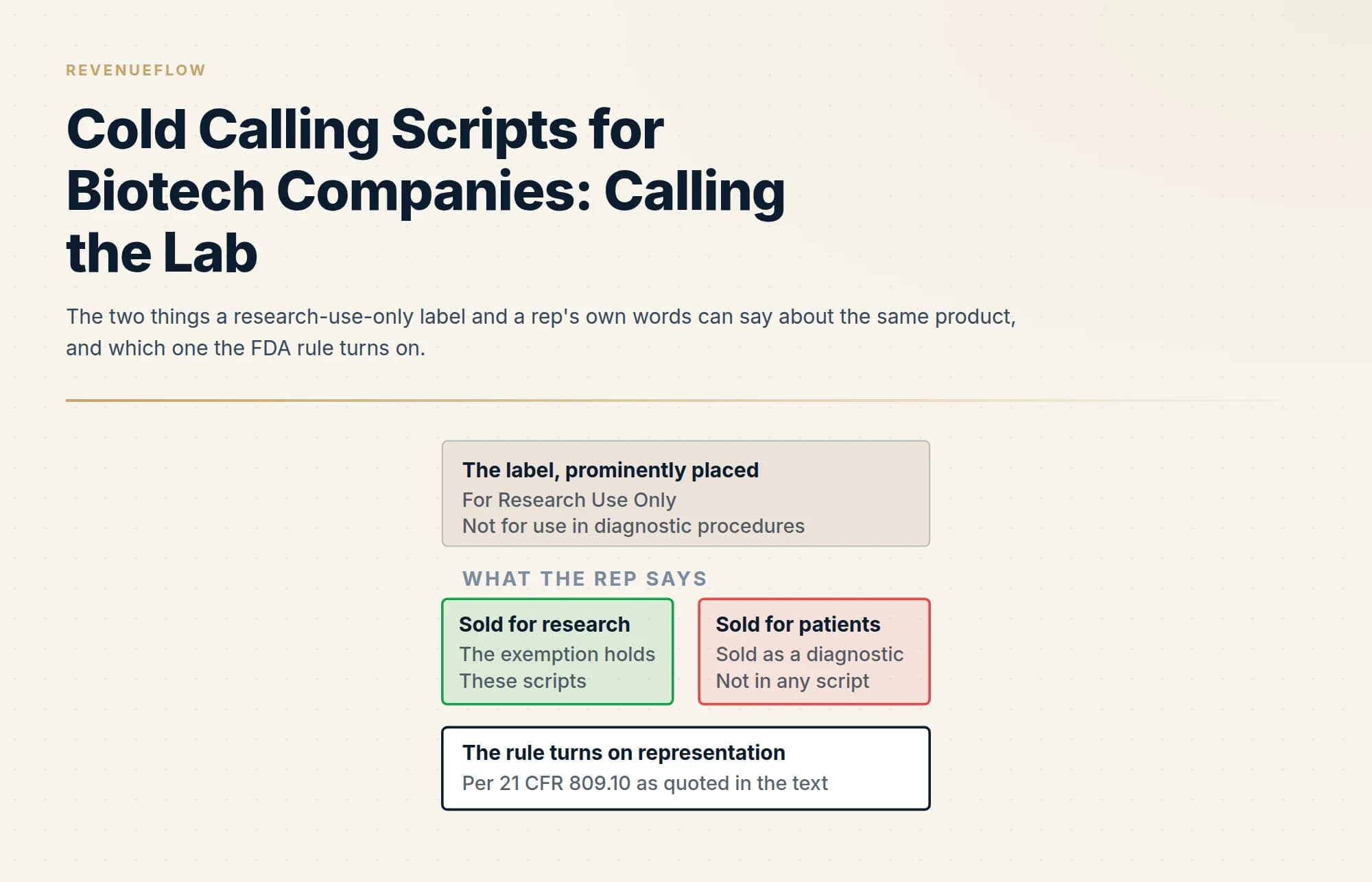
A lab rep's scripts rest on three public things: the NIH or NSF award that names the investigator who directs it, the university's own statement of its preferred lab supplier, and the FDA labelling rule that a research-use product may not be represented as a diagnostic. Name the award, ask the routing question, offer the specialist, respect the catalogue.
Key takeaways
- 21 CFR 809.10 exempts a research-phase product from full labelling when it is not represented as an effective in vitro diagnostic and carries the research-use-only statement, so what a rep says on the phone is part of the rule.
- NIH RePORTER publishes every NIH award with the principal investigator the grantee designated to direct it, records from FY 1985, and an active-projects search by budget end date; NSF's award search does the same for its awards.
- Cornell says VWR is its only preferred supplier for laboratory equipment and supplies, Kent State names Fisher Scientific and VWR as vendors of choice through punch-out catalogues, and Maryland says the punch-out is the preferred method.
- Lab Manager's April 2025 piece reports buyers complaining of too many contacts, unanswered questions, reps without technical chops and long cycles, and says in-lab time is a precious commodity buyers may not sacrifice for sales calls.
Reviewed and updated September 21, 2026
Cornell University's procurement page opens with the number that decides who a life science sales rep is really calling: "As a leading research organization, Cornell University spends more than $25 million annually on laboratory equipment and supplies." The next sentence names the door: "VWR International is the only preferred supplier for laboratory and scientific equipment and supplies." (Cornell University, Lab and Science Equipment and Supplies, read 21 September 2026.) A rep calling a lab at that university is calling into a purchase that already has a route, and a script that does not know it is a script that gets a polite no.
This page is scripts for a rep at a biotech company that sells to laboratories: instruments, reagents, consumables, sequencing or contract research services, lab software. It is not scripts for selling into a biotech company, which is the direction cold email for biotech covers with its buyer map. Why the initiator in a lab is a scientist, why the money has a public shape and why a distributor sits between a vendor and the order is the argument of biotech lead generation, and whether to hand the calling to an outside team is SDR outsourcing for biotech companies; neither is repeated. The federal rules on any business call are in is cold calling against the law. Every outside source was read on 21 September 2026, nothing here is legal advice, and every name inside a script is a placeholder.
The line a lab rep may not cross on the phone
Life science tools carry a rule about what a salesperson may claim a product does, and the regulator wrote it. The Food and Drug Administration's labelling rule for in vitro diagnostic products, at 21 CFR 809.10 on eCFR, exempts a product from the full labelling requirements when, among other conditions, it is a product "in the laboratory research phase of development, and not represented as an effective in vitro diagnostic product" and "all labeling bears the statement, prominently placed" that it is for research use only and not for use in diagnostic procedures. (eCFR, 21 CFR 809.10.) The condition is in the middle of that sentence: not represented as an effective diagnostic. A rep who tells a clinical lab on the phone that a research-use kit will work for patient testing has represented it as one, whatever the label says. Every script below sells a research-use product for research, and the word diagnostic does not appear in any of them.
The trigger is public, down to the name of the scientist
A lab rep's best reason to call is on a federal website. NIH RePORTER, the National Institutes of Health's database of funded projects, describes what it holds: "Each award supported by NIH promotes efforts to seek fundamental knowledge about the nature and behavior of living systems and/or the application of that knowledge to enhance health, lengthen life, and reduce illness and disability." It defines the person named on each award: "Principal Investigator/Project Leader: The individual designated by the grantee to direct the project supported by the grant." And it says how far back the record runs: "RePORTER contains records beginning with FY 1985." (NIH RePORTER, read 21 September 2026.) The National Science Foundation's award search does the same for its awards, and its page says a visitor can "Quickly find active and expired NSF-funded awards by searching for project title, awardee name, institution, or research topic." (NSF Award Search.)
For a script that means the opener can name the funded project and the investigator who directs it, from a source the investigator knows is public. It also means a rep can tell, before dialling, whether a project is active; RePORTER's page explains that its active-projects search returns projects that "have not yet reached their budget end date".
Who answers, from the buyer's own trade press
Lab Manager, a magazine for the people who run laboratories, published a piece on lab equipment purchasing on 25 April 2025 that describes the buyer's experience of vendors. Its list of what buyers had complained about is the objection list: "there are too many cooks in the kitchen, it's hard to get questions answered, sales reps don't have the necessary technical chops, and the sales cycles are too long." It states who the buyer is: "buyers are scientists; it's imperative that any equipment entering their lab can meet technical performance standards." And it describes the buyer's time: "Many buyers have embraced hybrid schedules, making their in-lab time a precious commodity they may not want to sacrifice for sales calls." (Lab Manager, Lab Equipment and Purchasing: What Buyers Must Know.) The same piece describes the vendor-side answer, an account manager who will "loop in specialists" who "can speak to the science on a granular or technical level."
Three scripts follow from those sentences: a call that does not claim technical depth the caller does not have, a call that does not spend in-lab time, and a call that offers the specialist rather than the pitch. SciLeads, a data vendor for science sales, publishes its own guide to contextual cold calling of researchers built on funding and publication signals; it is a vendor's page and is named here as what the market sells.
Script 1: the principal investigator
Grounded in RePORTER. The award is public, the investigator is named on it, and the budget end date is on the record.
Professor {{surname}}, this is {{name}} at {{company}}, a cold call and a short one. Your {{mechanism}} award on {{topic}} is listed as active through {{year}}, which is why we're calling now and not later. We make {{product}} for exactly that kind of assay. One question: is that part of the work done in your lab, or in a core facility we should be talking to instead?
The script names the public fact, says why the timing is now, and asks the routing question a scientist can answer in five seconds. It claims nothing about the product's performance on the phone.
Script 2: the lab manager
Grounded in the Lab Manager piece: in-lab time is precious, and the buyer wants questions answered by someone who can speak to the science.
Hi, this is {{name}} from {{company}}, a vendor, calling the lab's office line rather than the bench. We supply {{product}}, and the honest version of this call is that you'll have technical questions we should answer with our application specialist, not with a sales pitch. Could we send one page today, and would a fifteen-minute call with the specialist next week be worth your time?
To: the lab manager, on the office line
Calling the lab's office line rather than the bench. 1
You'll have technical questions we should answer with our application specialist, not with a sales pitch. 2
Could we send one page today? 3
And would a fifteen-minute call with the specialist next week be worth your time? 4
- 1Lab Manager: in-lab time is a precious commodity buyers may not want to sacrifice for sales calls.
- 2Lab Manager: buyers complained that reps lacked technical chops; the specialist is the answer the piece describes.
- 3The page goes first, so the buyer can decline before any bench time is spent.
- 4A time-boxed ask, with the specialist rather than the rep in the slot.
Script 3: the purchasing office, when a punch-out already exists
The distributor is the incumbent, and the universities say so on their own pages. Kent State University's procurement page says: "Kent State University has established agreements with Fisher Scientific and VWR International as vendors of choice for standard scientific supply expenses. You may order through either company by accessing their Punch-Out catalog in FlashCart." (Kent State University, Scientific Supplies.) The University of Maryland's page says "VWR is available as a punchout catalog in Shell Shop" and that the punch-out catalogues are "still the preferred method." (University of Maryland, VWR International.) A rep for a product that is not in the catalogue is asking a lab to leave the preferred route, and the script has to say so.
Good morning, this is {{name}} at {{company}}. We make {{product}}, and we know your lab supplies run through a punch-out with a preferred supplier, so this is a routing question, not a pitch. When a lab needs an item that isn't in that catalogue, what's the route your office prefers: a non-catalogue requisition, a card purchase, or getting the item listed with the distributor? We'd rather fit your process than argue with it.
Script 4: the scientist who says the lab is under agreement
The objection is the one Cornell's page states: the university has a single preferred supplier. The answer is not to contest the agreement.
Understood, and that's the route we'd expect. Two questions, then, and no pitch. Is {{product}} something your preferred supplier carries, or is it a gap? And if it's a gap, is the person who decides whether to order off catalogue you, your lab manager, or purchasing?
Script 5: the voicemail
Grounded in the Lab Manager piece, which says buyers had found it hard to get questions answered. The voicemail promises the answer, not the pitch.
{{name}} at {{company}}, {{phone}}. We make {{product}} for labs doing {{topic}}, and we noticed your award on {{topic}} is active. We'll send one page to the lab's address today with the specifications a lab manager would ask for. If it's relevant, reply there and we'll put you with our application specialist. If not, this is the only call.
Objections, from the sources
The vertical's practitioner voice for this exact search is a thread by a sales development representative in a remote biotech role; it could not be fetched from this network and is not quoted. What can be quoted is the buyer's side. Lab Manager's four complaints, too many contacts, unanswered questions, reps without technical depth and long cycles, are the objections a lab rep hears in other words: send a spec sheet, talk to our lab manager, does it work for our application, we are under agreement. The scripts above answer each with the specialist, the one page, the routing question and the punch-out question, and none of them argues.
The objection the sources cannot answer is the scientist who does not want to be called at all. Lab Manager says in-lab time is precious; the honest reading is that the office line, the one page and the specialist call are the offer, and a scientist who does not reply to the page has answered. The general shapes for handling an objection are in cold call objection handling.
| Complaint, per Lab Manager | Heard on a call as | The move in these scripts |
|---|---|---|
| Too many cooks in the kitchen | Talk to our lab manager | One caller, one page, one specialist |
| Hard to get questions answered | Send a spec sheet | The specialist call is the offer |
| Reps without the technical chops | Does it work for our application | The rep claims nothing technical |
| Sales cycles too long | We are under agreement | The routing question comes first |
The rules on the rep's call
A call to a laboratory's office line is a business call, and the federal position, with the separate statute on autodialers and mobile numbers, is on the calling rules page linked above. What this vertical adds is the labelling rule quoted at the top: a research-use product may not be represented as a diagnostic, and a phone call is a representation. What the university adds is its purchasing policy, which decides whether an off-catalogue order is possible at all.
When a script is the wrong tool
When the product is a research-use kit and the lab is clinical, where the only honest script is the one that says so. When the lab's item is in the preferred supplier's catalogue, where the call is a distributor conversation and not a lab one. When the investigator's award has reached its budget end date, which RePORTER shows. And when the number is a cell, where the mobile-number rules on the hub page apply.
Where the call sits next to written outreach
RevenueFlow runs email and LinkedIn for clients and does not cold-call, so these scripts describe a vendor's option and not our motion. In this vertical the sources argue for writing on their own: the award is public in writing, the buyer asks for questions answered and specifications sent, and the lab manager's time is the thing a call spends. We send one message per campaign, with no bumps, and a new campaign only when a new award, a new paper or a new lab gives a new reason. If a list built from public awards and that one message are what you would rather have built, see what a first campaign would target.
The short version
A lab rep's call rests on three public things: the award and the investigator named on it, the university's own statement of who its preferred supplier is, and a labelling rule that turns on what the rep represents. Name the award, ask the routing question, offer the specialist and the one page, respect the punch-out, and never say the word diagnostic about a research-use product.
The eCFR section, the NIH and NSF pages, the Lab Manager piece and the three university procurement pages quoted above were read on 21 September 2026 from stored snapshots. Rules and agreements change; read the current text before relying on it. Nothing here is legal advice.
Frequently asked questions.
Frequently asked questions- What can a rep say about a research-use-only product on a cold call?
- Only research use. 21 CFR 809.10 exempts a product in the laboratory research phase from full labelling requirements when it is not represented as an effective in vitro diagnostic product and its labelling carries the research-use-only statement. A rep who tells a clinical lab the kit will work for patient testing has represented it as a diagnostic whatever the label says, so the scripts on this page sell research products for research and never say diagnostic.
- How do I find a reason to call a principal investigator?
- On the federal award databases. NIH RePORTER lists every NIH award with the principal investigator the grantee designated to direct it, holds records from fiscal year 1985, and lets a rep search active projects that have not reached their budget end date. NSF's award search finds active and expired NSF awards by title, awardee, institution or topic. The opener names the award and asks whether the work happens in the lab or a core facility.
- Why does the script ask purchasing about the punch-out catalogue?
- Because the universities say the distributor is the route. Cornell's procurement page says VWR International is its only preferred supplier for laboratory equipment and supplies, Kent State's page names Fisher Scientific and VWR as vendors of choice ordered through punch-out catalogues, and Maryland's page says the punch-out is still the preferred method. A product outside the catalogue needs the office's own route, and the script asks for it.
- Should a lab rep call the scientist or the lab manager?
- The office line, and the lab manager first for anything technical. Lab Manager's piece says buyers are scientists who need equipment to meet technical performance standards, that they complained reps lacked technical chops, and that in-lab time is a precious commodity they may not want to sacrifice for sales calls. The script offers one page and a specialist call rather than a pitch, and the voicemail promises the specifications a lab manager would ask for.
About the author.

B2B cold email experts helping companies generate qualified leads through done-for-you outreach campaigns.
RevenueFlow Team
Explore more.
Ready to scale your outreach?
We build GTM engines that book real meetings. See the receipts.
Related articles.
Cold Calling Scripts for Higher Education Vendors: Six Calls
Six scripts for a vendor calling a campus: the department assistant, the purchasing agent, the chair, the IT leader, the open-solicitation check and the voicemail.
Cold Calling Scripts for Credit Unions: Field of Membership
Five scripts for a credit union's own business development officer calling employers and businesses, written around the field of membership NCUA has to approve.
Cold Calling Scripts for SEO Agencies: After Google's Warning
Six call scripts for SEO agencies calling local businesses, written around what Google and the FTC tell owners about this call: no Google tie, no ranking guarantee.
Cold Calling Scripts for 3PL Companies: One Lane at a Time
Six call scripts for brokers and 3PLs calling shippers: the front office line, the one-lane opener, the incumbent answer, the email brush-off and the voicemail.
Cold Calling for Consulting Firms: The Partner's Hour
Cold calling for a consulting firm: who it dials and who picks up, why partner-led economics argue against the phone, the client's fiscal year, and when to skip it.
Cold Calling for Chemical Companies: Who Picks Up
A chemical cold call rarely arrives first. It reaches a formulator who has already been comparing suppliers on a screen, for one of three published reasons.