Appointment Setting for Higher Education Vendors: Thresholds First
For vendors selling to colleges: who takes the meeting, the bid threshold ladder that decides what it can become, cooperative contracts, the calendar and three openers.
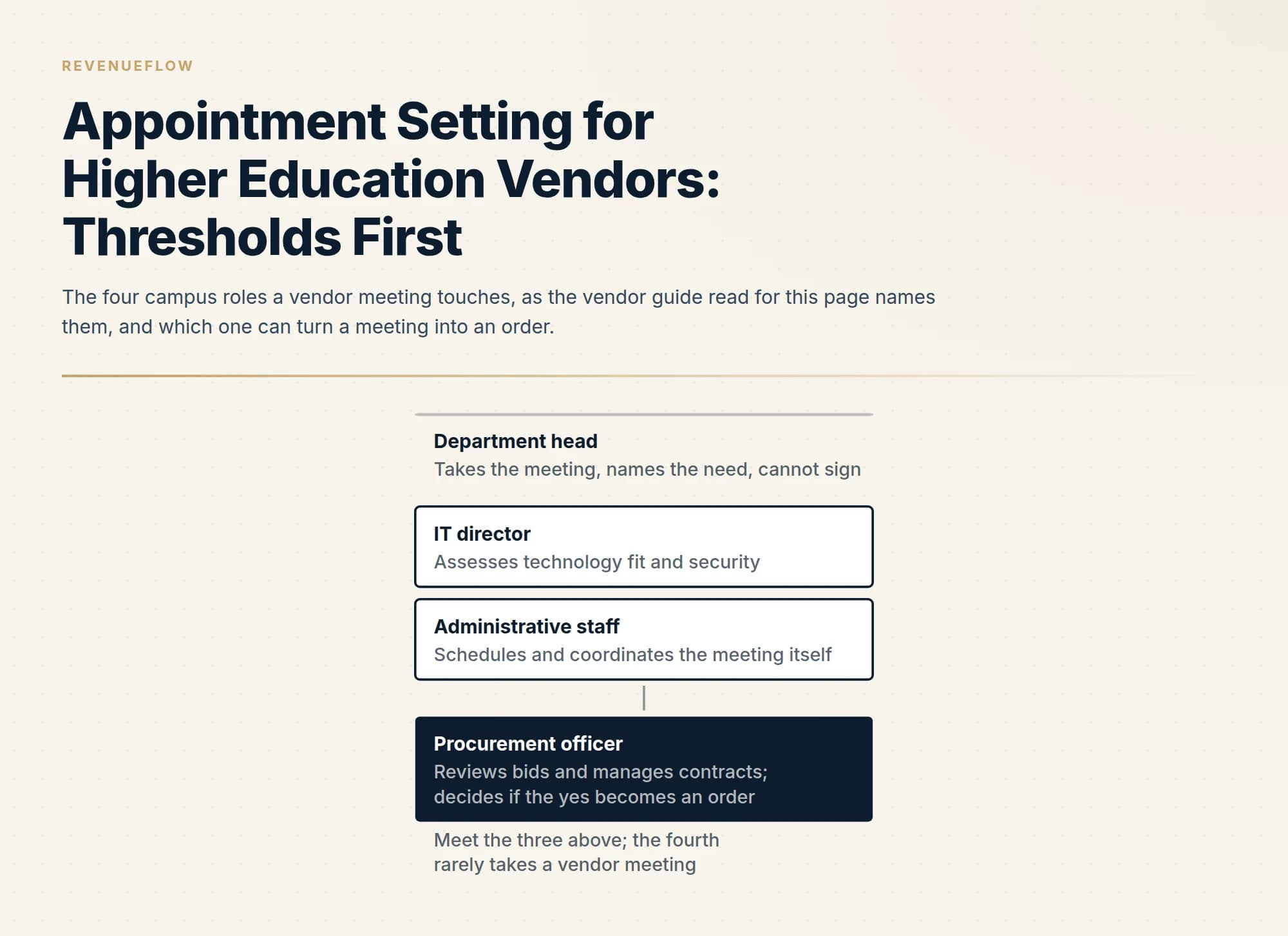
A campus meeting is taken by a department head who cannot sign and decided by a procurement officer who rarely attends. Check the institution's published bid thresholds and cooperative contract memberships before booking, book in the working windows between term starts and exams, and send privacy and accessibility documentation ahead so the IT review runs in parallel.
Key takeaways
- Penn State's purchasing page requires no competitive bid under 25,000 dollars, informal bids to 99,999 and a formal process at 100,000 or more, while Alabama's threshold is 75,000; the ladder decides whether a meeting can end in an order.
- E and I's primer states members can save 10 to 15 percent through group purchasing and that it has 6,000 institution members with no membership fee; a vendor on a cooperative contract can be bought without a campus solicitation.
- Penn State lists a long-standing relationship with a supplier among sole source justifications it does not approve, so the relationship a meeting builds is not a reason the university can skip competition.
- The Justice Department's Title II web accessibility compliance date moved to 26 April 2027 for entities of 50,000 or more, and FERPA at 34 CFR Part 99 binds the institution, so both arrive as questions in the meeting.
Reviewed and updated September 18, 2026
Appointment Setting for Higher Education Vendors: Thresholds First
A vendor books a meeting with a department chair in October. The chair likes the product, asks for a quote, and says she will take it to purchasing. The quote crosses the institution's bid threshold, so purchasing opens a competitive process, and the vendor who ran the meeting ends up as one of four names on a spreadsheet. The appointment did its job. The threshold did the rest.
This page is for vendors selling to colleges and universities: software, equipment, services, anything a campus buys. It is about what a booked meeting can and cannot become in this market, and it is sourced from the buyers' own cooperatives, purchasing offices and regulators, fetched on 18 September 2026. The message-level detail for the same reader is in cold email for education, and the calendar and public-records argument for the wider education market is in lead generation in education; neither is repeated here.
Who is actually in the room
The B2B Appointment Setting guide to university vendor meetings, read on 18 September 2026, names four roles: procurement officers who deal with bids, contracts and compliance; department heads who know their teams' needs and identify gaps a vendor can fill; IT directors centred on digital tools and systems; and administrative staff who deal with appointment logistics. Its own summary table gives the procurement officer the job of reviewing bids and managing contracts, the department head the job of identifying needs and approving ideas, and the IT director the job of assessing technology fit and security.
That list explains why an appointment programme in this vertical books a different meeting from the one it thinks it is booking. The department head is the person who will say yes to a conversation, and the person who cannot sign. The procurement officer is the person who decides whether the yes can turn into an order without a bid, and rarely takes a vendor meeting at all. E and I's cooperative, the member-owned purchasing cooperative for education, describes the process side in its own procurement primer dated 7 December 2023: procurement is the strategic framework for sourcing, negotiating, contracting and complying, purchasing is the subset that buys, and the methods include tendering through RFPs and RFQs, sourcing from contracted suppliers, and contract management with automated tracking of renewal dates.
The threshold ladder decides what a meeting can become
Every public institution publishes the dollar amounts at which a purchase must be competed, and those numbers are the single most useful fact a vendor can hold before booking a campus meeting. Penn State's competitive bidding page, read on 18 September 2026, states that under 25,000 dollars competitive bids are not required unless a programme is federally funded, from 25,000 to 99,999 dollars buyers obtain informal bids from suppliers, and at 100,000 dollars or more the university conducts a formal competitive bidding process. It adds that federal programmes carry a 10,000 dollar threshold under the Uniform Guidance. The University of Alabama's competitive bid page states that any purchase or contract exceeding its small dollar threshold of 75,000 dollars must be competitively bid under the Alabama Bid Law, and that a request cannot be split to avoid it. UC Santa Barbara's federal funds page puts the micro-purchase level at under 10,000 dollars for federal contracts and 50,000 dollars for federal grants. NASPO's competitive thresholds catalogue records, for Alabama state agencies, small purchase procedures below 25,000 dollars with no fewer than three written quotations between 5,000 and 25,000 dollars.
Those figures differ by state, by institution and by funding source, which is the point. A meeting about a product priced under the informal threshold can end in a purchase order from the department. A meeting about a product priced above the formal threshold ends in a solicitation you must then win in writing, against competitors who never had the meeting. The how to cold email procurement managers guide covers the procurement reader and RFP marketing covers the formal end; the appointment programme's job is to know which end it is booking for before it books.
One more line from Penn State's page belongs in every vendor's training. Among the examples of sole source justifications it does not approve are a long-standing relationship with a supplier and a preference based on previous interactions. The relationship a great meeting builds is real, and it is explicitly not a reason the university can buy from you without competing the purchase.
Cooperative contracts change the meeting
There is a route that skips the ladder, and the buyers built it themselves. E and I's primer on group purchasing organisations states that higher education institutions participating in GPOs can save 10 to 15 percent or more, that some GPOs take 3 to 5 percent of transaction prices plus membership fees, and that E and I's own cooperative charges no membership fee, leverages more than 50 billion dollars in member spending across 150 product categories, and has 6,000 educational institution members. OMNIA Partners' higher education page describes competitively solicited, publicly awarded contracts across more than 90 categories, with free membership for the institution.
The mechanism matters for appointment setting. A cooperative runs the competitive solicitation once, on behalf of its members, and a member institution can then buy from the awarded supplier at the contracted price without running its own bid. If you hold a cooperative contract, the meeting with a department head can end in an order at almost any size, and the opener should say so. If you do not, the meeting above the threshold is the start of a solicitation, and the honest opener says that too.
The calendar is two calendars
The vendor guide read for this page lists the windows in the academic year that decide whether a meeting can be scheduled at all: semester starts in August and September and in January and February, exam weeks in November and December and in April and May, and breaks in December, March and in July and August. Its advice is to contact staff in the lulls, immediately after final grading or before a new term, because staff are swamped at term starts and during exams. SalesRoads' school appointment page, addressed to the same vendors, describes a purchasing timeline driven by academic calendars and fiscal budgets and multi-layered approval processes.
- August to SeptemberTerm start
Staff swamped; meetings booked here get moved
- October to mid NovemberFirst working window
Department heads available; threshold check done before booking
- Late November to DecemberExams, then break
Grading first, then the quiet days after it
- January to FebruarySecond term start
Same scramble as August
- Late February to AprilSecond working window
Budget requests for the next year are being assembled
- May to AugustExams and summer
Fewer people, slower approvals, no new money until the year turns
The fiscal calendar runs underneath that, and it is the one that decides whether there is money. Most public institutions set budgets for a year that has not started, and a vendor absent from the budget build is absent for the year, which is the argument lead generation in education makes in full. For appointment setting the consequence is that the meeting a department head takes in October is a meeting about next year's request, and should be booked and run as one.
What the institution will ask you to show
Two federal rules reach into the meeting itself because they change what the buyer needs from you.
The Family Educational Rights and Privacy Act is implemented at 34 CFR Part 99, and the Department of Education's student privacy office publishes the regulations in full; section 99.30 sets the conditions under which prior consent is required to disclose personally identifiable information from education records. The rule binds the institution, so anything that will touch student data arrives at the IT director's desk with a question about how the vendor handles it. Answer it before the meeting, in writing, and the meeting becomes a shorter one.
Accessibility is the other. The Department of Justice's fact sheet on its Title II web rule, updated for the interim final rule published on 20 April 2026, states that the compliance date for state and local government entities with a population of 50,000 or more is extended to 26 April 2027, and to 26 April 2028 for smaller entities and special district governments. Title II covers state and local governments, and a public institution that reads itself as one will be asking every vendor with a web-facing product for its accessibility conformance documentation before that date. The Section 508 VPAT page that describes the federal template could not be read on 18 September 2026 because it returned a redirect stub, so its contents are not stated here; the institution's own accessibility office will name the document it wants.
What the vertical says gets in the way
The objections come from the buyers' side in their own words. E and I's procurement primer opens with declining enrollment and lower tuition fees, freshman numbers that continue to drop, and inflation, higher supply costs and staffing challenges all eating away at budgets, with a renewed emphasis on streamlining processes and delivering substantive cost reductions. The vendor guides say the same thing from the other side: SalesRoads names tight budgets, seasonal timelines and multi-layered approval, and the B2B Appointment Setting guide tells vendors to be ready for bureaucratic delays, committee decisions and budget constraints.
Penn State's sole source page adds the objection nobody says aloud in a meeting: the relationship you built is not a purchasing justification. And the cooperatives' own savings claims, 10 to 15 percent through group purchasing per E and I's primer, are the number a department head will be told by purchasing when she asks to buy from you off contract.
Channel reality, and when this is the wrong play
The search results for this topic are appointment-setting agencies pitching the education vertical, SalesRoads, Launch Leads and Sales Focus among them, a higher-education marketing agency, and AppointmentQuest, which sells scheduling software for education and belongs to the other meaning of the phrase entirely. None is endorsed here; they are what the market sells. What separates a useful campus appointment from a calendar entry is the threshold check and the cooperative check done before the invitation goes out.
Booking meetings is the right play when the product sits below the institution's informal threshold, when you already hold a cooperative or state contract the institution can buy against, or when the meeting is explicitly about next year's budget request and everyone in it knows that. It is the wrong play when the purchase will exceed the formal threshold and you hold no contract vehicle, because the meeting cannot end in an order and the RFP response is the work that decides it; when the product is a commodity the campus buys through a catalogue; and in the two term-start windows, when the people you want are not taking meetings. The generic comparison of providers and models is in B2B appointment setting and appointment setting services, and applies here without change.
To a department chair at a public university
Your purchasing office publishes the level below which a department can order without a competitive bid. Our pilot is priced under it, which is why we are asking for twenty minutes rather than a proposal. 1
To a director of procurement
We hold an awarded contract with a higher education purchasing cooperative your institution is a member of, so a department can buy against it without running its own solicitation. Would it help to see which categories it covers before anyone on campus asks you? 2
To an IT director
The Justice Department moved the Title II web accessibility date to April 2027 for larger public entities. Our conformance documentation is ready to send; is the accessibility review something you run before or after a department requests a tool? 3
- 1Built on the published threshold ladder; the message names the route it expects and asks for the smaller commitment the route allows.
- 2Built on the cooperative model that OMNIA and E and I's primer describe; it speaks to procurement in procurement's terms and offers information rather than a demo.
- 3Built on the ADA fact sheet dated for the April 2026 interim final rule; the question is about the institution's process, which only the IT director can answer.
Each opener asks a question about the institution's own process, makes no results claim, and names the route the vendor expects. Our own cadence rule applies unchanged: one message per campaign, sent once, a new campaign only when a new premise exists, and in this market the premises arrive on a calendar.
Running it
Build the target list at the level of the unit that can buy, which in higher education is often the school or department rather than the university, and attach to each account the published threshold ladder, the cooperative memberships you can find on the cooperatives' own sites, and the fiscal year. Book meetings in the two working windows. Send the privacy and accessibility documentation ahead of the meeting, so the IT director's review runs in parallel with the department head's interest rather than after it.
If the constraint is building that list and booking the first conversations under those rules, RevenueFlow books qualified campus meetings on a pay-per-meeting basis, by email and LinkedIn, with the qualification criteria, including which purchase route the meeting is for, agreed in writing before launch.
Threshold figures per Penn State Procurement, the University of Alabama Purchasing office, UC Santa Barbara Business and Financial Services and NASPO's competitive thresholds catalogue; cooperative figures per OMNIA Partners and E and I's two primers; roles and calendar windows per B2B Appointment Setting's university guide and SalesRoads; FERPA per the Department of Education's regulations page; accessibility dates per the Department of Justice ADA.gov fact sheet. All fetched 18 September 2026. Confirm each institution's current thresholds and rules on its own pages before relying on them.
Sources: Competitive Bidding, Penn State Procurement, Competitive Bid Process, University of Alabama Purchasing, Dollar Thresholds, UC Santa Barbara, Competitive Thresholds, NASPO, Higher Ed GPOs 101, E and I's blog, How Does Higher Education Procurement Work, E and I's blog, Higher Education, OMNIA Partners, Vendor Appointment Setting University Partnership Guide, B2B Appointment Setting, School Appointment Setting, SalesRoads, FERPA regulations, U.S. Department of Education, Fact Sheet: New Rule on the Accessibility of Web Content and Mobile Apps, ADA.gov
Frequently asked questions.
Frequently asked questions- Who should a vendor book meetings with at a university?
- The vendor guide read for this page names procurement officers, department heads, IT directors and administrative staff. The department head takes the meeting and names the need but cannot sign; the IT director assesses fit and security; the procurement officer reviews bids and manages contracts and decides whether the purchase must be competed. Book the department head, prepare for the other two.
- Why do university deals stall after a good meeting?
- Usually because the price crossed the institution's bid threshold. Penn State, for example, obtains informal bids from 25,000 dollars and runs a formal process at 100,000 or more, and it does not accept a long-standing supplier relationship as a sole source justification. Above the threshold the meeting becomes one entry in a solicitation unless the vendor holds a cooperative or state contract the institution can buy against.
- When is the best time to book meetings with college staff?
- In the lulls the vendor guides describe: after final grading and before a new term, avoiding the August to September and January to February term starts and the November to December and April to May exam weeks. Money follows the fiscal year underneath that calendar, so an autumn meeting is usually about next year's budget request and should be run as one.
- What documents will a university ask a vendor for?
- Anything touching student records raises FERPA, implemented at 34 CFR Part 99, so the IT director will ask how student data is handled. Public institutions preparing for the Title II web accessibility dates of April 2027 and April 2028 ask for accessibility conformance documentation. Sending both before the meeting lets the review run alongside the department's interest rather than after it.
About the author.

B2B cold email experts helping companies generate qualified leads through done-for-you outreach campaigns.
RevenueFlow Team
Explore more.
Ready to scale your outreach?
We build GTM engines that book real meetings. See the receipts.
Related articles.
Appointment Setting for 3PL Companies: Fit Before the Calendar
For 3PLs, warehousing operators and brokers wanting shipper meetings: the five fit gates, the bid calendar, contract terms, the trade's rules and three openers.
Outbound Sales for Higher Education Vendors: Which Door to Use
Outbound for higher education vendors, built on universities' own purchasing policies: three doors, the ask that fits each one, and a dated accessibility review.
Appointment Setting for Food Distributors
How a foodservice distributor opens accounts its routes do not reach: independents, chains and institutions, the FDA traceability rule as the opener, the DSR handoff.
Merchant Services Cold Calling Scripts: The Honest Version
Six call scripts for merchant services agents and ISO reps, built around what the FTC alleged about this exact call: no affiliation claim, no rate before a statement.
LinkedIn Outreach for Machine Shops
How a job shop or CNC machine shop uses LinkedIn to win OEM work: the four buyer titles, the RFQ gate, the ISO, AS9100 and ITAR facts, and LinkedIn's own rules.
Lead Generation for Telecommunications Companies: Four Lead Sources
For carriers, ISPs, UCaaS providers and MSPs: the installed base, the advisor channel, dated outbound and the funded network map as lead sources, with FCC rules.