15 Objection Handling Email Templates That Actually Work
Proven email templates for handling the most common sales objections, from price concerns to timing issues. Copy, customize, and close more deals.
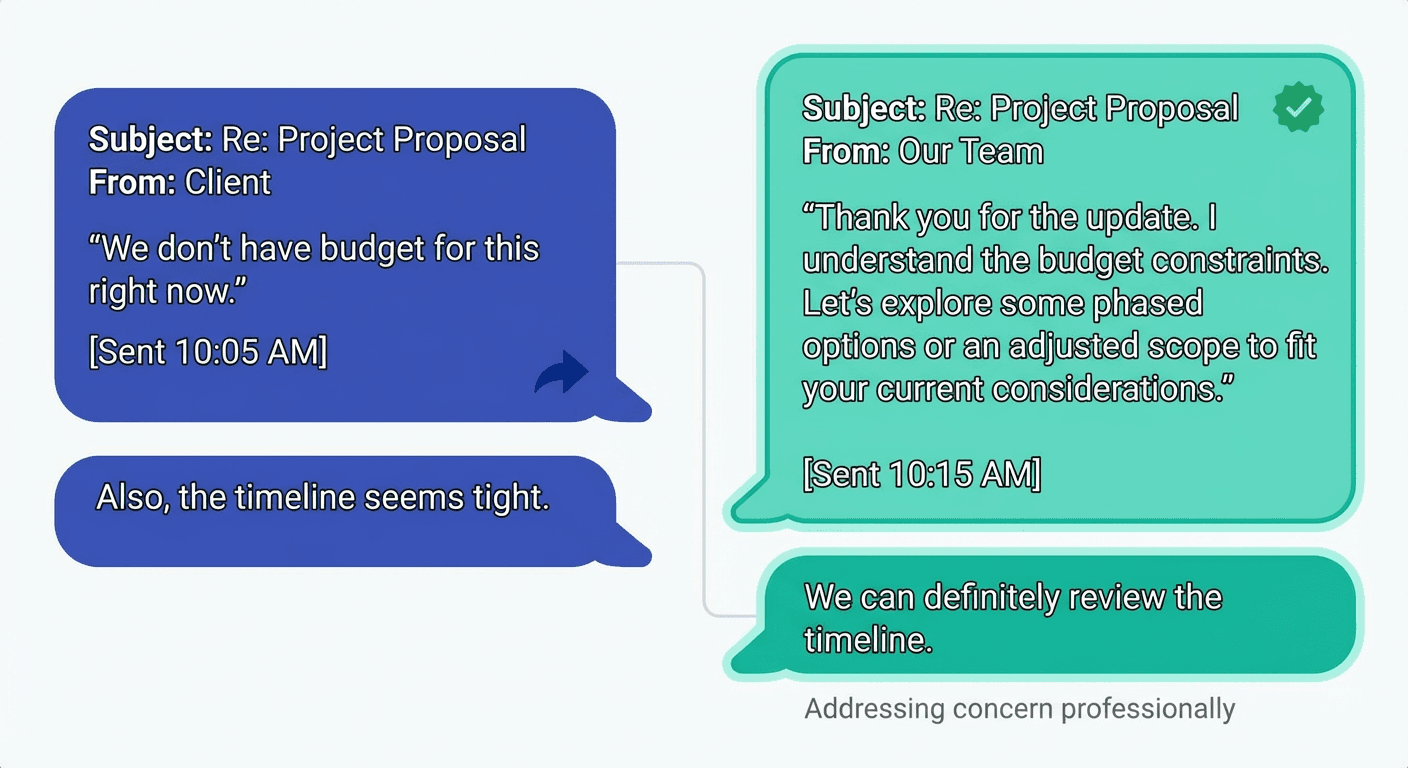
Effective objection handling emails acknowledge the prospect's concern before addressing it, use clarifying questions instead of assumptions, and offer value without pressure. The fifteen templates cover five objection categories: price concerns, timing issues, competitor comparisons, authority obstacles, and disinterest. Each follows a framework of validation, brief value reframing, and a low-pressure next step, keeping responses shorter than the original objection.
Key takeaways
- Objections signal interest because prospects who have zero interest do not bother replying to sales emails at all.
- The ROI Reframe template references peer companies that achieved results like 3.2x return within the first 90 days to address budget constraints.
- The Budget Timing Question distinguishes between temporary constraints and permanent rejections by asking if it's a 'not right now' or 'completely off the table' situation.
- Effective objection responses should be shorter than the prospect's objection email to avoid signaling desperation.
- The Scope Adjustment template offers smaller pilot programs at lower price points to help prospects prove ROI before larger commitments.
Reviewed and updated September 15, 2026
15 Objection Handling Email Templates That Actually Work
Your prospect just replied to your outreach with "We don't have the budget right now." Most salespeople see this as a dead end. The best salespeople see it as the beginning of a real conversation.
Objections are signals of interest. A prospect who truly had zero interest wouldn't bother replying at all. When someone takes the time to explain why they can't move forward, they're giving you valuable information and, whether they realize it or not, an opening to address their concerns.
The challenge is responding in a way that acknowledges their concern without being pushy, defensive, or desperate. These 15 templates will help you do exactly that.
What Makes a Great Objection Handling Email
Before diving into the templates, let's establish what separates effective objection handling from the typical responses that kill deals.
- Yes: Acknowledge first, then address
- Yes: Ask questions instead of making assumptions
- Yes: Provide value, not pressure
- Yes: Keep it brief
- Yes: Always include a soft next step
Acknowledge first, then address. The worst thing you can do is immediately launch into a rebuttal. Your prospect needs to feel heard before they'll be open to a different perspective.
Ask questions instead of making assumptions. You think you know why they're objecting, but you might be wrong. A good response often includes a clarifying question that helps you understand the real concern.
Provide value, not pressure. Every objection response should leave the prospect better informed than before, regardless of whether they move forward.
Keep it brief. Long-winded responses signal desperation. Your reply should be shorter than their objection email.
Always include a soft next step. Give them an easy way to continue the conversation without demanding a commitment.
Price Objection Templates
Price objections are the most common barrier in B2B sales. These responses help you understand what's really behind the concern and reframe the conversation around value.
Template 1: The ROI Reframe
Best for: Prospects who cite budget constraints but haven't seen concrete ROI data
Subject line: Re: [Original thread]
Email:
Hi [Name],
Totally understand budget is tight. Before we close the door on this, would it help to see what [similar company/industry peer] achieved with us?
They were in a similar spot and saw [specific result, e.g., "a 3.2x return within the first 90 days"].
Happy to share the case study if useful. No pressure either way.
[Your name]
Why it works: This template validates their concern, then introduces social proof from a relatable company. The "no pressure" close removes any sense of desperation while keeping the door open.
Template 2: The Budget Timing Question
Best for: Prospects who may have budget available at a different time
Subject line: Re: [Original thread]
Email:
Hi [Name],
Appreciate you being upfront about budget. Quick question: is this a "not right now" situation, or is [solution type] completely off the table for the foreseeable future?
If it's timing, I'm happy to circle back when it makes more sense. Just want to make sure I'm not wasting your time.
[Your name]
Why it works: This template distinguishes between a temporary constraint and a permanent no. Many prospects appreciate the directness and will tell you exactly when to follow up.
Template 3: The Scope Adjustment
Best for: Prospects who like your solution but genuinely can't afford the full package
Subject line: Re: [Original thread]
Email:
Hi [Name],
Got it. What if we started smaller?
Instead of [full solution], we could begin with [smaller scope/pilot program] at [lower price point]. That way you can prove out the ROI internally before committing to anything bigger.
Would that be worth exploring?
[Your name]
Why it works: This shows flexibility and a genuine interest in finding a solution that works for them, not just maximizing the deal size.
Timing Objection Templates
"Now isn't a good time" can mean many things. These templates help you uncover what's really going on and either set up a proper follow-up or move the conversation forward.
Template 4: The Specific Follow-Up
Best for: Prospects who say they're too busy right now
Subject line: Re: [Original thread]
Email:
Hi [Name],
No problem at all. When would be a better time to revisit this?
Happy to reach back out in [Q2/after your product launch/January], or if you have a specific date in mind, I'll put it on my calendar.
[Your name]
Why it works: Instead of accepting a vague "later," this template asks for specifics. Most prospects will give you a timeframe, which transforms a brush-off into a scheduled follow-up.
Template 5: The Priority Check
Best for: Prospects who seem interested but keep pushing back the timeline
Subject line: Re: [Original thread]
Email:
Hi [Name],
Completely understand. Out of curiosity, what would need to change for this to become a priority?
Is it a matter of bandwidth, getting approval from others, or something else entirely?
Not trying to push, just want to understand if there's anything I can do to make this easier when the timing is right.
[Your name]
Why it works: This template uncovers the real blocker. Often "timing" is code for another objection, and this question brings it to the surface.
Template 6: The Value-Add Delay
Best for: Prospects you want to stay top of mind with during their delay
Subject line: Re: [Original thread]
Email:
Hi [Name],
Makes sense. While you're focused on [their current priority], I'll keep an eye out for anything relevant to share.
In the meantime, here's a [resource/guide/case study] that might be helpful for [related challenge]. No strings attached.
Talk soon, [Your name]
Why it works: This positions you as a helpful resource rather than a pushy salesperson. When their timing improves, you'll be the vendor they remember.
Competitor Objection Templates
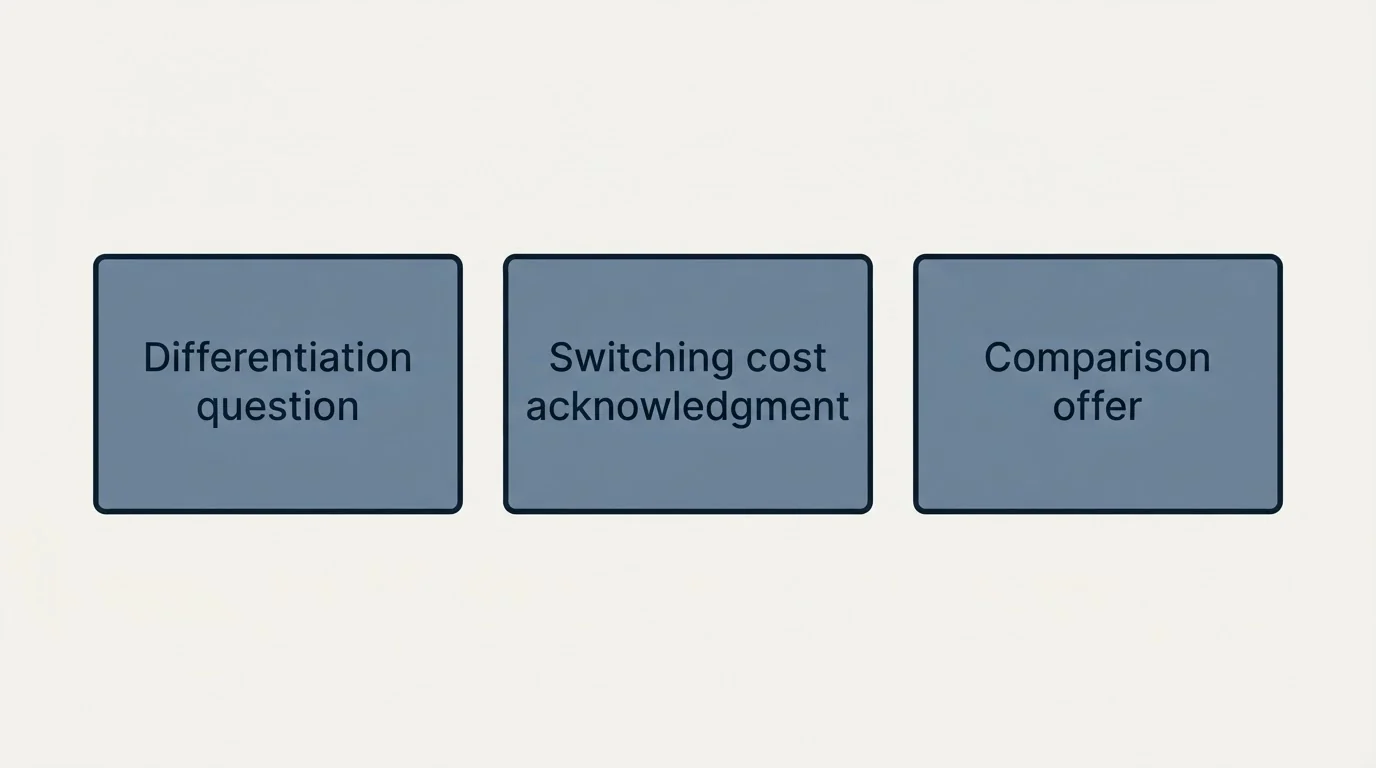
The reply that we are already working with another lead generation organization belongs in this group, and the honest response is not to argue: ask what the current arrangement is measured on, because a buyer who cannot answer that has told you something useful.
When a prospect is considering or already using a competitor, your response needs to be confident without being defensive or disparaging.
Template 7: The Differentiation Question
Best for: Prospects evaluating multiple solutions
Subject line: Re: [Original thread]
Email:
Hi [Name],
[Competitor] is solid. They do [what they're known for] well.
Quick question: what's most important to you in making this decision? That'll help me understand if we're actually a better fit, or if [Competitor] is the right choice for your situation.
[Your name]
Why it works: This shows confidence and maturity. By acknowledging the competitor's strengths, you build credibility. The question helps you understand their priorities so you can position accordingly.
Template 8: The Switching Cost Acknowledgment
Best for: Prospects already using a competitor
Subject line: Re: [Original thread]
Email:
Hi [Name],
Totally get it. Switching costs are real, and if [Competitor] is working well enough, there's no reason to change.
Out of curiosity, was there something specific that prompted you to take the call with us initially? Sometimes there's a gap that's worth addressing, sometimes there isn't.
[Your name]
Why it works: This acknowledges the effort involved in switching while gently reminding them they had a reason for exploring alternatives. It often resurfaces the original pain point.
Template 9: The Comparison Offer
Best for: Prospects in active evaluation mode
Subject line: Re: [Original thread]
Email:
Hi [Name],
Happy to help you make the best decision, even if that's not us.
Would it be useful if I put together a quick comparison of how we differ from [Competitor] on the areas you care most about? I'll be objective about where they're stronger and where we are.
Let me know what factors matter most.
[Your name]
Why it works: Offering an objective comparison shows confidence in your solution and positions you as a helpful consultant rather than a defensive salesperson.
Authority/Approval Objection Templates
When your contact needs buy-in from others, your job is to equip them with the tools to sell internally.
Template 10: The Champion Enablement
Best for: Contacts who need to convince their boss or a committee
Subject line: Re: [Original thread]
Email:
Hi [Name],
Getting internal alignment is always the tricky part. Happy to help make that easier.
Would any of these be useful?
- A one-pager summarizing the ROI case
- A brief call with your [decision maker's title] directly
- A reference call with a similar company who went through the same process
Let me know what would help most.
[Your name]
Why it works: This template provides multiple options and lets your champion choose what they need. It shows you understand their internal challenge.
Template 11: The Decision Process Clarification
Best for: Contacts who are vague about the approval process
Subject line: Re: [Original thread]
Email:
Hi [Name],
Appreciate you keeping me updated. So I can be more helpful, can you walk me through what the decision process looks like on your end?
Who else needs to be involved, and what questions do you think they'll have?
The more I understand, the better I can support you through it.
[Your name]
Why it works: Understanding the decision process helps you anticipate objections and provide the right materials. It also signals that you're a professional who has navigated complex sales before.
Template 12: The Executive Summary Offer
Best for: Contacts whose boss doesn't have time for a full pitch
Subject line: Re: [Original thread]
Email:
Hi [Name],
I know [Decision maker's name] is probably swamped. Would it help if I sent over a 2-minute executive summary they could review on their own time?
That way they can get up to speed without needing to block out calendar time. If they have questions after, we can always set up a quick call.
[Your name]
Why it works: This removes friction from the approval process. Most executives prefer reviewing materials asynchronously over attending another meeting.
"Not Interested" Objection Templates
The dreaded "not interested" can feel final, but it often just means the prospect doesn't see the value yet.
Template 13: The Clarifying Response
Best for: Generic "not interested" replies that don't explain why
Subject line: Re: [Original thread]
Email:
Hi [Name],
Appreciate you letting me know. Before I close out your file, mind if I ask: was it the approach, the timing, or does [solution type] just not fit your current priorities?
Just helps me improve for future outreach. Either way, thanks for taking the time to reply.
[Your name]
Why it works: This template asks for feedback in a non-threatening way. Many prospects will explain their real objection, giving you a chance to address it. Even if they don't, you've ended the conversation professionally.
Template 14: The Value Proposition Reset
Best for: Prospects who may not have understood your offering
Subject line: Re: [Original thread]
Email:
Hi [Name],
Fair enough. I may not have done a good job explaining what we actually do.
The quick version: we help [target companies] solve [specific problem] by [core approach]. [Company similar to theirs] used us to [specific result].
If that sounds relevant, happy to chat. If not, no worries at all.
[Your name]
Why it works: Sometimes prospects say "not interested" because they didn't understand the value. This gives you one more chance to communicate it clearly and concisely.
Template 15: The Graceful Exit
Best for: Prospects who have clearly made up their mind
Subject line: Re: [Original thread]
Email:
Hi [Name],
Got it. I'll remove you from any follow-up sequences.
If anything changes down the road, feel free to reach out. In the meantime, here's a [helpful resource] that might be useful regardless of whether we work together.
Best, [Your name]
Why it works: This respects their decision while leaving a positive impression. The free resource demonstrates goodwill and keeps you top of mind if their situation changes.
Tips for Customizing These Templates
Templates are starting points, not scripts. Here's how to make them your own:
Match their tone. If their objection email was casual, respond casually. If it was formal, maintain that formality.
Reference specifics from your conversation. Swap generic placeholders with actual details from your prior exchanges. "When we spoke about your Q2 launch..." is far more powerful than "Given your situation..."
Adjust the ask based on relationship depth. If you've had multiple conversations, you can be more direct. If this is your first exchange, keep the ask soft.
Test different approaches. What works in one industry might fall flat in another. Track your response rates and iterate.
Common Mistakes to Avoid
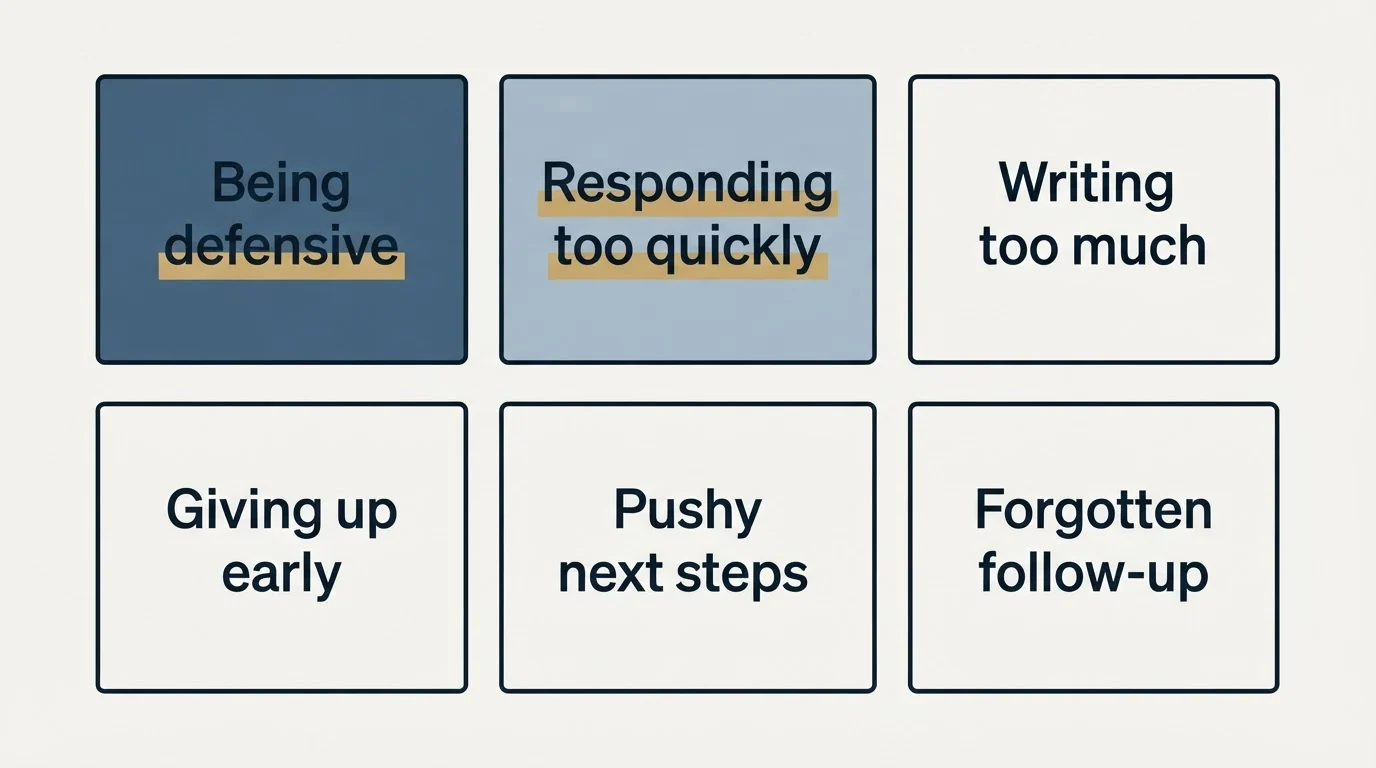
- No: Being defensive
- No: Responding too quickly
- No: Writing too much
- No: Giving up after one objection
- No: Being pushy about next steps
- No: Forgetting to follow up
Being defensive. When someone says your price is too high or they prefer a competitor, resist the urge to argue. Acknowledge, ask questions, then offer perspective.
Responding too quickly. Firing back a reply within minutes can seem desperate. Wait at least a few hours (unless they've asked for urgency).
Writing too much. Your objection response should be shorter than their objection. Long emails signal that you're overcompensating.
Giving up after one objection. Studies show that most sales happen after 5+ touchpoints. One "not interested" is rarely final.
Being pushy about next steps. "When can we schedule a call?" is aggressive. "Would it be helpful to chat?" gives them control.
Forgetting to follow up. If you set a time to reconnect, actually do it. Reliability builds trust.
Turn Objections Into Opportunities
The best salespeople welcome objections because they understand something important: a prospect who objects is a prospect who engaged. They took time to read your email, think about it, and respond. That's more than most people do.
Your job is to honor that engagement by responding thoughtfully, addressing their real concerns (not the surface-level ones), and making it easy for them to continue the conversation when they're ready.
Use these templates as a foundation, but remember that the best objection handling comes from genuine curiosity about your prospect's situation. When you truly want to understand their challenges and help them solve problems, your responses will naturally become more effective.
Related Reading
- 10 Referral Request Email Templates for B2B Sales
- 8 Sales Pitch Email Templates That Convert
- 12 Pricing Discussion Email Templates for B2B Sales
Tired of crafting objection handling emails yourself? Our done-for-you cold email campaigns handle everything from initial outreach to objection responses, delivering qualified meetings directly to your calendar. Get your free campaign and let us turn objections into opportunities for you.
Frequently asked questions.
Frequently asked questions- What makes an objection handling email actually effective?
- An effective objection handling email first acknowledges the prospect's concern, then uses clarifying questions rather than assumptions about the real issue. It provides value instead of applying pressure, keeps the response brief and shorter than the objection itself, and includes a soft next step that allows continued conversation without demanding commitment. The key is making prospects feel heard before offering a different perspective.
- How should I respond when a prospect says they don't have budget?
- Respond with one of three approaches depending on the situation. Use the ROI Reframe by sharing case studies showing concrete returns like 3.2x ROI from similar companies. Try the Budget Timing Question to determine if it's temporary or permanent by asking 'is this a not right now situation, or completely off the table?' Or offer the Scope Adjustment by proposing a smaller pilot program at a lower price point to prove value before a full commitment.
- What does it mean when a prospect says now isn't a good time?
- Timing objections often mask other concerns like bandwidth, approval processes, or competing priorities. Rather than accepting a vague 'later,' ask for a specific follow-up date or use the Priority Check to understand what would need to change for this to become important. Sometimes timing objections are code for price, authority, or interest issues that need to be uncovered through clarifying questions.
- Should I keep trying after a prospect says they're not interested?
- Yes, but with a strategic approach across three templates. The Clarifying Response asks what specifically doesn't fit to understand if it's a misunderstanding. The Value Proposition Reset offers a different angle on how you can help. The Graceful Exit acknowledges their decision while leaving the door open for future contact. The goal is distinguishing true disinterest from miscommunication or bad timing without being pushy.
About the author.

Ben Carden is CRO at RevenueFlow, which builds and operates outbound revenue engines for B2B companies. Previously at Gartner Enterprise. Studied at London School of Economics.
Ben Carden · CRO
Connect on LinkedIn →Explore more.
Ready to scale your outreach?
We build GTM engines that book real meetings. See the receipts.
Related articles.
10 B2B Cold Email Templates for One-Message Sends
Ten B2B cold email templates written for a single send, with the four slot structure underneath them and the test that separates a good example from a bad one.
Cold Email Templates for Customer Success Managers
Eleven cold email templates for customer success managers, covering champion change, expansion, renewal rescue, and win-back, with subject lines and timing.
14 Renewal Email Templates That Retain Customers
Master subscription and contract renewals with 14 proven email templates. Reduce churn, lock in renewals early, and maintain customer relationships.
13 Case Study Request Email Templates That Get Results
Get proven email templates for requesting case studies, video testimonials, and written reviews from your happiest customers. Includes templates for every stage from initial ask to final approval.
Email Subject Line Capitalization: What the Guides Say
What the style authorities actually rule on subject line case, what the published tests measured, and the default for a one to one sales email.
Follow-Up Call Scripts: Nine Calls Into a Live Conversation
Nine follow-up call scripts, each tied to the event that earns the call, from a demo to a renewal, plus the four moves they share and how each call should end.