Value Proposition Statement Template for Cold Email
Most value proposition statements are agreed in a workshop and never used where a buyer can see them. Five slots, and the test that shows whether yours holds.
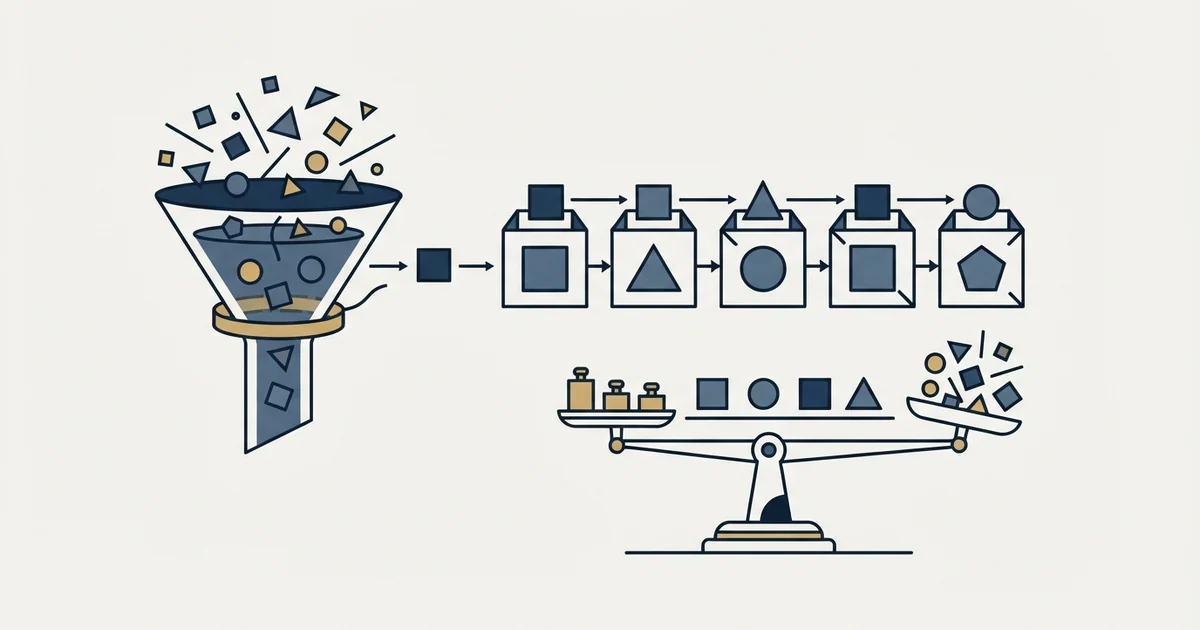
A value proposition statement answers why a specific buyer should change what they currently do. The workable shape is five slots: for whom, in what situation, what changes, unlike which alternative, and the reason it holds. Test it by pasting the one-sentence form into a cold email and reading it as the recipient.
Key takeaways
- The UNLIKE line is the slot most statements omit, and without it the reader has no reason to move, because they are never choosing between you and nothing.
- A cold email has no surrounding slides to support the reasoning, so a statement that only works inside a deck collapses into an unsupported claim when pasted into one.
- Write the situation rather than the persona: a persona produces statements true of everyone in the job title, while a situation makes the message arrive at a plausible moment.
- With no case studies yet, state the mechanism or narrow the claim until it is defensible, and never close the gap with an invented figure.
Reviewed and updated September 1, 2026
A value proposition statement is usually written in a workshop and then never used anywhere a customer can see it. It goes on a slide, gets agreed, and the website keeps saying something else while the sales team says a third thing. The statement was fine. Nothing downstream was ever built from it.
The fix is to write the statement against the hardest place it has to work, which is a cold email to someone who has never heard of you and owes you nothing. A statement that survives being pasted into that context, unedited, is a statement the website and the deck can safely inherit. One that has to be softened first was doing decorative work.
A value proposition statement example is only useful filled in, so each slot below carries a worked one rather than a blank.
Anyone asking what a value proposition looks like is asking to see one rather than to be told what one is, and the honest answer is that it looks like five filled slots and no adjectives.
Customer value proposition is the same artifact under a longer name, and the examples people search for are worked versions of the five slots below rather than a separate genre.
Since the term gets used for several different things, it is worth being plain about what a value proposition means in a business context before writing one: a short statement of the benefit a specific kind of customer gets, in their words rather than yours, and the reason to prefer you over the alternative they would otherwise pick. Everything below is a way of making that statement specific enough to survive a stranger reading it.
What the statement has to do
A value proposition statement answers one question: why should this particular buyer change what they currently do. Three things it is not, because each one gets written instead of it regularly.
It is not a tagline. A tagline is memorable and deliberately vague, and vagueness is the failure mode the statement exists to prevent.
It is not a positioning statement. Positioning locates you against a category for an internal audience, and it is written in category vocabulary that a buyer does not use.
It is not a feature list. Features are how the outcome is delivered, and a buyer who has not yet accepted the outcome has no reason to evaluate the mechanism.
The distinction that matters most is the last one, because a feature list looks like a value proposition to the person who wrote it. The test is whether a sentence would still be worth reading by someone who does not know what your product category is.
The template
This is also the answer to how to write a unique value proposition, with one correction to the usual advice: the uniqueness does not live in an adjective, it lives in the slot below that names who else the buyer could call and what that alternative cannot do. A statement that would still be true if a competitor published it has not failed at writing, it has failed at that one slot.
Five slots. Fill each one, then read them as a paragraph.
VALUE PROPOSITION STATEMENT

FOR      <the segment, specific enough that a list could be built>
WHO      <the situation they are in, stated as something observable>
WE       <what changes for them, in outcome terms, not feature terms>
UNLIKE   <the alternative they are using now, named>
BECAUSE  <the reason it is true, checkable by them>

One-sentence form:
  For <segment> who <situation>, we <outcome>, unlike <alternative>,
  because <reason>.
A worked example, written for a fictional company so that nothing here is a claim about a real one:
FOR      B2B software firms with 50 to 250 staff
WHO      have two SDRs building their own lists by hand
WE       take list building and sending off the reps entirely,
         so their week goes to replies instead of research
UNLIKE   hiring a third SDR, which adds the same problem again
BECAUSE  the list work is the part that scales without headcount
The UNLIKE line is the one most statements omit and the one that does the most work. A buyer is never choosing between you and nothing. They are choosing between you, the incumbent, an internal hire, and continuing to tolerate the problem. A statement that does not name at least one of those alternatives has not given anyone a reason to move.
A generic value proposition is what remains when the UNLIKE line is missing, since a statement that names no alternative describes a category rather than a choice, and every competitor in that category can say it too.
The cold email test

Take the one-sentence form and paste it into an email to somebody in the segment, with nothing else added. Then read it as them.
Choosing between a generic follow-up and genuine correspondence comes down to how the reminder is written once that cold email lands a booked call, which meeting reminder email templates covers in full.
Three things go wrong at that moment, reliably. The sentence turns out to be about you rather than about them, which shows up as a first clause naming your company or your product. The outcome turns out to be unmeasurable, which shows up as the reader having no way to tell whether it has happened. And the BECAUSE line turns out to be an assertion rather than a reason, which shows up as a sentence the reader would have to take on trust from a stranger.
That third failure is the expensive one, and it has a specific cause. In a deck, the BECAUSE line is backed by the twenty slides around it. In a cold email there are no surrounding slides, so the reason has to be self-supporting or the whole statement collapses into a claim.
- Depends: The first clause is about the reader, not about your company
- Depends: Someone could build a list from the FOR line without asking a question
- Depends: The WHO line describes something observable from outside the company
- Depends: The reader could tell, afterwards, whether the outcome happened
- Depends: The BECAUSE line stands up without any surrounding slides
Filling each slot
FOR. Write it so a list can be built from it. A segment defined by an attitude nobody publishes cannot be turned into names, and a statement aimed at a segment you cannot enumerate cannot be tested. The market segmentation entry covers which cuts hold up in B2B, and firmographic data covers what exists as a field.
WHO. The situation, not the persona. Personas describe a type of person and produce statements that are true of everyone in the job title. Situations describe what is happening now, which is what makes a statement arrive at a plausible moment rather than an arbitrary one.
WE. State the change in the reader's terms. The reliable move is to describe the after state of their week rather than the capability you provide. Their week is something they can picture. Your capability is something they would have to translate.
UNLIKE. Name the real alternative, which is frequently doing nothing or hiring somebody. Naming a competitor is defensible when the comparison is on an axis the reader can check for themselves, and indefensible when it amounts to asserting the competitor is worse.
BECAUSE. The structural reason, not the evidence. Evidence is a case study and belongs elsewhere. The BECAUSE line should be true by construction, which is why the worked example says the list work scales without headcount rather than quoting an outcome.
When there is no evidence to cite yet
Most guidance on this topic assumes a bank of case studies exists, and for a new offer it does not. Two honest routes exist, and inventing a number is neither of them.
The first is to state the mechanism instead of the result. A mechanism can be checked by reasoning, so a reader can evaluate it without trusting you. The second is to make the claim smaller until it is one you can defend completely. A narrow claim you can stand behind converts better than a broad one that invites the reader to test it and find nothing underneath.
Our own documented practice is relevant here as policy rather than as a result: we agree qualification criteria in writing before a campaign launches, precisely so that the outcome being promised has a definition both sides accepted in advance. A value proposition with no agreed definition of success is a value proposition nobody can be held to.
- An end-to-end outbound platform
- Powered by intelligent automation
- Best-in-class deliverability
- Trusted by growing teams
- Reader cannot tell what changes for them
- No alternative named, so no reason to move
- For B2B software firms with 50 to 250 staff
- Whose two SDRs build their own lists by hand
- Their week goes to replies instead of research
- Unlike hiring a third SDR, which repeats the problem
- Because list work scales without headcount
- Every line checkable by the reader
One statement, or one per segment

A single statement across every segment is the default and it is usually wrong, because the WHO line is the part that differs most between segments and it is load-bearing.
The practical shape is one FOR and WHO pair per segment you actively target, sharing the same WE and BECAUSE. That keeps the offer consistent while letting the opening clause be true of the specific reader. Splitting the WE line as well is where statements start contradicting each other across channels, because two versions of what you do will eventually appear on the same buyer's screen.
Three segments is a reasonable ceiling for most teams. Each additional one multiplies the copy, the list work and the reporting, and only pays off if the message genuinely differs.
Where the statement goes once it exists
The statement itself rarely appears verbatim anywhere. What appears is its parts, distributed: the WHO line becomes the opening sentence of an outbound message, the WE line becomes the middle, and the UNLIKE line becomes the answer to the objection that arrives on the call.
Beyond the statement itself, the go-to-market strategy template extends that same line-by-line testing to segment, channel and measurement decisions.
For the messages built out of those parts, value proposition email templates covers thirteen ways the WE line gets phrased in an email, and how to write a cold email covers the order the writing runs in. When the WHO line is the hard part, pain point templates and trigger event templates cover phrasing a situation the reader recognises.
If the shorter route is useful, we take the statement and run the campaign built from it: see what a campaign looks like.
What changes it

A value proposition statement is rewritten when the reason it was true stops being true, which happens in three ways. A competitor closes the gap named in the UNLIKE line. The situation in the WHO line becomes universal, so it no longer selects anybody. Or the outcome in the WE line turns out to be something buyers do not actually want, which is usually discovered on calls long before anybody edits the document.
A value proposition that is not resonating with a target market is usually failing at one of these three points rather than in its phrasing, and the WHO line is the most common of the three, because a statement written for everybody selects nobody.
The third is the most common and the slowest to be acted on, because the statement lives in a slide deck and the discovery happens on a call, and nothing connects the two.
The short version
Write the statement as five slots, FOR, WHO, WE, UNLIKE and BECAUSE, then test it by pasting the one-sentence form into a cold email and reading it as the recipient. The UNLIKE line is the one most statements skip and the one that gives the reader a reason to move. Where evidence does not exist yet, state the mechanism or make the claim smaller, and never fill the gap with a number.
Frequently asked questions.
Frequently asked questions- What is the difference between a value proposition and a positioning statement?
- Audience and vocabulary. A positioning statement locates you against a category and is written for an internal audience in category language. A value proposition statement is written for the buyer, in the buyer's language, and answers why they should change what they do now. The second one has to survive being read by someone with no context.
- Should we have one value proposition or one per segment?
- Share the outcome and the reason across segments, and vary the opening pair that names who they are and what situation they are in. That keeps the offer consistent while letting the first clause be true of the specific reader. Three segments is a sensible ceiling, because each one multiplies the copy, list work and reporting behind it.
- What if we have no results or case studies to point at?
- State the mechanism rather than the result, since a mechanism can be evaluated by reasoning without trusting you, or narrow the claim until it is one you can fully defend. A small defensible claim converts better than a broad one that invites the reader to look for evidence and find none.
- How do we know when to rewrite the statement?
- When the reason it was true stops holding. A competitor closes the gap named in the alternative line, the situation becomes so common that it no longer selects anyone, or calls reveal that buyers do not actually want the outcome. The last one is the most common and the slowest to be acted on.
About the author.

B2B cold email experts helping companies generate qualified leads through done-for-you outreach campaigns.
RevenueFlow Team
Explore more.
Ready to scale your outreach?
We build GTM engines that book real meetings. See the receipts.
Related articles.
Sample Cold Emails: Six Written to Be the Only One You Send
Most sample cold emails are step one of five, so they underperform alone. Six complete messages, what to change in each, and why the middle is the part to cut.
SmartReach Pricing: Two Ladders and a Struck Pro Rate
SmartReach prints an email ladder and a multichannel ladder on one page, loads monthly, and ships a machine-readable copy. Both ladders, both states, every add-on.
Drip Campaign Examples: The Permission Behind Each One
Every drip campaign example is one template filled in. The six fields it needs, five examples that hold up, and the one we replace with a single message.
Sales Email Subject Lines: The Metric That Stopped Working
A subject line has one job, which is to get the first line read. The metric everyone optimises it on is now a mixture of human readers and machine fetches.
Email Marketing Lead Generation: Two Motions, Two Domains
Permission-based email and cold outbound share a channel and almost nothing else. Running both through one domain is how teams quietly damage both at once.
Meeting Reminder Emails: Six Templates
A reminder to someone who accepted a meeting is administration of an agreement, not a bump. Six complete messages, what each has to carry, and how many is too many.