Email Marketing Lead Generation: Two Motions, Two Domains
Permission-based email and cold outbound share a channel and almost nothing else. Running both through one domain is how teams quietly damage both at once.
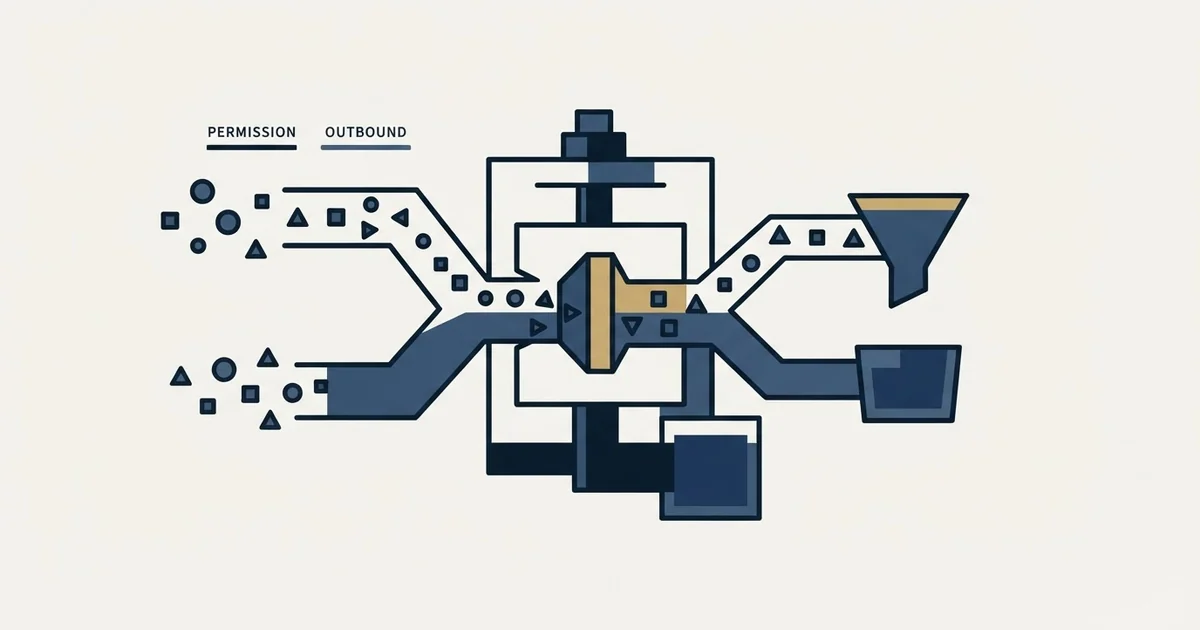
Email marketing lead generation describes two motions with one test between them: did this person give you this address. Permission-based email converts demand that already exists and produces good engagement signals. Cold outbound creates access to people who were not looking and carries complaint risk. They need separate domains, separate lists and separate measurement.
Key takeaways
- One question separates the two motions, and it is whether the recipient gave you the address for this purpose.
- Sending reputation is a property of the domain, so a cold campaign's bad days are charged to the account that also carries your customer email.
- Permission-based email converts existing demand and cannot create any; cold outbound is one of the few channels with access to people who are not looking.
- Comparing the two on cost per lead compares a marginal cost to a total one, and the comparison recommends cutting outbound every time.
Reviewed and updated September 1, 2026
Email Marketing Lead Generation: Two Motions That Should Not Share a Domain
A B2B marketing team has a newsletter with nine thousand subscribers and a healthy open rate. Sales asks for outbound. The obvious move is to use the platform already paid for, the domain already sending, and the templates already designed. Within two months the newsletter's open rate has halved, the outbound campaign is landing in spam, and nobody can point to the moment it went wrong.
Nothing was misconfigured. The team ran two different businesses through one pipe, and email infrastructure does not distinguish between them by intent. It distinguishes by how recipients behave, and the two audiences behave nothing alike.
AI driven marketing automation sits squarely on the permission side of that line, because what the AI layer optimises is segment and send time inside a database of people who already opted in, and none of it reaches a person who never did.
The phrase email marketing lead generation covers both motions, which is why advice about it is so frequently contradictory. Separating them is the first useful thing you can do.
That separation is what most guidance on B2B email marketing leaves out, because it treats the opted in list and the cold list as one programme running behind one domain.
The question that separates them
There is exactly one test, and it is not about tone, template or platform.
The phrase email marketing funnel belongs to the first motion and not the second: a staged sequence sent to people who subscribed, which is a legitimate practice on a domain built for it and a fast way to lose a sending domain when it is run at strangers.
Did this person give you this address, for this purpose?
If yes, you are running permission-based email. Someone downloaded a guide, attended a webinar, started a trial, or subscribed. They arrived through your own surfaces and they know who you are. Volume is bounded by how fast you can attract people.
If no, you are running cold outbound. You identified an account, resolved a person and found an address. They have no relationship with you and no memory of asking. Volume is bounded by how many good accounts exist and how much sending capacity you can maintain safely.
- Address given by the recipient
- Recipient recognises the sender
- Complaint risk low, engagement generally high
- Growth limited by traffic and offers
- Success measured by conversion of existing interest
- Address resolved by you from data
- Recipient has never heard of you
- Complaint and bounce risk carried on every send
- Growth limited by good accounts and safe capacity
- Success measured by conversations created from nothing
Almost every practical decision downstream falls out of that split: which domain sends, which platform, what the list looks like, what the message is allowed to assume, and what counts as a good result.
Why one domain cannot carry both
Mailbox providers score a sending domain on how recipients treat its mail. Opens and replies help. Complaints, deletions without reading, and mail to addresses that no longer exist hurt. That score is a property of the domain, not of the campaign.
Permission-based email tends to produce good signals, and it is also the mail you least want in a spam folder, because it goes to people who already chose you. Cold outbound tends to produce worse signals by construction, because a proportion of strangers will never engage and some will complain. Running both from one domain means the cold campaign's bad days are charged to the newsletter's account.
The agencies and platforms selling email marketing automation services are built for the permission motion for the same reason, which makes them the wrong tool for the cold half whatever the feature list says.
The separation that experienced teams run is structural. The primary domain, the one on business cards and in customer email, sends nothing cold. Outbound sends from separate domains, warmed and monitored independently, with capacity spread across enough addresses that no single one carries damaging volume. When something goes wrong, and periodically it will, the damage is contained to assets that exist to be spent.
Two of the pieces on how that inventory is built, and why the redundancy is deliberate rather than wasteful, are our own approach to sending infrastructure and email deliverability platforms compared. The tooling question splits along the same line, which is why a platform built for newsletters and a platform built for cold sending remain separate products despite appearing to do the same thing.
What each motion is genuinely good at
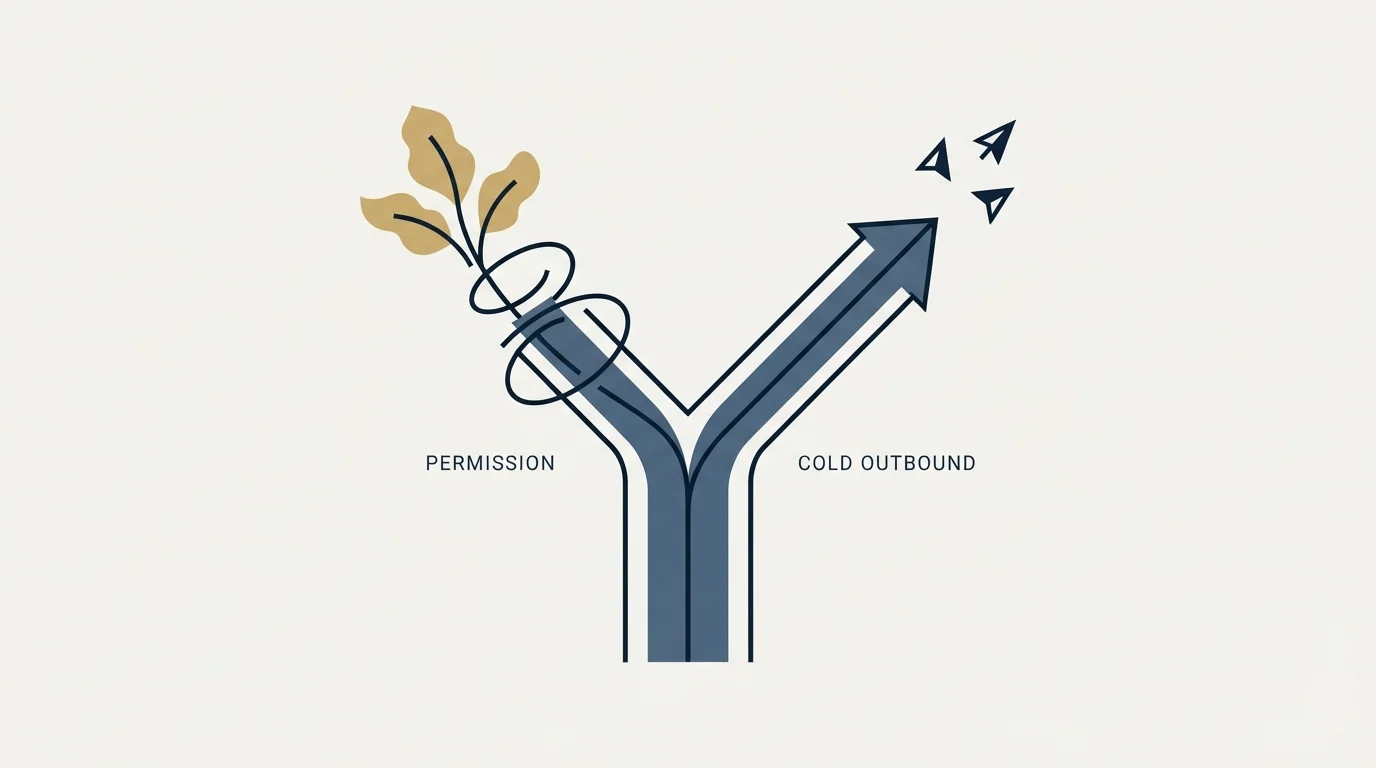
Confusing the two also produces the wrong expectations, and then the wrong verdict.
Industry benchmarks for email marketing are published by the platforms that send permission-based mail, so their open and click averages describe that motion and its denominators rather than a cold outbound programme.
Permission-based email is a conversion instrument. Its audience is people who have already indicated something. It is excellent at moving a person from vaguely interested to in a conversation, at keeping a slow-moving buyer aware of you across a long evaluation, and at monetising an audience you already worked to build. It is poor at creating demand where none exists, because it can only reach people who already found you.
Cold outbound is an access instrument. It is the only channel that reliably puts you in front of a named person at a named company who was not looking for you. It is excellent at reaching a defined, finite market, at testing whether a proposition lands with a segment, and at generating conversations on a timeline you control. It is poor at persuading anyone who has no live problem, and it damages assets when it is pointed at the wrong list.
- Step 1Not looking
Cold outbound is the only channel with access to this state
- Step 2Aware, not searching
Permission-based email holds attention if they already opted in
- Step 3Actively evaluating
Both channels work, and inbound search usually beats both
- Step 4In conversation
Neither channel is doing the work any more; the sales process is
The framing behind that split, and what it means for budget allocation, is set out in demand creation, capture and conversion.
The capture side has one trap worth naming
Most advice on the permission side reduces to offering something in exchange for an address. That works, and it has a well-known failure mode: the thing you offer selects the audience you get.
An offer with broad appeal and no relationship to your product produces a large list of people who will never buy, and that list then drags your engagement metrics down while costing money to store and send to. An offer that only makes sense to someone with the exact problem you solve produces a much smaller list that converts.
The strongest version of this is giving away something that is genuinely part of the product rather than adjacent content about it, because using the thing is a far better qualifier than reading about it. That argument is made at length in try before you buy lead magnets.
Compliance is not one conversation either

Both motions sit under commercial email law, and the specifics differ by jurisdiction in ways that matter to how you build a list.
In the United States, the CAN-SPAM Act covers all commercial messages rather than only bulk mail, and the Federal Trade Commission's compliance guide sets the obligations out in plain language. Header information, including the originating domain name and address, must be accurate and identify who initiated the message. The subject line must accurately reflect the content. The message must disclose clearly and conspicuously that it is an advertisement, must carry a valid physical postal address, and must explain how to opt out (FTC CAN-SPAM Compliance Guide). It is short enough to read in full rather than second-hand.
The European position is different in kind rather than in degree, because consent is generally the basis for contacting an individual and the definition of personal data is broad. A single global list treated under one policy is where most teams get this wrong, and the mistake is invisible until it is not.
- Yes: Cold sending happens on domains that are not your primary corporate domain
- Yes: Permission-based and cold lists are stored and suppressed separately
- Yes: Opt-outs from either motion suppress the address across both
- Yes: Bounce and complaint monitoring is per sending domain, not aggregated
- Yes: Jurisdiction is a field on the record, not an assumption
- No: Subscribers are added to cold campaigns because they are already in the database
- No: One platform sends everything because the seats are already paid for
The third line deserves emphasis, because it is the one teams get backwards. Suppression should be generous and shared. A person who opted out of the newsletter should not receive a cold campaign, even though the two lists are technically separate, because from their side there is one company sending them mail.
Putting both on one dashboard usually kills the better one
The last thing that goes wrong is measurement, and it goes wrong quietly.
The two motions cannot be compared on the same numbers, because the same number means different things in each. An open rate on a permission list measures whether the audience still cares about you. An open rate on a cold campaign measures deliverability at least as much as interest, and since the pixel-based measurement of opens has become unreliable across mailbox providers, treating a change in it as a change in performance is closer to reading tea leaves than to analysis.
Reply rate has the same problem in reverse. A cold campaign lives or dies on replies, so it is the right headline metric there. A permission-based programme can be doing its whole job with almost no replies, because its purpose is to keep an audience warm until they act through a different door.
Cost per lead is where the comparison does the most damage. Permission-based email looks dramatically cheaper per lead, because the cost of acquiring the audience was booked to a different budget in a previous quarter and the marginal send costs nearly nothing. Cold outbound carries its full acquisition cost in the current period. A dashboard comparing the two side by side will recommend cutting outbound every single time, and it will be wrong, because it is comparing a marginal cost to a total one. That arithmetic, and the ways the metric misleads generally, is unpicked in cost per lead B2B.
The workable arrangement is to measure each motion against its own job. For the permission side, what share of the audience eventually enters a sales conversation. For the cold side, how many qualified conversations were created from accounts that had no prior relationship, and at what total cost. Those are different questions, and answering them separately is what stops one motion from being cut to fund the other on the strength of a badly framed comparison.
Where we stand on the cold half
Our own practice on the outbound side is deliberately narrow, and it follows from everything above. One message per campaign, built on one premise, sent once. If a different premise is worth putting to the same account later, that is a separate campaign with its own reason to exist.
The reasoning is partly about the recipient and partly about the asset. Repeated sending to people who did not ask is the behaviour that generates complaints, and complaints are charged to infrastructure that takes weeks to rebuild. Constraining every campaign to a single message also forces the effort into the two places that actually decide the outcome, which are who is on the list and whether the message says something true and specific about them. What that looks like at the level of the message itself is in cold email format.
If you would rather see a cold list and a single message built against your own market before deciding how the two motions should sit together, see what a first campaign looks like.
CAN-SPAM requirements summarised from the Federal Trade Commission's compliance guide, verified mid-2026. This is not legal advice; confirm current obligations in every jurisdiction you send into.
Frequently asked questions.
Frequently asked questions- Can we run cold outreach from our main company domain?
- You can, and the cost is charged to the domain your customers use to reach you. Mailbox providers score a domain on how recipients treat its mail, and cold sending produces worse signals by construction. Separate domains keep the damage on assets that exist to be spent rather than on your primary one.
- Is it fine to add newsletter subscribers to a cold campaign?
- It is the most common way teams damage both motions at once. Subscribers opted in to one thing and receive another, which raises complaints, and the complaint is charged to your infrastructure. Suppression should be shared and generous: an opt-out from either motion should suppress the address across both, because from the recipient's side there is one company sending them mail.
- Does CAN-SPAM apply to business-to-business email?
- Yes. The Act covers all commercial messages rather than only bulk mail. Header information must be accurate, the subject line must reflect the content, the message must disclose clearly that it is an advertisement, and it must carry a valid physical postal address and an opt-out route. The FTC publishes the compliance guide directly.
- How should we measure the two motions against each other?
- Separately, against their own jobs. Ask what share of the permission-based audience eventually enters a sales conversation, and ask how many qualified conversations cold outbound created from accounts with no prior relationship, at what total cost. Putting both on one dashboard usually kills the one carrying its full acquisition cost in the current period.
About the author.

B2B cold email experts helping companies generate qualified leads through done-for-you outreach campaigns.
RevenueFlow Team
Explore more.
Ready to scale your outreach?
We build GTM engines that book real meetings. See the receipts.
Related articles.
Meeting Reminder Emails: Six Templates
A reminder to someone who accepted a meeting is administration of an agreement, not a bump. Six complete messages, what each has to carry, and how many is too many.
Drip Campaign Examples: The Permission Behind Each One
Every drip campaign example is one template filled in. The six fields it needs, five examples that hold up, and the one we replace with a single message.
Bad Email Examples: Six Shapes That Lose the Reader
A bad cold email is rarely bad throughout. It holds together for a line or two, then loses the reader at a specific word. Six failure shapes, and where each breaks.
SmartReach Pricing: Two Ladders and a Struck Pro Rate
SmartReach prints an email ladder and a multichannel ladder on one page, loads monthly, and ships a machine-readable copy. Both ladders, both states, every add-on.
RFP Response Executive Summary Sample: One Page, Read First
The executive summary decides how carefully the rest of a response gets read, and is usually written last by whoever has least time. A worked sample and what to cut.
Sales Email Subject Lines: The Metric That Stopped Working
A subject line has one job, which is to get the first line read. The metric everyone optimises it on is now a mixture of human readers and machine fetches.