Cold Email Format: The Anatomy That Survives a Real Inbox
The parts of a cold email in the order a recipient actually meets them, what each one is mechanically doing, and how to tell which part is failing.
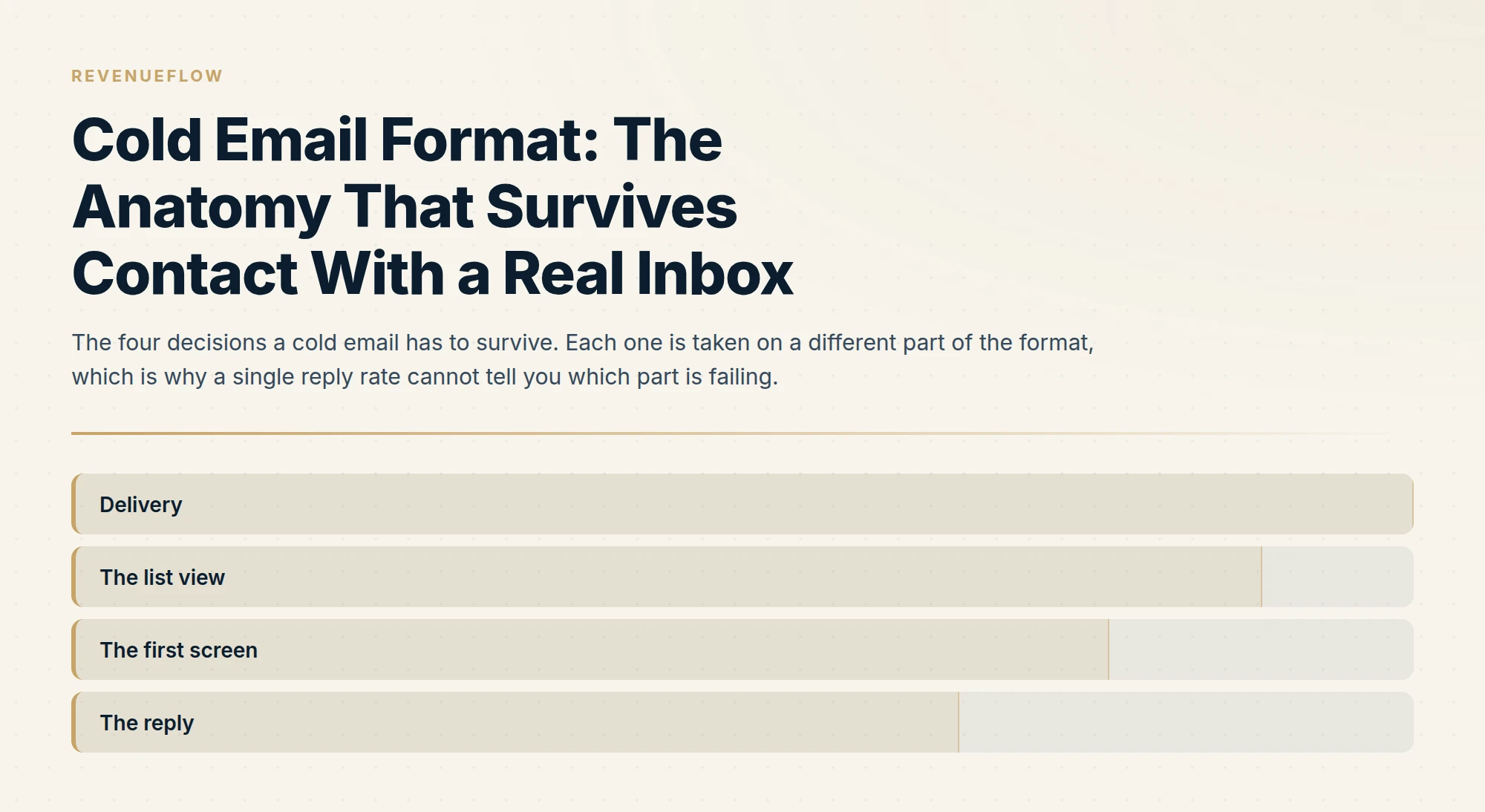
Cold email format is the order in which parts of a message become visible and the job each does while it is the only part on screen. A recipient meets the sender name, subject and preview first, then the opening line, then the ask. Each is judged separately, so a single reply rate cannot say which one failed.
Key takeaways
- A cold email is judged four times, at delivery, in the list view, on the first screen and at the ask, and each decision is taken on a different slice of the format.
- The first line of the body is displayed twice, once as preview text before the open and once after it, which makes a greeting the most expensive sentence in the message.
- A soft interest check transfers work to the recipient and produces replies that feel like progress without becoming meetings, so the ask should name one specific next action.
- Format is the third most powerful variable behind the list and the offer, so rewriting sentences to fix a list problem is the most common wasted week in outbound.
Reviewed and updated September 2, 2026
Open the last cold email you sent in a phone mail client and stop before you tap it. Three things are visible: the sender name, the subject line, and however much of the first sentence the preview strip allows. The paragraph you spent forty minutes on does not exist yet. Neither does the call to action, the signature, or the case study link. All of that becomes readable only after a decision has already been taken about it, using the three fragments above.
That is the practical meaning of cold email format. It is the order in which the parts of a message become visible to a person, and the job each part has to do while it is the only part they can see. Most advice about format describes an email as a stack of components on a page, which is how the writer experiences it and not how the reader does.
This page goes through the parts in the order a recipient meets them, says what each one is mechanically doing, and sets out how to work out whether your own format is the component that is failing. There are no templates in it, deliberately.
A worked email format example, with each part labelled: sender identity, subject line, opening line, one claim, one ask, and the signature block underneath it.
A cold email is judged four times
A message passes through four separate decisions before it can produce a reply, and each one is taken on a different slice of the format.
Taken by filtering infrastructure, on authentication, sending reputation, links and content signals. The human never sees a message that fails here.
Taken by the recipient in about a second, on sender name, subject line and preview text.
Taken on the opening line and the first claim. No scrolling has happened yet.
Taken on the ask: whether the next step is clear, small and answerable in one line.
The useful consequence is diagnostic. A campaign with a strong body and a weak subject line and a campaign with a strong subject line and a weak body produce roughly the same headline number, and the fix for each is in a different place. Treating format as one object hides that.
The sender identity is part of the format
The from name is the first word the recipient reads, and it is doing two jobs: it says who this is, and it establishes whether this is a person or a system.
A real human name in the from field is the standard advice and it is right, with one condition attached that usually goes unsaid. The name has to survive being searched. A recipient who is mildly interested and mildly suspicious will look up the person, and if the name returns no findable human at the company in the signature, the message reads as fabricated regardless of how good the copy is. Match the from name, the signature, the domain and a public profile somewhere, and that check resolves in your favour.
The reply-to address matters more than it looks. A message sent from one address with replies routed somewhere unrelated is a visible mismatch in most clients, and it is one of the few format details that reliably reads as automated to a non-technical reader.
The sending domain sits underneath all of this. Outbound belongs on domains separate from your primary company domain, so that a reputation problem in one cannot reach the other, and each of those domains needs its authentication records set up correctly before any of the writing matters. The mechanics of that are in SPF, DKIM and DMARC for cold email.
The subject line is a routing label
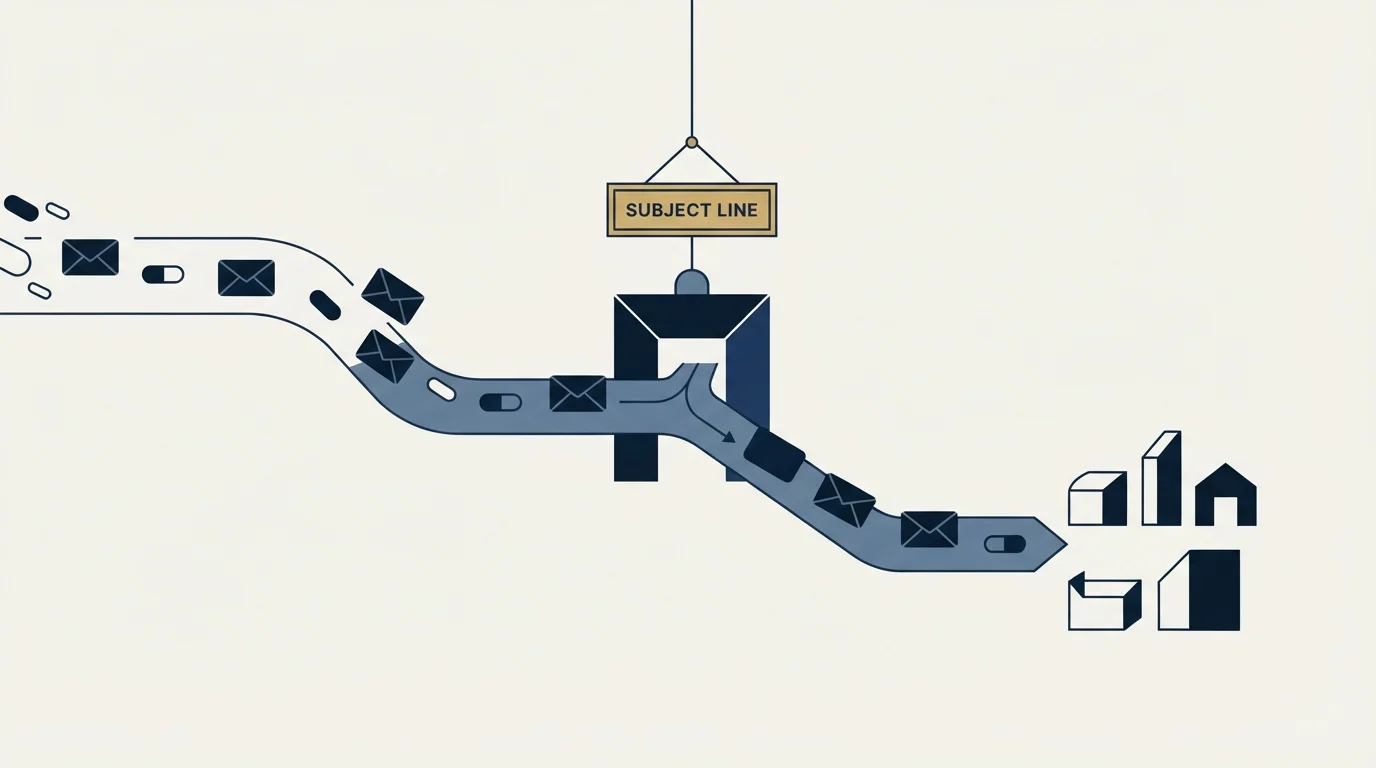
Its function is narrow: get the message sorted into the pile that gets opened now rather than the pile that gets opened later, which in practice means never.
The conventional advice is to be short, lowercase and slightly mysterious. Lowercase two-word subject lines and "quick question" work as a category signal, and the category they signal is cold outbound, because every sender using the same advice produces the same artefact. Once a subject line is recognisable as a cold email subject line, it has told the recipient what the message is before they open it.
The alternative is a subject that describes the contents accurately enough that opening it is not a gamble. If the email is about a specific thing the recipient's company is doing, the subject can say so. It reads as more ordinary correspondence, which is the point. Angle selection and the tests worth running on a subject line are covered in cold email subject lines.
The preview text is the second half of this surface and it gets forgotten, because it is not a field you fill in. Mail clients pull it from the beginning of the body, so your first sentence is displayed twice: once in the list view before the open, and once at the top of the message after it. A first line spent on "Hope you're well" or "My name is X and I work at Y" burns the second most visible piece of real estate in the whole format on information the recipient did not ask for.
The opening line has to prove the message was aimed
The opening line answers one question, which the recipient is asking whether or not they articulate it: why is this in front of me.
Personalisation is the standard answer and it has become unreliable, because the common implementations are recognisable. A compliment about a recent post, a reference to a funding round, or a merge field wrapped in a sentence all read as a mail-merge to anyone who receives outbound regularly, and a recognised personalisation token is worse than none because it signals volume.
What works mechanically is a specific observation about the recipient's situation that could not have been written to a random company in the same industry. That usually means the observation comes from something structural: what they sell, who they sell it to, a role they are hiring for, a market they have just entered. The test is to imagine the same sentence sent to their nearest competitor. If it survives the swap unchanged, it is a category statement and it is doing nothing.
Concision here is a format constraint rather than a style preference. The opening line and the sentence after it are the whole of the first screen on a phone, so they carry the entire read decision.
The body carries one claim
Most of what is published as a cold email framework, AIDA and PAS and the rest, is a naming scheme for these same parts, and a framework only helps where it forces the message down to one claim and one ask.
Which of the public cold email frameworks suits a given offer, and what none of them repair, is worked through in cold email frameworks.

Length advice usually arrives as a word count, and the number is a proxy for the real constraint. The constraint is the screen. Everything in the message should be readable without scrolling on a phone, because the scroll is a second decision the recipient has not agreed to make yet.
Within that space, one claim. A cold email that offers three reasons to care is asking the recipient to evaluate three things, and evaluation is expensive. One claim, stated plainly, with whatever specific evidence you have for it, leaves room for the ask.
Formatting inside the body is a real variable and it works in the opposite direction to most email design instinct. Short paragraphs, no bold, no bullets, no images and no header graphics. The reason is that the message should look like something a person typed, and the visual grammar of a marketing email is instantly legible even at a glance. Sentence-level craft inside that constraint is covered in cold email writing principles.
The ask is where most formats break structurally
The prevailing advice is to lower friction, which usually produces a soft interest check: "worth a chat?", "open to learning more?", "is this a priority for you?".
A soft ask transfers work to the recipient. Somebody who answers yes has agreed to nothing and now has to be converted into a booking, which is a second conversation that frequently does not happen. A soft ask also produces replies that feel like progress and do not turn into meetings, which corrupts the only reliable signal you have.
A clear ask names a specific next action and can be answered in one line. It has one ask, not two, because two asks turn the reply into a decision rather than an answer. Whether that is a proposed time, a booking link or a direct question depends on the market, and the choice is testable. The number of asks is not.
The parts nobody reads still shape the outcome
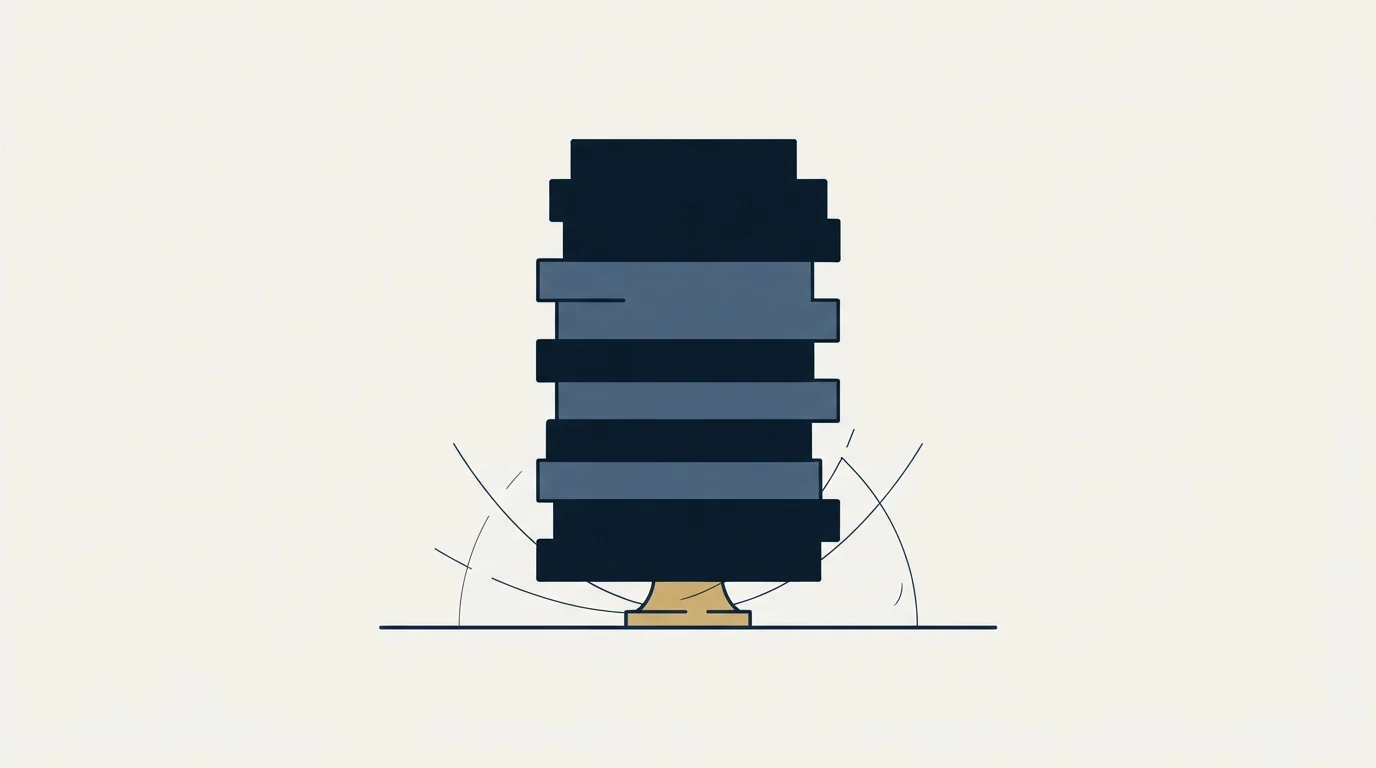
Some of the format is invisible to the recipient and highly visible to everything between you and their inbox.
- Whether the sender looks like a person
- Whether the subject describes the contents
- Whether the first line is about them
- Whether the ask is small and clear
- Whether the message looks typed rather than designed
- Authentication and domain reputation
- Volume and ramp pattern from the sending address
- The number and reputation of links
- Tracking pixels and image loads
- Similarity to other messages already classified as bulk
- A designed HTML template
- A logo or banner image
- Multiple links to different resources
- An image-based signature
- A long credentials paragraph
Three practical rules fall out of the middle column. Keep the message plain text or as close to it as your sending tool allows. Keep links to a minimum, ideally one, and use the same destination domain consistently rather than a fresh shortener per campaign. Consider turning open tracking off, because the pixel is a resource fetch that buys you a metric the diagnosis section below argues against relying on. The wider infrastructure picture is in the cold email deliverability guide.
Open on the reader or the team and the situation they are in: teams wiring plain text sending into a broader stack should see what lemlist's API can automate before building around it.
The compliance block at the foot is part of the format too. Requirements differ by jurisdiction and by where the recipient is, so check what applies to you rather than copying a footer from another company. A single plain line offering an opt-out costs nothing and removes an entire class of complaint.
The format changes when the email is the only one you send
Almost all published format advice quietly assumes the message is step one of a sequence. That assumption changes what the first email is allowed to leave out. If email two exists, email one can open a loop and defer the proof. If it does not, everything has to be present at once.
Teams weighing whether to build a multi step sequence should also check how pricing tied to contacted prospects changes the cost of running one.
We run one message per campaign. No thread replies, no bumps, ever. Every touch after the first is delivered exclusively to people who saw the first one and chose not to answer, which is the population most likely to mark it as spam, and the reply lift from those touches is measured inside the campaign while the reputation cost lands on the sending domain across everything else running on it. The full argument is in why we stopped using follow-ups.
The format consequence is concrete. A single-message format needs the relevance, the claim and the ask in one screen, with no reliance on a later touch to supply context. When a non-responding audience is worth another attempt, that becomes a new campaign with a genuinely different premise and its own subject line, so it is read as its own message rather than as a reminder about one that was ignored.
Working out whether the format is what is failing
This is the order to work down when a campaign returns zero replies, whether that is fifty emails with nothing back, a channel producing no meetings at all, or thousands of contacts and silence: the list and the delivery are checked before a single sentence is rewritten.
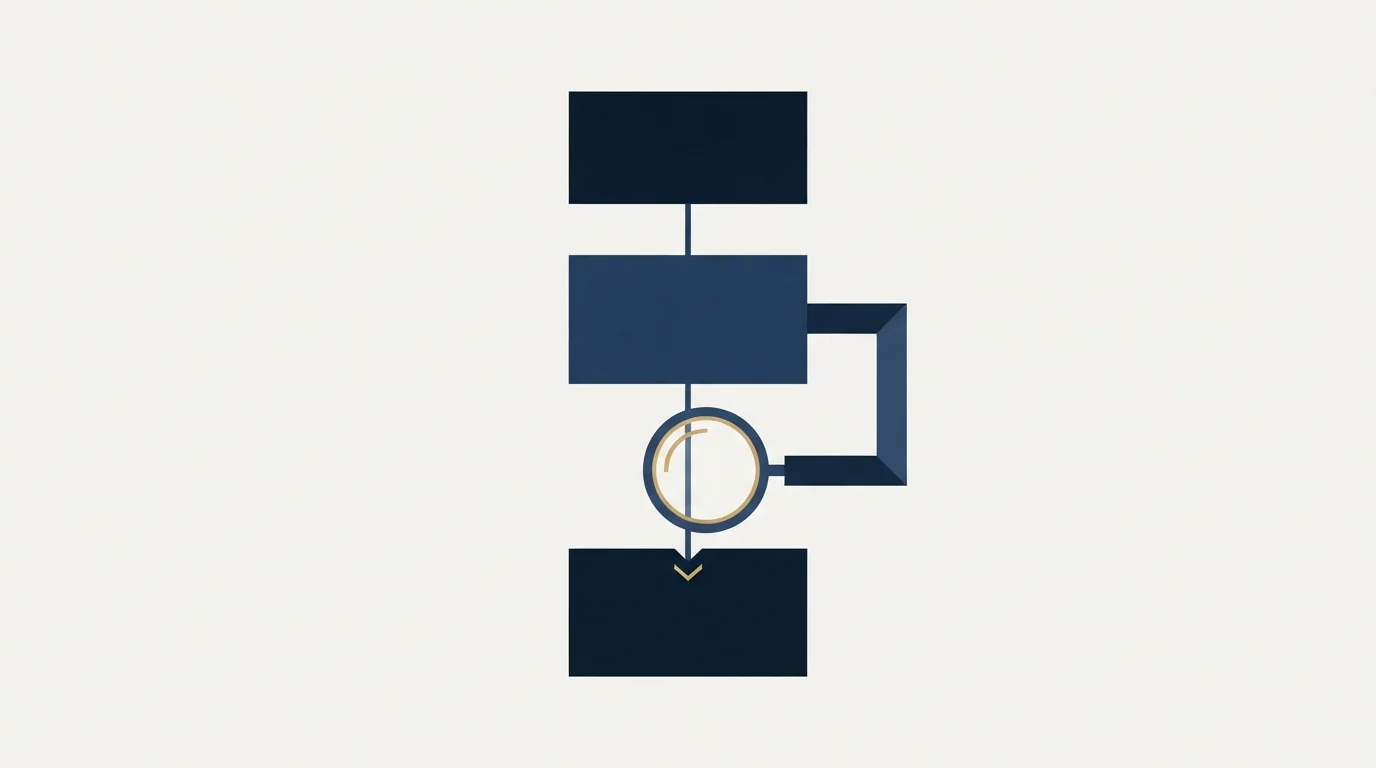
Format is one of four variables, and it is the third most powerful of them. Ranked by how much they move the outcome: the list, the offer, the format, the wording. Rewriting sentences to fix a list problem is the most common wasted week in outbound.
Diagnose in order.
- Yes: Is it arriving? Check bounce rate and authentication, and send to inboxes you control across the major providers. Nothing below this is measurable until the answer is yes.
- Yes: Is the list defensible? If you cannot state in one sentence why each company is on it, the format is not your problem.
- Depends: Are you getting replies of any kind, including negative ones? Silence usually means the message was not relevant. Objections mean it was read and the offer or the ask is wrong.
- Depends: Do positive replies become meetings? If they do not, the ask is producing interest checks rather than commitments.
- No: Are you changing one part at a time, across a whole campaign? Varying two parts at once makes attribution impossible.
- No: Are you judging on open rate? Image proxies register opens without a human reading, so it is a weak instrument. Use replies.
Two notes on running that honestly. Test one component per campaign rather than per lead, because per-lead variation inside a single send leaves you unable to attribute anything. And give a change enough volume that the result is not noise, which for most senders means waiting rather than concluding early.
If the list is the failure, the fix is upstream of every word in the email. Defining the audience tightly enough that relevance is available to write about is the subject of building an ideal customer profile.
The short version
Cold email format is the order in which parts of a message become visible, and each part is judged separately. Delivery is decided by infrastructure. The open is decided by sender name, subject line and preview text. The read is decided by the opening line and the first claim. The reply is decided by the ask.
Any link the body carries is judged separately by filters, since the domains that appear inside a message are what SURBL evaluates rather than the sender.
The sender identity has to survive being searched, with the from name, signature, domain and a findable public profile all agreeing. The subject line works best when it describes the contents rather than signalling curiosity, because curiosity subject lines are now a recognisable category marker. The first sentence is displayed twice, in the preview and at the top of the body, so it should never be a greeting.
The opening line has to be an observation that would not survive being sent to the recipient's nearest competitor. The body carries one claim, sized to a phone screen, in plain text with no design. The ask names one specific next action that can be answered in one line.
Underneath all of it, the invisible half of the format governs whether any of it is read: authentication, a separate sending domain, few links, no images, and a compliance line appropriate to your jurisdiction.
When something is not working, diagnose downward from delivery through list, relevance and ask, change one component per campaign, and use replies rather than opens as the instrument.
We build and run this end to end for clients, one message per campaign, and we are paid on attended meetings that meet criteria agreed in writing before launch. You can see what a campaign would look like for your market.
Frequently asked questions.
Frequently asked questions- What is the correct format for a cold email?
- Sender identity that survives being searched, a subject describing the contents, an opening line proving the message was aimed at this recipient, a body carrying one claim, and a single clear ask. Everything should be readable without scrolling on a phone, in plain text rather than a designed template.
- How long should a cold email be?
- Short enough to read without scrolling on a phone, which is the real constraint behind every word count people quote. The opening line and the sentence after it carry the whole read decision, because on a phone they are the entire first screen. Within that space, make one claim and leave room for the ask.
- Should a cold email use bullet points, bold text or images?
- No. Short paragraphs, no bold, no bullets, no images and no header graphics. The visual grammar of a marketing email is legible at a glance, and the message should look like something a person typed. Images and heavy formatting also give the filtering layer more to assess before a human is involved.
- How do I tell whether my format is the problem?
- Diagnose in order and stop at the first failure. Confirm messages are arriving at all, then that the list is defensible, then whether you get replies of any kind including negative ones. Silence usually indicates relevance rather than wording. Change one part at a time across a whole campaign, or attribution is impossible.
About the author.

Ben Carden is CRO at RevenueFlow, which builds and operates outbound revenue engines for B2B companies. Previously at Gartner Enterprise. Studied at London School of Economics.
Ben Carden · CRO
Connect on LinkedIn →Explore more.
Ready to scale your outreach?
We build GTM engines that book real meetings. See the receipts.
Related articles.
Cold Email Frameworks: Which One Fits Your Offer
AIDA, PAS and Before-After-Bridge arrange the same four elements in different orders. What each one assumes about the reader, and what none of them fix.
Can Buyers Tell an Email Was Written by AI?
Buyers are not running a classifier on your cold email. What they react to is a message containing nothing only somebody who looked could have written.
No-Reply Email Address: What It Costs a Sender
A no-reply address is defensible on a receipt and indefensible on a cold message, because the reply is the entire product of a first contact.
BASHO Email: Four Sentences Built on One Insight
A BASHO email is four or five sentences built on one researched insight about a specific person. The format is documented, and it cannot be produced at volume.
SMTP Reply Codes: What Each Class Instructs
The digits are a verdict and the text is the reason. Separating an address failure from a policy refusal before reacting is what decides whether the fix works.
Email Tracking Software: Six Tools, Priced and Capped
Streak, Mailsuite, Right Inbox, Mixmax, Yesware and HubSpot compared on free-tier caps and published prices, plus what an open event still proves.