12 Sales Pitch One-Liners and the Structure Behind Them
A one-line pitch has three slots and about two seconds. Twelve invented examples by situation, plus the test that separates a pitch from a description.
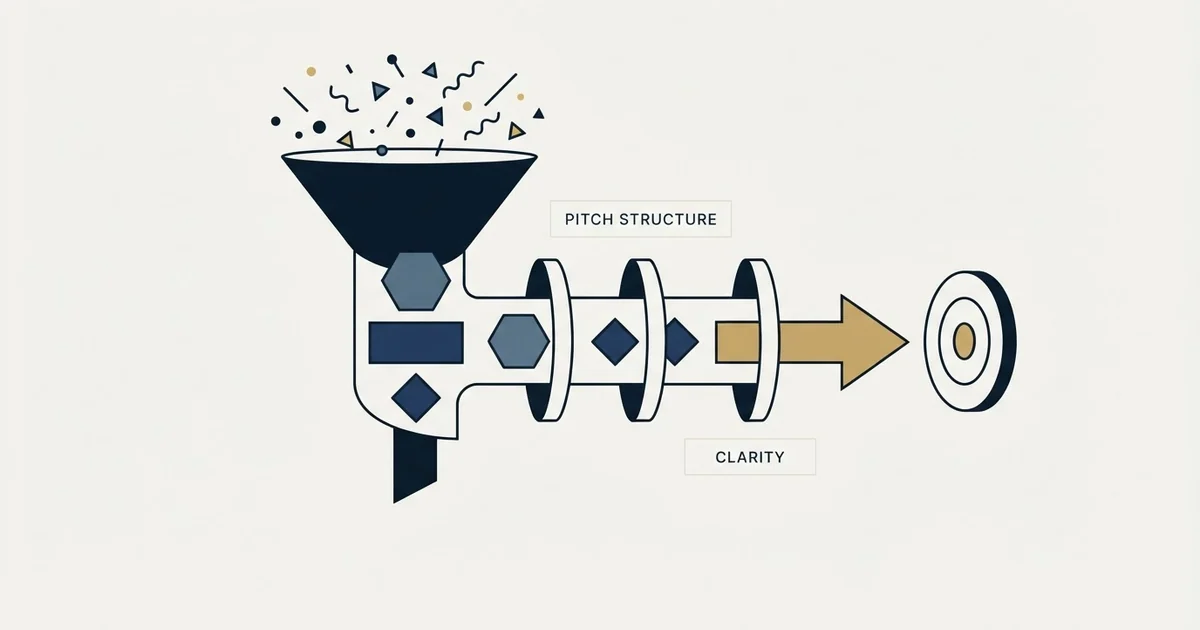
A one-line sales pitch has three slots: the situation the reader is already in, what that situation costs them, and one thing you do about it. Fifteen to twenty five words, with the reader in the subject position. Its only job is earning the next fifteen seconds, not closing or qualifying.
Key takeaways
- The working test is reading the line aloud: if someone doing the reader's job needs the product name before the sentence parses, it is a description rather than a pitch.
- Every example on this page is invented as an illustration, because a line built on a borrowed statistic cannot be defended when a reader questions it.
- A wrong fact about the reader costs more than a generic line does, so lines built on a trigger need a checkable trigger and lines without one are written differently.
- Separating a good line from an average one needs attempts in the high hundreds, because below that the rate moves by less than its own variance.
Reviewed and updated September 21, 2026
A one-line sales pitch has to survive being read in about two seconds by somebody who did not ask to hear from you and is already deciding whether to keep reading. That is the whole design constraint, and a weak one-liner usually fails it in the same way: it talks about the seller instead of the situation the reader is standing in.
The twelve lines below are written for that constraint. Every one of them is invented for this article as an illustrative example rather than taken from a real campaign, and every company, number and result in them is invented too. They are structures to fill in, not copy to paste.
What a one-liner is actually for
The line is doing one job: earning the next fifteen seconds. It is not closing, it is not qualifying, and it is not explaining the product. Any line trying to do a second job gets longer, and length is the one thing the format cannot absorb.
Qualification happens later and against written tests, where the entry criteria a Commit deal must meet count only what the buyer did rather than what the seller sent.
That makes the test unusually clean. Read the line aloud. If a person who does the reader's job would recognise the situation it names before the product is mentioned, it works. If they would need the product name to understand the sentence, it does not.
Earns the next fifteen seconds
- Opens on a situation the reader recognises
- Names something specific enough to be wrong
- Puts the reader in the subject position
- Uses the reader's words for their problem
- Ends on something answerable in a sentence
Spends them
- Opens on the company or the category
- Names a benefit that fits any vendor
- Needs the product name to parse
- Uses the category's vocabulary
- Ends on a request that needs a calendar
The structure underneath all twelve

Take the constraint seriously and there are only three slots.
The situation. A condition the reader is in, stated as fact rather than as a question. This is where the specificity lives, and it is the slot most people skip in favour of a greeting.
The consequence. What that condition costs, in a currency the reader's job is measured in. Not the industry's currency. Theirs.
The move. One thing you do about it, in plain words, short enough that no clause is needed to explain the previous clause.
Three slots, fifteen to twenty five words, one sentence or two short ones. That is the format. The rest of this page is that structure filled in for situations that come up repeatedly in business to business selling.
Twelve one-liners, by the situation they open on
Each line is followed by what it is doing, because the mechanism transfers and the wording does not.
| Situation | Lines | Needs a checked fact |
|---|---|---|
| A problem with an internal workaround | 1, 2 | No |
| A recent change | 3, 4 | Yes: the change |
| Hiring for the problem | 5, 6 | Yes: the open roles |
| Already owns a competitor | 7, 8 | Yes: the product in use |
| The reader does the work | 9, 10 | No |
| No trigger at all | 11, 12 | No |
When the buyer has the problem and an internal workaround.
- "You have a spreadsheet doing the job this replaces, and one person who knows how it works. We take that risk off a single laptop."
The situation is recognisable and slightly uncomfortable, which is what makes it land. It names the key-person risk rather than the feature.
- "Teams your size are usually exporting this to a spreadsheet every Monday. That export is the thing we delete."
Specificity through frequency. Monday is checkable, and being right about it buys credibility for the rest of the sentence.
When the buyer has recently changed something.
- "You moved the team onto a new CRM this quarter, which usually means reporting is broken until someone rebuilds it. That rebuild is what we do."
A named change plus its usual consequence. This shape only works when the change is genuinely observable, and inventing the change is the fastest way to lose the reader permanently.
- "New leadership usually means the pipeline gets re-forecast before it gets re-staffed. We do the first part in a week."
The situation is the reader's calendar, not their pain point.
When the buyer is hiring for the problem.
- "You are hiring a second analyst to do the reporting. We are the version of that where the job posting comes down."
Direct, and slightly cheeky. It works because a live job posting is a public fact about a real decision already made.
- "Three open roles on the same team usually means the work is growing faster than the hiring can. Here is the part of it that does not need a person."
When the buyer already has a competitor's product.
- "You already own something that does this. The question is whether it does the part your team keeps doing by hand afterwards."
It concedes the incumbency immediately, which is the only credible opening against a satisfied user, and moves the conversation to the gap.
- "Nobody switches this category for features. They switch when the renewal lands and the usage report is embarrassing."
Names the actual trigger rather than pretending one exists today.
When the buyer is the person doing the work.
- "If you are the one running this every month, you already know which part takes the longest. That part is a setting for us."
Puts the reader in the subject position and defers to their knowledge instead of asserting your own.
- "This is a two hour job that happens weekly and nobody has been given time to fix. We are the fix somebody else already paid to build."
When there is no trigger at all.
- "No event prompted this. Companies at your stage usually hit this problem about six months out, and the cheap version of solving it happens before then."
Honesty about the absence of a trigger is more credible than a manufactured one, and it is the line to reach for when the research turned up nothing.
Whether a researched fact earns its place in the line is a separate judgement, and what separates personalization from relevance draws that distinction.
- "You do not have this problem yet. I am writing because the teams who fix it early spend a fraction of what the teams who fix it late do."
| Read the line aloud | Pass if |
|---|---|
| Someone in the reader's job recognises the situation before the product is named | Yes |
| The specific claim could be wrong, and you could be told so | Yes |
| The reader is the subject of at least one sentence | Yes |
| It is answerable in one sentence without opening a calendar | Yes |
| It reads the same aloud as on a screen | Yes |
| It needs a second sentence to explain the first | No |
| It would be equally true if a competitor sent it | No |
Where one-liners fail

The invented trigger. Lines three and five above depend on a fact about the reader. Getting that fact wrong does not cost you the reply, it costs you the relationship, because the reader now knows the personalisation is automated and wrong. If the fact cannot be checked, use line eleven or twelve instead, which are built to work with no trigger at all.
The borrowed statistic. A line built around a percentage from somebody else's report is a line the reader cannot verify and you cannot defend if asked. It also ages badly. Structures survive; numbers borrowed from a listicle do not.
The line that was written for the seller. Read it aloud to a colleague who does not work on the account. If the first thing they can tell you is what your company does, rather than what the reader's week looks like, the sentence is pointing the wrong way.
Testing on volume that cannot answer the question. A one-liner tested across a few dozen sends has produced a result indistinguishable from noise. The rate you are trying to read moves by fractions of a percent, and separating a good line from an average one takes attempts in the high hundreds. Below that you are reading variance and calling it a verdict.
Where the line sits inside a message
A one-liner is rarely the whole message. It is the opening two sentences, and everything after it is either evidence for the claim or the ask.
Where the pitch runs longer than a line, the spoken and written formats are worked through as seven sales pitch examples, from the elevator version to the script a champion uses without you in the room.
Our own campaigns put unusual weight on that opening, because we send one message per campaign, with no bumps and no thread replies. There is no second touch to recover a weak opening, so the line has to earn the reply on its own or the campaign teaches us something and ends. The reasoning behind that constraint is set out in why we stopped using follow-up emails.
The cost of running it that way is that each contact hears from us less often. What it buys is that the premise has to be good enough to stand alone, which is exactly the discipline a one-liner enforces. Where the line becomes a full message, the shapes are in sales pitch email templates, and the longer-form version of the value claim underneath it is in value proposition email templates.
The line also has to survive the subject line above it, which is a separate piece of writing with a separate failure mode and a metric that has quietly stopped meaning what people think, covered in sales email subject lines.
The short version

A one-line pitch has three slots: the situation the reader is in, what it costs them, and one thing you do about it. Fifteen to twenty five words, one sentence or two short ones, with the reader in the subject position.
Test it by reading it aloud and asking whether someone who does the reader's job would recognise the situation before hearing the product name. If the sentence needs the product name to parse, it is a description rather than a pitch.
Build lines around structures rather than around borrowed statistics or invented triggers. A wrong fact about the reader costs more than a generic line does, and a number from somebody else's report cannot be defended when questioned.
Every example on this page is invented as an illustration. The transferable part is the structure, and the specific situation has to come from the accounts you are actually writing to. If the constraint is that too few of the right people are hearing any line at all, RevenueFlow builds and runs the outbound engine and is paid only for meetings that are actually attended. See if you qualify.
Frequently asked questions.
Frequently asked questions- How long should a one-line sales pitch be?
- Fifteen to twenty five words, as one sentence or two short ones. The constraint is not stylistic. The line is read in about two seconds by somebody who did not ask to hear from you, and any second job you give the sentence makes it longer. Length is the one thing the format cannot absorb.
- What makes a one-liner work?
- It opens on a situation the reader recognises without help, names something specific enough that you could be told you are wrong, and puts the reader rather than the seller in the subject position. Lines that open on the company, the funding round or the product category spend the reader's attention instead of earning it.
- Should a one-liner include a statistic?
- Prefer not. A percentage borrowed from somebody else's report is a claim the reader cannot verify and you cannot defend if challenged, and it ages badly. If a number belongs in the message, use one from your own work that you can explain, and put it after the opening rather than inside it.
- What if there is no trigger to write about?
- Say so. A line that admits no event prompted the message, then names a pattern that applies to companies at that stage, is more credible than a manufactured trigger. Two of the twelve examples here are built for exactly that case, because an invented fact about the reader costs the relationship rather than just the reply.
About the author.

B2B cold email experts helping companies generate qualified leads through done-for-you outreach campaigns.
RevenueFlow Team
Explore more.
Ready to scale your outreach?
We build GTM engines that book real meetings. See the receipts.
Related articles.
SDR Outsourcing for Business Brokers: The Fee Timing
Whether a success-fee brokerage should rent sales development at all: the fee timing, the texts that limit what an outside person may say about value, and who signs.
Appointment Setting for Business Brokers: The Seller Meeting
What a bought meeting with a business owner has to be for a brokerage: the three-part qualification, the confidentiality rules, the licence line and the owner's reasons.
SDR Outsourcing for Logistics Companies: The Brokerage Line
What an outside sales development team may do in a freight company's name, the calling and email rules it inherits, and which arrangement survives a bid-shaped market.
Sales Prospecting for Consulting Firms: Find the Event
Prospecting for a consulting firm: where triggers are published by practice, who inside the firm reads them, why alumni and referrals come first, when to skip it.
LinkedIn Outreach for Utilities: Selling to the Sector
How a vendor selling to utilities uses LinkedIn next to a published sourcing process: the three ownership models, the registration gate and what a message may ask.
SDR Outsourcing for Financial Services: The Third Party
What a bank, broker-dealer, adviser or agency's regulators say about an outside team that speaks for it, the licensed line, and which arrangement survives due diligence.