Follow-Up Call Scripts: Nine Calls Into a Live Conversation
Nine follow-up call scripts, each tied to the event that earns the call, from a demo to a renewal, plus the four moves they share and how each call should end.
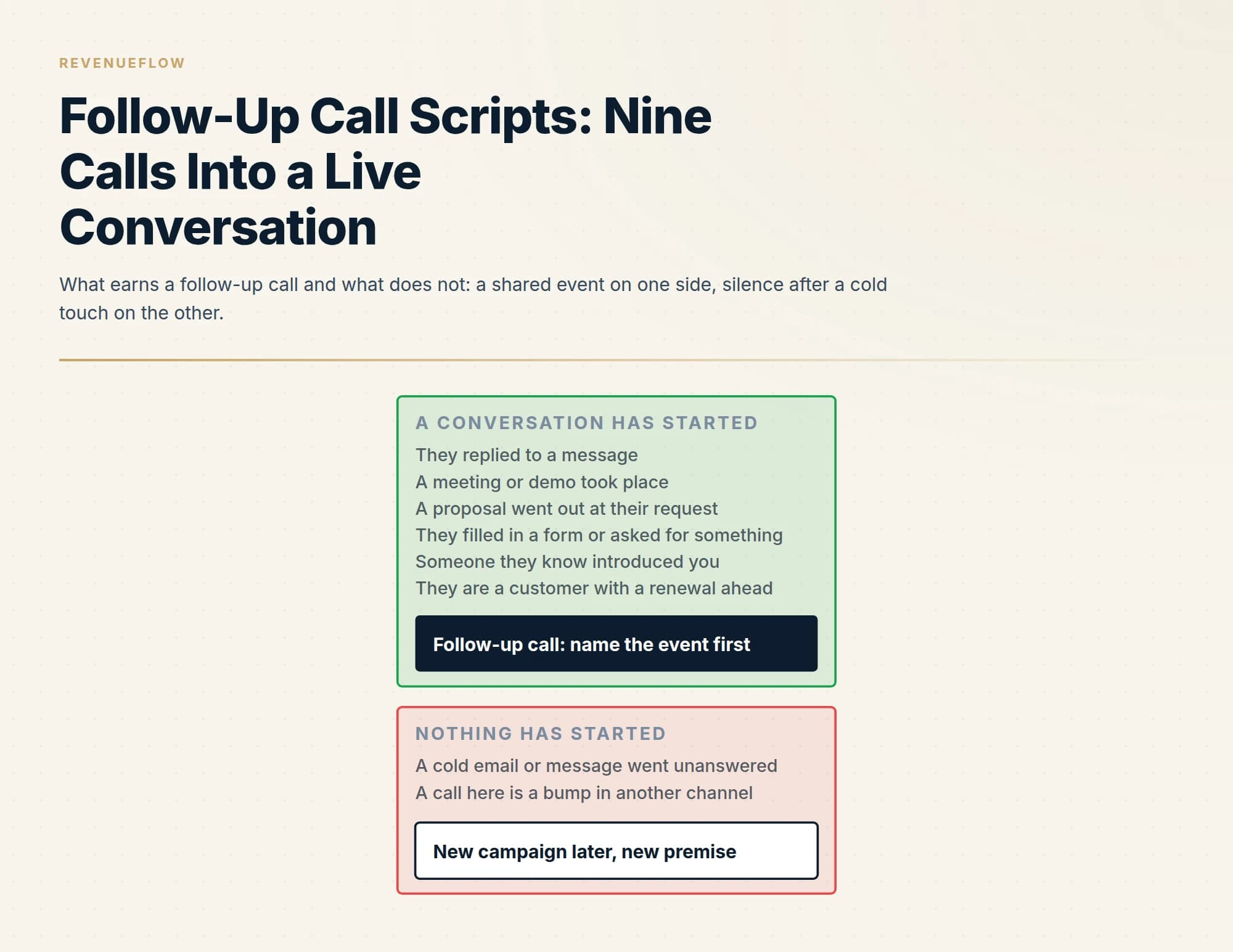
A follow-up call script opens by naming the event both people remember, such as a demo, a proposal or a reply, then says what is new since, asks for one specific next step and leaves a real way to say no. Silence after a cold message does not earn a follow-up call; that contact gets a new campaign later.
Key takeaways
- A follow-up call is a call into a conversation that has already started; ringing someone because a cold email went unanswered is a bump in another channel, and these scripts are not written for it.
- Every script makes four moves in order: name the shared event with a date or detail, say what is new since then, ask for one specific next step, and leave a real way to decline.
- Nine events earn the call: a demo, a requested proposal, a positive reply, a no-show, an inbound form, a stalled deal, an introduction, a callback they asked for, and an upcoming renewal.
- End on one of three outcomes, a next step with a date, a clear no, or a named blocker, and refuse a vague promise to get back to you, because it produces the next checking-in call.
Reviewed and updated September 18, 2026
A rep rings a prospect three days after a demo and opens with "just checking in". The prospect, who liked the demo, now has to do the rep's job: remember what was discussed, work out what the call is for, and think of something to say. Most follow-up calls that go nowhere fail in that first sentence, and they fail because the caller arrived without a reason the other person could recognise.
This page is a set of nine follow-up call scripts, each tied to the event that earns the call. Every script, company and person in it is invented for illustration. RevenueFlow runs written outbound, email and LinkedIn, and does not sell calling, so nothing here is a results claim. It is a method and it has one boundary, stated first.
What counts as a follow-up call
A follow-up call is a call into a conversation that has already started. Something happened that both people can remember: a reply, a meeting, a demo, a proposal, a form, an introduction, a contract. The call refers to that event, and the person answering can check the reference against their own memory.
Ringing someone because they did not answer a cold email is a different thing. That is a bump delivered through another channel, and the scripts below are not written for it. Our position on chasing silence is set out in why we stopped using follow-ups, and the same page names the exception this whole article lives inside: once someone has replied, following up is ordinary correspondence and worth doing well. A contact who never answered gets a new campaign with a new premise later, and if that campaign includes a call, it opens like any other cold call, for which the lines are in cold call openers by situation.
The shape every script shares
Each script below has the same four moves, and the order does the work.
It names the shared event in the first sentence, with a date or a detail. It says what is new since then: the thing you promised, a change on their side, a question that came out of the last conversation. It asks for one specific next step. And it leaves a real way to say no, because a follow-up call that cannot be declined turns into a series of unreturned voicemails.
The move that gets skipped is the second one. A call with nothing new in it is a request for a status update, and the prospect owes you none.
Nine scripts, by the event that earns the call
The seller in these scripts is an invented software firm, Harbourline, that sells scheduling software to clinics. The names and details are made up. None of these repeats the two follow-up scripts in our older 12 Cold Call Scripts page.
1. After a demo, to take the agreed next step. Invented script:
"Hi Tom, it's Aisha at Harbourline. On Tuesday's demo you wanted to see how the rota handles two sites. I have set that up in a test account with your Leeds and York clinics in it. Can I show you in ten minutes on Thursday, or send the login and let you look first?"
The demo is named, the promised thing exists, and the ask offers two sizes of yes.
2. After a proposal they asked for. Invented script:
"Hi Tom, Aisha at Harbourline. You have had the proposal since Monday. I am not ringing for a decision. There is one line I expect you to question, the onboarding fee, and I would sooner explain it now than have it sit there. Is this a good moment?"
Raising the awkward line yourself is the new thing. It also tells you whether the proposal has been read.
3. After a positive email reply. Invented script:
"Hi Tom, it's Aisha from Harbourline. You replied to my email this morning and said rota gaps were costing you locum fees. I thought a call would be quicker than three more emails. Have you got five minutes to tell me how you cover gaps today?"
The reply is quoted back, and the call is offered as a saving of their time.
4. After a no-show. Invented script:
"Hi Tom, Aisha at Harbourline. We had half past two in the diary and I think the day got away from you, which happens. Do you want to pick another slot now while we are both here, or has the priority moved?"
No reproach, one easy option, and an honest question that lets them say the timing has gone.
5. After an inbound form or a content request. Invented script:
"Hi Tom, it's Aisha at Harbourline. You asked for our staffing template on the website about an hour ago. I am ringing to check it arrived and to ask what prompted it. Are you rebuilding the rota, or was it curiosity?"
The form is the event. The question sorts a buyer from a reader without assuming either.
6. A stalled opportunity. Invented script:
"Hi Tom, Aisha at Harbourline. We last spoke in June, and you were waiting on the budget round. I am ringing because that round should have closed by now. Did scheduling make the list, or should I take this off mine?"
The reason the deal stalled is stated, the thing that should have changed is named, and the exit is explicit.
7. After an introduction. Invented script:
"Hi Tom, it's Aisha at Harbourline. Priya Nair at Larkhollow Clinics said she would mention me, because you are dealing with the same two-site rota problem she had. Did she get to you? I can tell you what we did there in two minutes."
Ask whether the introduction happened. If it did not, say so plainly and ask whether they would still like the two minutes.
8. The callback they asked for. Invented script:
"Hi Tom, Aisha at Harbourline. In March you said to try you after the new clinic opened, and I saw it opened last week. Is now a better time to look at the rota, or is it still too early?"
Their own instruction is the event. Keeping it is the point of the call.
9. An existing customer, ahead of a renewal. Invented script:
"Hi Tom, it's Aisha, your account contact at Harbourline. Your renewal is in two months. Before anyone sends paperwork I would like twenty minutes on what has worked and what has not. When suits?"
The purpose is stated as a review, and the renewal is named, so there is no hidden agenda to discover later.
| Event named | What is new | The ask |
|---|---|---|
| 1. Demo | The promised setup exists | Ten minutes or a login |
| 2. Proposal | The line they will question | Talk it through now |
| 3. Email reply | Their own words, quoted back | Five minutes today |
| 4. No-show | An easy reset | A new slot, or an honest no |
| 5. Inbound form | A check that it arrived | What prompted it |
| 6. Stalled deal | The blocker should have cleared | On the list or off it |
| 7. Introduction | A named peer's problem | Two minutes |
| 8. Asked-for callback | The date they set has arrived | Now, or still too early |
| 9. Renewal | A review before paperwork | Twenty minutes |
When it goes to voicemail
A follow-up voicemail follows the same shape in less space: the event, the new thing, when you will try again. Here is an invented one for script 1.
"Tom, it's Aisha at Harbourline. I have set up the two-site rota you asked about on Tuesday. I will try you Thursday morning, and the login is in your inbox if you would like to look first."
It asks for nothing and it does not say "call me back". The written side of the same moments, the recap and the proposal note, belongs in email, and our demo follow-up templates cover the emails for the same stretch, from the same-day recap to the no-show.
Three ways a follow-up call can end well
A follow-up call has three good endings and one bad one. The good ones are a next step with a date, a clear no, and a named blocker: the person or event the decision is waiting on. The bad one is "let me get back to you" with nothing attached, because it produces the next check-in call.
So the last question on any of these calls is about the ending. If the answer is yes, put a date on it before hanging up. If the answer is no, thank them and close the record with the reason. If the answer is "not yet", ask what it is waiting on and when that resolves, and you have the event that earns the next call.
Before you dial
A follow-up call is won or lost before it is placed. The notes from the last conversation are either in front of you or they are not, and a prospect can hear the difference inside one sentence. What a manager should listen for when reviewing these calls is covered in sales rep coaching, where a recorded call is one of the artifacts a session is built around.
- Yes: The shared event is named in your first sentence, with a date or a detail
- Yes: Something is new since then: a promised item, a change on their side, a question
- Yes: One specific next step to ask for
- Yes: A real way for them to say no
- No: The only reason to ring is that they have gone quiet
- No: The only contact so far is a cold message they never answered
The short version
A follow-up call is a call into a conversation that has already started, and it opens by naming the event that started it. Every script here makes four moves: the event, what is new, one ask, a real exit. Nine events earn the call, from a demo to a renewal. Silence after a cold touch does not, and a contact who never answered gets a new campaign with a new premise instead. End every call on a dated step, a clear no or a named blocker, and refuse the vague promise.
If the conversations themselves are what you are short of, that is the part we run, in writing, one message per campaign: see what a first campaign would look like.
Every script, company, person and date in this article is invented for illustration. The method is ours and carries no measured result.
Frequently asked questions.
Frequently asked questions- What do you say on a follow-up sales call?
- Open by naming the event you share, with a date or a detail: the demo on Tuesday, the proposal sent Monday, the reply this morning. Then say what is new since then, such as the item you promised or a change on their side, ask for one specific next step, and give them an easy way to say no. Avoid opening with just checking in.
- How soon should you call after a demo or a proposal?
- Call when you have something new to bring, such as the setup you promised or the point in the proposal you expect them to question. A call with nothing new in it is a request for a status update. We do not quote a best number of days, because published timing figures come from other teams' lists; agree the next contact date at the end of the demo instead.
- Is it okay to call a prospect who did not reply to a cold email?
- Not as a follow-up. A call placed only because a cold email went unanswered is a bump delivered through another channel. Our practice in written outbound is one message per campaign, and a contact who never answered gets a new campaign later with a new premise. If that campaign includes a call, it opens as a cold call with its own reason, not as a reminder.
- How should a follow-up call end?
- On one of three outcomes: a next step with a date, put in the diary before you hang up; a clear no, recorded with the reason; or a named blocker, meaning the person or event the decision is waiting on and when it resolves. A promise to get back to you with nothing attached is the ending to refuse, because it leads to another checking-in call.
About the author.

Ben Carden is CRO at RevenueFlow, which builds and operates outbound revenue engines for B2B companies. Previously at Gartner Enterprise. Studied at London School of Economics.
Ben Carden · CRO
Connect on LinkedIn →Explore more.
Ready to scale your outreach?
We build GTM engines that book real meetings. See the receipts.
Related articles.
10 B2B Cold Email Templates for One-Message Sends
Ten B2B cold email templates written for a single send, with the four slot structure underneath them and the test that separates a good example from a bad one.
14 Renewal Email Templates That Retain Customers
Master subscription and contract renewals with 14 proven email templates. Reduce churn, lock in renewals early, and maintain customer relationships.
Customer Onboarding Template: Five Messages and a Checklist
Five onboarding messages that take a new customer from signature to a working account with a named owner, plus the reasoning to rewrite before each one goes out.
Cold Email Templates for Customer Success Managers
Eleven cold email templates for customer success managers, covering champion change, expansion, renewal rescue, and win-back, with subject lines and timing.
13 Case Study Request Email Templates That Get Results
Get proven email templates for requesting case studies, video testimonials, and written reviews from your happiest customers. Includes templates for every stage from initial ask to final approval.
13 Demo Follow-Up Email Templates to Close More Deals
Proven demo follow-up email templates for every scenario, from same-day recaps to re-engaging stalled prospects and handling competitive evaluations.