Email Subject Line Capitalization: What the Guides Say
What the style authorities actually rule on subject line case, what the published tests measured, and the default for a one to one sales email.
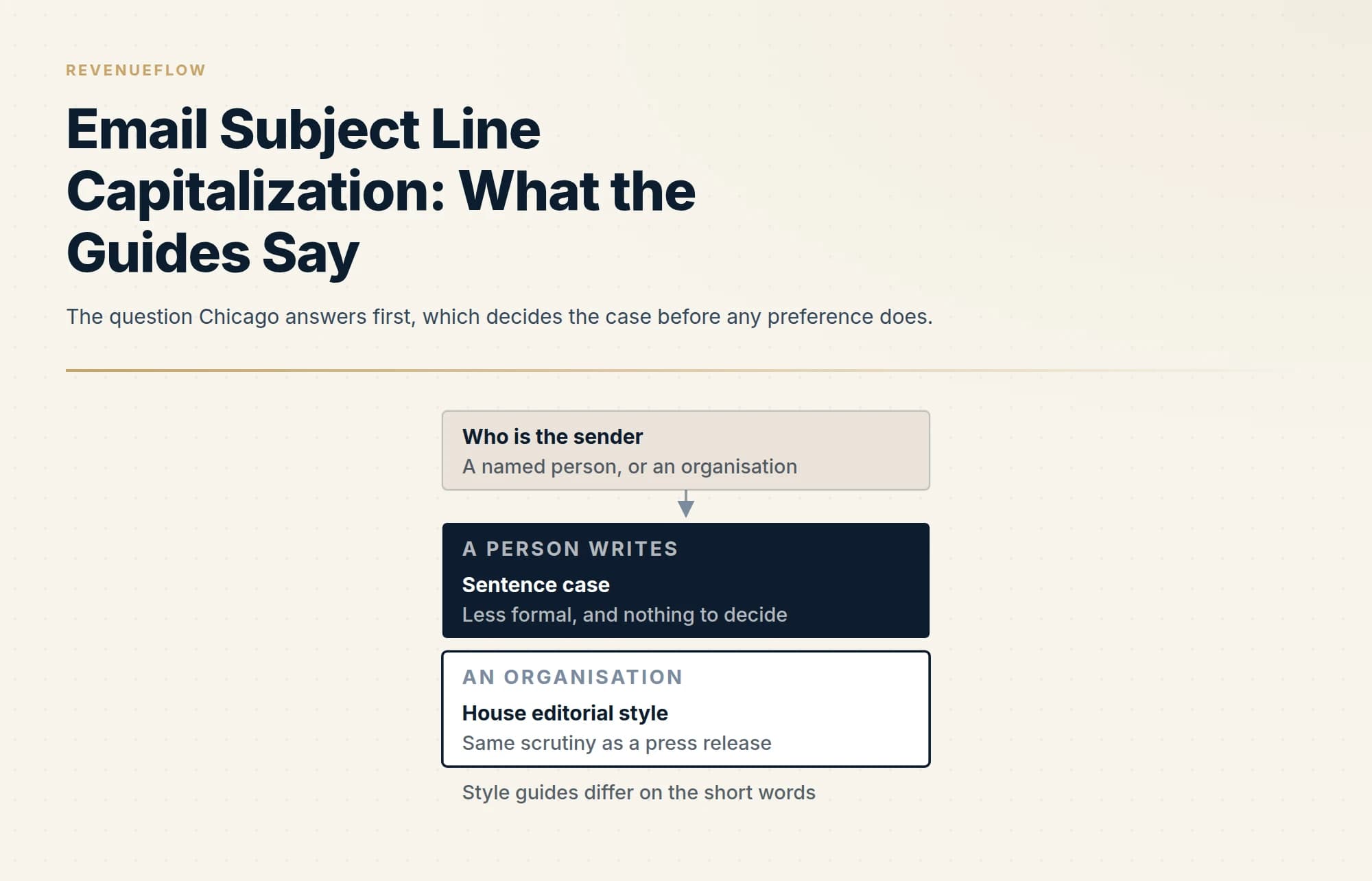
Use sentence case for a subject line a person sends to a person, which is what the Chicago Manual of Style recommends for personal and work messages and what Microsoft, Google and APA have standardised on. Title case belongs to formal organisational mailings, to document titles and to proper nouns. All capitals reads as bulk promotion.
Key takeaways
- The Chicago Manual of Style declines jurisdiction over email subject lines and then draws the line that matters, between a message from a person and a mailing from an organisation.
- Microsoft, Google and APA have all standardised on sentence case for the titles and headings they govern, and Chicago notes that the style guides disagree about which short words title case capitalises.
- The strongest marketing evidence is observational: a count of what high performing senders use, which shows sentence case is the majority formula without showing that case caused the performance.
- Case tests ranked on open rate are decided on an instrument that mixes human readers with machine image fetches, so a lift in opens is not evidence a subject line worked.
Reviewed and updated September 21, 2026
The Chicago Manual of Style was asked this exact question and its answer begins by declining jurisdiction. "CMOS doesn't cover email subject lines," its editors reply, "but if we did we'd make a distinction between personal email messages, on the one hand, and formal announcements or mailings, on the other." That distinction, between a message from a person and a mailing from an organisation, settles more of the argument than any test result does.
Two completely different bodies of advice answer this question. One is editorial, from the style authorities that govern how titles and headings are capitalised. The other is marketing, from platforms reporting what happened when they changed the case of a broadcast subject line. Both are worth reading and they are answering different questions. This page is scoped to business and sales email, meaning a message one person writes to another person at work, and it says what each body of advice actually establishes.
What the style authorities say
Chicago's full answer is the most useful thing published on this. For personal messages, including work ones, it says that "sentence case would usually be appropriate", and it gives two reasons: "Not only will sentence case come across as less formal than title case, but it will save the sender the trouble of determining which words get capitalized and which do not." For the other case it is equally clear: "Formal messages sent out by an organization, on the other hand, may be subject to the same editorial scrutiny that a press release or similar document might get."
Then it adds the observation that undercuts every confident rule you will read elsewhere: "Note that not all styles apply title case in the same way." Chicago capitalises prepositions of more than four letters; APA and the Associated Press capitalise all words longer than three letters; and AP prescribes sentence case for news headlines specifically. So a writer who decides on title case has not finished deciding.
The major technical style guides have settled the same argument in the same direction for everything they govern. Microsoft's style guide opens its capitalization page with a rule rather than a preference: "Use sentence-style capitalization most of the time." Google's developer documentation style guide says to "use sentence case for titles, headings, and references to them within the document", and extends it to captions, labels, glossary terms, list items and table elements. APA Style defines both conventions and explains the difference in one line: "In title case, major words are capitalized, and most minor words are lowercase. In sentence case, most major and minor words are lowercase".
The one authority that addresses email subject lines head on and refuses to pick is Syntaxis, a business writing firm. Its page lays out the two options and names the trade off: title case "can give email subject lines a more polished, professional appearance", while "For long subject lines, initial capital letters throughout can be overwhelming; in such cases, a better choice may be to capitalize only the first word and any proper nouns."
What the published tests actually measured
The marketing side of this question is thinner than it looks, and the reason is that every piece of it read for this article is ranked on open rate.
AWeber published the most concrete piece of it. Its study is observational rather than experimental: it counted the subject lines a hundred high performing senders actually use, describing the method as "we analyzed 1,000s of emails from 100 of the top experts". The result is a distribution rather than a verdict: "60% of email subject lines use sentence-case capitalization, 34% use title-case capitalization, and only 6% use all lowercase email subject lines." That tells you what successful senders do. It does not tell you that the case is why they are successful, and the page does not claim it does.
The same page carries a single split test from one sender, reported as the lowercase version getting thirty five percent more opens and clicks. One test, one list, one offer, one moment, ranked partly on opens. Treat it as an anecdote with a number attached.
The rest of the marketing literature on this is assertion. One email vendor's page argues at length that capitalised words draw the eye and convey urgency, importance and excitement, with no measurement anywhere on the page. That may be true and it is not evidence.
There is a deeper problem with all of it, which is the instrument. Open rate is produced by a tracking pixel, and mail providers now load or block those images on the reader's behalf, so any case test decided on opens is decided on a number that mixes human readers with machine fetches. The full argument is in cold email open rate benchmarks, and its consequence for subject lines specifically is in our sales email subject line guide.
| Measure | Value |
|---|---|
| Sentence case | 60% |
| Title case | 34% |
| All lowercase | 6% |
The house position for a one to one sales email
A cold sales email is the clearest case in the whole argument, because the sender is a person and the recipient can tell.
Sentence case, reading like a colleague's email, is the right default, and the invented example below shows why. The reason is not that it tests better. It is that the subject line is read alongside the sender name and the preview text, and everything in that row is telling the reader what kind of message this is. Title case is what organisations use for announcements and newsletters. A subject line in title case from an unfamiliar individual is a small mismatch between the sender and the format, and mismatches in that row are what make a message read as a mailing rather than as correspondence.
All capitals is the one form to avoid outright. It reads as shouting, it is the format most associated with promotional bulk mail, and it gains nothing that a specific first word does not gain more cheaply.
The same logic decides the punctuation questions people ask in the same breath. A subject line is not a headline and does not need a full stop; a question mark is fine where the line is genuinely a question; and exclamation marks belong to the newsletter register rather than to correspondence. What the line has to do, and the only thing it has to do, is get the first sentence read. That argument, and the order the message is actually written in, is in how to write a cold email, where the subject line is written last for exactly this reason.
Sentence case
The three SDR roles on your careers page 1
Title case
The Three SDR Roles on Your Careers Page 2
All capitals
THE THREE SDR ROLES ON YOUR CAREERS PAGE 3
- 1Reads as a message a person typed. Nothing to decide about minor words, which is the reason Chicago gives for preferring it in personal and work messages.
- 2Reads as something an organisation published. Defensible for a formal announcement, and a mismatch coming from one named individual.
- 3Reads as bulk promotion whatever the message says. This is the one form to rule out rather than test.
Where title case is still right
Three cases, and they are narrower than the habit of using it suggests.
The first is a named document. If the subject line is the title of an attached report, a proposal or a published piece, the title is capitalised the way its own cover page capitalises it, because you are quoting a name rather than writing a sentence.
The second is a proper noun inside an otherwise sentence case line. Product names, company names and people's names keep their own capitals wherever they fall, which is the one rule every style guide agrees on and APA states explicitly when it notes that proper nouns "are always capitalized".
The third is an organisational mailing that your house style already governs. If your company publishes a newsletter under an editorial style, the subject line belongs to that style rather than to this page, and Chicago's advice applies directly: check your organisation's style before applying title case to a formal subject line, because the guides disagree about which short words are capitalised.
There is a neighbouring question that gets mixed into this one and has a different answer. Capitalisation in the email address itself, as opposed to the subject, is governed by a specification rather than by taste, and it costs money in suppression matching rather than in tone. That one is answered in email address capitalization.
The short version
The style authorities have answered this, and they answer it by asking who is sending. Chicago would put personal and work messages in sentence case and formal organisational mailings under the same editorial scrutiny as a press release. Microsoft, Google and APA have all standardised on sentence case for the titles and headings they govern. Syntaxis, the one authority writing specifically about subject lines, names the trade off and leaves the choice to the sender.
The marketing evidence is one observational count showing sentence case is what most high performing senders use, one split test from one list, and a lot of assertion, most of it ranked on an open rate that stopped being a clean instrument. So use sentence case for a one to one sales email because it matches what the message is, keep proper nouns and document titles as they are, never use all capitals, and spend the attention you would have spent on case on the premise instead. If you would rather see a whole first message built against your own market than tune the line on top of it, see what a first campaign produces.
Style guidance and test figures above were read on the publishers' own pages on 21 September 2026, with dated snapshots kept as evidence, and each is attributed to the page it appears on. Verify current guidance at source before relying on it.
Frequently asked questions.
Frequently asked questions- Should email subject lines be sentence case or title case?
- Sentence case for a message one person sends to another, including at work. That is what the Chicago Manual of Style recommends when it is asked directly, and its reasoning is that sentence case reads as less formal and saves the writer deciding which minor words to capitalise. Title case belongs to formal mailings sent by an organisation under a house style.
- Does capitalizing a subject line improve open rates?
- There is no reliable evidence either way. One vendor counted the formulas high performing senders use and found sentence case in the majority, which is observational rather than causal. A single split test reported more opens for lowercase. Both are ranked partly on open rate, which mail providers corrupted when they began loading tracking images on the reader's behalf.
- Is it bad to use all caps in an email subject line?
- Yes, for a business or sales message. All capitals is the format most associated with promotional bulk mail, it reads as shouting, and it gains nothing that a specific first word does not gain more cheaply. Rule it out rather than testing it, and keep any emphasis in the words themselves.
- When is title case correct in a subject line?
- Three cases. When the line is the title of a named document, report or published piece, because you are quoting a name. When a proper noun appears inside an otherwise sentence case line, since product, company and personal names keep their capitals. And when an organisational mailing already has a house editorial style that governs it.
About the author.

Ben Carden is CRO at RevenueFlow, which builds and operates outbound revenue engines for B2B companies. Previously at Gartner Enterprise. Studied at London School of Economics.
Ben Carden · CRO
Connect on LinkedIn →Explore more.
Ready to scale your outreach?
We build GTM engines that book real meetings. See the receipts.
Related articles.
Follow-Up Call Scripts: Nine Calls Into a Live Conversation
Nine follow-up call scripts, each tied to the event that earns the call, from a demo to a renewal, plus the four moves they share and how each call should end.
Customer Onboarding Template: Five Messages and a Checklist
Five onboarding messages that take a new customer from signature to a working account with a named owner, plus the reasoning to rewrite before each one goes out.
10 B2B Cold Email Templates for One-Message Sends
Ten B2B cold email templates written for a single send, with the four slot structure underneath them and the test that separates a good example from a bad one.
Cold Email Templates for Customer Success Managers
Eleven cold email templates for customer success managers, covering champion change, expansion, renewal rescue, and win-back, with subject lines and timing.
14 Renewal Email Templates That Retain Customers
Master subscription and contract renewals with 14 proven email templates. Reduce churn, lock in renewals early, and maintain customer relationships.
13 Case Study Request Email Templates That Get Results
Get proven email templates for requesting case studies, video testimonials, and written reviews from your happiest customers. Includes templates for every stage from initial ask to final approval.