How to Get Past the Gatekeeper: Routes, Rules and Scripts
How to get past the gatekeeper without a pretext: who is really answering, the routes that never meet a front desk, the order of asks, and eight scripts.
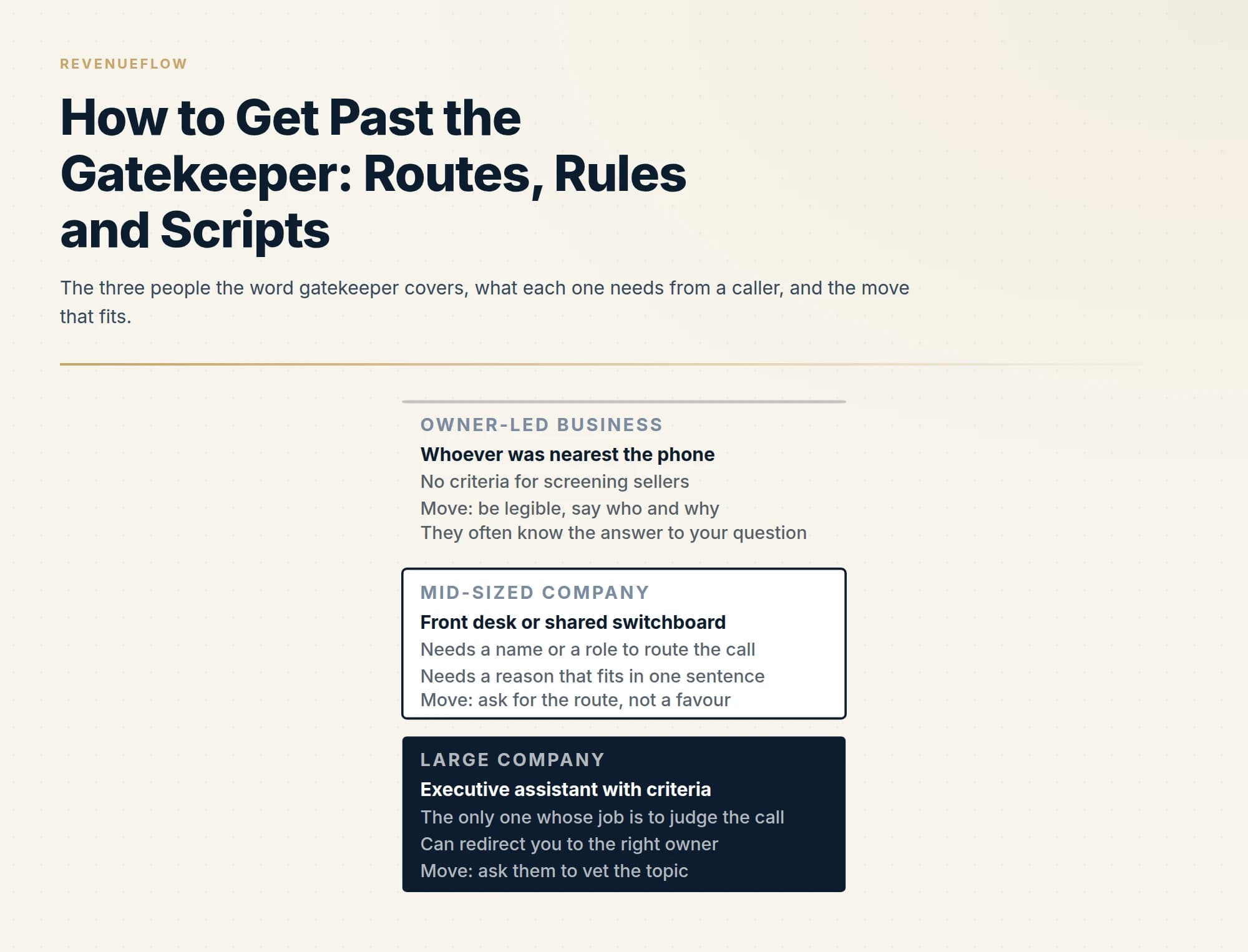
To get past the gatekeeper, first try a route that never meets one: a direct or mobile number, a written campaign to a named address, or a different hour. At the front desk, give your name, company and one true reason, then ask for the transfer, the right owner, and the best time or voicemail, in that order.
Key takeaways
- The word gatekeeper covers three people: whoever was nearest the phone at an owner-led business, a front desk at a mid-sized company, and an executive assistant with criteria at a large one, and each needs a different move.
- Check for a route that needs no gatekeeper before writing a script: a direct or mobile number, email or LinkedIn run as its own campaign, or a different hour tested on your own list.
- Give your name, your company and one true reason in the first exchange; a transfer won on a pretext opens with the buyer asking who you are, and the pretext is the first thing they learn.
- Sequence the asks from largest to smallest: the transfer by name, then whether this is the right owner, then the best time or the voicemail, and never a callback request.
Reviewed and updated September 18, 2026
The call connects, a voice says the company name, and the rep has about four seconds to decide what kind of caller to be. Most of the advice written for that moment is about sounding like someone who should not be questioned. This guide takes the opposite position: the fastest way past a gatekeeper is usually a route that never meets one, and when you do meet one, the caller who says plainly who they are and why they rang gets further than the caller who performs importance.
RevenueFlow runs written outbound, email and LinkedIn, and does not sell calling, so nothing here is a results claim. It is a method, the scripts are invented for illustration, and every published claim below is attributed to the page it came from.
Who is actually answering, by company size
The word gatekeeper covers three different people, and the right move depends on which one picked up.
At an owner-led business the person answering is an office manager, a relative or whoever was nearest. They have been given no criteria for screening sellers, which is why technique aimed at a professional screener reads as evasive to them. We cover that case on its own page, calling owner-led businesses, and the short version is to be legible: say who you are and why you called.
At a mid-sized company the phone is answered by a front desk or a shared switchboard. That person routes dozens of calls a day and needs two things to route yours: a name or a role, and a reason that fits in one sentence. They are not deciding whether your product is good. They are deciding which extension is least likely to complain about the transfer.
At the top of a large company an executive assistant manages the calendar and has been given criteria. This is the only one of the three whose job includes judging your call, and it is the only one who can also help you: an assistant who decides the topic belongs to someone else will often tell you who, which is worth more than the transfer you asked for.
The routes that never meet a gatekeeper
Before any script, check whether the front desk is the only way in. It usually is not.
A direct number. A mobile or a direct line reaches the person without a transfer. Cognism, which sells mobile numbers and so has an interest in the point, puts it first in its own guide to the subject (published 29 September 2025, last updated 16 April 2026, as read on 18 September 2026), saying of calling the prospect's mobile: "It's more effective than dialling direct dials." Treat that as a vendor's claim about its own product category. The mechanism underneath it is plain enough: a switchboard number costs you a gatekeeper conversation, and a number that rings on the person's own phone does not.
The written channel, carrying its own campaign. An email to a named person's own address has no front desk. That is a reason to let email or LinkedIn run as its own campaign with its own reason to exist, and it is not a reason to send a LinkedIn invitation as call preparation, for the reasons set out in what LinkedIn does and does not add to a cold call.
Someone else navigating. Some dialer vendors sell people who work the phone tree and the front desk on the rep's behalf. Koncert's pricing page, as read on 18 September 2026, lists a feature it calls Busy Work Delegation: "Delegate navigation of phonetrees, gatekeepers, and voice mail systems to human dialing agents." Our Koncert dialer guide raises the question that follows, which is that a human in the path is a person hearing your prospect's front desk, and your own policy has to cover that.
A different hour. Switchboards keep office hours and the people behind them often do not. Whether an early or late dial reaches your buyer is a property of their trade and their habits, and it is testable on your own list in a week. We are not going to quote a best time, because the published ones trace to other people's lists.
The honesty rule, and the advice it contradicts
A lot of popular gatekeeper advice is about withholding. The clearest published version is 30 Minutes to President's Club's newsletter of August 9, 2024, by Armand Farrokh, 3 Steps to Bypass The Gatekeeper on a Cold Call, as read on 18 September 2026. Its first step is to ask to be put through and nothing else: "First name's all you need, and you don't have to share which company you're from." If the gatekeeper asks what the call is about, the advice is to give context rather than the product, because "If you bluntly share your company name or mention your product, you're busted." The same piece says it does not support lying or being disrespectful, and it is fair to read it as a method for sounding familiar rather than for deceiving anyone.
Our house method goes the other way, and it is a method rather than a measurement. Give your name and your company in the first sentence. Give a reason that is true. Never imply a relationship that does not exist: no returning a call that was never made, no first-name familiarity with someone you have not met, no claim that the person is expecting you. Three reasons sit behind that.
The first is that the person answering is the one most practised at hearing the performance. A screener hears the confident first-name ask many times a week, and the callers who use it have taught them what it means.
The second is what happens after the transfer. A call that arrived on a pretext opens with the buyer asking who you are, and the pretext is now the first thing they know about you. Our sales pitch examples make the same point about the false familiarity opener.
The third is the rule book. The Telemarketing Sales Rule exempts calls between a telemarketer and a business at 16 CFR 310.6(b)(7), and the same paragraph, as read on eCFR on 18 September 2026, says the exemption does not apply to the requirements of section 310.3(a)(2) and (4). Those two paragraphs prohibit "Misrepresenting, directly or by implication" a list of material facts about what is sold, and "Making a false or misleading statement to induce any person to pay for goods or services". So the part of the rule that still reaches a business caller is the part about telling the truth. We set the exemption out in full in what cold calling is and which rules apply. That page is not legal advice and neither is this one, and states add rules of their own.
- First name only, no company
- Context instead of the real topic
- Works until the screener has heard it before
- The buyer's first question is who you are
- Anything implying a prior relationship is a pretext
- Name and company in the first sentence
- One true reason that fits in a sentence
- Gives the front desk what it needs to route you
- The transfer arrives with its reason attached
- A no from the right person is a real answer
Sequence the asks
A front-desk call has three asks in it, and the order matters because each one is smaller than the last. Callers who open with the smallest ask, a request to leave a message, never find out whether the largest was available.
Ask for the transfer first, by name. If that is refused, ask whether this person is the right owner for the topic or whether someone else is. If the owner is confirmed and unavailable, ask for the best time to reach them or for their voicemail. Do not ask for a callback, because a callback request hands your next step to someone with no reason to take it.
Eight scripts, by situation
Every script below is invented for this article, including the companies and roles. None repeats the two gatekeeper scripts in our older 12 Cold Call Scripts page. Rewrite the reason for your own market before using any of them.
1. You have the name. Invented script:
"Morning, it's Dana Reyes from Northfield Payroll. Could you put me through to Priya Shah, please?"
Name, company, request. Nothing else until you are asked.
2. "What is this regarding?" Invented script:
"Of course. You opened a second site in Leeds in the spring, and we run payroll for multi-site firms. I wanted to ask Priya one question about how the two sites are paid. Is she the right person for that?"
One checkable fact, one sentence on what you do, and a question the front desk can answer.
3. You do not have the name. Invented script:
"Hi, it's Dana Reyes from Northfield Payroll. I'm trying to find whoever looks after payroll across your two sites. Who would that be, and what's the best way to reach them?"
Asking for the route is a smaller request than asking for a person, and the answer improves your list whether or not you are transferred.
4. The executive assistant with criteria. Invented script:
"Hi, it's Dana Reyes from Northfield Payroll. I know you look after Priya's diary, so I'll ask you first. It's about paying staff across two sites on one run. Is that something she would want to hear about, or does it sit with someone else?"
This asks the assistant to do the job they already do. If they say it belongs elsewhere, take the name they give you and thank them.
5. "Send an email to the info address." Invented script:
"Happy to. So it reaches the right desk, whose name should I put at the top?"
Accept the deflection and ask for the one detail that makes the email land.
6. "She's not available." Invented script:
"No problem. Is there a time of day she tends to be at her desk, or would her voicemail be better?"
Two options, both of which keep the next step with you.
7. Your third call to the same desk. Invented script:
"Hi, it's Dana at Northfield again. I've tried Priya twice this month, so tell me if I should stop. Is there a better route than ringing you?"
Naming the repetition is more comfortable for both people than pretending it is the first call.
8. The voicemail hand-off. Invented script:
"Could you put me through to her voicemail? Thank you." Then: "Priya, it's Dana Reyes at Northfield Payroll. I rang about paying your Leeds and Hull sites on one run. I'll try you Thursday morning. No need to call back."
The message carries the same true reason, says when you will try again, and asks for nothing.
Front desk asks: what is this regarding?
"You opened a second site in Leeds in the spring, and we run payroll for multi-site firms." 1
"I wanted to ask Priya one question about how the two sites are paid." 2
"Is she the right person for that?" 3
- 1One checkable fact about their company and one sentence on what you do. It is true, so it survives being repeated to the buyer.
- 2A small, specific purpose. The front desk can pass it on in their own words.
- 3A question the front desk can answer, which turns a screen into a routing decision.
Once the transfer happens, the first fifteen seconds with the buyer are a separate piece of work, and the catalogue for it is in cold call openers by situation.
When to stop
A gatekeeper's no is sometimes the company's no. If the right owner has been named, reached and has declined, the account is finished for this premise and a fourth call to the front desk will not change it. If you have only ever reached the desk, the account is not finished, it is unreached, and the routes in the second section are where to go next.
The short version
Work out who is answering before choosing a move: whoever was nearest at an owner-led business, a front desk at a mid-sized company, an assistant with criteria at a large one. Try the routes that need no gatekeeper first: a direct number, the written channel as its own campaign, a different hour. At the desk, give your name, your company and one true reason, and sequence the asks from the transfer down to the voicemail. Refuse the pretext, because the buyer inherits it.
If the underlying problem is that too few of the right people hear from you at all, that is the part we run, in writing: see what a first campaign would look like for your market.
Third-party pages quoted above were fetched and read on 18 September 2026 and are cited as their publishers' statements. Every script, company and name in this guide is invented for illustration.
Frequently asked questions.
Frequently asked questions- What do you say to a gatekeeper on a cold call?
- Say your name, your company and who you are trying to reach, and nothing more until you are asked. If the front desk asks what the call is about, give one checkable fact about their company, one sentence on what you do, and ask whether the person you named is the right owner. That turns a screen into a routing decision the front desk can make.
- Should you tell the gatekeeper which company you are calling from?
- Yes, as house method. Some published advice recommends giving a first name only and holding back the company so the call sounds familiar. The cost arrives after the transfer, when the buyer asks who you are and the pretext becomes the first thing they know about you. A front desk that hears name, company and a one-sentence reason has what it needs to route the call.
- How do you get past the gatekeeper without lying?
- Use routes that do not meet one, such as a direct or mobile number or a written message to the person's own address, and be plain at the front desk. Do not claim to be returning a call, do not imply the person expects you, and do not use first-name familiarity you have not earned. Ask the assistant to judge whether the topic belongs with their principal or with someone else.
- What if the gatekeeper says the decision maker is not available?
- Ask for the time of day the person tends to be at their desk, or ask to be put through to their voicemail. Both keep the next step with you. Avoid asking for a callback, which hands the next step to someone with no reason to take it. On voicemail, give the same true reason, say when you will try again, and ask for nothing.
About the author.

B2B cold email experts helping companies generate qualified leads through done-for-you outreach campaigns.
RevenueFlow Team
Explore more.
Ready to scale your outreach?
We build GTM engines that book real meetings. See the receipts.
Related articles.
Cold Call Openers: Eleven Lines by Situation, and the Data
Eleven cold call openers sorted by what is true about the call, the four beats every opener has, and what Gong's 2018 opener study actually counted.
MEDDIC vs BANT: What Each Qualifies and When to Use Which
MEDDIC and BANT from the originators' own text: IBM's BANT form as a gate after the first call, PTC's six themes as an audit of a live deal, and when to run each.
The Urgency Close: Real Deadlines and Manufactured Ones
The urgency close from the publishers who teach it, the test that separates a real deadline from a manufactured one, the structure, and why we never invent one.
3x3 Research: Three Facts in Three Minutes Before Outreach
3x3 research as Funnel Clarity publishes it: three unique facts in three minutes that the prospect would be surprised you know, the variants, and where it fits.
B2B Sales for Financial Services Companies: Regulated Seller
For the bank, agency, broker-dealer or adviser selling to businesses: the buying group, the credit and renewal windows, and the rules that bind the seller's own message.
The Direct Close: Asking Plainly for the Business
The direct close asks for the business with nothing wrapped around the question. The condition the publishers attach, the buyer it suits, where it backfires.