Appointment Setting for Telecom Companies: What a Meeting Carries
For carriers, UCaaS providers and MSPs buying or running appointment setting: the three gates a telecom meeting carries, vendor models, FCC rules, three openers.
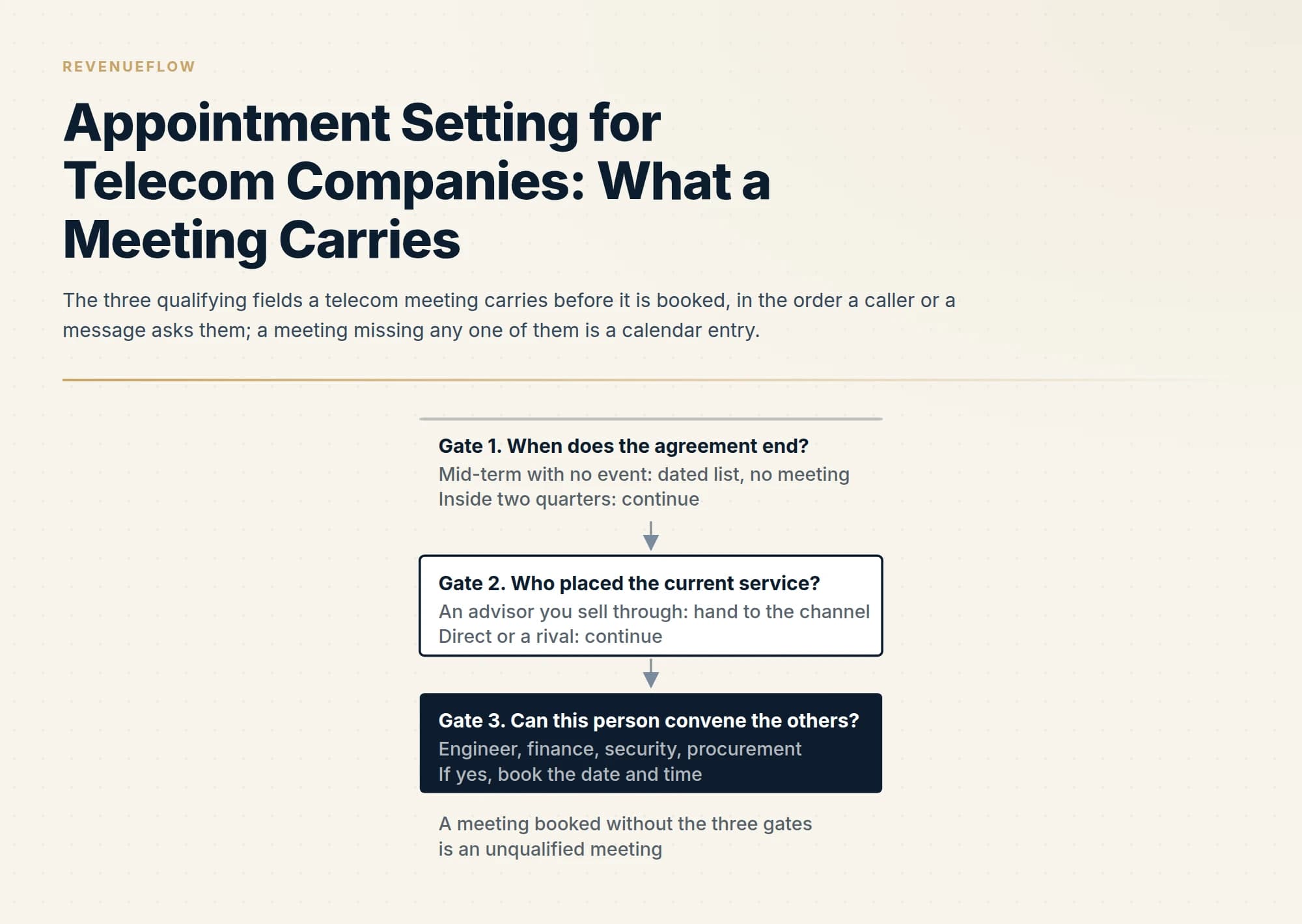
A telecom meeting is worth booking only when three fields are known: the month the current agreement ends, who placed the current service, and whether the contact can convene the engineer, finance and security roles. Write those into the qualification criteria before any programme starts, vendor or in-house, and price per shown meeting only after shown is defined.
Key takeaways
- GenSales delivers date-and-time-specific appointments against client-defined rules, dials by hand with no auto dialer and reports a 60 to 75 percent show rate that depends on the client's own follow-up; it guarantees neither counts nor timing.
- ViB contrasts a flat retainer paid whether a vendor books zero meetings or 20 with paying only for completed, verified meetings, and tells buyers to ask for show rates and post-meeting validation.
- A business mid-way through a multi-year agreement cannot buy, and an account placed by a technology advisor belongs to that advisor, so the term end and the placing channel are qualification criteria rather than billing conditions.
- The FCC's guide requires prior permission for automated calls or texts to cell phones and identification on prerecorded calls; manual dialling and client-branded caller ID are compliance choices as much as sales choices.
Reviewed and updated September 18, 2026
Appointment Setting for Telecom Companies: What a Meeting Carries
An appointment vendor books forty meetings for a regional fibre provider in a quarter. Eleven of the businesses are eighteen months into a three-year agreement with the incumbent. Nine were placed by a technology advisor who hears about the meeting from the customer and calls the provider's channel manager. The forty meetings happened, the invoice was correct, and the quarter produced two orders. Nothing in the vendor's contract was wrong. The meetings were missing the three fields that decide whether a telecom meeting can become anything.
This page is for the telecommunications company deciding whether to buy or run an appointment programme: the carrier, the unified communications provider, the managed service provider, the technology advisor selling business connectivity and voice. It is not about which vendor to hire, which the B2B appointment setting companies framework covers for every vertical, and it is not about where telecom leads come from, which is the companion page on lead generation for telecommunications companies. It is about what the meeting itself must carry in this market, sourced from the vertical's own vendors and regulator, fetched on 18 September 2026. Selling into telecom companies runs the other way and lives in cold email for telecom.
What the vendors selling telecom appointments say they deliver
Three vendors on the results page describe their product in enough detail to learn from. GenSales, writing on 16 August 2026 for technology and telecom sellers, delivers date-and-time-specific appointments that meet every rule the client marks as required, sets three to five qualifying questions in a campaign roadmap during a strategy session, dials every number by hand with no auto dialer or power dialer, shows the client's own caller ID, and launches new programmes in about 14 days. It states that it does not guarantee appointment counts or delivery timing and does not promise money back, that the first month normally serves as a ramp-up period, and that it reports a 60 to 75 percent show rate on set appointments, a figure that depends partly on how promptly the client follows up. Those are the vendor's own claims about its own service and are recorded as such.
ViB, writing for telecom providers on 1 October 2025 and on pay-for-performance on 17 October 2025, describes the alternative model: with a traditional vendor you pay a flat retainer regardless of whether they book zero meetings or 20, while pay-for-performance means you pay only for completed, verified meetings with your ideal buyers. Its checklist for choosing a partner asks about lead quality and access to decision makers in your specific telecom niche, domain expertise with telecom or IT clients, transparency on how meetings are sourced and qualified, show rates and post-meeting validation, and no cold-call factories. Telecom, Inc., a contact centre whose name puts it on this results page, sells US-based agents who qualify leads and schedule appointments, and has for over 30 years by its own account.
The pattern across all three is that the meeting is defined by the client, and the vendor's product is whatever definition the client wrote. In telecom that definition has to contain more than a title and a willingness to talk.
The three fields a telecom meeting cannot be booked without
The first is the term. Business connectivity and communications are sold on multi-year agreements, and a meeting with a business eighteen months into one is a meeting about something it cannot buy. GenSales' own description of enterprise deals, which move through evaluators, budget holders and procurement with contract values large enough that every step gets scrutiny, is the reason: the scrutiny is about a commitment, and the commitment already exists. The qualifying question is the month the current agreement ends, and an appointment programme that does not ask it is booking calendar entries.
The second is the channel that placed the incumbent. Intelisys, the technology services distributor owned by ScanSource, describes flexible routes to market for its partner community and invites advisors to become sales partners; the Channel Partners Conference describes thousands of technology advisors, managed service providers and suppliers meeting each year. An account placed by an advisor belongs to that advisor's relationship, and a meeting booked by a supplier around the advisor is a channel conflict with a calendar invitation attached. The qualifying question is who placed the current service.
The third is the convener. GenSales writes that a network engineer cares about integration, a finance lead cares about total cost and a security reviewer cares about risk, and that a booked meeting has to be set with the person who can convene the rest. ViB names the same committee as CIOs, CTOs, IT leaders and finance teams. A meeting with any one of them is a meeting with a fifth of the decision; a meeting with the one who can call the other four into a room is the appointment.
Write those three into the qualification criteria the vendor works to, or into your own programme's definition of a meeting, and the forty-meeting quarter above becomes a different quarter. Our own practice is that meetings are qualified against criteria agreed in writing before launch, and budget, timing and authority are never billing conditions; the three telecom gates are qualification criteria, not billing conditions, because they describe the account rather than the buyer's intent.
Timing, and the desk reality the phone-led vendors describe
The vendors read for this page are phone-led, and their pages describe the desk. GenSales says large technology and telecom organisations route unknown callers through reception, assistants and shared inboxes, and that a live caller can answer a first question, work politely past a screen and agree a callback time. It cites HubSpot's roundup for the claim that most successful sales take five or more follow-up calls and that a quarter of sales professionals name direct contact with decision makers as one of their hardest problems; those are HubSpot's figures relayed by a vendor, recorded here as such. ViB says gatekeepers are everywhere and that reaching IT or network executives directly is tough.
That is the vertical's reality and it is described here as such. Our own motion is email and LinkedIn, one message per campaign, no bump sequences and no second LinkedIn message under an ignored one. The reason the two can coexist in one market is timing: a phone programme earns its keep in the weeks before a term ends, when a live conversation can agree a date; a written message earns its keep earlier, when the job is to find out the term and the convener, and later, when the meeting needs an agenda the committee can forward.
| Model, as its vendor describes it | What the telecom company still owns |
|---|---|
| Retainer programme with client-defined rules and manual dialling | The qualifying questions, prompt follow-up on every booked meeting, outcome feedback that tunes the rules |
| Pay only for completed, verified meetings with the ideal buyer | The definition of ideal, post-meeting validation, and the decision to pause or scale |
| Contact centre agents qualifying and scheduling | The script, the list, the compliance review and the person who takes the call |
The rules the caller works under
A telecom company is regulated by the same commission whose calling rules its appointment programme must follow, and the regulator's own page is the reference. The Federal Communications Commission's guide on telemarketing and robocalls, read on 18 September 2026, states that calls, texts or prerecorded messages to cell phones require the recipient's prior permission unless sent manually, that prerecorded or artificial-voice calls must begin with the caller's name, phone number and organisation, that telemarketing calls to homes are prohibited before 8 a.m. and after 9 p.m., and that the National Do Not Call Registry lists landline and wireless numbers that legitimate telemarketers agree not to call. The rules sit at 47 CFR 64.1200 on eCFR, with amendments applied as recently as March 2026 on its timeline.
Two of the vendor design choices above are compliance choices in disguise. Manual dialling, which GenSales describes as no auto dialer or power dialer, is the difference the FCC's guide draws for cell phones. Client-branded caller ID means the telecom company's own name and number are what the called party sees, so the telecom company is the party the rules name. Neither is legal advice; both are reasons to read the regulator's page before signing a vendor's order form, and to ask the vendor which numbers it treats as wireless.
What the vertical says gets in the way
The objections are on the vendors' own pages, which is where a buyer of appointment setting should look for them. ViB's telecom page says many lead gen vendors promise big results but deliver unqualified meetings that waste your team's time and budget, and that between chasing bad leads, inconsistent outreach and paying high retainers for uncertain results, many teams are rethinking their approach. GenSales says outreach that treats the first contact as the decision maker stalls the moment the account routes the call elsewhere, and that every added reviewer means another round of scheduling and internal sign-off, any of whom can pause a deal.
Both objections are about the definition of a meeting. Unqualified meetings are meetings booked without the three gates. Stalled meetings are meetings with someone who cannot convene the committee. The vendor that can describe how it asks the term, the channel and the convener is answering the objection its competitors' customers raised.
When appointment setting is the wrong play for a telecom seller
It is the wrong play when the accounts you want are mid-term. A list of businesses with two years left on their agreements produces meetings that cannot close, and no vendor model, retainer or pay-per-meeting, changes that; the list belongs in a dated queue for the quarter before the term ends.
It is the wrong play when the accounts are placed by advisors you sell through. The distributor and the conference exist because thousands of advisors own those relationships, and a supplier booking around them trades a channel for a meeting.
It is the wrong play when the offer is a seat. Telecom Reseller wrote on 1 September 2026 that the channel's growth formula of adding customers, seats and revenue gets harder when a small business is not adding employees, and quoted BCM One's chief revenue officer that customers ask their provider to solve a specific problem, to stop losing business when the phone is not answered. A meeting to sell a seat to a business that is not hiring is a meeting the buyer took out of politeness; a meeting about the calls that go to voicemail after five is a meeting about a problem the owner already has.
And it is the wrong play when the programme's economics rest on a show rate nobody validated. GenSales reports a 60 to 75 percent show rate and says the result depends partly on the client's own follow-up; ViB tells buyers to ask for show rates and post-meeting validation. A programme priced per meeting with no agreed definition of shown is priced per calendar entry.
- No: The accounts you want are mid-term, with years left on their agreements
- No: The accounts were placed by advisors you sell through
- No: The offer is a seat, to a business that is not adding employees
- No: The economics rest on a show rate nobody validated
- Yes: The term ends soon, the account is direct, and the contact can convene the committee
Three meeting requests a telecom seller could send
Each of these asks a qualifying question before it asks for a date.
To the office manager of a fourteen-person accounting firm
Before I ask for a meeting: when does your current phone contract end? If it is inside the next six months, twenty minutes on what after-hours calls do today is worth your time; if not, we will write again nearer the date. 1
To the finance director of a company with five branches
Five sites usually means five agreements ending in five different months. If you can tell us who placed them, we can say whether a single term makes sense and bring the engineer's questions and the security questions to one meeting rather than three. 2
To an IT advisory firm, from a provider's channel manager
Your firm advises businesses on connectivity in the counties where we are building. Rather than approach your clients, we would like thirty minutes on how our partner programme works, so the relationship stays yours. 3
- 1Gate one is the first sentence; the message names what happens if the answer is the wrong one, which is the honest version of a follow-up.
- 2Asks gate two and offers to be the convener the vendors say the meeting needs, naming the roles GenSales describes.
- 3The channel conflict handled as a meeting of its own, modelled on the distributor's own invitation to become a sales partner.
Each asks one question the buyer alone can answer, makes no results claim and names no rate. One message per campaign; when the term-end date creates a new premise, that is a new campaign.
Running it
Write the three gates into the qualification criteria before any programme starts, whether the caller is a vendor's or your own. Split the list by term end, so the phone-led work lands in the right quarter and the written work lands earlier. Hand advisor-placed accounts to the channel team. Agree what a shown meeting is, with the convener in the room, before the first invoice. The generic evaluation of providers and pricing models is in appointment setting services and applies unchanged.
If the constraint is running the written part of that programme, RevenueFlow books qualified telecom meetings on a pay-per-meeting basis, by email and LinkedIn, with the three gates written into the criteria agreed before launch.
Vendor descriptions per GenSales, 16 August 2026, ViB, 1 and 17 October 2025, and Telecom, Inc.; channel descriptions per Intelisys, the Channel Partners Conference and Telecom Reseller's report of 1 September 2026; calling rules per the FCC's telemarketing and robocalls guide and 47 CFR 64.1200 on eCFR. All fetched 18 September 2026. Confirm current rules with the regulator before relying on them.
Sources: B2B Appointment Setting for Technology and Telecom, GenSales, Appointment setting companies for telecom providers, ViB, Pay-for-performance appointment setting for B2B telecom companies, ViB, Appointment Setting, Telecom, Inc., Intelisys, Channel Partners Conference and Expo, UCaaS Partners Look Beyond the Seat, Telecom Reseller, Telemarketing and Robocalls, FCC, 47 CFR 64.1200, eCFR
Frequently asked questions.
Frequently asked questions- What should a telecom company require of an appointment setting vendor?
- Three qualifying fields on every meeting: the month the prospect's current connectivity or voice agreement ends, who placed the current service, and whether the contact can convene the engineer, finance and security reviewers GenSales describes. Then a written definition of a shown meeting, since GenSales reports a 60 to 75 percent show rate that depends on client follow-up and ViB tells buyers to ask for post-meeting validation.
- Is pay-per-meeting better than a retainer for telecom appointment setting?
- ViB describes the retainer as paid whether the vendor books zero meetings or 20 and pay-for-performance as paying only for completed, verified meetings with ideal buyers. Neither model removes the three qualifying gates; a per-meeting price with no agreed definition of shown is a price per calendar entry. The decision turns on who writes the definition and who validates the meeting afterwards.
- What rules apply to the calls an appointment vendor makes for a telecom company?
- The FCC's telemarketing guide: automated or prerecorded calls and texts to cell phones need prior permission unless sent manually, prerecorded calls must begin with the caller's name, number and organisation, home telemarketing calls are barred before 8 a.m. and after 9 p.m., and the Do Not Call Registry applies. The rules sit at 47 CFR 64.1200. Client-branded caller ID makes the telecom company the named party.
- When is appointment setting the wrong play for a telecom seller?
- When the target accounts are mid-term with no event coming, when they were placed by advisors the seller sells through, when the offer is another seat to a business that is not hiring, which the channel press says is the model that has hit its limit, and when the programme is priced on a show rate nobody validated. In each case the fix is the list or the definition, not the vendor.
About the author.

B2B cold email experts helping companies generate qualified leads through done-for-you outreach campaigns.
RevenueFlow Team
Explore more.
Ready to scale your outreach?
We build GTM engines that book real meetings. See the receipts.
Related articles.
Appointment Setting for 3PL Companies: Fit Before the Calendar
For 3PLs, warehousing operators and brokers wanting shipper meetings: the five fit gates, the bid calendar, contract terms, the trade's rules and three openers.
Lead Generation for Telecommunications Companies: Four Lead Sources
For carriers, ISPs, UCaaS providers and MSPs: the installed base, the advisor channel, dated outbound and the funded network map as lead sources, with FCC rules.
Appointment Setting for Food Distributors
How a foodservice distributor opens accounts its routes do not reach: independents, chains and institutions, the FDA traceability rule as the opener, the DSR handoff.
Merchant Services Cold Calling Scripts: The Honest Version
Six call scripts for merchant services agents and ISO reps, built around what the FTC alleged about this exact call: no affiliation claim, no rate before a statement.
LinkedIn Outreach for Machine Shops
How a job shop or CNC machine shop uses LinkedIn to win OEM work: the four buyer titles, the RFQ gate, the ISO, AS9100 and ITAR facts, and LinkedIn's own rules.
Sales Outsourcing for SaaS Companies: What to Hand Over
For SaaS companies weighing an outside sales team: what the industry's own survey found, what a third party cannot hold in a software sale, and what can go out.