Cold Calling Scripts for Accounting Firms, by Service Line
Six call scripts for accounting firms by service line, the Supreme Court case that lets CPAs call business prospects, and the filing calendar that says when to.
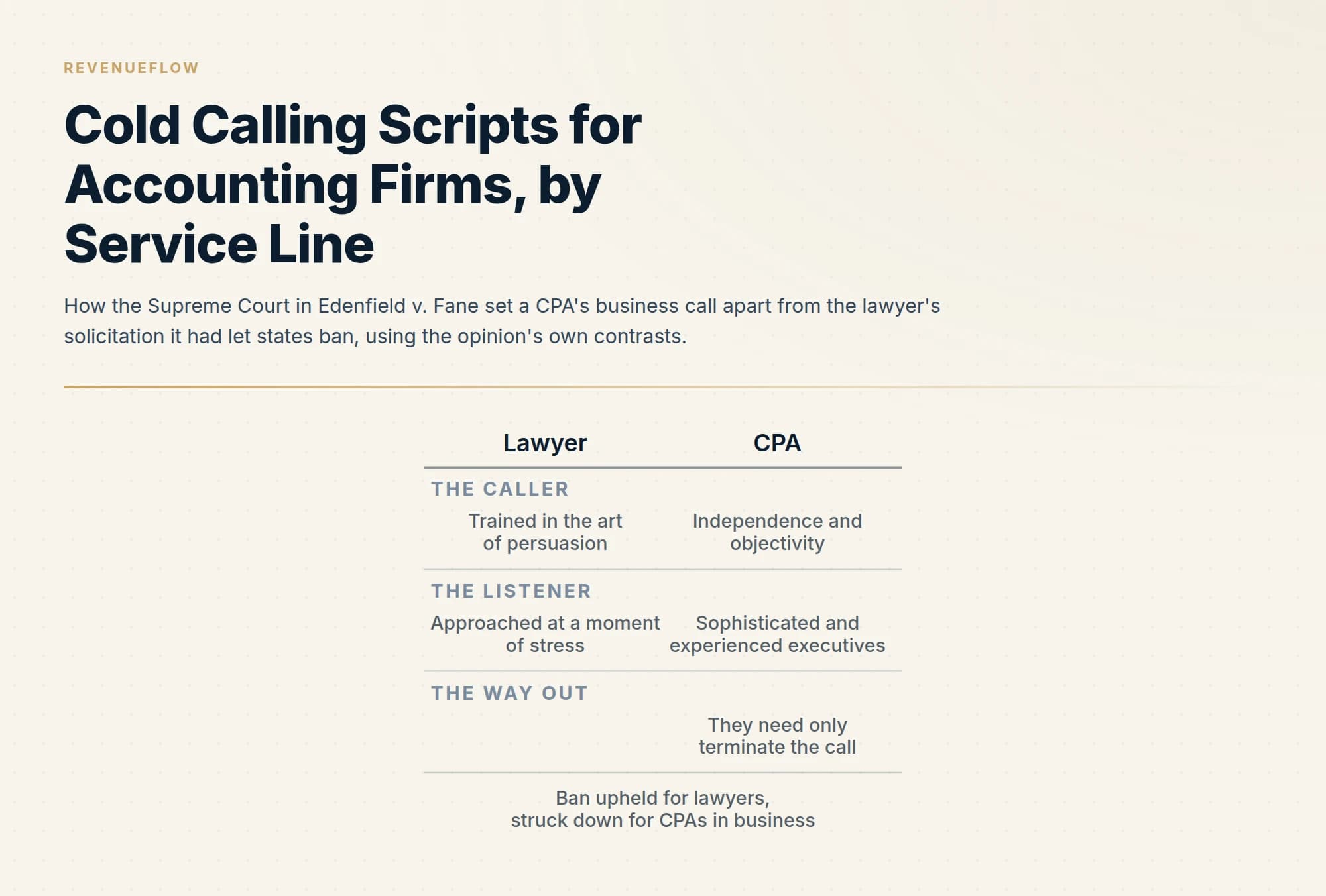
CPAs may call business prospects: in Edenfield v. Fane (1993) the Supreme Court struck down Florida's ban as applied to the business context, leaving a conduct standard against false, coercive or harassing solicitation. Scripts should be built by service line, ask for something small, avoid filing season, and stop when the owner says no.
Key takeaways
- Edenfield v. Fane, decided April 26, 1993, held Florida's ban on direct, in-person, uninvited CPA solicitation inconsistent with the First and Fourteenth Amendments as applied to the business context.
- A Florida Board of Accountancy notice prints rule 61H1-24.002: a licensee may solicit an engagement without coercion, duress, compulsion, intimidation, threats, or overreaching, vexatious or harassing conduct.
- IRS Publication 509 for 2026 puts Forms 1065 and 1120-S on the 15th day of the 3rd month and Forms 1040 and 1120 on the 15th day of the 4th, so May, June and November are the quiet calling windows.
- Each script asks for something that does not require firing the incumbent: two pages on a tax change, a one-off clean-up before an extended deadline, or a question about who watches cash.
Reviewed and updated September 18, 2026
Cold Calling Scripts for Accounting Firms, by Service Line
Scott Fane built a CPA practice in New Jersey the way most accountants would never admit to. According to the United States Supreme Court, he "often obtained business clients by making unsolicited telephone calls to their executives and arranging meetings to explain his services and expertise." When he moved to Florida in 1985 the state's Board of Accountancy told him he could not. He sued, and in 1993 he won. Accountants have been allowed to pick up the phone ever since, and most still do not know what to say when someone answers.
This page is scripts for the accounting, tax or bookkeeping firm whose own partners and staff call business owners to win clients. It is the firm's side of the call and nobody else's: a vendor selling software to accountants is a different reader. The live guide to accounting lead generation covers which businesses to approach and why switching is rare and triggered. This page is what to say once the list exists. Every outside source was fetched on 18 September 2026, and every name and figure inside a script is a placeholder.
The rule on the call, in three sentences
The case is Edenfield v. Fane, 507 U.S. 761, read here from Cornell's Legal Information Institute. Florida's Board had a rule that a CPA "shall not by any direct, in-person, uninvited solicitation solicit an engagement to perform public accounting services", and the Court held that, as applied to CPA solicitation in the business context, the prohibition was inconsistent with the free speech guarantees of the First and Fourteenth Amendments.
The reasoning is the useful part for a script. The Court contrasted the CPA with the lawyer whose in-person solicitation it had allowed states to ban: unlike a lawyer, it wrote, a CPA is not "a professional trained in the art of persuasion", and a CPA's training emphasises independence and objectivity, not advocacy. The clients in the lawyer's case were approached at a moment of high stress and vulnerability. Fane's prospects were "sophisticated and experienced business executives", who met him in their own offices at a time of their choosing, and the opinion adds that if they are unreceptive to his initial telephone solicitation, "they need only terminate the call."
What survived is a conduct standard. A Florida Board of Accountancy rulemaking notice on flrules.org prints the solicitation rule, 61H1-24.002, whose history line shows an amendment dated 30 November 1993, seven months after the decision. Under that text a licensee may solicit an engagement provided the licensee complies with the advertising rule, which bars anything fraudulent, false, deceptive, or misleading, and "does not use coercion, duress, compulsion, intimidation, threats, or conduct that is overreaching, or vexatious or harassing." The notice shows proposed wording changes, so check the Board's current text; other states have their own rules and this page reads none of them. Nothing here is legal advice. For a script the working summary is short: true statements, no pressure, and stop when asked. The general calling rules, including mobile numbers and autodialers, are in is cold calling against the law.
When to call, and when never to
The Court's phrase about a time of their choosing is a scheduling instruction. A business owner's year is punctuated by the same filing dates the firm's is, and the Internal Revenue Service publishes them. Publication 509 for 2026 says Form 1065 for partnerships and Form 1120-S for S corporations are due on the 15th day of the 3rd month after the end of the tax year, Form 1040 and Form 1120 on the 15th day of the 4th month, and that Forms 4868 and 7004 request automatic 6-month extensions. It tells employers to give employees their Form W-2 copies by February 2, 2026, and says Form 941 is due the last day of the first calendar month after each quarter ends.
For a calendar-year business that means W-2s in early February, mid-March for partnership and S corporation returns, mid-April for individual and corporate returns, mid-September and mid-October for the extended ones, and each quarter's end for payroll. January through April is pressure, and so are September and October. The Bureau of Labor Statistics notes in its entry for accountants and auditors that longer periods of work are typical at certain times of the year, such as for quarterly audits or during tax season, so the caller is unavailable in the same weeks the listener is. The windows that are left, May and June and then November, are when an owner has the clearest memory of how the current firm performed under pressure, a point the live lead generation guide makes about the window right after a filing deadline. July, August and December carry no federal filing date in this list and are neutral.
Who answers, briefly
At an owner-led business the line is answered by an office manager, a bookkeeper or the owner, and the live page on cold calling business owners explains why that person is seldom a trained screener. For an accounting firm the bookkeeper matters more than usual, because the bookkeeper is the person whose work the call is implicitly about. A script that treats them as an obstacle makes an opponent of the one person the owner will ask.
Script 1: the bookkeeper or office manager
Hi, this is {{name}}, a CPA with {{firm}} here in {{town}}. The call is for {{owner_name}} about {{service_line}}, and it's a sales call, so say so if this is a bad week. Are you the one who works with your outside accountant? It seemed right to ask you first when a good time would be.
Script 2: tax, opened on a published change
Grounded in the practitioner thread this search returns. In December 2018 an accountant starting a firm asked r/smallbusiness for cold calling tips, and one reply suggested writing a short post on how that year's tax changes affect small business and using it as the opening line. The shape holds for any year in which something changed.
{{owner_name}}, this is {{name}}, a CPA at {{firm}}. It's a cold call and it will take one minute. {{tax_change}} took effect for {{tax_year}}, and for {{business_type}} businesses it changes {{specific_item}}. We wrote two pages on it. Nobody is asking you to leave your accountant. Would it be useful to have it, and to call us if it raises a question?
The ask is a document. Fane's prospects could end the call at will, and the script makes that easy.
Script 3: bookkeeping clean-up, opened on the extension
Grounded in Publication 509: an extension moves the filing date six months, and a business that needed one often needed it because the books were behind.
{{owner_name}}, {{name}} from {{firm}}. Quick one. We do catch-up bookkeeping for {{business_type}} businesses, mostly for owners who filed an extension because the books weren't closed in time. If that was you this year, we can close {{months}} months before the extended deadline. If it wasn't, that's the end of the call.
It is a one-off job, and it does not ask anyone to fire their accountant. The live lead generation guide calls this kind of work the easiest entry point for exactly that reason.
Script 4: advisory, opened on a question
Grounded in Credfino, a vendor to accounting firms whose script guide for firms selling advisory services sets out a sequence: begin by seeking permission and framing the tax or cash flow issue pertinent to the prospect's industry, then pose a question.
{{owner_name}}, this is {{name}}, a CPA at {{firm}}. Do you have ninety seconds? We work with {{industry}} companies around {{revenue_band}}, and the issue we see most is {{cash_issue}}. One question: who looks at your cash position each week, and how far ahead can they see? If the answer is nobody, that's the conversation worth having.
Tax
Opens on a published change for that tax year
Asks for permission to send two pages
Bookkeeping clean-up
Opens on the extension and the books behind it
Asks for a one-off job before the extended deadline
Advisory
Opens on permission and a cash flow issue in their industry
Asks for a conversation about who watches cash
Script 5: the owner who already has an accountant
Every owner does. The response concedes it and narrows the offer.
We'd be worried if you didn't. This isn't about your returns. {{firm}} does {{specialist_service}}, which most general practices refer out. If that ever comes up, would you want our number, or should it go to your accountant?
Offering to go through the incumbent is sincere: the live guide notes that another accounting firm without a given capability is itself a reachable buyer.
Script 6: the voicemail
{{owner_name}}, {{name}}, CPA at {{firm}}, {{phone}}. We wrote a short note on {{tax_change}} for {{business_type}} owners. If you'd like it, call {{phone}} or email {{email}}. If not, ignore this and we won't call again.
The last sentence is the Florida rule's conduct standard turned into a promise. It also contradicts the loudest advice in the r/smallbusiness thread, where one reply recommends ten attempts and another says to keep trying until the prospect buys, dies, or unsubscribes. A profession whose rules name vexatious or harassing conduct should read that advice with care.
When a script is the wrong tool
Build Your Firm, a marketing vendor to accounting practices, argues in its piece on warming up cold calls that firms which hired telemarketing companies saw far-from-good results because the callers did not know much about the firm, and that it is too difficult to provide enough information and create any trust from a cold call pitch. Its remedy is a letter first and a call second. It is a vendor with a letter to sell, and the first half of the argument still holds: a script read by someone who cannot answer a tax question is worse than no call. The partner-time problem that follows is covered in the lead generation guide. A script is also the wrong tool for a list with no trigger behind it, which is that guide's whole subject.
Where the call sits next to written outreach
RevenueFlow runs email and LinkedIn for clients and does not cold-call, so these scripts describe the profession's option and not our motion. How email and cold calling each fail compares the two. For an accounting firm the written channel suits the two-page note in Script 2: it arrives when the owner chooses to read it, which is the condition the Supreme Court found reassuring. We send one message per campaign, with no bumps, and a new approach waits for a new reason. The opening that carries any call is covered in bank cold calling scripts, written for another regulated caller. If the trigger-built list is the part you would rather have done for you, see what a first campaign would target.
The short version
CPAs have been free to call business prospects since Edenfield v. Fane in 1993, under a conduct standard: nothing false or misleading, no pressure, nothing harassing. Build the scripts by service line, open on a published change, an extension or a permissioned question, ask for something small that does not require firing the incumbent, call in the quiet weeks after a filing deadline, and stop when told.
Frequently asked questions.
Frequently asked questions- Are CPAs allowed to cold call business prospects?
- In the business context, yes, subject to conduct rules. In Edenfield v. Fane, 507 U.S. 761 (1993), the Supreme Court held Florida's ban on direct, in-person, uninvited solicitation by CPAs unconstitutional as applied to business clients. State boards still bar false or misleading statements and coercive or harassing conduct. Rules differ by state, and nothing on this page is legal advice.
- When is the best time for an accounting firm to call prospects?
- Away from filing pressure. IRS Publication 509 for 2026 puts partnership and S corporation returns in mid-March, individual and corporate returns in mid-April and extended returns in mid-September and mid-October. That leaves May, June and November, when an owner also has the clearest memory of how the current firm handled the last deadline.
- What do you say when the owner already has an accountant?
- Agree, because every owner does, and narrow the offer to work that general practices usually refer out. The script on this page says the call is not about the owner's returns, names one specialist service, and offers to send the firm's number either to the owner or to the current accountant. It asks nobody to switch.
- How many times should an accounting firm call the same prospect?
- Once, with a voicemail that promises not to call again, unless the owner asks for a later call. Replies in an r/smallbusiness thread recommend ten attempts, but the Florida rule printed in the Board's notice names vexatious or harassing conduct. A later call needs a new reason, such as a new tax year or a published change.
About the author.

B2B cold email experts helping companies generate qualified leads through done-for-you outreach campaigns.
RevenueFlow Team
Explore more.
Ready to scale your outreach?
We build GTM engines that book real meetings. See the receipts.
Related articles.
Cold Calling Scripts for SEO Agencies: After Google's Warning
Six call scripts for SEO agencies calling local businesses, written around what Google and the FTC tell owners about this call: no Google tie, no ranking guarantee.
Cold Calling Scripts for 3PL Companies: One Lane at a Time
Six call scripts for brokers and 3PLs calling shippers: the front office line, the one-lane opener, the incumbent answer, the email brush-off and the voicemail.
Merchant Services Cold Calling Scripts: The Honest Version
Six call scripts for merchant services agents and ISO reps, built around what the FTC alleged about this exact call: no affiliation claim, no rate before a statement.
Cold Calling Scripts for Law Firms: Who Answers and What Works
Five call scripts for vendors calling law firms: the receptionist, the legal assistant, the firm administrator and the partner, plus why firms cannot cold call clients.
Cold Calling Scripts for Restaurants: Call Between Services
Six call scripts for vendors calling independent restaurants: when the line can talk, who to ask for by name, the contract objection and the pre-opening call.
Sales Outsourcing for SaaS Companies: What to Hand Over
For SaaS companies weighing an outside sales team: what the industry's own survey found, what a third party cannot hold in a software sale, and what can go out.