Bank Cold Calling Scripts: The First Twenty Seconds
A banker calls a company whose bank already works. The shapes that survive that opening, what a script cannot fix, and where the call sits next to written outreach.
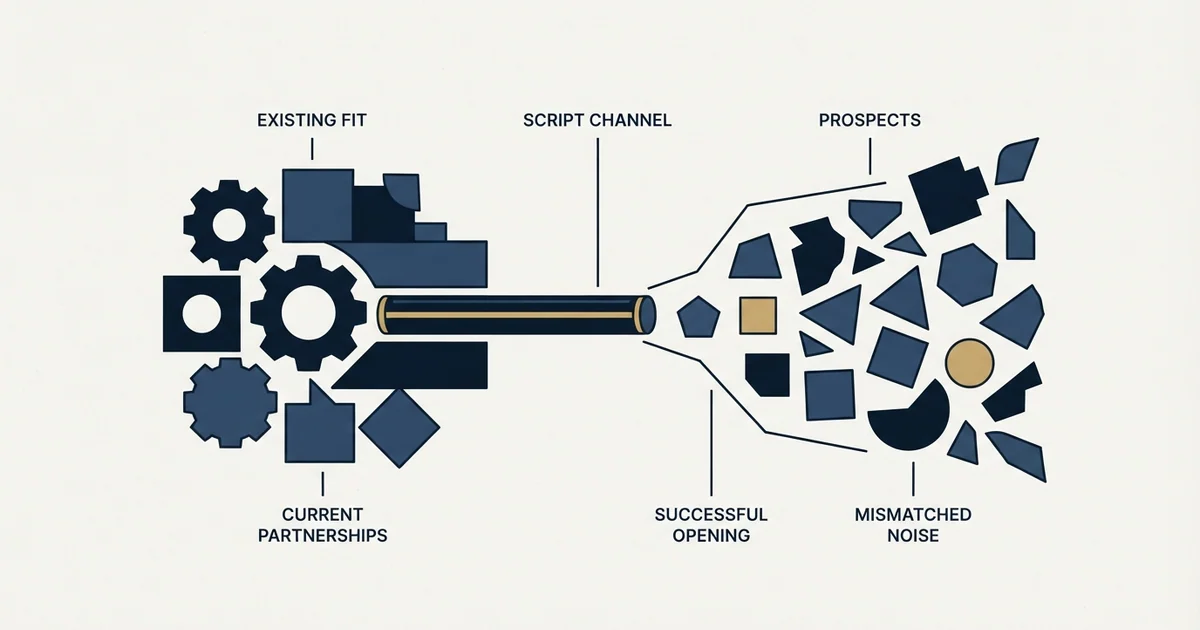
A bank cold calling script has to name why this company and why today inside the first twenty seconds, ask permission in a way that can be refused, open with a question about a decision rather than a balance, and close on a small timed next step. Generic openers fail because the prospect already has a bank.
Key takeaways
- A banker is asking a company with a working banking relationship to justify keeping it, so the opening has to supply the reason rather than request the time to look for one.
- The strongest openers name a verified change at that company, such as a new site or an acquisition, and draw one consequence from it that the current facility may not cover.
- Scripts fix ordering, wording and objection handling. They cannot fix a list of companies with no reason to change, and reach rate usually moves the meeting count more than phrasing does.
- Business-to-business calling sits largely outside the FTC Telemarketing Sales Rule, but state statutes and the supervisory obligations a bank carries sit on top of the federal position.
Reviewed and updated September 1, 2026
A commercial banker carries a call quota, a portfolio target, and a list of businesses that already bank somewhere else. The call is not selling a product the prospect lacks. It is asking a company with a working banking relationship to spend twenty minutes explaining what is wrong with it. That is a harder opening than most script collections admit, and it is the reason bank cold calling scripts fail in a specific way rather than a general one.
Script collections aimed at bankers converge on a small number of shapes. The shapes are fine. What separates the version that books a meeting from the version that gets a polite refusal sits in the first twenty seconds, in the reason the caller gives for calling at all.
What a banker's call is actually asking for
Every other cold call has a gap to point at. A software seller can say the prospect has no tool for the thing. A staffing firm can say a role has been open for eleven weeks. A banker calling a business owner is pointing at a relationship that already exists and functions well enough that nobody has changed it.
So the call has to do one of three things. It can name a condition the incumbent relationship handles badly, which requires knowing something about the business. It can name a change that makes the current arrangement newly wrong, such as an acquisition, a new facility, a covenant renegotiation or a growth curve the existing line of credit was not sized for. Or it can offer a comparison that costs the owner nothing, which is the weakest of the three and the one most scripts default to.
The comparison opener is weak because it asks for time and gives nothing back. An owner who is happy with their bank has no reason to audit it for a stranger, and an owner who is unhappy usually knows it already and is waiting for a reason to move rather than a reason to look.
- Step 1The reason
Twelve seconds naming why this business, today. Generic openings die here.
- Step 2The permission
An explicit ask for the next sixty seconds, which the prospect can refuse cleanly.
- Step 3The question
One question about how the current arrangement handles a specific condition.
- Step 4The ask
A named, small next step with a time attached, not an offer to send information.
The shapes that work, and what to change in each
What follows is the shape, written as a single call rather than an opening line to be repeated later. Every name, figure and business in them is invented for illustration.
The condition opener, for commercial and business banking. This one earns its place when the caller has read something real about the company.
"Morning, this is Dana at Northgate. I called because you opened the second location in Bellwood in March, and companies that add a site usually find the credit line was sized for the old footprint. I am not asking you to move anything. One question: when the Bellwood build went through, did the existing facility cover it, or did you fund it out of working capital?"
The line that does the work is the second sentence, because it names a fact about that company and draws a consequence from it. Change the fact for every call. A version that says "companies like yours" has given the owner nothing to react to.
The gatekeeper approach, for owner-operated businesses. The person answering is often the office manager, the controller, or the owner's spouse, and treating them as an obstacle is the standard error.
"Hi, this is Dana at Northgate. I am trying to reach whoever handles the banking relationship. It might be you, and if it is not, you will know who it is faster than I will."
The value of that phrasing is that it is true, it is short, and it gives the person a role other than blocking. Refusing to say why you are calling converts a neutral gatekeeper into a hostile one.
The sell-side approach, for corporate and investment banking. The unit of value here is a view, not a service. A banker calling a founder about a possible sale is asking for a conversation the founder may not want to be seen having.
"This is Dana with Northgate industrials group. I am not calling with a buyer. Two companies in your segment traded this quarter at multiples that surprised the people who own them, and most founders find that out after the window closes. If it is useful, I will send the two comparables and you can decide whether the conversation is worth having."
Note what is missing. There is no request for financials, no pitch about the bank's league table position, and no claim about the prospect's own valuation, because the caller does not know it.
The voicemail. The shape that gets returned states one reason and one number, and does not attempt the pitch.
"Dana at Northgate, 555 0148. I called about the Bellwood site and how the facility was sized for it. If that is a live question, call me back on 555 0148. If it is not, ignore this and I will not chase you."
The closing clause matters more than it looks. It is a commitment the caller then has to keep, and keeping it is house policy here: one message per campaign, no second attempt at a stranger who did not answer.
Where these calls actually fail

The most common failure is the opener that asks before it gives. "Do you have a few minutes to talk about your banking?" invites the answer no, and it has spent the call's only advantage, which is that a live human is on the line and curious for about eight seconds.
The second failure is the fake trigger. Scripts that instruct the caller to say "I noticed you are growing" without a source produce a specific damage: the owner asks where you saw that, the caller has nothing, and the call is over on a credibility problem rather than a timing one.
The third is the request for information the prospect cannot give a stranger. A banker who asks about deposit balances, covenants or receivable ageing in the first minute is asking a business to hand commercially sensitive detail to an unverified caller. The question that works early asks about a decision, not a number.
The neighbouring trade has the same problem in a sharper form, and a merchant services cold calling script has to be written around what the FTC has alleged about that exact call.
- The order the call makes its points in
- The wording of the permission ask
- The question that opens the diagnosis
- How an objection gets answered without arguing
- Calling a company with no reason to change banks
- A list with no verified reason for the call
- A caller who cannot answer a pricing question
- An offer that is identical to the incumbent's
The arithmetic behind a call quota
The reason script quality gets over-blamed is that the numbers around it are rarely written down. The figures below are invented for illustration and are not our data or anyone's benchmark. They exist to show which lever moves the outcome.
Take a banker making sixty dials in a day and reaching eight live conversations. If one conversation in eight becomes a meeting, that is one meeting per day of calling, and improving the script from a one in eight conversion to one in six adds roughly a third of a meeting per day. Improving the list so that reach rate goes from eight conversations to twelve, at the same one in eight, adds half a meeting per day. Both are worth having. Only one of them is a wording change.
Assumed, for the arithmetic
Reach is a list and timing property
At an assumed one in eight
The practical consequence is that a banker whose script is competent and whose list is generic should spend the next hour on the list. The reverse is also true. A tightly built list of companies with a visible change, worked with an opener that names no reason, wastes the expensive half of the work.
A banker's calling calendar is only one piece of a bank's go-to-market machine, and the question of who actually owns those hiring decisions is explored in renting part-time revenue leadership.
The rules that apply to a business call

United States business-to-business calling sits mostly outside the Federal Trade Commission's Telemarketing Sales Rule, and the national Do Not Call registry is a consumer protection rather than a business one. The exemption is real but it is not unlimited, and the residue that still binds a business caller is the obligation not to misrepresent what is being sold. The detail, with the regulation quoted, sits in our note on what cold calling is and which rules apply.
Two things are worth adding for a regulated caller specifically. State telemarketing statutes sit on top of the federal position and are amended on their own timetable, so a national calling programme is subject to the strictest state on its list rather than the average one, and the separate statute governing dialers and mobile numbers does not care whether the call was business to business at all. And a bank's own supervisory obligations around recorded lines, disclosures and complaint handling are set by its compliance function, not by a script vendor. Any script collection, including this one, is a starting shape that your compliance team edits before it is used.
Where calling sits next to written outreach
Cold calling scripts for bankers get judged against a standard that no channel meets on its own. A call buys something written outreach cannot: an answer inside sixty seconds, including the answer that the person is not the right one. Written outreach buys something calling cannot: the ability to work several hundred companies in a morning with the same verified reason, and a record of exactly what was said.
Our own position is plain, and it is a policy rather than a result. We run email and LinkedIn for clients, not phone, and we say so in the comparison of how the two channels fail. Teams that want calling in the mix generally either build it in-house against their own compliance rules or hire a firm that specialises in it. For banks working a list of business owners in writing rather than by phone, the banking outbound guide covers what changes when the audience is a regulated buyer, and our note on what actually moves a cold call covers the parts that are not vertical-specific. If you want the list side of this built and worked for you, that is what our free campaign build does.
The short version

A banker's call is an interruption addressed to somebody whose current arrangement works. The script's job is to spend the first twelve seconds naming why this company and why today, ask permission in a way that can be refused cleanly, open with a question about a decision rather than a number, and close with a small next step that has a time on it. Everything else on the call is recoverable. The opening is not.
Frequently asked questions.
Frequently asked questions- What should a banker say in the first ten seconds of a cold call?
- Name the bank, then the specific reason for calling this company today. A verified fact about the business, such as a new location or a recent acquisition, followed by one consequence for the current facility. Asking whether the person has a few minutes before giving a reason invites the refusal it usually gets.
- Do cold calling scripts for bankers differ from ordinary sales scripts?
- The structure is the same and the opening premise is not. Most sellers point at a gap the prospect has. A banker points at a relationship that already functions, so the call has to name a condition the incumbent handles badly or a change that made the existing arrangement newly wrong.
- Is cold calling businesses legal in the United States?
- Most calls between a telemarketer and a business are exempt from the FTC Telemarketing Sales Rule, and the national Do Not Call registry is a consumer protection rather than a business one. The anti-deception provisions still apply, state statutes sit on top, and the compliance function inside the bank sets its own rules.
- Should a banker keep calling a prospect who does not answer?
- Our own position is one message per campaign and no second attempt at a stranger who did not respond, which is the standard we hold ourselves to in email and LinkedIn. A voicemail that promises not to chase and then chases costs more credibility than the extra dial is worth.
About the author.

B2B cold email experts helping companies generate qualified leads through done-for-you outreach campaigns.
RevenueFlow Team
Explore more.
Ready to scale your outreach?
We build GTM engines that book real meetings. See the receipts.
Related articles.
Cold Calling for PPC Agencies: What You Can See First
A paid media prospect is partly readable before the call and has already been told by the platform what to do when a stranger rings about its ads.
SDR Outsourcing for Logistics Companies: The Brokerage Line
What an outside sales development team may do in a freight company's name, the calling and email rules it inherits, and which arrangement survives a bid-shaped market.
SDR Outsourcing for Business Brokers: The Fee Timing
Whether a success-fee brokerage should rent sales development at all: the fee timing, the texts that limit what an outside person may say about value, and who signs.
SDR Outsourcing for Financial Services: The Third Party
What a bank, broker-dealer, adviser or agency's regulators say about an outside team that speaks for it, the licensed line, and which arrangement survives due diligence.
LinkedIn Lead Generation for Financial Services Firms
A LinkedIn message from a regulated firm is a communication the rulebook already defines, and the definition turns on how many people receive it within thirty days.
Appointment Setting for Business Brokers: The Seller Meeting
What a bought meeting with a business owner has to be for a brokerage: the three-part qualification, the confidentiality rules, the licence line and the owner's reasons.