Fractional GTM: What a Shared Leader Gets to Decide
Fractional go-to-market covers a leader, a team and a pair of hands. The decision rights that separate them, and the setup work that stays with the founder.
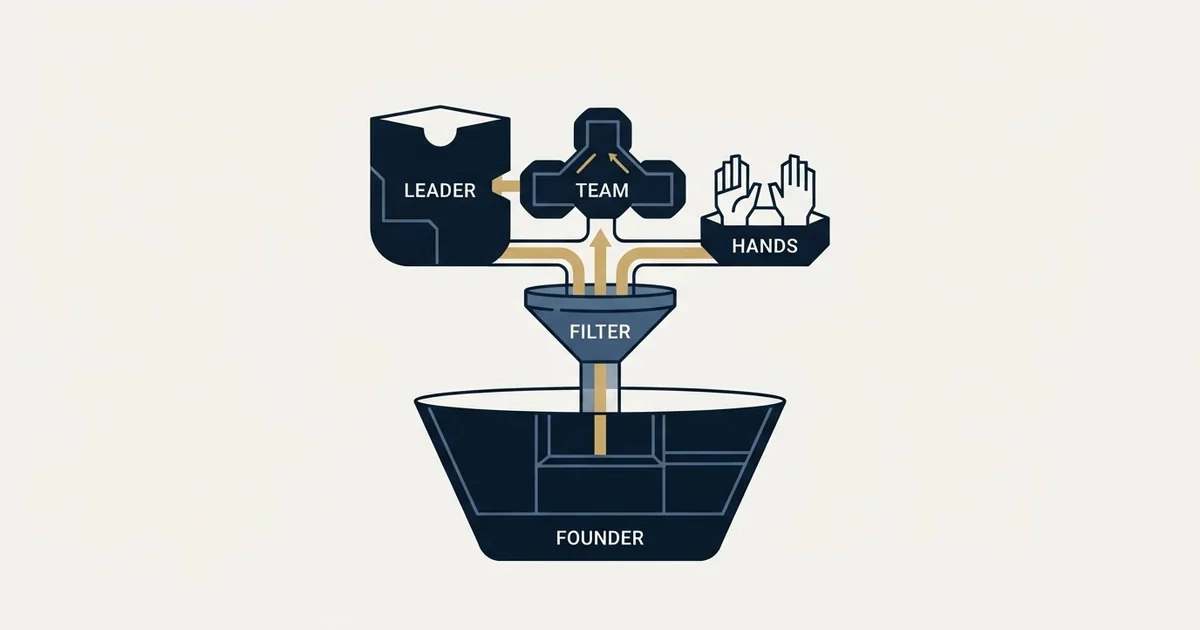
Fractional GTM means renting go-to-market leadership part time. The label covers three purchases: a leader who owns decisions, a team that owns a function, and an operator who owns output. What predicts the result is which decisions the person can settle without you, and whether execution capacity exists underneath them.
Key takeaways
- Write the decision rights before the contract. Segment, message, channel and what gets stopped are the four that matter, and split rights produce split results.
- A fractional leader with no execution capacity underneath them produces decisions nobody runs, which is indistinguishable from inaction when viewed from outside the company.
- The supply side stays yours. Data access, product answers and one named internal owner have to exist on day one, or the first month is consumed by setup at senior rates.
- Contract for artefacts rather than hours. A one-page strategy, a running motion, one documented change and a handover pack are checkable by anyone; billed hours are not.
Reviewed and updated September 2, 2026
A founder signs a fractional go-to-market lead for two days a week, and the first month is genuinely good. There is a segment definition, a competitor teardown, a channel recommendation and a hiring plan. In month three the same founder is still the person writing the emails, still the person deciding which accounts get worked, and still the person who has to answer when a prospect asks something technical. The strategy improved. The bottleneck did not move.
That outcome is not a bad hire. It comes from buying a role without agreeing what the role gets to decide. Fractional go-to-market covers at least three different purchases, and the one you meant is rarely the one written into the contract.
Three things get sold under one label
A GTM advisor is the third of these purchases described in the language of the first. An advisory engagement produces recommendations and holds no decision rights, which is a legitimate thing to buy and a different thing to buy, and the mismatch shows up as excellent thinking that nobody has the authority to act on.
The phrase covers a leader, a team, and a pair of hands, and the difference is not seniority. It is what leaves your desk.
- Sets the segment, the message and the channel
- Decides what gets stopped
- Needs execution capacity underneath them
- You keep: hiring, budget, product
- Leader plus the people who send, build lists and reply
- Runs the motion end to end for a period
- Costs more and moves without you
- You keep: the customer relationship and the data
- Builds lists, writes copy, runs the tooling
- Executes a strategy that already exists
- Cheapest and the most common mismatch
- You keep: every decision, which is the trap
Most disappointment traces back to buying the first shape while needing the second. A leader with nobody underneath them produces decisions that nobody executes, and a set of excellent decisions with no execution behind them looks exactly like inaction from the outside.
The variable that decides everything is decision rights
Seniority is easy to check and it predicts very little. What predicts the outcome is the list of decisions this person can make without you in the room.
Write the list before the contract. Four decisions matter more than the rest: which segment gets worked this quarter, what the first message says, which channel carries it, and what gets stopped. A fractional lead who can settle all four is a leader. One who can settle none of them is a consultant producing recommendations, which is a legitimate purchase with a completely different definition of success.
Those decisions hold at every company size, and three constraints that change enterprise selling alter how they are answered rather than which ones get asked.
The stopping decision is the one founders reflexively keep, and it is the one worth handing over. Anybody can add a channel. The value in an experienced operator sits in their willingness to end things that are absorbing capacity without producing evidence, and they will not do that on somebody else's authority.
The same logic explains the awkward middle case. A fractional lead who can decide the message but not the segment will produce better copy aimed at the wrong companies, and the improvement will be invisible in the results. Split decision rights produce split outcomes, and the seam is usually where the founder's comfort ended rather than where the expertise stopped.
What has to exist on your side

A shared leader arrives with judgement and a network. They do not arrive with your data, your inbox infrastructure, your product knowledge or your calendar. Every one of those has to be supplied, and the supplying is the part that quietly stays on the founder.
- Yes: Someone internal can answer product questions within a day
- Yes: There is execution capacity underneath the role, in-house or contracted
- Yes: CRM access, past campaign data and won-deal history are available on day one
- Yes: One named internal owner holds the relationship and unblocks access
- Yes: The four decision rights are written down and agreed
- No: The founder still approves each individual account before it is contacted
- No: The role is expected to also build the lists, write the copy and run the tooling
The last two lines are where the arrangement usually fails. Account-level approval turns a leader into a person waiting for replies, and expecting the leader to also be the operator produces a senior person doing junior work at senior cost, slowly.
The arithmetic of two days a week
The following numbers are invented for illustration and are not measurements of any engagement. Take two days a week, which is roughly eight working days a month. Assume three of those go to internal meetings, reviews and reporting, which is normal for any leadership role. That leaves five days a month of actual building. Now assume the segment definition, the message and the channel setup each take two days of concentrated work in the first month. The whole first month is gone before anything is sent.
That arithmetic is not an argument against the model. It is an argument for arriving with the inputs ready and for judging the engagement on a horizon that matches the capacity you bought. A quarter is a fair first read. Six weeks is not, and a shared leader asked to prove themselves in six weeks will optimise for something visible rather than something durable.
It also explains why the cheapest version is frequently the most expensive. On the same invented figures, one day a week leaves roughly two building days a month after the meeting overhead, and two days a month cannot hold a motion together.
Where it works, and the two shapes where it stalls
The model works well where the constraint is judgement rather than volume. A founder who can execute but keeps changing direction gets more from a few days of decisions than from weeks of extra sending. It works where the motion is already chosen and needs running properly. It works as a bridge before a full-time hire, particularly when the fractional lead's brief includes writing the specification for that hire and interviewing for it.
It stalls in two recognisable shapes. The first is the no-execution shape described above. The second is the split-attention shape, where the person carries five clients and your account is the one whose context is hardest to hold. Ask directly how many engagements they run and what the notice period is, and treat a refusal to answer as the answer.
There is a third case that is not a stall so much as a mismatch: a company that needs a repeatable sending machine more than it needs a strategist. Where the missing piece is a person to work a list every week, a shared seat at the rep level is the closer fit, and the conditions under which that works are covered in the fractional SDR guide. Where the missing piece is the whole function, the tradeoffs are different again and they are laid out in outbound sales outsourcing.
The adjacent roles it keeps getting confused with
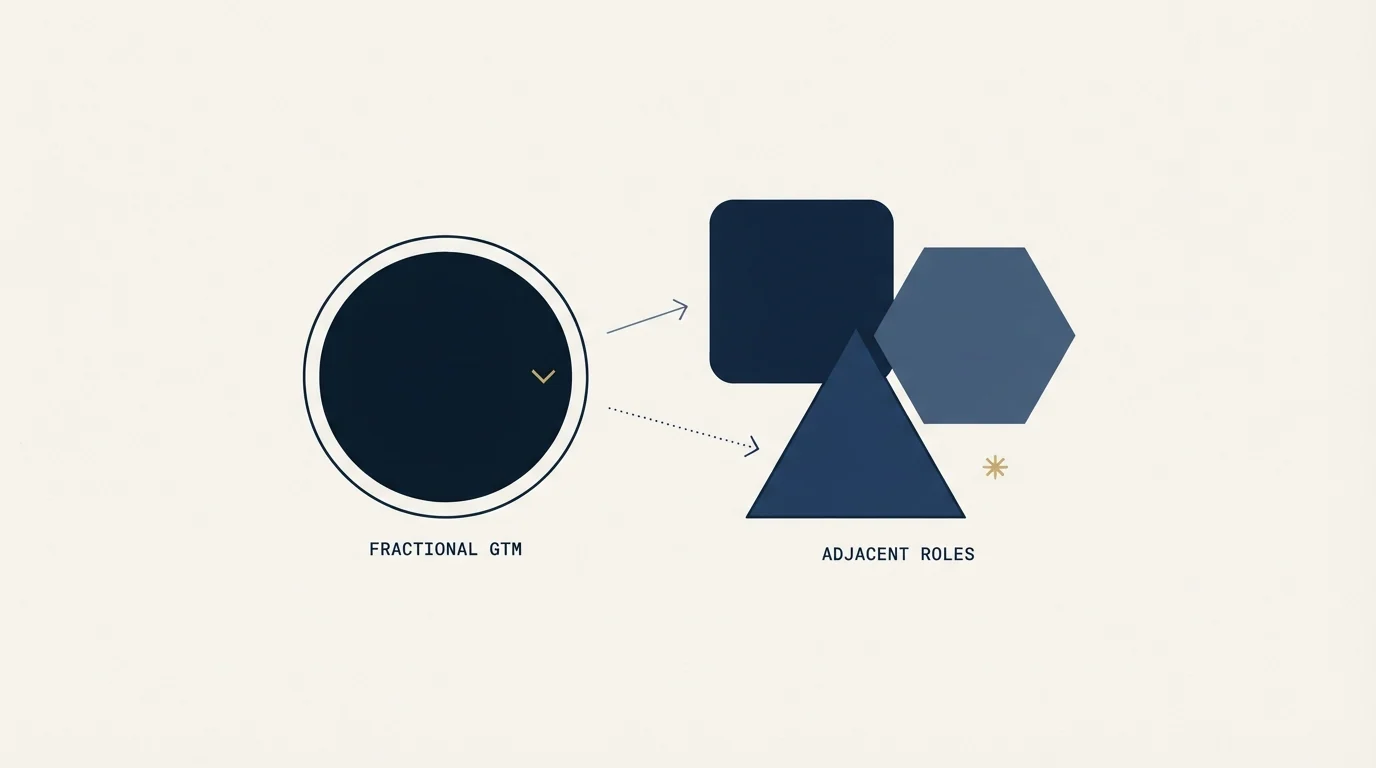
Three titles sit close enough to this one that companies regularly buy one of them when they needed another.
A fractional VP of sales is a manager of people. If there are no reps to manage, the title is doing nothing for you. A go-to-market engineer builds the systems that make a motion run, which is a technical purchase rather than a strategic one, and the distinction matters because a strategist cannot wire up your data and an engineer will not tell you which segment to abandon. What that role actually covers is set out in the GTM engineer guide. An agency sells a delivered outcome rather than a person, so the decisions stay outside your company by design, which is fine when the motion is understood and poor when it is still being discovered.
Once a fractional lead is managing people rather than deciding alone, the failure point shifts to the handoffs between functions, which is exactly what assigning ownership across GTM functions addresses.
The useful sorting question is what you want to still have in twelve months. If the answer is a working motion that your own team runs, you want a leader plus execution and a documented handover. If the answer is meetings on the calendar with no intention of building the capability, an agency is the more honest structure and the comparison to make is commercial rather than organisational.
In contrast, agencies price the engagement by scope rather than decision rights, and what an agency retainer actually buys unpacks how that fee gets defined.
Contract for artefacts, not for hours
Hours are easy to bill and impossible to evaluate. Deliverables that are actually decisions can be checked by anyone.
- Step 1Weeks 1 to 2
The one-page strategy: segment, buyer, problem, message, channel, meeting definition, measurement. Written, not presented.
- Step 2Weeks 3 to 6
One motion running at a stated weekly volume, with the target list built from the segment definition and the first message written out in full.
- Step 3Weeks 7 to 10
Reply reading and one documented change. What was learned, what was stopped, and why.
- Step 4Weeks 11 to 13
The handover pack: what is running, what is scheduled to stop, the hiring specification, and the numbers that would trigger a rewrite.
The one-page strategy is the artefact that matters most, because it is the thing you keep. Five decisions on one page is a format any successor can read in a morning, and the version we use is described in the go-to-market strategy guide. If the engagement ends and the only durable output is a slide deck and a set of logins, the company has rented judgement rather than acquired it.
One clause is worth insisting on regardless of shape. Where the engagement is measured on meetings, the criteria that make a meeting count belong in writing before anything is sent. That is our own operating rule for paid work, and it applies with more force to a shared leader than to anyone else, because they will not be present for the argument in month three about whether the meetings were any good.
Questions that separate the shapes

Ask what they will decide without you, and listen for whether the answer contains verbs. Ask how many other engagements they carry. Ask who executes, and if the answer is "we can bring people in", ask whether those people are theirs or subcontracted. Ask what they would stop in the first month, which is the fastest test of whether they have understood the business. Ask what artefact you keep at the end.
Then ask what they need from you. A fractional lead who has done this before will produce a specific list within a minute: data access, a product point of contact, a decision on the segment, and someone who can approve copy inside a day. A vague answer to that question predicts a slow first month more reliably than any reference check.
The short version
Fractional go-to-market covers three different purchases. A leader who owns decisions, a team that owns a function, and an operator who owns output. Buying the first while needing the second is the most common mismatch, and it looks like excellent strategy with nothing shipped.
Decision rights decide the outcome. Write down which of the four core decisions the fractional lead can settle alone: segment, message, channel, and what gets stopped. Split rights produce split results, and the stopping decision is the one most worth handing over.
The supply side is yours. Execution capacity, data access, product answers and a named internal owner have to exist on day one, or the first month is consumed by setup at senior rates. Contract for artefacts rather than hours, insist on a one-page strategy and a handover pack, and agree the meeting definition in writing before anything is sent.
If the channel decision is going to be cold outbound, the fastest way to test the segment and the message is to run one against real people rather than to model it for another month. You can see what a campaign would look like for your market.
Frequently asked questions.
Frequently asked questions- What does a fractional GTM lead actually do?
- In the leadership version, they decide which segment gets worked, what the first message says, which channel carries it and what gets stopped, then oversee the people executing. They do not usually build lists or write copy themselves. Where that execution work is what you need, you are buying an operator rather than a leader.
- How is fractional GTM different from a fractional VP of sales?
- A fractional VP of sales manages salespeople, so the role assumes there are reps to manage. Fractional GTM sits earlier and wider: it covers who you sell to, what you say and which route reaches them, whether or not a sales team exists yet. Companies with no reps often buy the sales title and get little from it.
- How long before a fractional GTM engagement shows anything?
- A quarter is a fair first read. Two days a week is roughly eight working days a month, and internal meetings take a share of those, so the first month is usually consumed by the segment definition, the message and the channel setup. Judging the arrangement at six weeks measures the setup rather than the motion.
- When is a fractional GTM lead the wrong purchase?
- When the constraint is volume rather than judgement. If the missing piece is somebody working a list every week, a shared rep-level seat fits better. If the missing piece is the whole function and you have no intention of building it in-house, an agency is the more honest structure, because the decisions stay outside by design.
About the author.

B2B cold email experts helping companies generate qualified leads through done-for-you outreach campaigns.
RevenueFlow Team
Explore more.
Ready to scale your outreach?
We build GTM engines that book real meetings. See the receipts.
Related articles.
Appointment Setting for Business Brokers: The Seller Meeting
What a bought meeting with a business owner has to be for a brokerage: the three-part qualification, the confidentiality rules, the licence line and the owner's reasons.
SDR Outsourcing for Logistics Companies: The Brokerage Line
What an outside sales development team may do in a freight company's name, the calling and email rules it inherits, and which arrangement survives a bid-shaped market.
SDR Outsourcing for Business Brokers: The Fee Timing
Whether a success-fee brokerage should rent sales development at all: the fee timing, the texts that limit what an outside person may say about value, and who signs.
Cold Calling for Chemical Companies: Who Picks Up
A chemical cold call rarely arrives first. It reaches a formulator who has already been comparing suppliers on a screen, for one of three published reasons.
SDR Outsourcing for Financial Services: The Third Party
What a bank, broker-dealer, adviser or agency's regulators say about an outside team that speaks for it, the licensed line, and which arrangement survives due diligence.
LinkedIn Outreach for Banks: A Regulated Message
How a bank's relationship managers use LinkedIn to reach business owners: what the FFIEC guidance, FINRA's notices and LinkedIn's own rules require, and where to stop.