Cold Email for Cloud Services: The Complete Guide
Learn how to effectively reach decision-makers at cloud service providers and enterprises adopting cloud infrastructure. This guide covers targeting strategies, technical credibility, and email templates for the cloud services industry.

Cold email in cloud services requires targeting distinct market segments (cloud providers, enterprise adopters, cloud-native companies, MSPs) with technically credible messaging that addresses specific cloud challenges. Effective outreach reaches multiple decision-makers (from cloud architects focused on technical architecture to FinOps managers managing costs), and demonstrates provider-specific expertise while timing messages around budget cycles, migrations, and cost review periods.
Key takeaways
- Cloud purchasing decisions involve multiple stakeholders with different priorities, requiring targeted messaging for roles ranging from cloud architects to FinOps managers to CIOs.
- The cloud services market encompasses five distinct segments: cloud service providers, enterprise cloud adopters, cloud-native companies, managed service providers, and cloud consulting firms.
- Technical credibility in cloud outreach requires accurate terminology, provider-specific expertise, and acknowledgment of cloud complexity rather than generic cloud messaging.
- Strategic timing for cloud outreach includes budget and planning cycles, cloud provider events, contract renewal timing, migration projects, and cost review periods.
- Common mistakes include generic cloud messaging, ignoring provider specificity, overstating savings claims, neglecting security context, and assuming greenfield deployments.
Reviewed and updated December 26, 2025
Cold Email for Cloud Services: The Complete Guide
Cloud computing has become the foundation of modern IT infrastructure. Organizations of all sizes are migrating workloads, building cloud-native applications, and transforming their operations through cloud services. The major cloud providers continue to expand their offerings, while a growing ecosystem of tools and services helps organizations optimize their cloud investments.
This growth creates substantial opportunities for vendors serving the cloud ecosystem. Whether you offer cost optimization tools, security solutions, migration services, or consulting expertise, cold email can help you reach decision-makers who are actively managing and expanding their cloud infrastructure.
However, the cloud services market presents unique challenges. Buyers range from highly technical cloud architects to business executives managing cloud budgets. Competition for attention is fierce, and generic cloud messaging fails to stand out. Breaking through requires targeted strategies that address specific cloud challenges.
This guide covers everything you need to know about cold emailing cloud services companies and cloud adopters effectively.
Understanding the Cloud Services Market
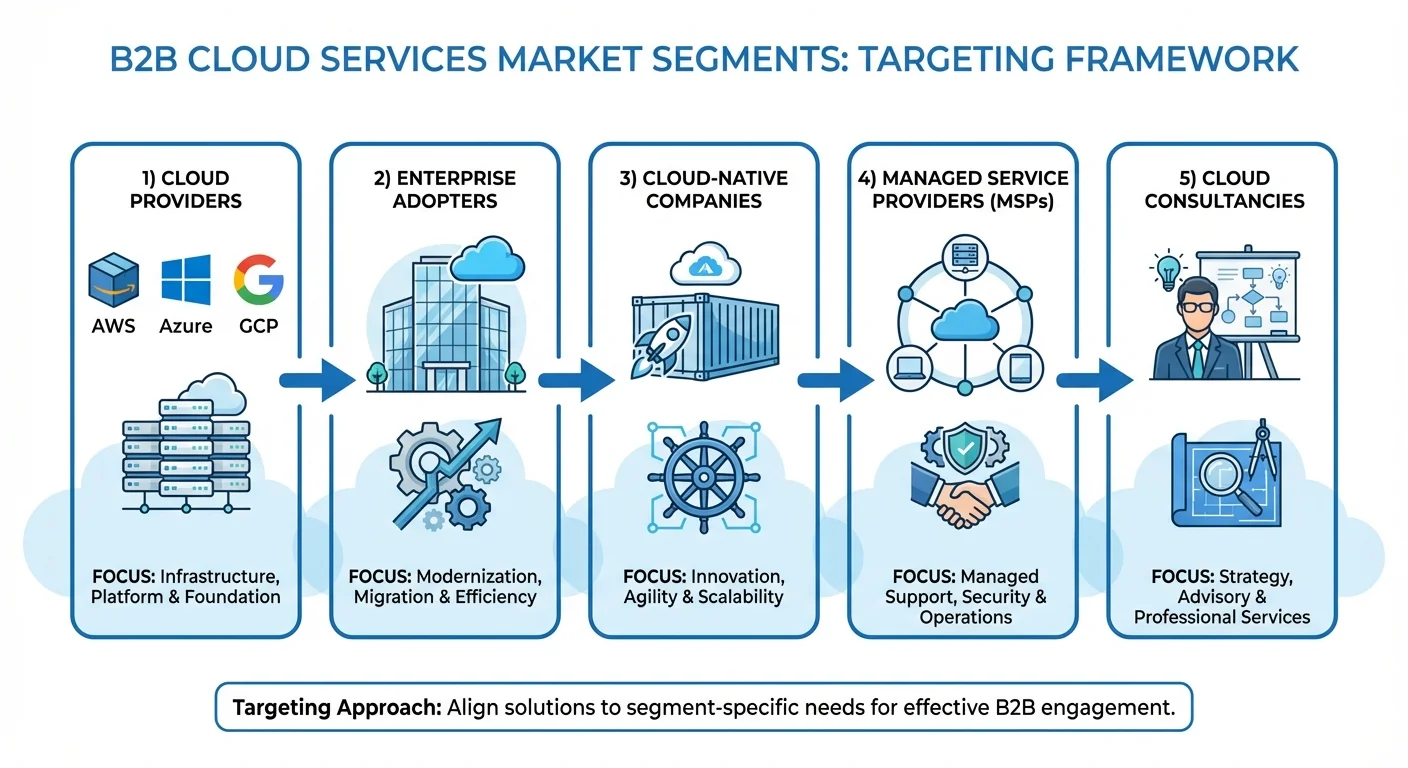
The cloud industry encompasses distinct segments with different needs and buying behaviors.
Cloud Service Providers
The major cloud providers (AWS, Microsoft Azure, Google Cloud) and smaller specialized providers build and operate cloud infrastructure. They include infrastructure as a service (IaaS), platform as a service (PaaS), and software as a service (SaaS) providers.
These organizations focus on service reliability, feature development, and customer growth. They evaluate partners and tools based on how they enhance their platform value.
If you are the cloud services provider rather than a vendor selling to one, sales prospecting for cloud services companies covers where your own customer accounts are reached and the end-of-support dates that give a reason to write.
Enterprise Cloud Adopters
Large enterprises are migrating workloads to cloud and building cloud-native applications. They span industries from financial services to healthcare to manufacturing.
Enterprise adopters focus on cost management, security, compliance, and integration with existing systems. They need proven solutions that work within their organizational constraints.
Cloud-Native Companies
Companies born in the cloud build their entire infrastructure on cloud platforms. They include SaaS companies, startups, and digital-first businesses.
Cloud-native organizations prioritize development velocity, scalability, and operational efficiency. They evaluate solutions based on cloud-native design and integration capabilities.
Managed Service Providers (MSPs)
MSPs manage cloud infrastructure for their clients. They include cloud consultancies, IT service providers, and specialized cloud management companies.
MSPs focus on operational efficiency, client success, and service differentiation. They need tools that improve their service delivery.
How an MSP, reseller or cloud software company chooses its own route to market, through the hyperscalers' partner programmes and the buyer's consumption commitment, is in sales strategy for cloud companies.
Cloud Consulting and Professional Services
Consulting firms help organizations plan and execute cloud strategies. They combine technical expertise with business transformation capabilities.
Service providers focus on project delivery, methodology development, and client relationships.
Key Decision Makers in Cloud Services
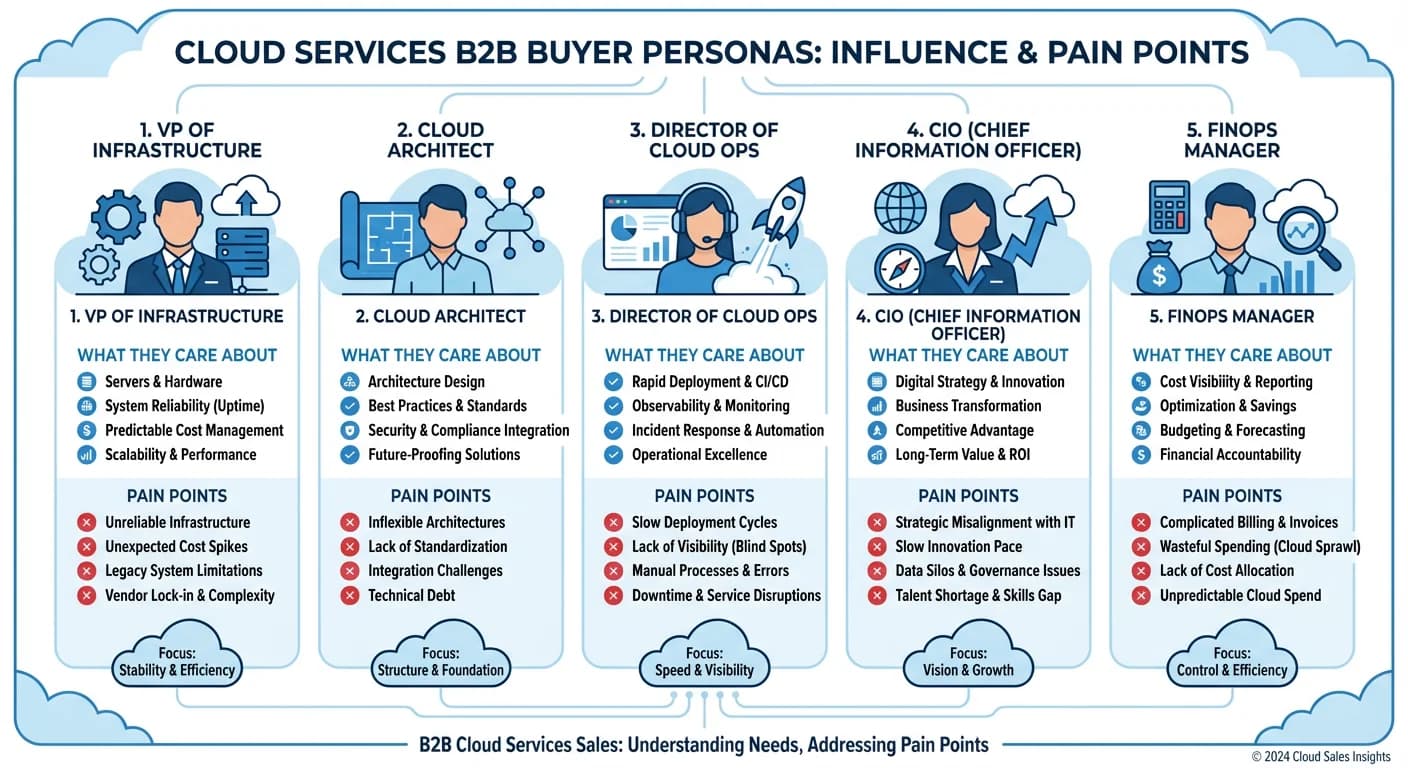
Cloud purchasing decisions involve multiple stakeholders with different priorities.
VP of Infrastructure or Cloud
What they care about: Infrastructure reliability, scalability, cost optimization, team productivity, and technology strategy.
Pain points: Cost overruns, performance issues, security concerns, skill gaps, and vendor management complexity.
Trigger events: Cost reduction mandates, performance incidents, cloud migrations, and infrastructure reviews.
Email angle: Focus on infrastructure outcomes and operational efficiency. Quantify improvements to reliability, costs, or team productivity.
Cloud Architect
What they care about: Architecture design, best practices, service selection, security patterns, and performance optimization.
Pain points: Architecture complexity, service sprawl, governance challenges, and keeping current with cloud evolution.
Trigger events: New project initiatives, architecture reviews, and cloud modernization efforts.
Email angle: Lead with technical capabilities and architectural benefits. Offer resources like architecture guides and best practices.
Director of Cloud Operations or Platform Engineering
What they care about: Operational reliability, deployment automation, observability, incident response, and team efficiency.
Pain points: Alert fatigue, incident management, deployment friction, and on-call burden.
Trigger events: Operational incidents, scaling challenges, and team growth.
Email angle: Address operational efficiency and reliability improvements. Emphasize automation and observability capabilities.
Chief Information Officer (CIO)
What they care about: IT strategy, digital transformation, cost management, security posture, and organizational alignment.
Pain points: Budget pressures, legacy modernization, security concerns, and stakeholder management.
Trigger events: Strategic planning cycles, budget reviews, and organizational changes.
Email angle: Focus on strategic outcomes and business value. Connect technical capabilities to business objectives.
FinOps Manager or Cloud Financial Manager
What they care about: Cloud cost visibility, optimization opportunities, budget forecasting, and chargeback allocation.
Pain points: Cost visibility gaps, unexpected bills, optimization complexity, and stakeholder accountability.
Trigger events: Budget overruns, FinOps initiatives, and finance team involvement in cloud decisions.
Email angle: Lead with cost visibility and optimization capabilities. Quantify potential savings.
Security Architect or Cloud Security Lead
What they care about: Cloud security posture, compliance requirements, identity management, and data protection.
Pain points: Configuration drift, compliance complexity, multi-cloud security, and skill requirements.
Trigger events: Security assessments, compliance audits, and security incidents.
Email angle: Address cloud security challenges specifically. Reference relevant compliance frameworks and security capabilities.
Technical Considerations in Cloud Services
Cloud buyers are technically sophisticated. Your outreach must demonstrate genuine understanding of cloud challenges.
Multi-Cloud and Hybrid Considerations
Many organizations operate across multiple cloud providers and on-premises infrastructure.
Multi-cloud motivations: Avoiding vendor lock-in, leveraging best-of-breed services, meeting data residency requirements.
Hybrid requirements: Connecting on-premises systems with cloud resources, handling data gravity, meeting latency requirements.
Challenges: Consistency across environments, skills requirements, operational complexity.
Understanding your prospect's multi-cloud strategy helps you position your solution appropriately.
Cloud-Native Architecture
Cloud-native approaches have become standard for modern applications.
Containers and Kubernetes: Containerized workloads and orchestration platforms.
Serverless: Function-as-a-service and managed services that abstract infrastructure.
Microservices: Distributed architectures with independent service components.
Infrastructure as Code: Defining and managing infrastructure through code and automation.
Reference relevant cloud-native concepts when reaching out to organizations building modern applications.
Cost Management
Cloud costs are a significant concern for most organizations.
Reserved instances and savings plans: Commitment-based pricing for cost reduction.
Right-sizing: Matching resource allocation to actual usage.
Spot instances: Using surplus capacity at reduced prices for flexible workloads.
Tagging and allocation: Tracking costs by project, team, or business unit.
Cost optimization messaging resonates with many cloud decision-makers.
Security and Compliance
Cloud security differs from traditional data center security.
Shared responsibility model: Understanding which security aspects the provider handles versus customer responsibility.
Identity and access management: Managing permissions across cloud resources.
Configuration management: Ensuring cloud resources are configured securely.
Compliance frameworks: Meeting regulatory requirements in cloud environments.
Security considerations are often paramount in cloud purchasing decisions.
Industry Verticals Using Cloud Services
Different industries adopt cloud with different priorities. Tailoring your messaging to specific verticals improves response rates.
Financial Services
Applications include core banking modernization, trading platforms, risk analytics, and customer-facing applications.
Key concerns center on regulatory compliance, data residency, security requirements, and operational resilience.
Messaging angle:
"Financial services organizations running workloads on [cloud provider] need [specific capability] to meet regulatory requirements. We help banks and financial institutions achieve [specific outcome] while maintaining compliance."
Healthcare
Applications include electronic health records, clinical analytics, patient engagement, and medical imaging.
Key concerns include HIPAA compliance, patient data protection, and integration with healthcare systems.
Messaging angle:
"Healthcare organizations using cloud for [specific use case] need [specific capability] to meet HIPAA requirements. We help healthcare teams achieve [specific outcome] while maintaining compliance."
Retail and E-commerce
Applications include e-commerce platforms, inventory management, customer personalization, and supply chain optimization.
Key concerns center on scalability during peak periods, customer experience, and cost efficiency.
Messaging angle:
"Retail organizations handling [traffic pattern] on cloud infrastructure need [specific capability] to maintain performance during peak periods. We help e-commerce teams achieve [specific outcome] while optimizing costs."
Technology and SaaS
Applications include SaaS application hosting, development platforms, and customer-facing infrastructure.
Key concerns include reliability, development velocity, and scaling with customer growth.
Messaging angle:
"SaaS companies scaling infrastructure need [specific capability] to maintain reliability as customer base grows. We help technology companies achieve [specific outcome] while managing operational complexity."
Manufacturing
Applications include connected factory systems, supply chain visibility, quality analytics, and operational technology integration.
Key concerns include operational technology integration, edge computing, and hybrid architecture requirements.
Messaging angle:
"Manufacturing organizations connecting factory systems to cloud need [specific capability] to bridge OT and IT environments. We help industrial companies achieve [specific outcome] while maintaining operational reliability."
Building Credibility in Cloud Outreach
Cloud professionals evaluate vendors carefully. Building credibility requires demonstrating genuine cloud understanding.
Use Accurate Terminology
Cloud has specific terminology. Using terms correctly signals expertise.
Correct usage examples:
- Specific service names (EC2, Lambda, S3) rather than generic descriptions
- "Availability zones" and "regions" for geographic distribution
- "VPC" for network isolation
- "IAM" for identity management
- Provider-specific terminology when relevant
Incorrect terminology immediately signals unfamiliarity with cloud platforms.
Reference Specific Metrics
Cloud professionals measure performance and costs with specific metrics. Reference relevant metrics in your outreach.
Cost metrics: Monthly spend, cost per transaction, reserved instance coverage, savings rate.
Performance metrics: Latency percentiles, availability percentage, error rates, throughput.
Operational metrics: Deployment frequency, mean time to recovery, incident count, on-call hours.
Including specific metrics demonstrates understanding of how cloud teams measure success.
Acknowledge Cloud Complexity
Cloud environments involve significant complexity. Acknowledging nuances builds credibility.
Example:
"Multi-account AWS environments require centralized visibility while respecting account-level autonomy. Our platform aggregates data across accounts while maintaining appropriate access controls."
This demonstrates understanding that real-world cloud deployments involve organizational complexity.
Demonstrate Provider Expertise
If your solution focuses on specific cloud providers, demonstrate provider-specific expertise.
Example:
"Our integration uses AWS-native services (CloudWatch, EventBridge, Cost Explorer API) for deep platform integration without additional agents or infrastructure."
Provider-specific knowledge builds credibility with teams committed to that platform.
Timing Your Outreach
Several factors affect timing in the cloud services industry.
Budget and Planning Cycles
Enterprise cloud initiatives typically follow annual budget cycles. Reaching decision-makers during planning periods (Q3-Q4) positions you for consideration in upcoming budgets.
Cloud cost optimization receives attention during budget reviews and after unexpected overruns.
Cloud Provider Events
Major cloud provider events create natural conversation opportunities.
Relevant events:
- AWS re:Invent (November/December)
- Microsoft Ignite and Build
- Google Cloud Next
- KubeCon and CloudNativeCon
Reaching out before or after events with relevant context improves engagement.
Contract Renewal Timing
Cloud commitments (reserved instances, enterprise agreements) have renewal cycles. Organizations approaching renewals may evaluate alternatives or optimization tools.
Migration and Modernization Projects
Major cloud initiatives (migrations, modernization projects) create concentrated purchasing activity. Identifying accounts in active projects creates timely outreach opportunities.
Signals include job postings for cloud roles, announcements about digital transformation, and conference presentations about cloud initiatives.
Cost Review Periods
Organizations often conduct cloud cost reviews quarterly or after significant spending changes. Timing cost optimization outreach around these periods improves relevance.
Email Templates for Cloud Services
Here are templates adapted for different cloud scenarios.
Template 1: Cost Optimization Outreach
Subject: Cloud costs at [Company]
Body:
[First Name],
Quick question: how is [Company] currently handling [specific cost challenge, e.g., reserved instance management, rightsizing recommendations, cost allocation across teams]?
We help cloud teams reduce [cloud provider] costs by [percentage range] through [specific approach].
Organizations using our platform typically identify [dollar amount or percentage] in savings opportunities within the first week.
Worth a brief conversation to see if this applies to your cloud environment?
[Your name]
Template 2: Cloud Security Outreach
Subject: [Cloud provider] security posture at [Company]
Body:
[First Name],
Cloud security teams typically face challenges with [specific security concern, e.g., configuration drift, IAM complexity, multi-account visibility].
We help organizations improve their [cloud provider] security posture through [specific capability].
Happy to share our compliance documentation (SOC 2, penetration test results) and a demo environment before any call.
Is cloud security configuration on your priority list?
[Your name]
Template 3: Platform Engineering Outreach
Subject: Platform engineering at [Company]
Body:
[First Name],
Platform teams scaling developer infrastructure often struggle with [specific challenge, e.g., self-service provisioning, deployment automation, environment consistency].
We help platform engineering teams [specific capability] without sacrificing governance requirements.
Currently supporting [X] organizations managing [scale indicator, e.g., hundreds of developers, thousands of deployments daily].
Worth exploring if this applies to your platform team?
[Your name]
Template 4: Cloud Migration Outreach
Subject: Cloud migration at [Company]
Body:
[First Name],
Noticed [Company] is [migrating workloads to cloud / expanding cloud footprint] based on [specific observation].
Organizations at this stage typically face challenges with [specific migration challenge, e.g., application assessment, dependency mapping, cost forecasting].
We help teams [specific capability] during cloud migrations. Currently supporting [X] organizations through their migration journeys.
Would it be useful to share how similar teams have approached this?
[Your name]
Template 5: Multi-Cloud Outreach
Subject: Multi-cloud management at [Company]
Body:
[First Name],
Organizations operating across [AWS/Azure/GCP] often struggle with [specific multi-cloud challenge, e.g., consistent governance, unified visibility, skills requirements].
We help multi-cloud teams [specific capability] while maintaining provider flexibility.
Currently deployed at [X] organizations managing workloads across multiple clouds.
Is multi-cloud management a priority for your infrastructure team?
[Your name]
Common Mistakes to Avoid
Mistake 1: Generic Cloud Messaging
Cloud computing encompasses diverse technologies and use cases. Generic messaging fails to resonate.
Weak:
"Our solution helps with cloud."
Strong:
"Our platform reduces AWS EC2 costs by identifying unused reserved instances and recommending optimal savings plans based on your usage patterns."
Specificity about providers, services, and use cases demonstrates expertise.
Mistake 2: Ignoring Provider Specificity
Different cloud providers have different services, pricing models, and approaches. Generic cloud messaging misses the mark.
Reference specific providers and services relevant to your target accounts.
Mistake 3: Overstating Savings Claims
Cloud cost savings are highly dependent on current optimization levels. Unrealistic savings claims damage credibility.
Weak:
"We guarantee 50% cost reduction."
Strong:
"Organizations typically identify 15-30% in savings opportunities. Results vary based on current optimization levels and workload characteristics."
Be realistic about expected outcomes.
Mistake 4: Neglecting Security Context
Cloud security is a top concern for most organizations. Ignoring security in your messaging limits relevance.
Address security considerations, even for non-security products. Explain how your solution maintains or improves security posture.
Mistake 5: Assuming Greenfield
Most organizations have existing cloud infrastructure and commitments. Positioning your solution as requiring a complete change creates resistance.
Weak:
"Replace your current cloud management tools with our comprehensive platform."
Strong:
"Integrates with your existing AWS tooling and enhances visibility into your current environment."
Acknowledge existing investments and show how you complement them.
Mistake 6: Ignoring Organizational Complexity
Enterprise cloud environments involve multiple teams, accounts, and governance requirements. Simplistic approaches fail.
Acknowledge organizational complexity and show how your solution handles multi-team, multi-account scenarios.
Building a Cloud Services Cold Email Program
List Building
Quality targeting matters in the competitive cloud market.
Focus on:
- Organizations with visible cloud investments (job postings, cloud certifications, conference activity)
- Companies in target industries adopting cloud
- Decision-makers at appropriate levels for your solution
- Accounts with observable growth signals or challenges
Segmentation Approaches
Effective segmentation improves response rates.
By cloud provider:
- AWS-primary organizations
- Azure-primary organizations
- Google Cloud organizations
- Multi-cloud environments
By organization type:
- Enterprise adopters
- Cloud-native companies
- Managed service providers
By cloud maturity:
- Early migration phase
- Established cloud presence
- Cloud-native operations
By focus area:
- Cost optimization
- Security and compliance
- Platform engineering
- Cloud operations
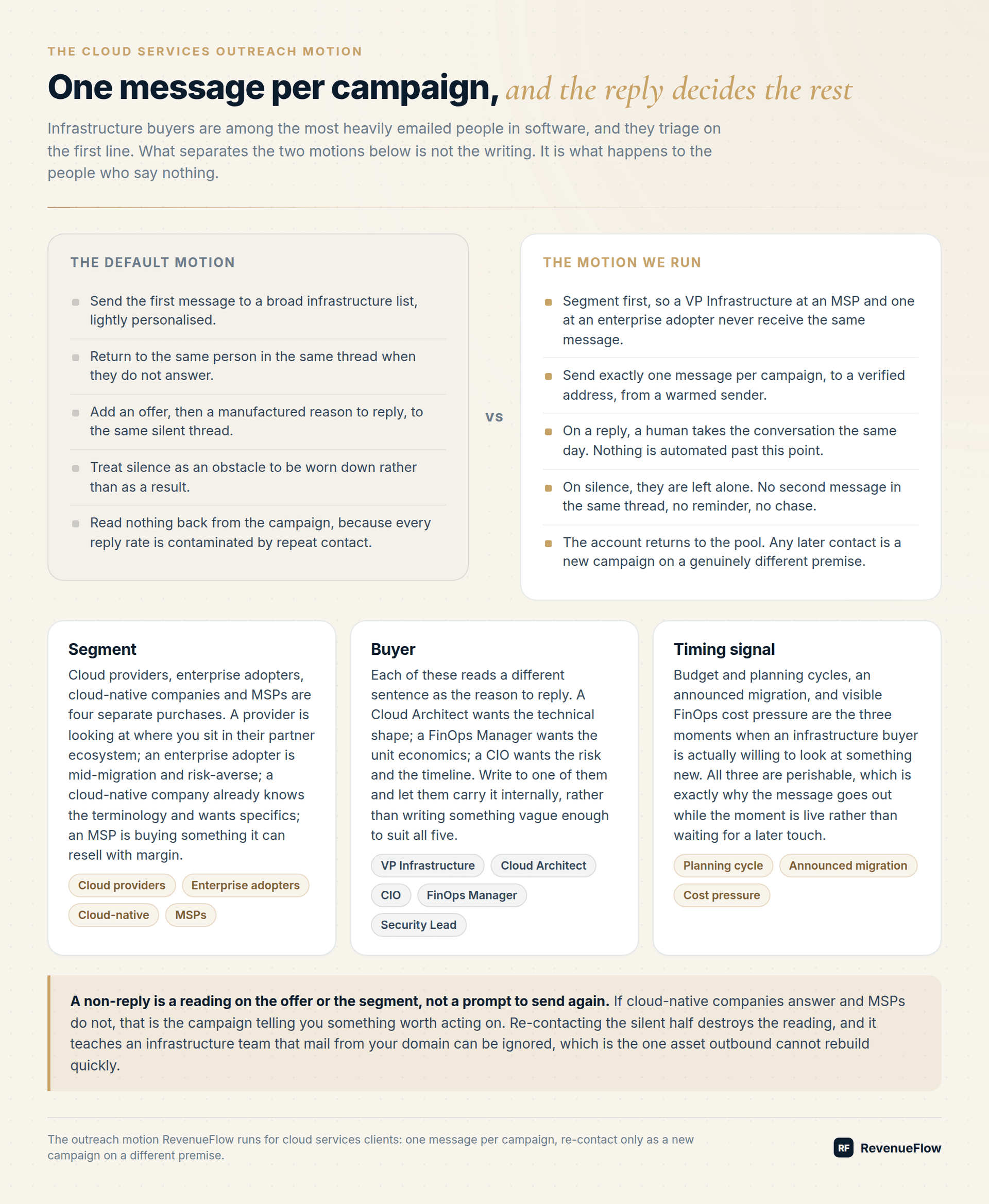
Where we differ from standard practice
Much of the advice on this page reflects how outbound is commonly run. We run it differently, and since this page sits on our site it is worth saying where the difference is and what it costs us.
- A sequence of messages to each prospect over several weeks
- Later messages often land in the same email thread
- Every contact is reached more than once, so a distracted reader gets another chance
- The later messages go only to people who did not answer the first
- Reputation cost accrues on the sending domain across everything else it sends
- One message, then that campaign is finished for that contact
- No thread replies and no bumps
- A non-responding audience becomes a new campaign with a genuinely different premise, not a reminder
- More of the work moves into targeting and into the one message
- We reach each contact less often, and that is the cost we accept
The reasoning is mechanical rather than moral. A follow-up arrives underneath a message the recipient has already seen and chosen not to answer, so it is delivered to the population most likely to mark it as spam, and the reputation cost of that lands on the sending domain across every campaign running on it. We set that cost against the replies a sequence recovers and decided the trade was not worth it. The full argument, with the numbers from our own campaigns, is in why we stopped using follow-ups.
Follow-Up Strategy
Cloud professionals are busy managing complex environments. Most programmes plan four to six touches spaced five to seven business days apart. We send one message per campaign and put that effort into targeting and into the first message instead.
Where that effort goes:
- Share relevant technical content or best practices
- Reference cloud provider announcements or new services
- Provide useful information about their specific challenges
- Keep the message concise and focused
When a non-responding list is worth another approach, it becomes a new campaign with its own premise rather than a second message under the first.
Measurement and Optimization
Track metrics to improve your program over time.
Key metrics:
- Open rates by segment and cloud provider
- Reply rates by organization type and maturity level
- Meeting conversion rates
- Pipeline progression from cold outreach
- Deal size and close rates by source
Use data to refine targeting, messaging, and timing continuously.
Building Long-Term Relationships in Cloud
The cloud industry values technical expertise and community involvement.
Contribute Technical Content
Publishing useful technical content, best practices guides, or benchmarks builds credibility. Share content that helps cloud teams solve real problems.
Engage with Cloud Communities
Cloud communities are active on forums, social media, and user groups. Participating thoughtfully builds visibility and credibility.
Obtain Cloud Certifications
Cloud provider certifications demonstrate platform expertise. Certified professionals and partners often receive preferential treatment.
Participate in Cloud Events
Cloud conferences and meetups create networking opportunities. Building relationships at events makes subsequent outreach more effective.
Partner with Cloud Providers
Partner programs with major cloud providers provide credibility and co-selling opportunities. Explore relevant partnership tiers and benefits.
Summary
Cold emailing the cloud services industry requires genuine understanding of cloud technology, providers, and current challenges.
Success depends on:
- Understanding the market including cloud providers, enterprise adopters, cloud-native companies, and managed service providers
- Targeting the right decision-makers with role-appropriate messaging
- Demonstrating technical credibility through provider-specific knowledge and relevant metrics
- Tailoring to industry verticals with use-case-specific messaging
- Timing outreach around budget cycles, events, and cloud initiatives
- Avoiding common mistakes like generic messaging and unrealistic savings claims
- Building for the long term through community engagement and technical contribution
The cloud services market continues to grow as organizations expand their cloud adoption and optimize their investments. Vendors who demonstrate genuine expertise and provide real value will succeed in reaching decision-makers at cloud organizations.
Related Reading
- Cold Email for Security Services: The Complete Guide
- Cold Email for Data Analytics: The Complete Guide
If you would rather have this run for you, RevenueFlow books qualified meetings on a pay-per-meeting basis and publishes client results.
Frequently asked questions.
Frequently asked questions- Who are the key decision makers I should target when cold emailing about cloud services?
- Target six primary decision makers: VP of Infrastructure or Cloud (focused on reliability and cost optimization), Cloud Architect (concerned with architecture design and best practices), Director of Cloud Operations (managing operational reliability and automation), CIO (overseeing IT strategy and digital transformation), FinOps Manager (handling cost visibility and budget forecasting), and Security Architect (responsible for security patterns and compliance). Each role has distinct pain points and requires tailored messaging.
- What are the main market segments in the cloud services industry?
- The cloud industry has five distinct segments. Cloud Service Providers include AWS, Azure, and Google Cloud building cloud infrastructure. Enterprise Cloud Adopters are large companies migrating workloads and building cloud-native applications. Cloud-Native Companies are businesses born in the cloud like SaaS startups. Managed Service Providers manage cloud infrastructure for clients. Cloud Consulting firms help organizations plan and execute cloud strategies.
- When is the best time to send cold emails to cloud services companies?
- Time outreach around five key periods: budget and planning cycles when organizations allocate cloud spending, cloud provider events like AWS re:Invent when decision-makers focus on cloud strategy, contract renewal timing when organizations evaluate alternatives, migration and modernization projects when companies need specialized tools, and cost review periods when finance teams scrutinize cloud spending. These moments create natural openings for relevant solutions.
- What mistakes should I avoid when cold emailing cloud services prospects?
- Avoid six critical mistakes: using generic cloud messaging that fails to differentiate, ignoring provider specificity by not acknowledging whether prospects use AWS, Azure, or Google Cloud, overstating savings claims without evidence, neglecting security context in regulated industries, assuming greenfield deployments when most organizations have legacy constraints, and ignoring organizational complexity involved in cloud decisions. These errors undermine credibility with technical buyers.
About the author.

Fernando Cao is CEO at RevenueFlow, which builds and operates outbound revenue engines for B2B companies. Previously at Accenture Strategy. Studied at University of Bath.
Fernando Cao · CEO
Connect on LinkedIn →Explore more.
Ready to scale your outreach?
We build GTM engines that book real meetings. See the receipts.
Related articles.
Cold Email for Maintenance Services: The Complete Guide
A comprehensive guide to cold email outreach for commercial maintenance companies, covering how to reach facility managers, property managers, and operations directors with messaging that wins preventive maintenance and repair contracts.
Cold Email for Staffing Agencies: The Complete Guide
A comprehensive guide to cold email outreach for staffing and temp agencies, covering how to reach HR directors, hiring managers, and operations leaders with messaging that wins temporary staffing, contract placement, and direct hire business.
Cold Email for Telecom: Reaching Carriers and MSPs
Telecom companies face rapid technology changes and competitive pressures. Here's how to approach cold email outreach to carriers, MSPs, and UCaaS providers.
Cold Email for Electronics Companies: The Complete Guide
A comprehensive guide to cold email outreach for electronics manufacturers, component suppliers, and EMS providers, covering buyer personas, OEM relationships, contract manufacturing, and proven strategies for reaching engineers, procurement managers, and supply chain leaders.
Cold Email for Security Services: The Complete Guide
A comprehensive guide to cold email outreach for security service providers, covering how to reach facility managers, corporate security directors, and property managers with messaging that builds trust and wins contracts.
Cold Email for Event Planning: The Complete Guide
A comprehensive guide to cold email outreach for event planning companies, covering how to reach corporate event managers, HR directors, and marketing leaders with messaging that wins event contracts and planning engagements.