Lead Generation for Food Distributors: Finding New Operators
How a food distributor finds new operator accounts: public licence and inspection lists, who controls the purchase, the DSR model, show dates and FDA traceability.
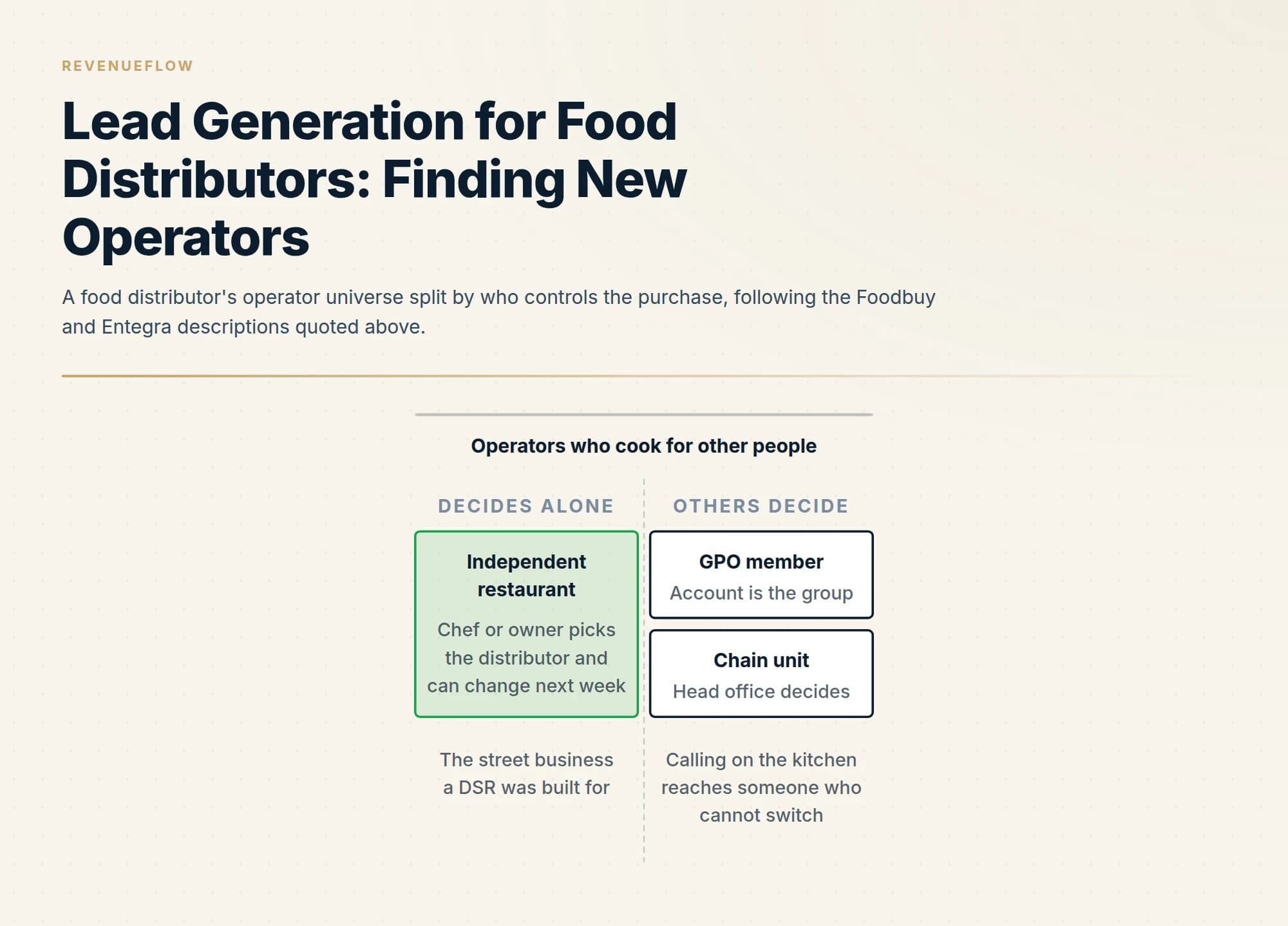
A food distributor's winnable accounts are operators who choose their own supplier, since members of a group purchasing organization and chain units buy through a contract decided elsewhere. New independents appear in public liquor licence lists and health inspection data before competitors notice them, and written outbound can reach them ahead of a distributor sales rep's first visit.
Key takeaways
- A Harbor Foodservice rep told the Foodservice Sales Pros podcast he prospects new accounts with the Washington liquor license website and Eater, both public sources.
- IFDA's description of the distributor sales role lists identifying prospective customers as one duty among on-site consultation, menu advice, bids and margins.
- The FDA says the Food Traceability Rule's original compliance date was January 20, 2026, that it proposed extending it to July 20, 2028, and that Congress directed no enforcement before then.
- The National Restaurant Association Show lists May 22 to 25, 2027 at McCormick Place, and IFDA lists its 2027 Solutions Conference for September 26 to 28 in Louisville.
Reviewed and updated September 18, 2026
A distributor sales rep at Harbor Foodservice told a trade podcast how he finds new restaurants before his competitors do. The show notes summarise it: "Tim shares his strategies for prospecting new accounts, including using online tools like the Washington liquor license website and Eater to identify potential customers." (Foodservice Sales Pros, AFDR episode 1725, read 18 September 2026.) A licence register and a restaurant news site: that is lead generation for a food distributor, done by hand, one territory at a time.
This guide is for a food distributor, broadline, specialty or redistribution, that wants more operator and retail accounts. It is written for the distributor's own sales leadership. Most published advice under this heading addresses food and beverage manufacturers looking for distributors, which is the opposite problem. If you sell software or services to distributors, cold email for wholesale distribution covers your side. What follows is the distributor's account universe and who controls it, where new accounts are listed, the route-based selling model and what outbound adds to it, the dated calendar, the food safety question buyers now ask, and when outbound is the wrong play.
The account universe, and who controls the purchase
A foodservice distributor sells to operators: restaurants, caterers, hotels, schools, hospitals, anyone who cooks for other people. The first cut of that universe is about who decides where the food is bought.
An independent restaurant decides for itself. The chef or owner picks a distributor, and can change next week. That is the street business the distributor sales rep was built for.
A member of a group purchasing organization has handed part of that decision to the group. Foodbuy describes its model as "Group Purchasing Programs for Supplies, Equipment, and Services", and says it gives "suppliers unparalleled access to purchasing locations" (Foodbuy, read 18 September 2026). Entegra calls itself "the largest food group purchasing organization (GPO) in the world" and promises members "significant savings on nearly everything you buy" (Entegra, read 18 September 2026). Those are the groups' own claims. The point for a prospector is structural: when an operator buys through a programme, the programme's contracted distributor has the account, and a rep calling on the kitchen is selling to someone who cannot switch. The account in that case is the group.
Chains work the same way with a different name on the contract: the purchase is decided at a head office, and the unit manager receives the truck.
Where new accounts are listed
The Harbor rep's two sources generalise. A new restaurant has to tell regulators it exists before it tells anyone else, and those records are public.
| Source | What it lists | What a distributor learns |
|---|---|---|
| State liquor licence lists | Washington publishes lists of Washington licensees | Who holds a licence, and who is new on the list |
| Health inspection results | New York City publishes restaurant inspection results as open data | Kitchens whether or not they serve alcohol |
| Restaurant news | Eater, named by the Harbor rep as a prospecting tool | Which new restaurants to look up |
| The restaurant show | The National Restaurant Association Show, where operators shop | Which operators in your territory may attend |
The Washington State Liquor and Cannabis Board keeps a page of Frequently Requested Lists that includes its Washington licensees, downloadable by anyone (Washington State LCB, read 18 September 2026). The board warns on the same page that the lists "contain possible errors due to a known data transfer issue", which is a useful reminder that a public list is a starting point to verify. New York City publishes its health department's results as a dataset titled "DOHMH New York City Restaurant Inspection Results" (NYC Open Data, read 18 September 2026). Check what your own state and city publish. A licence record can be the earlier signal, since a restaurant needs the licence before it can pour, and a name that is new on the list is a reason to look. An inspection dataset is the broader list, because it covers kitchens whether or not they serve alcohol.
Neither source says whether the operator is independent or buys through a group. That has to be established per account, and it is the first thing to find out, for the reason in the section above.
The route-based model, and what outbound adds
The industry's association describes the person at the centre of foodservice sales. The International Foodservice Distributors Association says distributor sales representatives, "known as DSRs", are "the face of foodservice distribution companies in the marketplace and trusted business partners of restaurant and foodservice operators across the United States" (IFDA, read 18 September 2026). Its description of the sales role lists the duties: "Provide on-site sales and consultation for customers", advice on "menu development, product selection, and operational strategies", and, in one line among many, "Identify prospective customers and new opportunities within existing accounts."
That list explains why new accounts are hard to come by. A DSR's week belongs to existing customers: orders, shorts, credits, menu changes. Prospecting is one duty of several, and it has no customer waiting on it. The Harbor rep's show notes describe what prospecting looks like when it does happen: research online, then cold calls in person, with attention to "the importance of timing when visiting restaurants".
Written outbound does not replace that visit. What it can do is the part before it, across the whole territory at once: read the licence and inspection lists every week, work out which new operators are independent, and send the owner one short message before the opening rush, so that the DSR's first visit is to someone who has already heard the distributor's name and said what they need. For specialty and redistribution businesses with no street force at all, the same method is the whole front end.
RevenueFlow's own practice is email and LinkedIn, one message per campaign, with no bumps behind it. A later approach is a new campaign with a new reason, and this market supplies reasons: a new licence, a change of ownership, a second location.
The calendar, with dates
As read on 18 September 2026, the organisers list:
- The National Restaurant Association Show, May 22 to 25, 2027, at McCormick Place in Chicago (National Restaurant Association Show).
- The IFDA Partners Executive Forum, January 24 to 27, 2027, at Grande Lakes, Florida, and the 2027 IFDA Solutions Conference, September 26 to 28, 2027, in Louisville, Kentucky (IFDA events).
The restaurant show is where operators shop, so the weeks before it are a reason to write to operators in your territory who may attend. The IFDA events are where distributors meet their own suppliers and peers, which makes them planning dates for the sales organisation more than prospecting dates. We did not find a published source for operator buying seasons that was worth citing, so none is given; your own order history by month is the better guide.
The food safety question buyers now ask
Operators and retailers have a reason to ask a distributor what records it keeps, and the reason is a federal rule with a moving date. The FDA's Food Traceability Rule, made under section 204 of the Food Safety Modernization Act, sets "traceability recordkeeping requirements" for foods on its Food Traceability List. The agency's page gives the history of the deadline in three sentences: "The original compliance date for all persons subject to the recordkeeping requirements of the Food Traceability Rule was Tuesday, January 20, 2026. The FDA proposed to extend the compliance date for the rule by 30 months to July 20, 2028." It adds that Congress then "directed FDA not to enforce the Food Traceability Rule prior to that same date" (FDA Food Traceability Rule, read 18 September 2026).
For lead generation the rule is a conversation opener that is true and useful. A distributor that can already produce the records the rule describes can say so to a multi-unit operator or a retailer who will need them from every supplier. This is a description of what the FDA page says, not regulatory advice, and whether a given food or business is covered is a question for the agency's own guidance.
Commercial email to businesses in the United States is covered by the CAN-SPAM Act, and our explanation of what the CAN-SPAM Act requires sets out the sender's duties. If reps phone operators, what cold calling is and which rules apply covers business calls, including the rules on mobile numbers, which matter when the number on a licence record is the owner's own phone.
Three reasons to write, each from a source above
None names a real person or claims a result.
The new licence.
Congratulations on the licence application for {{restaurant}} on {{street}}. We deliver {{category}} to independent kitchens in {{area}} {{days}} a week. Before you open, would it help to see a starting order guide built for a {{cuisine}} menu?
The source is the state's public licence list, and the offer mirrors the customised purchasing guides the Harbor rep describes.
The traceability records.
FDA's traceability rule now points to July 20, 2028, and buyers are asking suppliers about records well before that. We already keep lot-level records for {{foods}}. If you are reviewing suppliers for {{locations}}, may we send a sample record?
The source is the FDA's page.
The show.
The National Restaurant Association Show is May 22 to 25 at McCormick Place. If you are going, our team will be there, and we can walk you through {{category}} in ten minutes.
The source is the organiser's date.
When outbound is the wrong play
Outbound is the wrong play for accounts locked to a group contract you do not hold; the prospect there is the group, by a different process. It is the wrong play where your trucks do not run, because an operator outside the delivery area is not a lead. It is the wrong play for a distributor at capacity on its routes. And it is the wrong play as a substitute for the first visit, since this is a business where the operator wants to meet the person who will answer the phone when a delivery is short.
It fits independents that are opening, changing hands or adding a location, inside your delivery area, found from public records before a competitor's rep drives past. If you want that list built weekly and a first message written for it, see what a first campaign looks like. The general method behind a list like that is on our sales prospecting page.
The short version
A food distributor's universe divides into operators who decide alone and operators whose purchase is decided by a group or a head office, and only the first kind can be won on the street. New accounts are listed in public before they open: liquor licence lists, health inspection data and restaurant news, the same sources a Harbor Foodservice rep named on a trade podcast. IFDA describes prospecting as one duty among many for a DSR, which is the gap written outbound fills ahead of the first visit. The National Restaurant Association Show is May 22 to 25, 2027, and the FDA's traceability rule, originally due January 20, 2026, will not be enforced before July 20, 2028, while buyers ask about records now.
AFDR, IFDA, FDA, Washington State, New York City, show organiser and purchasing group pages quoted above were read on 18 September 2026. Dates and rules change. Confirm them on the source's own page before relying on them.
Frequently asked questions.
Frequently asked questions- How do food distributors find new restaurant customers?
- From public records and local news, then a visit. A Harbor Foodservice rep described using the Washington liquor license website and Eater to identify potential customers. Washington's Liquor and Cannabis Board publishes lists of licensees, and New York City publishes restaurant inspection results as open data. Written outbound can work those lists weekly, ahead of the rep's first visit.
- Why can't a distributor win every restaurant in its territory?
- Because many operators do not control the purchase. Members of a group purchasing organization buy through the group's programme, and chain units receive what a head office contracted. Foodbuy says it gives suppliers access to purchasing locations, and Entegra describes itself as a food group purchasing organization. For those operators the account is the group, reached by a different process.
- What does the FDA traceability rule mean for distributor sales?
- It gives buyers a reason to ask suppliers about records. The FDA says the Food Traceability Rule's original compliance date was January 20, 2026, that it proposed an extension to July 20, 2028, and that Congress directed it not to enforce the rule before that date. A distributor that already keeps the records can say so truthfully when approaching multi-unit operators.
- When is outbound lead generation wrong for a food distributor?
- When the operator is locked to a group contract the distributor does not hold, when the address is outside the delivery area, when routes are already at capacity, and when it is used instead of a first visit. Operators want to meet the person who answers when a delivery is short, so written outreach should set up that visit and not replace it.
About the author.

B2B cold email experts helping companies generate qualified leads through done-for-you outreach campaigns.
RevenueFlow Team
Explore more.
Ready to scale your outreach?
We build GTM engines that book real meetings. See the receipts.
Related articles.
Lead Generation for Hotels: Group, Corporate and RFP Demand
How a hotel sales team generates B2B demand: RFP platforms, convention bureaus, the corporate rate cycle, and the smaller travel programmes that skip the RFP.
B2B Lead Lists for Collection Agencies: Fields and Sources
What a creditor prospect list needs for a collection agency: the fields that matter, the FDIC, NCUA, CMS and court sources behind them, and the rules that apply.
Lead Generation for Telecommunications Companies: Four Lead Sources
For carriers, ISPs, UCaaS providers and MSPs: the installed base, the advisor channel, dated outbound and the funded network map as lead sources, with FCC rules.
Lead Generation for Trucking Companies: Three Routes
How a motor carrier finds freight customers: the load board, the broker relationship and the shipper's annual bid, with the calendar and the rules on outreach.
Outbound Sales for Food and Beverage Companies: Who to Reach
Outbound sales for food and beverage brands: the four buyers behind a yes, the public show calendar, what a message may claim, and when outbound is the wrong play.
Outbound Sales for Higher Education Vendors: Which Door to Use
Outbound for higher education vendors, built on universities' own purchasing policies: three doors, the ask that fits each one, and a dated accessibility review.