Outbound for Consultants: Renting Machinery, Not Judgement
A practice needs a handful of conversations a year, not volume. What a consultant can hand over, what stays theirs, and how to judge a provider.

A consulting practice needs precision rather than volume, so the useful split is substance against machinery. The point of view, the segment and the reply stay with the consultant. List building, infrastructure and scheduling can be handed over. Judge a provider on sizing for a narrow list, the billing unit and reputation exposure.
Key takeaways
- A solo practice may need only six to ten relevant conversations a year, which makes precision the constraint rather than sending volume.
- Hand over list building, infrastructure and scheduling; keep the point of view, the segment definition and the answer to every reply.
- Self-run outbound costs the most exactly when the practice is full, which is when stopping is hardest and pipeline matters most.
- A list of a few hundred companies cannot support a split test, so judge a program over a quarter and several campaigns rather than a fortnight.
Reviewed and updated September 1, 2026
Outbound for Consultants: Renting the Machinery Without Renting the Judgement
An independent consultant with three live engagements has almost no reason to prospect on a Tuesday, and every reason to have prospected six weeks ago. That gap is the whole problem. Utilisation and business development compete for the same hours, and the hours go to the client who is paying today. A practice that runs this way oscillates: full, then empty, then full again, with the empty stretch arriving right after the busiest one.
Fractional executives feel the same pattern in a sharper form, because a fractional engagement occupies a fixed share of a week and the free share is the only place new business can come from.
What a consulting practice actually needs from outbound
For most practices the gap is specifically the cold end of pipeline generation rather than pipeline as a whole: the warm half runs on reputation and referral and works perfectly well, and the part that has never been built is the one that reaches people who have not heard of the practice.
The version of this that catches practices out is calendar management once outbound starts working, since meetings arrive in the same hours the delivery work needs and a booking link with no protected blocks behind it turns a full pipeline into a delivery problem.
The volume requirement is small and the quality requirement is severe, which is the opposite of most outbound advice.
A solo practice serving three or four clients at a time might need six to ten genuinely relevant conversations a year to stay full. That is not a scale problem. It is a precision problem. A list of four hundred well-chosen companies, worked properly, is a bigger asset than a list of forty thousand.
What the buyer is purchasing also constrains the message. Nobody can evaluate consulting judgement before buying it, so the only evidence available in a cold context is the judgement visible in the message itself. A message that describes capability rather than demonstrating a point of view gives the reader nothing to assess. That argument, and what giving away the diagnosis looks like in practice, is worked through in consultant lead generation.
The referral plateau is the usual trigger for looking at outbound at all. Referrals arrive from a network whose reach is fixed by the segments you have already served, and a practice that wants to move upmarket or sideways runs out of them at exactly the moment the move begins.
What can be handed over and what cannot
The useful division is between the substance and the machinery. The substance is the point of view, the segment definition, the observation the message is built on, and the answer when somebody replies with a hard question. The machinery is list building, verification, exclusion handling, sending infrastructure, deliverability, scheduling and reporting.
- The segment and why you are credible in it
- The point of view the message is built on
- Approval of every message sent over your name
- The reply, the diagnosis and the call itself
- Sourcing and verifying the list
- Exclusion of clients, referrers and live conversations
- Sending infrastructure and deliverability
- Scheduling, tracking and reporting
An arrangement in which an outside team writes the substance of a consultant's messages produces exactly the capability-describing message that fails on this audience. An arrangement in which an outside team runs the machinery frees the scarce input, which is senior thinking, to go where it differentiates.
The build-versus-buy decision at a consultant's scale
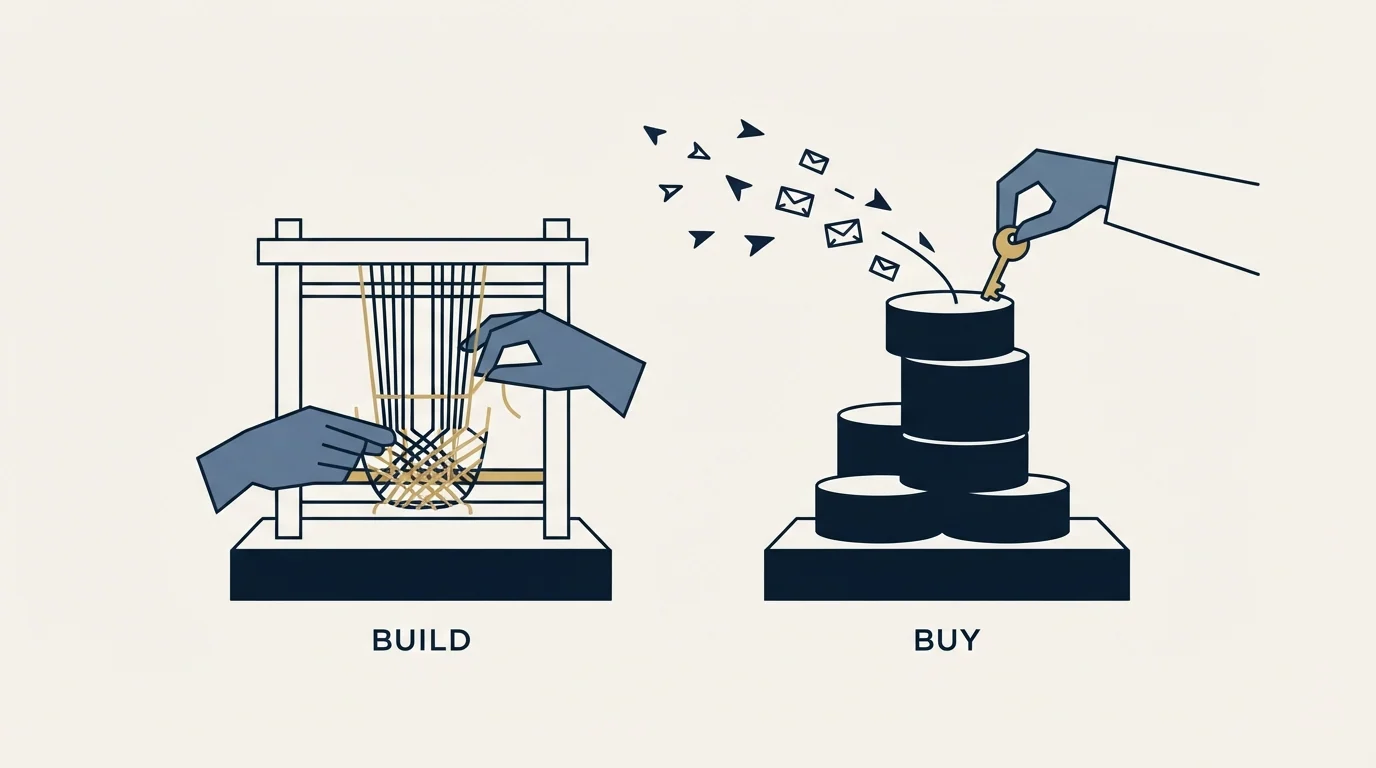
The arithmetic that follows is illustrative and invented for the purpose of showing the shape of the calculation. It reports nothing measured, and the figures are placeholders for your own.
Using invented placeholder figures, suppose a day rate of 1,200 and a self-run outbound habit that consumes half a day a week once list work, sending and admin are counted. That is roughly 2,400 a month of displaced capacity when the practice is full, and nothing at all when it is empty. The oscillation is the point: the cost of doing it yourself is highest exactly when you are least able to stop, and lowest when it is least useful. A fixed external cost is flat across that cycle, which is worth something on its own even before the cost per meeting is compared.
The comparison itself should be built the same way any buyer builds it: fully loaded on both sides, divided by meetings that actually happened rather than meetings booked, with ramp counted honestly. The method is set out in outsourced SDR vs in-house, and it does not change because the buyer is a practice of one.
One option specific to this scale is a shared or part-time resource rather than a full program. It brings its own trade, since a shared seat keeps the machinery around the person and gives up exclusive ownership of the person. The conditions under which that works and the conditions under which it stalls are covered in fractional SDR.
Narrow, researched, one segment
After verification and exclusions
Replies worth a call
Enough to fill a solo practice
The funnel is deliberately short. A practice does not need a wide top, and widening it usually destroys the precision that made the message worth reading.
How a done-for-you motion maps to a practice
Stated as our documented policy, not as a performance claim.
One message per campaign. A campaign carries one premise and sends once. No bumps, no thread replies. For a consultancy this fits the economics unusually well, because the scarce input is the thinking behind the observation, and a model that demands one good message rather than repeated contact puts the effort where the differentiation is. It also protects a professional reputation that took years to build and can be spent quickly by a sequence that reads as automated.
Qualification agreed in writing before launch. What counts as a meeting worth your time is defined up front, in terms you set: company size, sector, the role you need in the room, the situation that makes the engagement relevant. Budget, timing and authority are never billing conditions.
Copy sign-off. Nothing sends over your name until you have approved it. Since the point of view is yours, this is not a formality. It is the mechanism by which the substance stays yours while the machinery sits elsewhere.
Email and LinkedIn, not phone. The channels are written, which suits a message whose value is in the argument rather than in the delivery.
Phone based outbound, when a program does add automated calling, carries its own pricing puzzle, explained in how AI calling agents are priced.
The construction of the message itself, once the division of labour is settled, is covered in cold email for consulting firms, and consulting cold email benchmarks gives a sense of what the distribution of outcomes tends to look like in the category.
Measurement when the sample size is tiny

A practice that sends to four hundred companies cannot run a meaningful split test. Reply rates on a list that size swing wildly on chance, and a difference that looks decisive is often four replies against one. Treating those numbers as a signal leads to changing the message every fortnight, which destroys the only thing that was working, which was consistency of premise.
The measures that survive at this scale are coarser and slower. Whether the replies are from the right kind of company. Whether the objection that comes back is the one you expected, since a surprising objection usually means the segment is wrong rather than the copy. Whether conversations reach a scoping discussion at all. A practice should expect to judge a program over a quarter and several campaigns, not over a fortnight and one.
Fractional executives, same problem on a different clock
A fractional CMO or CFO carries an extra constraint. The engagement itself consumes a named share of the week, so free capacity is both small and predictable, and the next engagement has to start close to when the current one ends. That makes timing the binding issue rather than volume. Pipeline built during a full engagement is the only pipeline that exists when it finishes, and the practices that stay full are the ones that keep a small motion running while utilisation is high.
There is a positioning wrinkle too. A fractional executive is buying a seat inside somebody's leadership team, so the outreach is closer to a hiring conversation than a vendor pitch. The message that works usually names a specific situation the company is visibly in rather than a service line, and the exclusion list has to cover the companies where you already sit.
That is what outbound sales for fractional executives comes down to: a short list, a situation the company is visibly in, and a message timed to the end of the current engagement.
What to evaluate in any provider

Provider-neutral, and several of these are questions worth asking us.
- Yes: Who writes the substance, and can the copy carry your point of view rather than a category pitch
- Yes: What happens when a prospect replies with a hard technical question
- Yes: Is the program sized for a narrow list, or does it need volume you do not have
- Yes: What triggers payment, and who wrote the definition of a qualified meeting
- Yes: How are referrers, current clients and live conversations excluded before the first send
- Yes: Can you see rendered messages across the real list, not a template with sample data
- Depends: What happens to the list and the learning if the arrangement ends
Two of these decide most outcomes for a practice.
Sizing. A provider whose model assumes tens of thousands of contacts will either widen your segment until the message stops being specific, or will report activity you cannot use. If your addressable market is a few hundred companies, say so early and ask directly how the program works at that size. The answer separates providers quickly.
Reputation exposure. Your name is the asset. Ask whose domains send, what the rendered message looks like on a bad record, and what the escalation path is if a recipient objects. A consultant recovers from a slow quarter more easily than from a message that made them look like a vendor.
Where to start
Write down the segment in a sentence that a stranger could apply, then write down the observation you would want a prospect in that segment to read. If the observation is generic, the outbound is not the constraint yet and the narrowing has to come first. Collect the exclusion list next, including referral sources, because the relationship cost of contacting one of them wrongly exceeds any pipeline gain. Then compare providers on sizing and on the billing unit rather than on the headline number.
If you would rather keep the point of view and the calls, and have somebody else run the machinery around them, RevenueFlow is paid on attended meetings that meet criteria agreed in writing before launch. You can see what a first campaign looks like.
Frequently asked questions.
Frequently asked questions- Can someone else write my outbound if I sell my own expertise?
- Somebody else can run the machinery around the message. The substance has to stay with you, because a cold reader can only evaluate the judgement visible in the message itself. An outside team writing the argument produces capability descriptions, which is precisely what fails on this audience. Keep the point of view and the sign-off, hand over the list and the sending.
- Is my market too small for an outbound program?
- Small markets are common in consulting and they are workable, but ask providers directly how their program behaves at a few hundred accounts. A model built for tens of thousands of contacts will either widen your segment until the message stops being specific, or report activity you cannot use. The sizing answer separates providers faster than pricing does.
- How do I keep prospecting when I am fully booked?
- That oscillation is the core problem, since business development loses every hour to the client paying today. The practical fix is a small motion that runs at a fixed external cost regardless of utilisation, so it continues through the busy stretch. Pipeline built during a full engagement is the only pipeline that exists when the engagement ends.
- What happens if a prospect replies with a hard technical question?
- You answer it. That is the moment the whole approach is built around, and delegating it undoes the reason the message worked. Ask any provider what their reply handling actually does, because a generic holding answer sent under your name costs more reputation than a slow quarter costs revenue. Route replies straight to you.
About the author.

Ben Carden is CRO at RevenueFlow, which builds and operates outbound revenue engines for B2B companies. Previously at Gartner Enterprise. Studied at London School of Economics.
Ben Carden · CRO
Connect on LinkedIn →Explore more.
Ready to scale your outreach?
We build GTM engines that book real meetings. See the receipts.
Related articles.
Two Agencies, One Target List: Who Owns Which Accounts
Two outbound suppliers on one market will contact the same companies unless the buyer splits it first. How to cut the list, run the exclusion feed and check the overlap.
HR Lead Generation: The Renewal Clock and Who Signs
An HR buyer who agrees with every word still cannot act outside their own renewal window. Which triggers are observable, and who signs.
IT Lead Generation: The Buyer Runs Your Playbook
Technology buyers evaluate outbound for a living, and their purchases carry a security review nobody in your meeting owns. Which triggers are real.
5 ABM Campaign Examples and How Each One Is Built
Five worked account-based campaign examples, each built on the same five fields: account set, tier, plays in order, owner and handoff, and the exit condition.
Last Outbound Agency Did Not Deliver: Locating the Failure
The leads were bad names a symptom and no stage. Four places an outbound engagement fails, the counts that separate them, and what to change in the next purchase.
When Outbound Stops Scaling: What Breaks First
Doubling the budget rarely doubles the meetings. The five constraints that bind in order, the signature each one leaves in the numbers, and what actually buys more.