Nearshore Sales Outsourcing: Buy It for the Overlap
Nearshore is sold on the hourly rate and bought on the timezone. Which work needs the overlap, where the saving stops, and how to pilot the question.
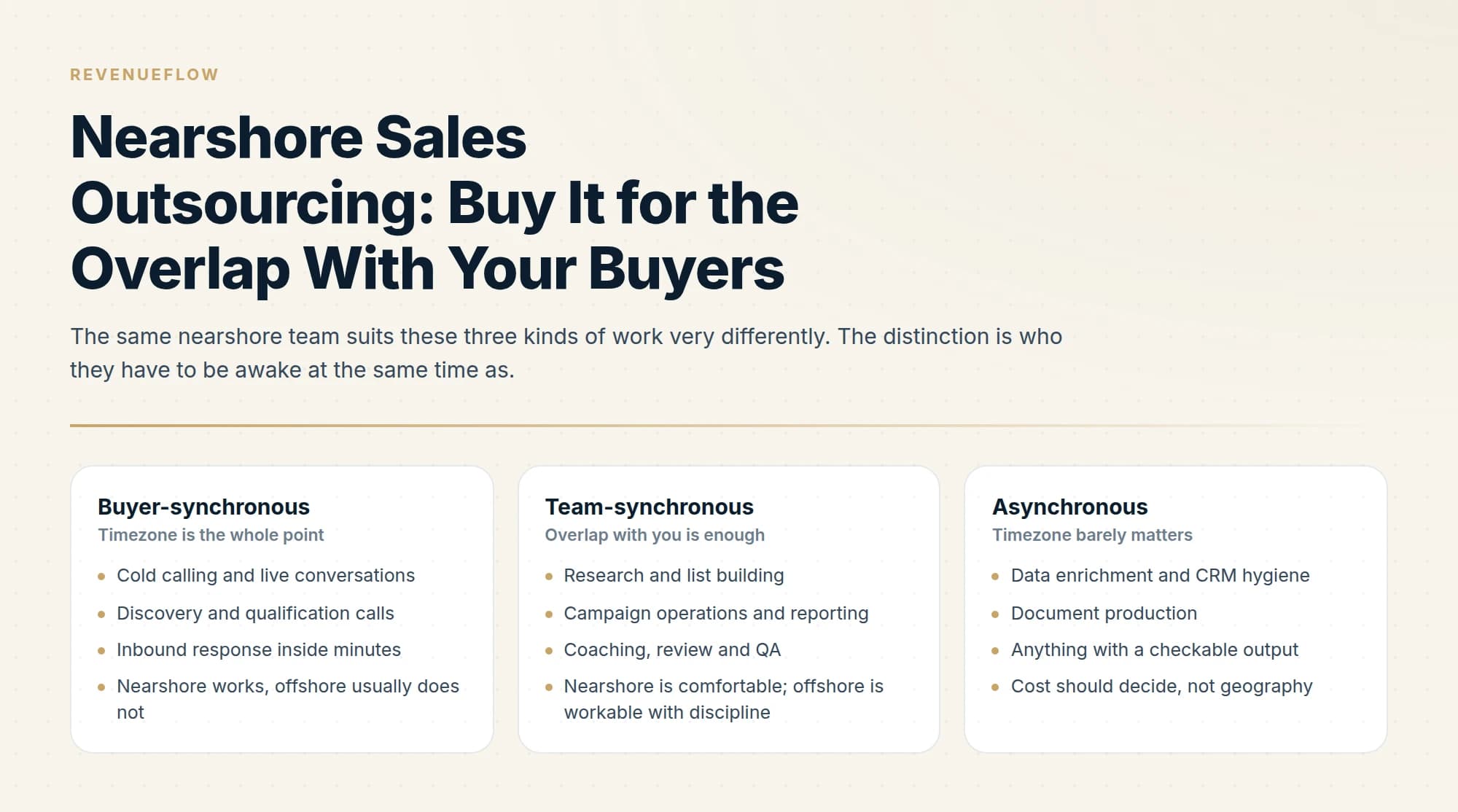
Nearshore means a delivery team a few hours from your market rather than eight or twelve. The question that decides fit is whether the work needs synchronous contact with your buyers or only with your team. Buyer-synchronous work justifies the premium, and asynchronous work should be decided on cost.
Key takeaways
- Contact data, sending infrastructure, verification and tooling cost the same wherever the person sits, so halving the labour rate does not halve the cost of the function.
- Accent sensitivity should be tested against your own baseline by running a small volume into your actual market rather than assumed in either direction.
- Written outreach and phone are affected by different variables here, so blending them in a pilot hides the finding the pilot exists to produce.
- Moving an unproductive motion somewhere cheaper produces the same lack of results at a lower burn, which is a saving rather than a solution.
Reviewed and updated September 1, 2026
Nearshore outsourcing gets sold on the hourly rate and bought on the timezone. Of the two, the timezone is what actually determines whether it works for sales, and it is the one that rarely appears in the business case.
A nearshore sales team sits in a country a few hours from yours rather than eight or twelve. For work that requires talking to your buyers during their working day, that difference is the whole proposition.
What nearshore means in practice
Offshore usually means a delivery centre eight or more hours from your market. Nearshore means the overlap is most of a working day: Latin America for a United States buyer, Eastern Europe or North Africa for a Western European one.
The rate sits between onshore and offshore, and the pitch is that you get most of the cost saving with none of the coordination penalty. That is broadly true for some work and misleading for others, and which is which depends on one question.
Does the work require synchronous contact with your buyer, or only with your team?
- Cold calling and live conversations
- Discovery and qualification calls
- Inbound response inside minutes
- Nearshore works, offshore usually does not
- Research and list building
- Campaign operations and reporting
- Coaching, review and QA
- Nearshore is comfortable; offshore is workable with discipline
- Data enrichment and CRM hygiene
- Document production
- Anything with a checkable output
- Cost should decide, not geography
The mistake is paying the nearshore premium for asynchronous work, where offshore delivers the same output for less, or buying offshore for buyer-synchronous work and discovering that your reps are calling prospects at the wrong end of the day.
Where the saving actually comes from, and where it does not
Rate arbitrage is real. What is less often modelled is that the saving applies to the labour line and not to the rest.
Contact data, sending infrastructure, verification and tooling cost the same wherever the person sits. On an outbound programme those are a meaningful share of the total, so a headline rate saving of half does not halve the cost of the function.
Management does not disappear either. A nearshore team needs the same list decisions, the same qualification criteria and the same coaching cadence as an onshore one, and if you are buying staff rather than a managed service, that management is yours. The distinction between those two purchases is set out in SDR as a service, and it matters more than geography.
The accent and idiom question, handled honestly

For buyer-synchronous work this is the variable everyone skirts and nobody should.
Some markets and some buyers are entirely indifferent. Others are not, and pretending otherwise sets a team up to fail against a standard nobody told them about. The honest framing is not about capability; it is that in a cold call the first five seconds are spent establishing that this is worth continuing, and anything that adds friction there is a real cost against a real benefit.
Two practical consequences. Test it rather than theorise: run a small volume into your actual market and compare connect-to-conversation rates against your existing baseline. And separate the channels, because written outreach is unaffected by this entirely, which is why a nearshore team frequently outperforms on email and struggles on phone in the same programme.
- Yes: The work requires overlap with your buyers' working day, not just yours
- Yes: You have a baseline to test connect and reply rates against
- Yes: You know whether you are buying staff or a managed service
- Yes: Data, tooling and infrastructure costs are in the comparison
- No: The work is asynchronous, where offshore costs less for the same output
- Depends: Whether your buyers are sensitive to accent on live calls
Running a pilot that answers the question
A nearshore decision is easy to test and frequently is not, because the test gets designed to prove the saving rather than to measure the output.
Keep one thing constant that most pilots change: the list. Running a nearshore pilot on a fresh segment while your onshore team works the existing one compares two teams and two markets simultaneously, and the result cannot be attributed. Split the same segment instead.
Give it long enough to include held meetings. Judging on dials and connects in week two measures effort rather than outcome, and effort is the thing least in doubt.
Report by channel separately. Written outreach and phone are affected by different variables here, and blending them hides the finding that most nearshore pilots actually produce, which is strong email performance alongside weaker phone performance or the reverse.
Then decide on cost per qualified meeting rather than on the rate card, and be prepared for the answer to be split: the right structure is frequently nearshore for the written and research half with onshore or specialist coverage for live calls into a sensitive market, rather than an all-or-nothing choice.
- Step 1Split the same segment
Running the pilot on a fresh segment while the onshore team works the existing one compares two teams and two markets at once, and the result cannot be attributed to either.
- Step 2Run it long enough to include held meetings
Judging on dials and connects in week two measures effort, which is the thing least in doubt.
- Step 3Report written and phone separately
The two are affected by different variables here, and blending them hides the finding most nearshore pilots actually produce.
- Step 4Decide on cost per qualified meeting
Not on the rate card, and be prepared for the answer to be a split rather than an all-or-nothing choice.
Contracting, data and the parts that are genuinely harder
Three practical frictions that do not appear in a rate comparison.
Data protection. Moving prospect data across borders has rules that vary by jurisdiction, and the accountability stays with you rather than with the provider. Establish where data is stored and processed before signing, not because it is likely to be a problem but because it is very awkward to unwind later.
Employment structure. Whether you are contracting with a company or effectively employing individuals through one changes your obligations. Providers vary and some are vague about it.
Continuity. Turnover in outsourced sales roles is high everywhere. Ask what happens when someone leaves, how quickly a replacement arrives, whether they inherit documented account context, and who pays for the ramp. Those questions apply to any vendor and are covered in choosing an SDR company.
Running the comparison properly
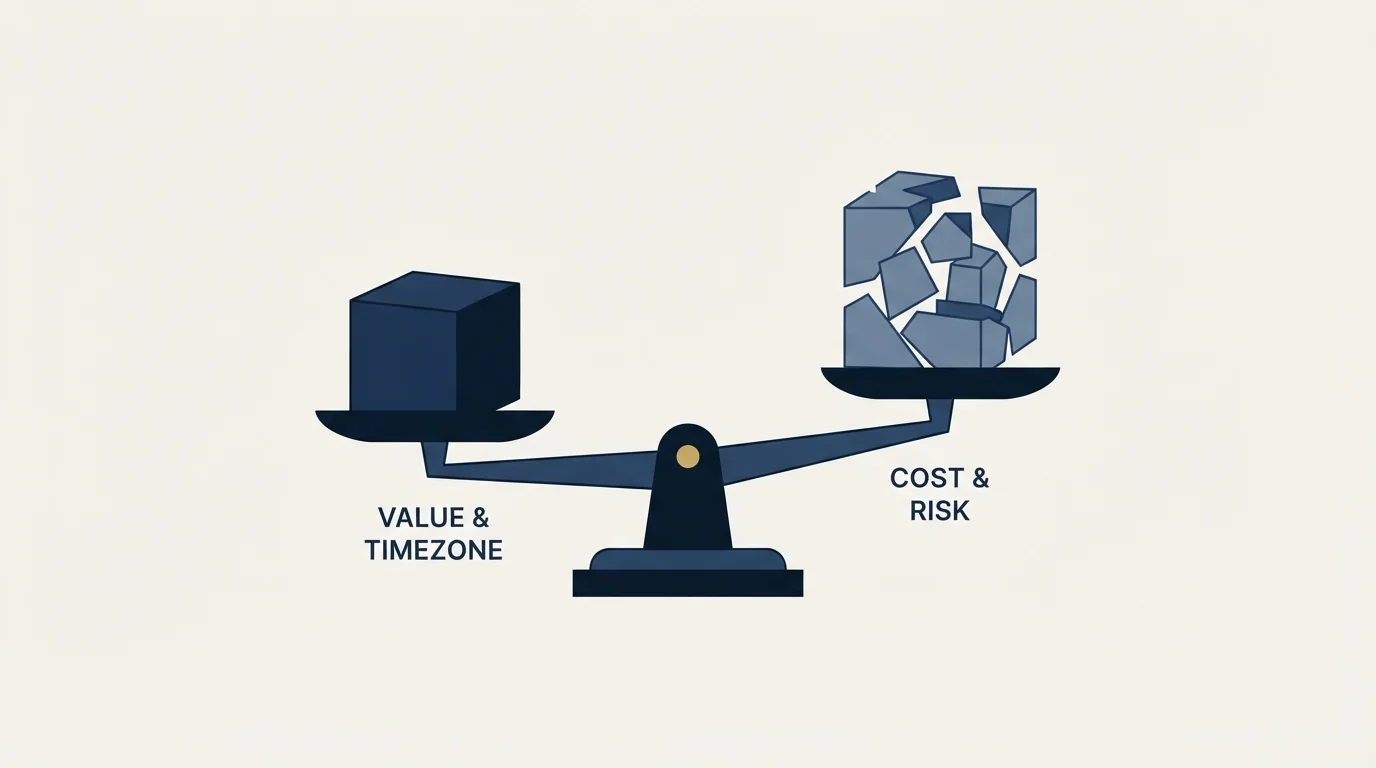
Compare on cost per outcome, not cost per hour, because the hours are not equivalent.
Take the fully loaded cost of each option, including data and tooling which are constant across them, and divide by held meetings that meet your written criteria. A nearshore team at a lower rate producing meaningfully fewer qualified meetings can be more expensive per outcome than an onshore team, and the rate comparison will never show it.
Give any test enough time to include held meetings rather than judging on activity, and change one variable at a time. Running a nearshore pilot against a new segment produces a result that cannot be attributed to either.
For the wider decision about whether to outsource the function at all, rather than where to put it, see outbound sales outsourcing. For the five types of firm you might be buying from, outsourced sales companies.
Making a distributed team actually work
Assuming the fit is right, the difference between a nearshore team that performs and one that quietly drifts is almost entirely operational.
One daily overlap window, protected. The whole advantage of nearshore is that a real-time conversation is possible. Waste it on nothing and you have paid a premium for a timezone you did not use. A short daily window for coaching, list decisions and escalations converts the geography into an actual benefit.
Escalation paths written down. A rep who hits an ambiguous account, a data problem or a hostile reply needs to know who to ask and how fast an answer arrives. Without that, ambiguity gets resolved with a guess, and guesses on a target list are expensive.
Recordings reviewed, not just reported. Distance makes it tempting to manage by dashboard. The dashboard cannot tell you what is being said in your name. Weekly review of real calls and real messages is the only control that works, and it matters more at distance rather than less.
Context, not just instructions. Remote teams get task lists and rarely get the reasoning. A rep who understands why a segment matters makes better judgement calls on the accounts nobody anticipated, and those accounts are a large share of any list.
The failure pattern to watch for is silence that looks like smooth operation. A team producing steady activity reports and never escalating anything is usually not encountering fewer problems; it is routing around them, and you find out when the quarter closes.
Where nearshore is genuinely the best answer

Being concrete, since the analysis above is mostly cautionary.
Nearshore fits well when you need live phone coverage across your buyers' day at a cost onshore cannot support, when volume justifies a dedicated team rather than a shared one, and when the written half of the programme can absorb most of the work anyway. It fits especially well for teams selling into a market where they have no local presence and no plan to build one, where the alternative is not an onshore team but nothing at all.
It fits badly as a pure cost-reduction exercise applied to work that was not producing results onshore either. Moving an unproductive motion somewhere cheaper produces the same lack of results at a lower burn, which is a saving rather than a solution.
The short version
Choose nearshore for work that has to happen while your buyers are awake, and choose on cost for work that does not. Remember that the saving applies only to the labour line, since data, tooling and infrastructure cost the same anywhere, and that management does not disappear unless you bought a managed service rather than staff. Test accent sensitivity against your own baseline instead of assuming either way, separate written from phone results, and compare on cost per qualified meeting rather than per hour.
If you would rather buy the outcome than the geography, we work on a pay-per-qualified-meeting basis with the criteria agreed in writing first, and you can see what a campaign would look like for your market.
Frequently asked questions.
Frequently asked questions- What is nearshore outsourcing in a sales context?
- A delivery team in a country a few hours from your market rather than eight or twelve: Latin America for a United States buyer, Eastern Europe or North Africa for a Western European one. The rate sits between onshore and offshore, and the proposition is most of the cost saving without the coordination penalty.
- Which sales work suits nearshore delivery?
- Buyer-synchronous work, where the timezone is the whole point: cold calling, live conversations, discovery and qualification, and inbound response within minutes. Team-synchronous work such as research, campaign operations and coaching is comfortable nearshore and workable offshore with discipline. Purely asynchronous work with a checkable output should be decided on cost rather than geography.
- How do you run a nearshore pilot properly?
- Keep the list constant by splitting the same segment, since running the pilot on a fresh segment compares two teams and two markets at once. Give it long enough to include held meetings rather than judging on dials in week two. Report written and phone results separately. Then decide on cost per qualified meeting rather than on the rate card.
- What does the rate comparison miss?
- That the hours are not equivalent. Compare the fully loaded cost of each option, including data and tooling which are constant across them, and divide by held meetings meeting your written criteria. A cheaper team producing meaningfully fewer qualified meetings can cost more per outcome, and the rate card will never show it. Management does not disappear either unless you bought a managed service.
About the author.

B2B cold email experts helping companies generate qualified leads through done-for-you outreach campaigns.
RevenueFlow Team
Explore more.
Ready to scale your outreach?
We build GTM engines that book real meetings. See the receipts.
Related articles.
Physician Email Lists: The Row, Its Sources and Its Gaps
The anatomy of a physician email list: the six field groups, which CMS, AMA and state board records hold each, what vendors claim, the rules, and the order to verify.
Cold Calling for Food and Beverage Companies: Three Doors
Cold calling for a food or beverage company: who picks up at a chain, a distributor and an independent grocer, where each publishes its door, and when the phone is wrong.
Win Rate Benchmarks: Which Figures State a Population
A catalogue of the published average sales win rates, sorted by whether the page names the population behind its own number. Most do not.
SDR Outsourcing for Commercial Insurance Agencies
What an outsourced sales development team may legally say for a commercial insurance agency, how it may be paid, and the expiration-date calendar it has to work.
LinkedIn Outreach for Utilities: Selling to the Sector
How a vendor selling to utilities uses LinkedIn next to a published sourcing process: the three ownership models, the registration gate and what a message may ask.
Cold Calling for Manufacturers: The Desk and the Floor
Cold calling for a manufacturer calling plants and OEMs: who answers the main line, the buyer's desk against the floor, the show calendar, the channel map, the limits.