SDR as a Service: Testing the Productisation Claim
A system with people attached and people with an invoice attached are sold in the same words. One question separates them, and onboarding confirms it.
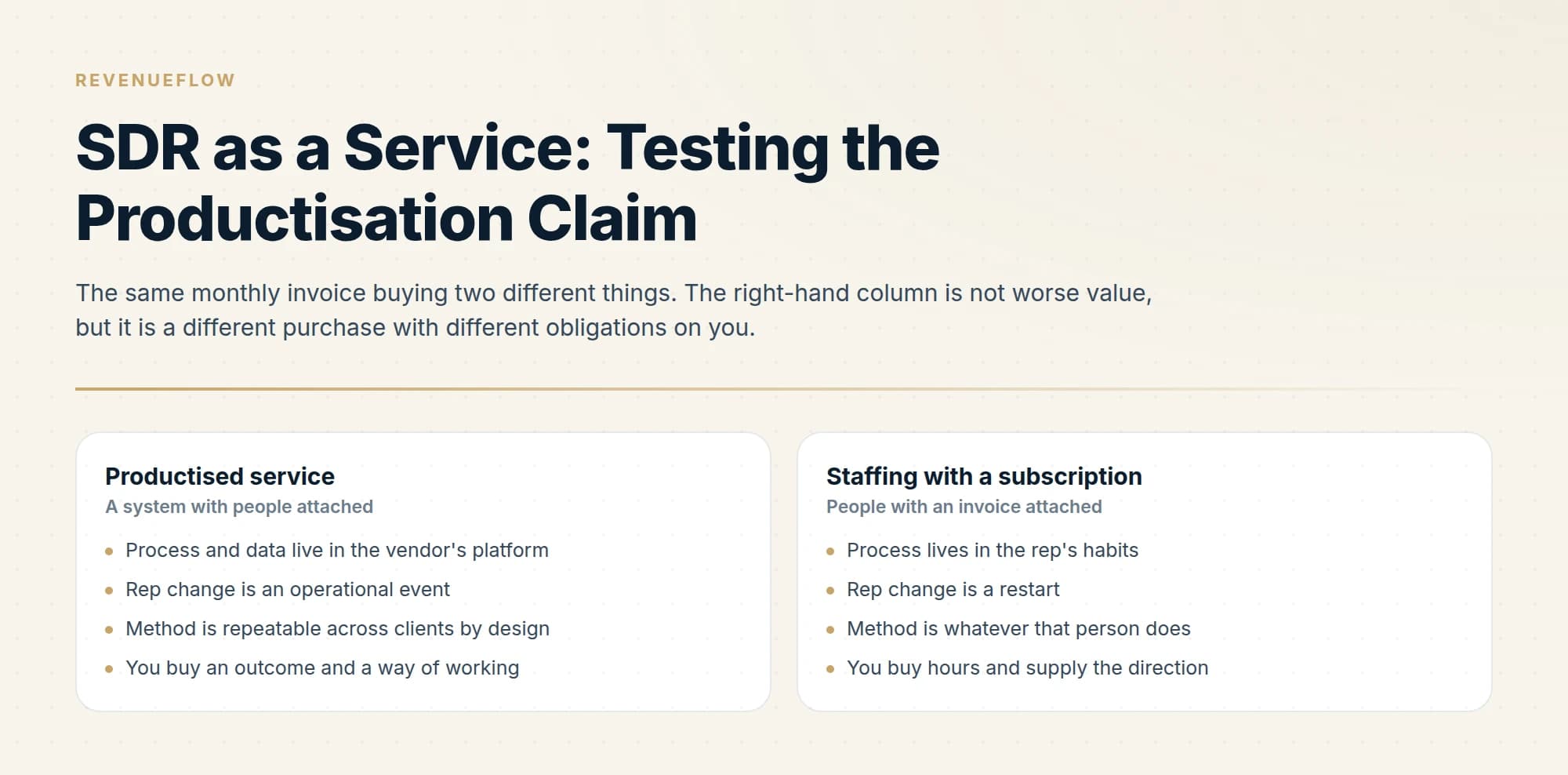
SDR as a service claims that you are buying a system with people attached rather than people with an invoice attached. The question that separates the two is what happens when the rep leaves. A product answers with what transfers and how long it takes, while staffing answers by reassuring you about retention.
Key takeaways
- Productisation requires a platform the work happens in, a documented method that predates you, data and tooling bundled inside the vendor's margin, and an output defined as meetings against written criteria.
- A large one-time build fee indicates something is being constructed for you specifically, which sits closer to bespoke than to product.
- The model suits a conventional motion and low management overhead, and it suits a long technical or regulated sale badly because generalisation is exactly wrong there.
- The direction of the onboarding questions is the tell: a product asks what it needs to configure itself while staffing asks what you would like done.
Reviewed and updated August 28, 2026
"SDR as a service" is a claim about productisation. It says the thing you are buying is a system with people attached, rather than people with an invoice attached. The distinction is real and it is worth testing, because both are sold with the same words and only one of them survives its own staff turnover.
Here is how to tell which one a vendor is actually selling, and when the productised version is genuinely the better buy.
The test: what happens when the rep leaves
Every question about productisation collapses into this one.
In a genuinely productised service, a rep leaving is an operational event. The account context is documented, the sequences and lists live in the vendor's platform, the qualification criteria are written, and a replacement picks up a running motion within days.
In staffing with a subscription wrapper, a rep leaving is a restart. The knowledge was in their head, the account history was in their inbox, and you ramp a new person while your pipeline goes quiet.
Ask it directly and listen for whether the answer describes a system or reassures you about retention. "Turnover is low here" is an answer about staffing. "Here is what transfers and how long it takes" is an answer about a product.
- Process and data live in the vendor's platform
- Rep change is an operational event
- Method is repeatable across clients by design
- You buy an outcome and a way of working
- Process lives in the rep's habits
- Rep change is a restart
- Method is whatever that person does
- You buy hours and supply the direction
What productisation actually requires
Four components, and a vendor claiming the model should have all four.
A platform the work happens in. Not a CRM licence resold to you, the vendor's own operating surface where sequences, lists and replies live. SalesHive is explicit about this, listing the platform as included in every tier with no per-seat tooling charges and no data add-ons, alongside a dedicated strategist. Whether their platform suits you is a separate question; the structure is the productised shape.
Teams building their own outbound platform still need reliable inbox deliverability, and a comparison of tools for warming up email inboxes is a useful next stop.
A defined method that predates you. A documented way of building a list, writing a first message, qualifying a reply. If the method is assembled fresh for each client, the vendor is a consultancy with reps.
Data and tooling bundled rather than passed through. In a productised model, contact data and sending tools are inputs the vendor manages within its own margin. In a staffing model they are your line items, and you discover this in month two.
Best email sending tools for SDR teams breaks down which platforms handle sequence automation and CRM sync well enough to matter here.
An output definition. Meetings meeting written criteria, rather than hours delivered.
The commercial signature of the real thing is that setup is small or absent, because the machine already exists. SalesHive publishes "$0 setup fees, ever", which is consistent with a productised claim. A large one-time build fee is not disqualifying, and it does indicate that something is being constructed for you specifically, which is closer to bespoke than to product.
When productised is the better buy
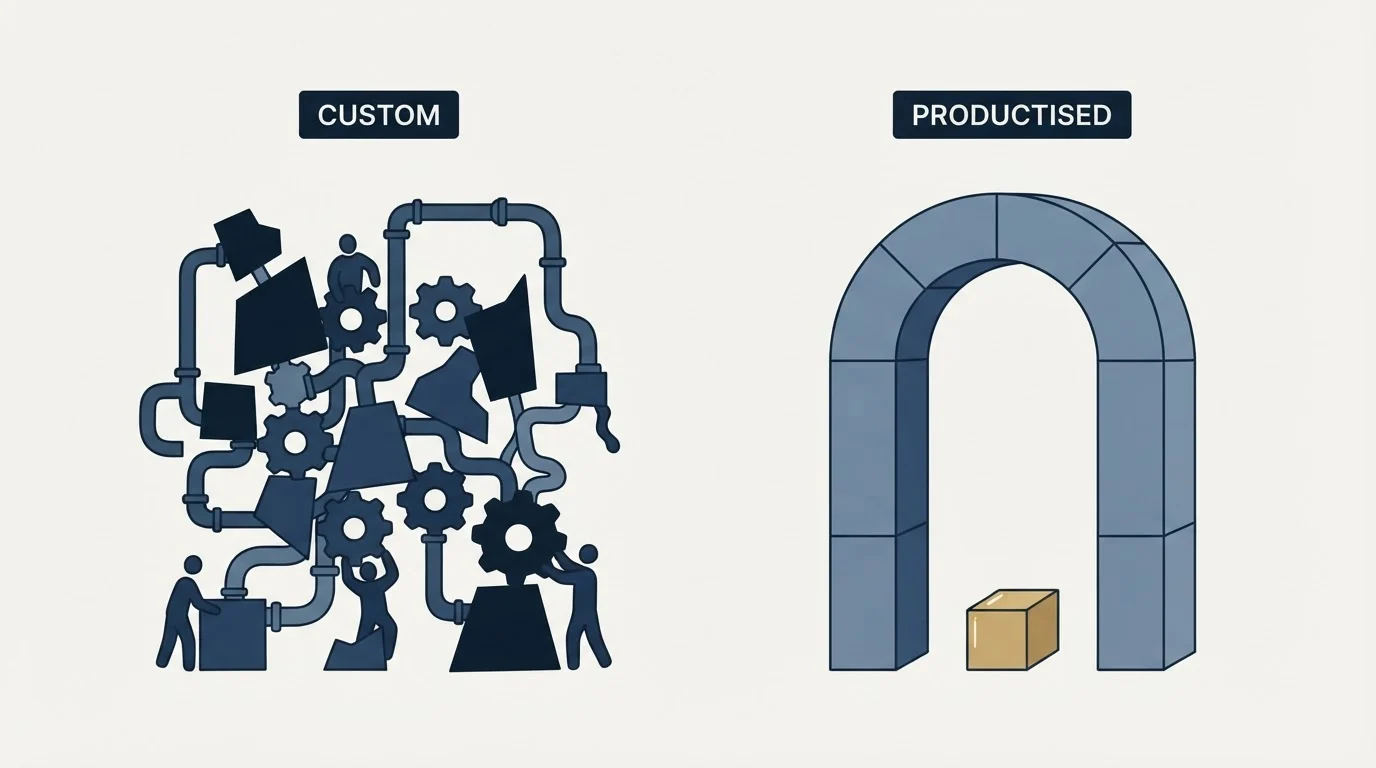
Not always. The model has a shape and it suits some situations badly.
It suits you when your motion looks like other people's. A standard B2B ICP, a recognisable offer, a normal sales cycle. The vendor's method was built on motions like yours and transfers cleanly.
It suits you when you want low management overhead. The whole point is that you buy an outcome and do not supervise a process.
It suits you when speed matters. An existing machine starts faster than one built for you. SalesHive publishes a two to three week launch window against three to six months to hire, which is the structural advantage of the model rather than a claim about any one vendor.
It suits you badly when your motion is unusual. A long technical sale, a regulated buyer, an ICP that needs genuine domain knowledge to talk to. Productised methods generalise, and generalisation is exactly wrong for a specialised conversation.
It suits you badly when you need the learning in house. A productised vendor runs the motion inside their system, which means the accumulated understanding of what works in your market accumulates there. That is fine if outbound is a channel and a problem if it is how you are still discovering your market, which is the decision covered in outbound sales outsourcing.
- Yes: They can describe exactly what transfers when a rep leaves
- Yes: There is a platform the work happens in, not just your CRM
- Yes: Data and sending tools are bundled rather than billed to you
- Yes: The method predates your engagement and is documented
- Yes: The output is defined as meetings against written criteria
- No: Scoping questions are about headcount, hours and shift coverage
- Depends: A large one-time build fee, which suggests bespoke rather than product
The trade you are making
Productisation buys consistency and costs flexibility, and it is worth being clear-eyed about the second half.
A productised vendor will resist doing things their way that are not their way. That is the source of the consistency, and it becomes friction when your market genuinely needs something the method does not cover. Buyers who choose the model and then demand extensive customisation get the worst of both: a method bent out of shape and a vendor whose advantage has been removed.
If you know in advance that you need substantial customisation, you want a different type of firm, and the category map is in outsourced sales companies.
What to check in the platform claim

Since the platform is the load-bearing part of the model, two checks are worth making.
Does it hold the reply history, and can you export it? The replies are your market feedback. A platform that holds them and will not release them turns a service into a dependency.
Does it write into your CRM? Two-way sync means your team sees every touch and the account history survives the engagement ending. A vendor platform that keeps activity to itself leaves you with a monthly report and no record.
Both are usually agreed without difficulty if raised at the start, and both are awkward to retrofit.
Onboarding tells you which model you bought
You will know within two weeks, whatever the contract says, because the two models start completely differently.
A productised service onboards by extracting from you what their system needs: the ICP definition, the offer, the qualification criteria, the suppression list, and access to push results back. The questions are structured, they arrive in a defined order, and the vendor has clearly asked them before. It can feel impersonal, and that is the machine working.
A staffing arrangement onboards by asking what you want the rep to do. The questions are open, the answers become the process, and you are effectively writing the playbook in a series of calls. That is not necessarily worse, and it means you are the process designer, which is a role you should have chosen deliberately rather than inherited.
The tell is the direction of the questions. A product asks what it needs to configure itself. Staffing asks what you would like done.
One practical consequence: if onboarding reveals you bought staffing when you wanted product, the fix is to decide quickly who internally owns the process design, rather than to wait for the vendor to produce one. Vendors in that model genuinely will do what you ask, and the failure is that nobody is asking for anything specific.
- Step 1Watch the direction of the questions
A product asks what it needs to configure itself. Staffing asks what you would like done.
- Step 2Structured extraction in a defined order means product
ICP definition, offer, qualification criteria, suppression list, and access to push results back. It can feel impersonal, and that is the machine working.
- Step 3Open questions whose answers become the process mean staffing
You are writing the playbook across a series of calls, which makes you the process designer.
- Step 4If it is staffing and you wanted product, name the owner
Decide quickly who internally owns the process design, in the first week, rather than waiting for the vendor to produce one.
How this differs from what you might already be reading

Two neighbouring questions are covered elsewhere and deliberately not repeated here. The delivery models available across the category, including dedicated teams, fractional reps, offshore staffing and outcome-based arrangements, are in SDR outsourcing. How each model is priced, and the billing-unit arithmetic that makes quotes hard to compare, is in outsourced SDR pricing.
This article is about one narrower question: whether the thing calling itself a service is a product or a payroll arrangement, and how to find out before you sign.
Worth saying plainly at the end: neither answer is disqualifying. Staffing with a subscription wrapper is a legitimate purchase that suits a company with the management capacity to direct it and an unusual motion that no product would fit. The failure is not buying staffing; it is buying staffing while believing you bought a product, and therefore not assigning anyone to do the process design that the arrangement quietly assumes you will do. Name that person in the first week and the model works perfectly well.
The short version
Test the productisation claim with one question: what happens when the rep leaves. A real product answers with what transfers and how fast; staffing answers by reassuring you about turnover. Look for a platform the work lives in, a method that predates you, bundled data and tooling, and an output defined as meetings against written criteria. Choose the model when your motion is conventional, speed matters and you want low management overhead. Avoid it when the sale is specialised or when outbound is still how you are learning your market.
If you want the output with the delivery risk on the vendor, we work on a pay-per-qualified-meeting basis with the criteria agreed in writing first, and you can see what a campaign would look like for your market.
SalesHive product and pricing claims verified against its own site as of mid-2026. Verify current terms with the vendor before relying on them.
Sources: SalesHive pricing
Frequently asked questions.
Frequently asked questions- What is SDR as a service?
- A claim about productisation: that the thing you are buying is a repeatable system with people attached, where the method, platform, data and tooling belong to the vendor and the output is defined as meetings against written criteria. The alternative sold with the same words is staffing under a subscription wrapper, where the process lives in one rep's habits.
- How do you test whether a vendor is genuinely productised?
- Ask what happens when the rep leaves and listen to whether the answer describes a system or reassures you about turnover. Then check the four components: a platform the work happens in rather than a resold CRM licence, a documented method that predates your engagement, data and sending tools bundled rather than billed to you, and an output defined against written criteria.
- When does a productised SDR service suit you badly?
- When your motion is unusual, such as a long technical sale, a regulated buyer or an ideal customer profile needing genuine domain knowledge, because productised methods generalise. And when you need the learning in house, since the vendor runs the motion inside their system and the understanding of your market accumulates there rather than with you.
- What should you check about the vendor's platform?
- Whether it holds the reply history and whether you can export it, since the replies are your market feedback and a platform that keeps them turns a service into a dependency. And whether it writes into your CRM, because two-way sync means your team sees every touch and the account history survives the engagement ending. Both are easy to agree at the start.
About the author.

B2B cold email experts helping companies generate qualified leads through done-for-you outreach campaigns.
RevenueFlow Team
Explore more.
Ready to scale your outreach?
We build GTM engines that book real meetings. See the receipts.
Related articles.
B2B Lead Lists for Aviation Companies: Build or Buy
Aviation is one of the few industries whose accounts are published by its regulator, which changes what is worth buying and what is worth downloading yourself.
Cold Calling for Food and Beverage Companies: Three Doors
Cold calling for a food or beverage company: who picks up at a chain, a distributor and an independent grocer, where each publishes its door, and when the phone is wrong.
Win Rate Benchmarks: Which Figures State a Population
A catalogue of the published average sales win rates, sorted by whether the page names the population behind its own number. Most do not.
LinkedIn Outreach for Banks: A Regulated Message
How a bank's relationship managers use LinkedIn to reach business owners: what the FFIEC guidance, FINRA's notices and LinkedIn's own rules require, and where to stop.
Cold Calling for PPC Agencies: What You Can See First
A paid media prospect is partly readable before the call and has already been told by the platform what to do when a stranger rings about its ads.
Cold Calling for Consulting Firms: The Partner's Hour
Cold calling for a consulting firm: who it dials and who picks up, why partner-led economics argue against the phone, the client's fiscal year, and when to skip it.