Apollo.io for Lead Generation: Protecting Your Domain
Search, enrich, verify, then send somewhere else. A four-stage Apollo workflow that keeps credit costs down and keeps sending reputation away from your data vendor.
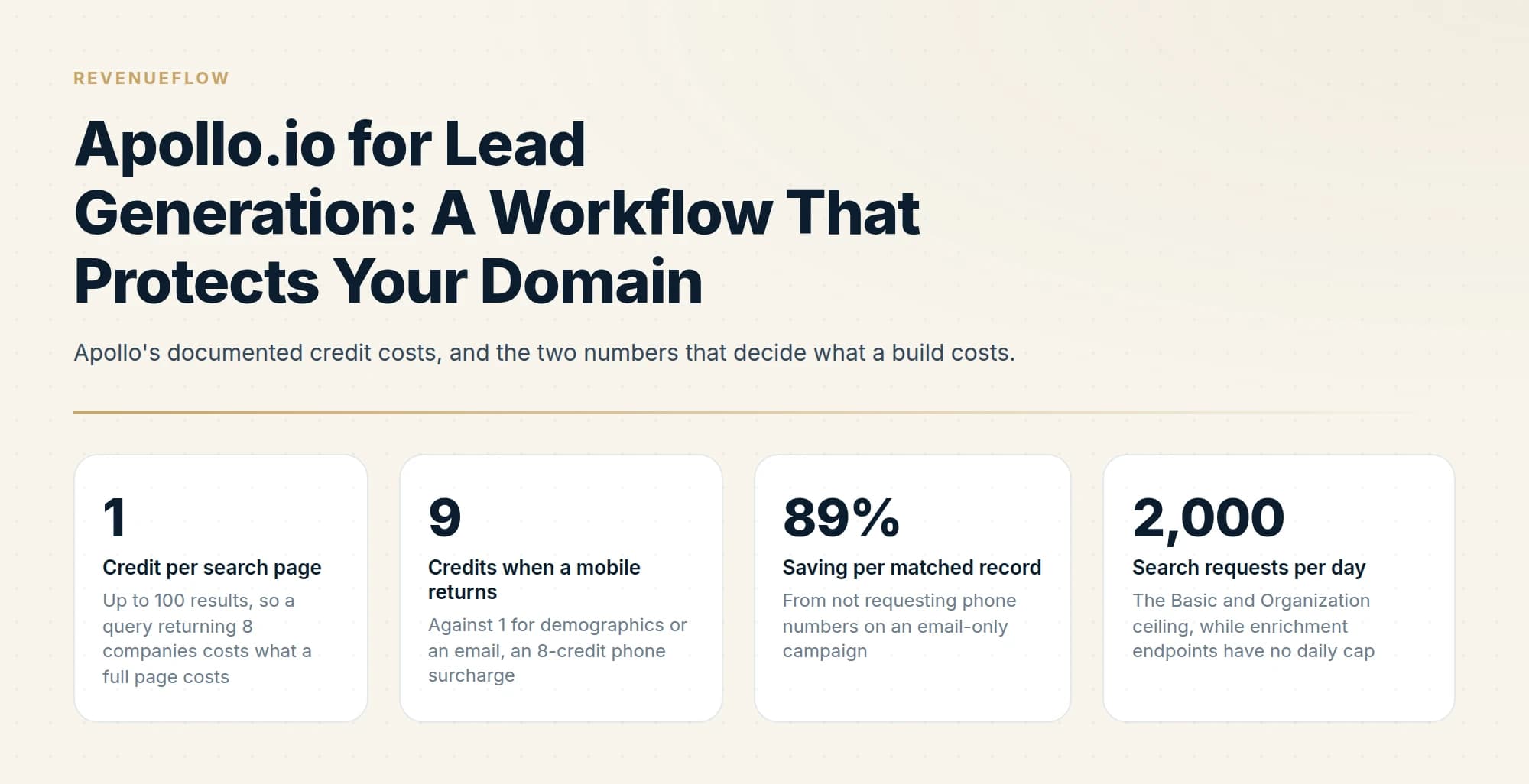
Use Apollo for search and enrichment, then verify addresses independently and send from separate infrastructure. Search bills per page so request maximum page sizes, skip phone enrichment to avoid the 8-credit surcharge, and keep sending domains away from your primary company domain.
Key takeaways
- Organization search bills 1 credit per page of up to 100 results, so narrow queries waste the same credit a full page would use.
- Skipping mobile phone enrichment cuts a matched record from 9 credits to 1, an 89% saving on an email-only campaign.
- Verification belongs immediately before the send, not at the moment the record was created, because addresses decay as people change jobs.
- Keeping the sending platform separate from the data vendor removes a single point of failure from the entire outbound motion.
Reviewed and updated September 1, 2026
The fastest way to damage a sending domain is to do everything inside one tool. Source a list, skip verification because the tool already gave you addresses, load it into the same platform's sequencer, and send. Every step is one click, which is the selling point, and the bounce rate arrives about four days later.
Apollo is good at the first half of that. The workflow below uses it for what it is genuinely strong at, sourcing and enrichment, and keeps the sending layer somewhere its problems cannot reach your data vendor or the reverse.
Teams weighing whether Apollo can also handle engagement should see how it compares to Groove by Clari, since the two tools solve different problems entirely.
The shape of the workflow
- Step 1Search
Build the account and contact list in Apollo, requesting maximum page sizes because search bills per page rather than per record.
- Step 2Enrich
Bulk-enrich in batches of up to 10 people per request, skipping phone numbers unless you need them.
- Step 3Verify
Run every address through an independent verifier immediately before send, not at the point the record was created.
- Step 4Send elsewhere
Load verified contacts into dedicated sending infrastructure on domains separate from your primary company domain.
Stage zero: decide the segment before you open the tool
The stage with the highest leverage happens before any of the four, and skipping it is what makes the other three expensive.
Credits are consumed by searching and enriching, so an undefined segment costs money to explore. More importantly, a loose segment produces a list whose response rate is low, and low response rates are what put pressure on sending reputation in the first place. The list quality problem and the deliverability problem are the same problem viewed from two ends.
Write down three things before querying anything. Which companies have the problem you solve, expressed as firmographic filters you can actually apply rather than as an aspiration. Which role owns that problem, as specific job titles including the variants different industries use for the same job. What disqualifies a company, which is the filter people skip and the one that keeps competitors, existing customers and obvious non-fits out of the list before they cost credits.
A tightly defined list of 400 companies outperforms a loose list of 4,000 on reply rate, on bounce rate, and on credit spend simultaneously. That is not a trade-off, which is unusual enough to be worth exploiting.
Stage one: search without burning credits
Apollo bills search per page rather than per record. Organization search costs 1 credit for a page of up to 100 results, so a narrow query returning 8 companies costs exactly what a full page of 100 costs. Always request the maximum page size.
The bigger saving is not repeating searches. Apollo notes that paginating through results or running repeated searches increases total credit usage, and iterative filter-tweaking is exactly the behaviour that quietly multiplies it. Define the segment before you start querying, then pull it once.
Watch the daily ceiling here too, because it is the tighter constraint on paid plans. Search sits under Apollo's "all other endpoints" limit, capped at 2,000 requests per day on Basic and Organization plans, while enrichment endpoints have no daily cap at all on any paid tier. A workflow that searches heavily and enriches lightly is running against the grain of how the product is metered.
Stage two: enrich deliberately
Two decisions carry most of the cost.
Do not request phone numbers you will not call. People enrichment costs 1 credit when demographics or an email come back, and 9 when a mobile number is returned, because the phone carries an 8-credit surcharge. On an email-only campaign that is an 89% saving per matched record.
Understand what waterfall enrichment will do to the bill. Email waterfall typically consumes 1 to 4 credits and can exceed 20 on some vendor configurations. More importantly, Apollo documents that some waterfall vendors consume credits per lookup even when no data is found, so a weak list costs money to fail on. Waterfall belongs on a tight, high-value segment rather than on everything.
Supply strong identifiers. Apollo lists first and last name together, a LinkedIn URL, or an email as the inputs that improve match rates, and warns that insufficient identifiers may be accepted and return nothing.
Up to 100 results, so a query returning 8 companies costs what a full page costs
Against 1 for demographics or an email, an 8-credit phone surcharge
From not requesting phone numbers on an email-only campaign
The Basic and Organization ceiling, while enrichment endpoints have no daily cap
Stage three: verify, every time, fresh
This is the step the all-in-one workflow skips, and it is the one that decides whether your domain survives the campaign.
An enriched address is a claim. Whether the mailbox exists and accepts mail is a separate question that only a verifier answers, and the answer changes over time as people leave jobs. Verifying at the moment the record was created tells you about a mailbox that may have closed since. Verify immediately before the send.
Handle catch-all domains explicitly rather than hoping. On an accept-all mail server every address returns as neither valid nor invalid, which means a list heavy in enterprise domains produces a large ambiguous tier. Sending into that tier blind is how a clean-looking list produces a bounce spike.
The threshold to protect is small. Mailbox providers read bounce rate as a sender-quality signal, and the tolerances are tighter than most people expect. Our cold email bounce rate benchmarks cover what healthy looks like, and how the email finder works covers the match-rate-versus-accuracy distinction underneath it.
Stage four: send from somewhere else

Two separations matter, and they are different from each other.
Separate the sending domain from your primary company domain. Cold outbound should never send from the domain your invoices and contracts come from. A reputation problem on a prospecting domain must not be able to reach the domain your customers rely on. That means dedicated sending domains, properly authenticated, warmed before use. The SPF, DKIM and DMARC setup guide covers the authentication layer.
Separate the sending platform from the data vendor. This one is commercial rather than technical. When sourcing and sending live in one account, a billing dispute, a policy change or a suspension removes your list and your ability to contact anyone at the same moment. Keeping them apart costs a second subscription and removes a single point of failure from the whole motion.
There is also a metering consequence worth planning for. Apollo consumes export credits whenever a contact leaves the platform, explicitly including CSV export and API enrichment synced to an outside system. An architecture that verifies and sends elsewhere exports constantly, so that meter belongs in your cost model from the start rather than as a surprise. The pricing breakdown covers how export credits work.
Our own stack runs this way: Email Bison for sending, HeyReach for LinkedIn, and a MillionVerifier, Prospeo and Findymail waterfall for finding addresses. We do not send from our data tooling, and the separation has never once been the thing we regretted.
The pacing rules that keep it alive
A verified list still gets you into trouble if you send it too fast from cold infrastructure.
- Yes: Sending domains are separate from your primary company domain
- Yes: SPF, DKIM and DMARC are published and passing on every sending domain
- Yes: Mailboxes are warmed before carrying real volume
- Yes: Daily volume per mailbox is conservative and ramps rather than starting at capacity
- Yes: Every address was verified within days of the send, not months
- No: The campaign includes follow-up steps in the same thread
- Depends: Catch-all domains are separated into their own risk tier
The "no" line is deliberate and it is a house position rather than a technical constraint. We run one message per campaign and do not send thread follow-ups or bump sequences. Most of the market runs multi-step sequences, and the reason we do not is that a sequence multiplies volume against the same list without improving targeting, which puts pressure on exactly the deliverability signals this whole workflow exists to protect. When an angle does not land, we build a fresh campaign with a genuinely new angle rather than adding a step to the old one.
What to do when the list runs dry
Every well-defined segment eventually exhausts, and what happens next decides whether the programme stays healthy.
The tempting move is to widen the filters. Drop the headcount floor, add three adjacent industries, include a more junior title band. It works in the sense that the list gets longer, and it degrades every downstream number: reply rate falls because fit is worse, bounce rate rises because the data on smaller companies is thinner, and the sending domains absorb both.
The better moves, in order. Add a second buyer role at the companies you already qualified, which keeps fit constant while roughly doubling the addressable contacts. Move to an adjacent segment deliberately, treating it as a new campaign with its own copy and its own success criteria rather than as an extension of the old one. Re-approach earlier non-responders with a genuinely new angle, as a separate campaign rather than a follow-up step in the existing one.
That last one is the RevenueFlow house motion on email, and it is worth being precise about why it is legitimate here when we refuse the equivalent on LinkedIn. A fresh email lands as a new message in an inbox. A second LinkedIn message lands in the same visible thread, directly under the one the person ignored, which reads as a bump no matter how the campaign is structured. Same intent, different mechanics, different answer. Our LinkedIn automation guide covers that side.
What this workflow does not fix
Apollo gives you access to contacts. It does not make them the right contacts, and no amount of credit efficiency compensates for a segment that was chosen badly.
The highest-leverage work happens before any of the four stages: deciding which companies genuinely have the problem you solve, and which role inside them owns it. A tightly defined list of 400 companies outperforms a loosely defined list of 4,000 on every metric that matters, and it costs dramatically fewer credits to build. For the wider picture on Apollo itself, the review covers where the product fits and where it does not.
We run sourcing, verification, infrastructure and sending for clients on a pay-per-qualified-meeting basis, which means the domain risk in this article sits on our side. You can see what a campaign would look like for your market.
Apollo credit consumption, search page-size billing, rate limits and export-credit behaviour are per Apollo's developer documentation and pricing page, fetched 11 August 2026. Apollo revises these; verify current terms with Apollo before building a workflow around them.
Sources: Apollo API pricing and credits, Apollo API rate limits, Apollo.io pricing
Frequently asked questions.
Frequently asked questions- Can I send cold email directly from Apollo?
- You can, and we would not. Sending from the platform that also sources your list ties your prospecting data and your sending reputation to one account, so a billing dispute or policy change takes out both at once. Separating them costs a second subscription and removes a single point of failure worth far more than that.
- How do I keep Apollo credit costs down on a large list?
- Request maximum page sizes on search, since it bills per page rather than per record. Skip phone enrichment unless you need calls, which takes a matched record from 9 credits to 1. Reserve waterfall enrichment for tight high-value segments, because some waterfall vendors charge per lookup even when nothing is found.
- Do I need to verify emails Apollo already gave me?
- Yes, and fresh. An enriched address is a claim that a mailbox exists rather than confirmation it accepts mail, and records decay continuously. Bounce rate is read by mailbox providers as a sender-quality signal, so an unverified batch degrades placement for everything else sending from that domain, not just the bad addresses.
- Should cold email come from my main company domain?
- No. Use dedicated sending domains, authenticated with SPF, DKIM and DMARC, and warmed before carrying volume. A reputation problem on a prospecting domain must never be able to reach the domain your invoices and contracts come from. That separation is the cheapest insurance in the whole setup.
About the author.

Ben Carden is CRO at RevenueFlow, which builds and operates outbound revenue engines for B2B companies. Previously at Gartner Enterprise. Studied at London School of Economics.
Ben Carden · CRO
Connect on LinkedIn →Explore more.
Ready to scale your outreach?
We build GTM engines that book real meetings. See the receipts.
Related articles.
When Outbound Stops Scaling: What Breaks First
Doubling the budget rarely doubles the meetings. The five constraints that bind in order, the signature each one leaves in the numbers, and what actually buys more.
Multichannel Lead Generation: Coverage or Sequencing
Multichannel covers two decisions that behave nothing alike. One adds people the first channel cannot reach. The other adds touches to people you already contacted.
5 ABM Campaign Examples and How Each One Is Built
Five worked account-based campaign examples, each built on the same five fields: account set, tier, plays in order, owner and handoff, and the exit condition.
Field Marketing in B2B: What a Programme Costs Per Meeting
Two different practices answer to the name field marketing. The B2B one runs dinners and roadshows for named accounts, and it divides like any other channel.
Email Marketing Database: What a Bought One Costs
Three different objects are sold under this one phrase, and the platforms ranking for it forbid the version half the results are selling.
Average Landing Page Conversion Rate: What It Measures
Four published answers to one question span more than four to one. What each dataset actually counted, and why none of them applies to a page fed by cold outbound.