Apollo.io Review: What It Includes, Costs and Where It Fits
A documentation-grounded look at Apollo: the published plans, how credits really work, what the Unlimited fair-use formula means, and where an all-in-one is weaker.
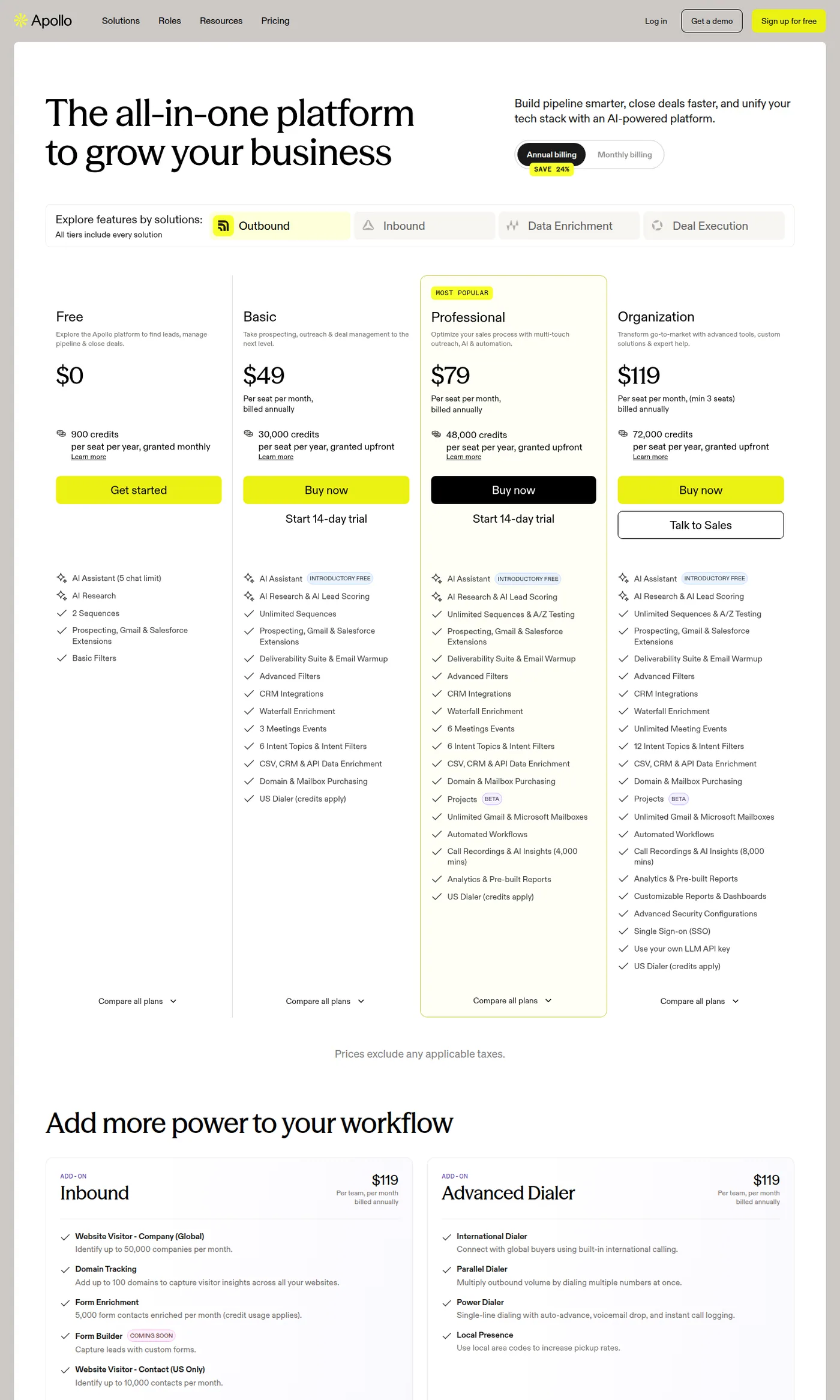
Apollo bundles a contact database, an enrichment API and a sending tool into one subscription, published on annual billing at US$0, US$49, US$79 and US$119 per seat per month. Credits rather than plan price drive the real cost, and the Unlimited plans carry a published fair-use ceiling.
Key takeaways
- Apollo's annual-billing plans are US$0, US$49, US$79 and US$119 per seat per month, with the Organization tier carrying a three-seat minimum.
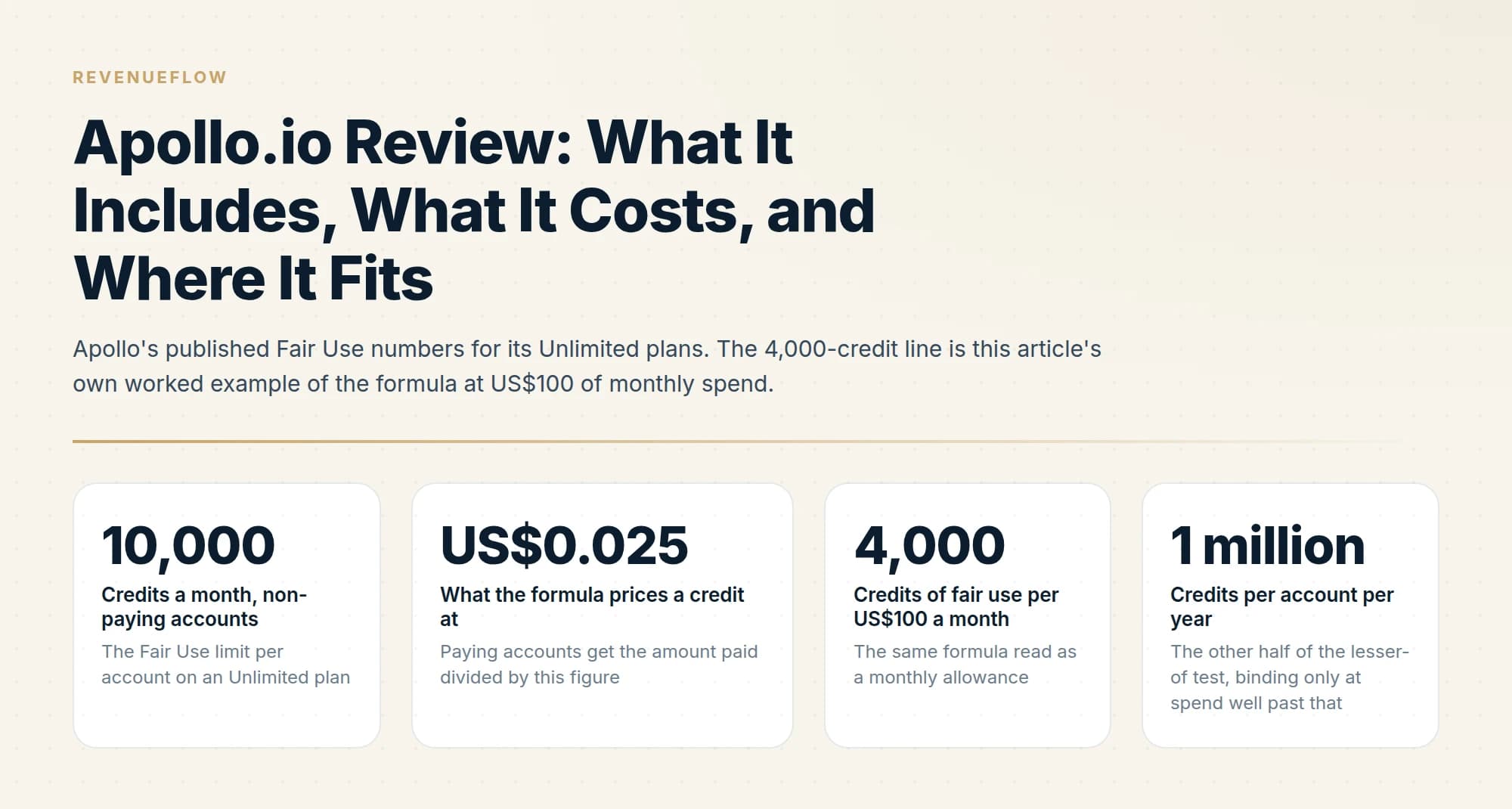
- Unlimited plans are capped by a Fair Use Policy at the lesser of amount paid divided by US$0.025, or 1 million credits per account per year.
- Export credits are consumed whenever a contact leaves Apollo, including CSV export and API enrichment synced to an outside system.
- People enrichment costs 1 credit for demographics or an email and 9 if a mobile number is returned, so skipping phone data saves 89% per record.
Reviewed and updated September 5, 2026
Apollo sells three things in one subscription: a contact database, an enrichment engine, and a sending tool. Most reviews treat that as the selling point. It is also the thing that makes the product hard to evaluate, because the price you compare against a data vendor is not the price you compare against a sending platform, and the credit system connects the two in ways that only become visible on the invoice.
Apollo sales intelligence is the vendor phrase for all three of those parts at once, so a team comparing it against a data provider and a team comparing it against a sequencer are pricing different products under one name.
This is a documentation-grounded assessment rather than a hands-on one. We run Email Bison for sending and HeyReach for LinkedIn, and our email waterfall is MillionVerifier, Prospeo and Findymail, so we do not send from Apollo and will not pretend otherwise. What follows is what Apollo publishes about itself, checked against its own pricing page and developer documentation, plus what is structurally true about tools built this way.
Where the data comes from matters more than the headline database size: Apollo's own compliance documentation describes a contributory model alongside licensed and public sources, which is why a record can be current for one company and years stale for the next, and why the removal-request process is part of the product rather than a footnote.
What you are actually buying
Apollo's own materials describe a database of more than 240 million contacts, an enrichment API, a CRM-adjacent record layer, and sequencing for outbound email. The developer documentation covers all of it: search endpoints, enrichment endpoints, account and contact records, deals, and email sending.
Read as a list of Apollo.io features, that is four products sharing one login, and the operator question is which of them to actually run rather than how many exist.
The published plans, read off Apollo's pricing page in its default annual-billing view, are Free at zero, Basic at US$49, Professional at US$79, and Organization at US$119 with a three-seat minimum. Every one of those is priced per seat per month, billed annually, and each carries a credit allowance granted per seat per year: 900 on Free, then 30,000, 48,000 and 72,000. Monthly billing costs more, with the page advertising annual as a 24% saving.
- Search across Apollo's contact database
- People and organization enrichment endpoints
- Waterfall enrichment across configured vendors
- Competes with dedicated data providers
- Priced in credits rather than seats
- Email sequences sent from your mailboxes
- Competes with dedicated sending platforms
- Ties your sending reputation to the same vendor as your data
- Sending volume is not what credits meter
- The piece we deliberately keep separate
- Documented REST API with an OpenAPI spec
- Published rate limits by plan
- Published per-endpoint credit costs
- MCP server and CLI for agent-driven use
- Rewards teams that build rather than click
The credit system is the real pricing model
The plan price is the entry fee. Credits are what you actually spend, and Apollo documents their consumption precisely enough that you can model it before committing.
Enrichment is metered per result rather than per request. People enrichment costs 1 to 9 credits per person and is charged only when credit-consuming data is returned: 1 credit for demographics or an email address, plus 8 more if a mobile phone number comes back. Organization enrichment is 1 credit per organization. Search endpoints charge per page rather than per record, so organization search is 1 credit for a page of up to 100 results.
Waterfall enrichment is where costs become hard to predict, and Apollo says so itself. Email waterfall typically uses 1 to 4 credits, though some vendor configurations or higher-cost matches run past 20. Phone waterfall typically uses 8 to 25 and can exceed 45. Most importantly, Apollo documents that some waterfall vendors consume credits per lookup even when no data is found, which means a low-match-rate list can spend real money returning nothing.
Endpoints that create, update, list or manage records consume no credits at all. The meter is on data retrieval, which is the correct design and worth knowing before you architect anything against the API. The Apollo API guide works through the rate limits and the caching strategy that follows from this.
The "unlimited" plans are not unlimited
This is the finding most worth carrying away, and Apollo publishes it in the fine print of its own pricing page rather than hiding it.
Apollo's Unlimited plans are governed by a Fair Use Policy. For non-paying accounts on an Unlimited plan the limit is 10,000 credits per account per month. For paying accounts it is the lesser of the amount paid divided by US$0.025, or 1 million credits per account per year.
Read that second formula carefully, because it prices a credit. At US$0.025 each, every US$100 of monthly spend buys 4,000 credits of fair use, and the annual million-credit ceiling only becomes the binding constraint at spend levels well past that. "Unlimited" here means "generous, with a published formula", which is more honest than most usage of the word and still not what the label implies.
The Fair Use limit per account on an Unlimited plan
Paying accounts get the amount paid divided by this figure
The same formula read as a monthly allowance
The other half of the lesser-of test, binding only at spend well past that
Export credits are a separate line to understand. Apollo consumes them whenever you export a contact outside Apollo, which explicitly includes CSV export, CRM sync, and Person API enrichment synced to any outside system such as Outreach or Salesloft. If your intended architecture is Apollo for data and something else for sending, that is the meter you will be running against constantly.
The API is the best-documented part of the product
If you are the kind of team that builds rather than clicks, this is where Apollo separates itself from most of its competitors, and it is underweighted in almost every review.
The developer documentation publishes rate limits by plan, per-endpoint credit costs, an OpenAPI specification, and status-code behaviour. Apollo also ships an MCP server and a command-line interface, both aimed at agent-driven and terminal-driven workflows. Very few data vendors publish their metering this openly, and the ones that do not are considerably harder to budget for.
The rate limits themselves have a useful shape. On any paid plan, enrichment endpoints allow 1,000 requests a minute with no hourly or daily ceiling at all, while search and record-management endpoints are capped at 200 a minute and 2,000 a day on Basic and Organization. Apollo is steering you toward enriching in volume and searching sparingly. A workflow designed the other way round hits a wall that upgrading does not immediately clear.
One caveat Apollo states directly: legacy plans may carry different limits, and Professional plans may carry custom ones. The usage-stats endpoint returns the limits actually assigned to your workspace, and Apollo names it as the source of truth over any published table.
What the free tier is genuinely useful for
The free plan is not a viable prospecting tool, and it is a good evaluation instrument.
Trials include 50 credits and 5 mobile credits with almost all the features of the plan selected, and the Starter plan is described as free forever. Fifty credits buys roughly fifty enriched contacts if you skip mobile numbers, which is precisely the sample size needed to answer the only question that matters: does Apollo hold good records for your specific market.
Use it for that and nothing else. Fifty credits will not tell you whether the sequencer suits your process or whether the CRM layer fits your pipeline, and those are answerable later. Data quality in your niche is answerable now, for free, and it is the question that should decide the purchase.
Where an all-in-one is structurally weaker
Two arguments here, and neither depends on Apollo's execution quality.
Your data vendor and your sending reputation should not be the same account. Sending from the platform that also sources your list concentrates risk: a billing dispute, a policy change, or a suspension takes out your prospecting and your ability to talk to prospects at the same time. Keeping the sending layer separate is cheap insurance, and it is why our own stack splits them.
Teams weighing a separate sourcing tool against Apollo's own database may find it useful to see how Apollo compares with Lead411, since the two solve different parts of the workflow.
A tool that meters exports taxes the architecture you probably want. The most reliable outbound setups verify addresses independently before sending, which means moving data out. Apollo's export credits are a documented cost on exactly that motion, and any honest cost model has to include them rather than comparing plan prices alone.
None of that makes the data worse. It makes the all-in-one framing a commercial argument rather than a technical one.
What we would actually verify before buying
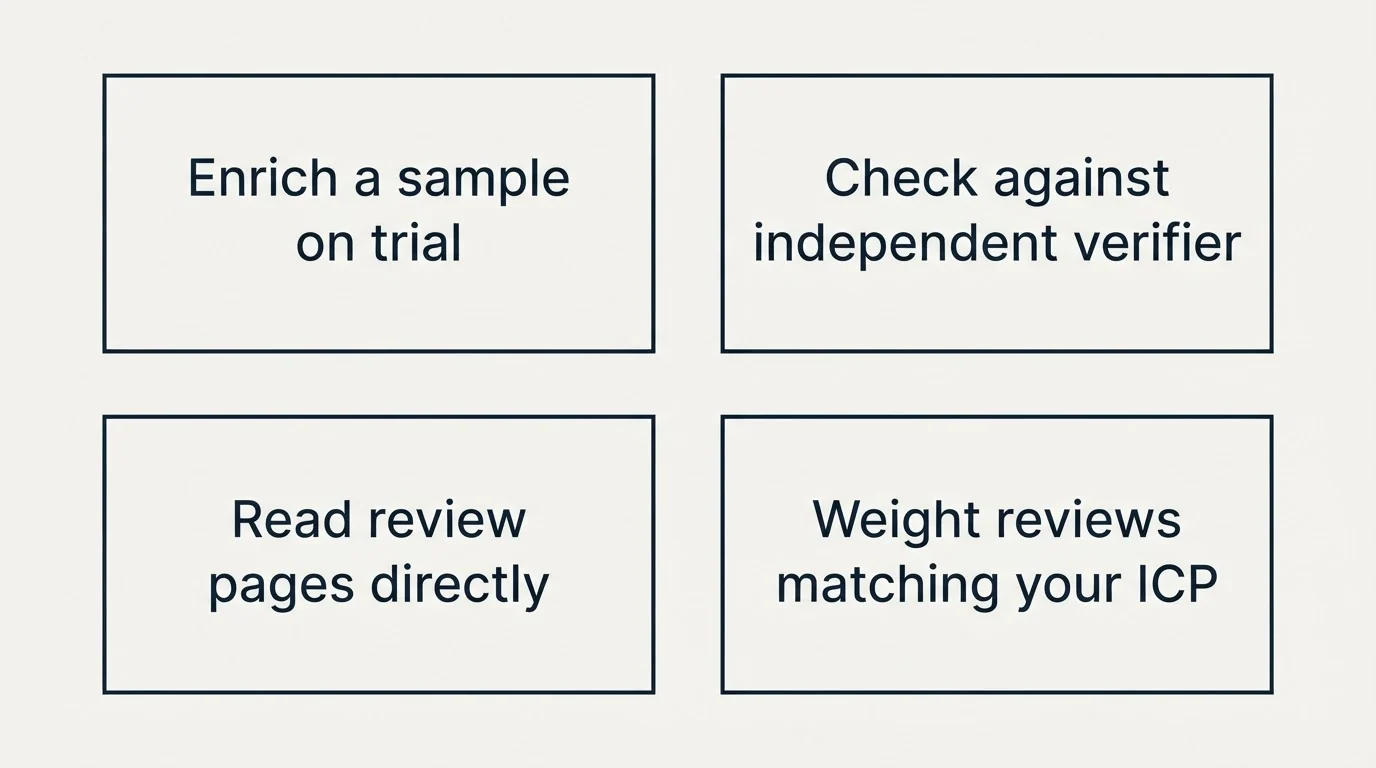
The published documentation answers the pricing questions well and cannot answer the only question that matters for a data vendor, which is whether the records are right for your specific market.
- Yes: Pull 100 contacts in your exact ICP and verify the emails independently
- Yes: Check how many of those records carry a current job title, not a stale one
- Yes: Model your monthly credit burn including export credits, not just the plan price
- Yes: Confirm the rate limits on your intended plan support your batch sizes
- No: Assume the database size claim tells you anything about your niche
- No: Assume an Unlimited plan means unlimited
- Depends: Decide whether sending belongs in the same tool as sourcing
Apollo's trial makes the first check cheap: trial plans include 50 credits and 5 mobile credits, with almost all features of the plan selected, and there is a Starter plan described as free forever to fall back to. Fifty credits is enough to enrich a small sample and check it against an independent verifier, which is a far better signal than any review score.
On reviews: Apollo has substantial listings on G2, Capterra and TrustRadius. We are not quoting ratings from them here, because those pages block automated retrieval and we do not restate numbers we could not load ourselves. Read them directly, and weight the reviews that describe an ICP resembling yours.
Who it fits
Apollo fits a team that wants one contract covering data and outbound, is comfortable with a metered model, and has someone who will read the credit documentation before running a large job. It fits API-first teams especially well, because the documentation is genuinely good and the per-endpoint cost table is unusually explicit.
It fits less well where sending reputation is the constraint rather than data access, which is most of what determines cold email results. Deliverability is an infrastructure discipline that lives in domains, warmup, volume pacing and list hygiene, and no data vendor solves it. Our cold email deliverability guide covers that layer, and the domain-safe workflow covers how to use Apollo for sourcing without putting your sending domains behind it.
If you are comparing Apollo against specific alternatives, we maintain head-to-head breakdowns including Apollo versus ZoomInfo and Apollo versus Clay. For the pricing detail on its own, the full plan and credit breakdown is here.
We run outbound for clients on a pay-per-qualified-meeting basis, which means the tool selection, the credit budget and the deliverability work sit on our side of the line. You can see what a campaign would look like for your market.
Apollo plan prices and credit allowances are read from Apollo's pricing page as rendered on its default annual-billing view, captured 11 August 2026; monthly billing costs more and was not captured. Trial terms, Fair Use credit limits and export-credit rules are from the same page, and API credit consumption is per Apollo's developer documentation, same date. Apollo revises pricing and credit policies; verify current terms on Apollo's own pages before purchasing.
Sources: Apollo.io pricing, Apollo API pricing and credits, Apollo API rate limits
Frequently asked questions.
Frequently asked questions- How much does Apollo.io cost?
- On annual billing, Apollo publishes Free at zero, Basic at US$49, Professional at US$79 and Organization at US$119, all per seat per month, with Organization requiring three seats. Monthly billing costs more. The plan price is only part of the cost, because credits are consumed separately for enrichment, search and exporting contacts out of Apollo.
- Is Apollo's unlimited plan really unlimited?
- No. Apollo publishes a Fair Use Policy governing its Unlimited plans: 10,000 credits per account per month for non-paying accounts, and for paying accounts the lesser of the amount paid divided by US$0.025 or 1 million credits per account per year. That formula prices a credit at two and a half cents, so budget against it rather than the label.
- Is Apollo good enough to replace a dedicated sending tool?
- It can send, but tying your data vendor and your sending reputation to one account concentrates risk: a billing dispute or policy change removes your list and your ability to contact anyone at once. We keep the layers separate and run Email Bison for sending, which also means verification happens outside the tool that supplied the addresses.
- How accurate is Apollo's data?
- That depends entirely on your market, and no published figure transfers between segments. Apollo's trial includes 50 credits, which is enough to enrich a sample from your real ICP and check the addresses against an independent verifier. That test tells you more about your niche than any review score or vendor accuracy claim.
About the author.

B2B cold email experts helping companies generate qualified leads through done-for-you outreach campaigns.
RevenueFlow Team
Explore more.
Ready to scale your outreach?
We build GTM engines that book real meetings. See the receipts.
Related articles.
The Real Cost per 1,000 Emails, Verifications and Data Credits in 2026
Unit prices computed from verified vendor plans: $1.00 per 1,000 emails sent, $2.00 per 1,000 verifications and $19.60 per 1,000 enrichment credits.
Firmographic Data Providers: What Six of Them Publish
Six firmographic data providers read from their own pages: the fields each sells, the coverage each states, how the data is delivered, and who prints a price.
Which CRMs and Tools the Outbound Stack Connects To: Integration Data From 342 Sales Tools
HubSpot is named as an integration by 52.3% of 342 verified sales tools, Zapier by 50.3% and Salesforce by 43.3%. Here is the full map by category.
Sales Engagement Platform Pricing in 2026: What 61 Tools Charge and Which Hide It
Sales engagement platforms start at a median of $75 a month, 70.5% carry a quote-only tier, and AI SDR platforms start at $204.50. Data from 61 verified tools.
Free Tiers and Trials in Sales Tools: What $0 Gets You Across 386 Vendors
37.0% of 386 verified sales tools have a permanent free plan. The median free data tier gives 50 credits and the median free sending plan 2,500 emails a month.
Salesgear Pricing: Two Ladders Under One Plan Title
Salesgear's page is titled as one plan and carries a Data ladder and an Outreach ladder. Both at both billing states, what each meters, and the two vendor-side conflicts.