Which CRMs and Tools the Outbound Stack Connects To: Integration Data From 342 Sales Tools
HubSpot is named as an integration by 52.3% of 342 verified sales tools, Zapier by 50.3% and Salesforce by 43.3%. Here is the full map by category.
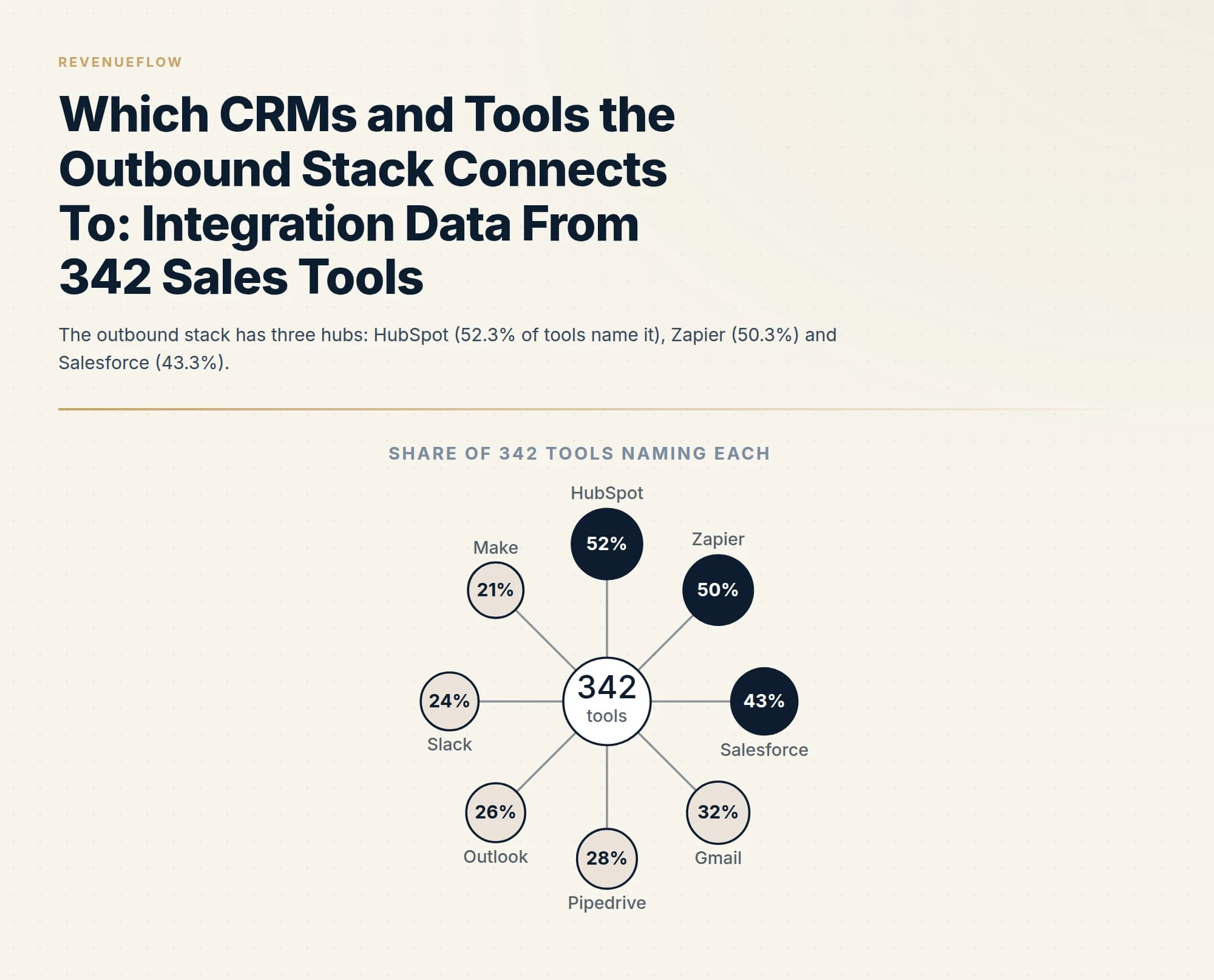
Among 342 sales tools that name at least one integration, 52.3% name HubSpot, 50.3% name Zapier and 43.3% name Salesforce. No other integration reaches a third. 130 tools name both HubSpot and Salesforce, 49 name only HubSpot and 18 name only Salesforce. Of 586 distinct integrations named, 59.2% are named by a single tool.
Key takeaways
- HubSpot (179 tools, 52.3%), Zapier (172, 50.3%) and Salesforce (148, 43.3%) are the only integrations named by more than a third of 342 sales tools.
- HubSpot and Salesforce travel together: 130 tools name both, 49 name only HubSpot and just 18 name only Salesforce.
- 60.8% of tools name at least one CRM and 56.7% name an automation platform such as Zapier, Make or n8n; 62 tools offer an automation platform and no native CRM connection.
- 37 tools (10.8%) already name an AI assistant or assistant protocol such as Claude, ChatGPT or an MCP server as an integration, led by data enrichment tools at 15.2%.
Reviewed and updated September 17, 2026
The integrations page is the most skimmed page on a vendor's site and the one that decides whether a tool survives its first month. A sequencer that cannot write replies back to the CRM becomes a second inbox nobody checks. An enrichment tool that cannot push into the sequencer becomes a CSV export habit. Before a team compares features, it needs to know whether a tool fits the systems it already runs.
RevenueFlow's verified vendor dataset records, for each tool, the integrations the vendor names on its own site. As of September 2026 the dataset holds 386 sales tools, and 342 of them (88.6%) name at least one integration. This study counts what they connect to. The result is a map of the outbound stack's real hubs: which three systems almost everything plugs into, how the pattern changes by category, and how long the tail is behind them.
The three hubs
HubSpot is named by 179 of the 342 tools, or 52.3%. Zapier is named by 172 (50.3%) and Salesforce by 148 (43.3%). Nothing else reaches a third of the dataset.
| Rank | Integration | Tools naming it | Share of 342 tools |
|---|---|---|---|
| 1 | HubSpot | 179 | 52.3% |
| 2 | Zapier | 172 | 50.3% |
| 3 | Salesforce | 148 | 43.3% |
| 4 | Gmail | 108 | 31.6% |
| 5 | Pipedrive | 94 | 27.5% |
| 6 | Outlook | 89 | 26.0% |
| 7 | Slack | 83 | 24.3% |
| 8 | Make | 71 | 20.8% |
| 9 | Zoho CRM | 51 | 14.9% |
| 10 | Mailchimp | 46 | 13.5% |
| 11 | 41 | 12.0% | |
| 12 | Clay | 40 | 11.7% |
| 13 | Google Sheets | 35 | 10.2% |
| 14 | Shopify | 34 | 9.9% |
| 15 | WordPress | 34 | 9.9% |
| 16 | Google Workspace | 33 | 9.6% |
| 17 | n8n | 31 | 9.1% |
| 18 | Outreach | 31 | 9.1% |
| 19 | Microsoft Dynamics | 29 | 8.5% |
| 20 | Claude | 28 | 8.2% |
The ranking says something about who these vendors are selling to. HubSpot leading Salesforce by nine points is a small and mid-sized business signature: a dataset of enterprise software would reverse the order. Pipedrive at 27.5% points the same way. Zoho CRM (51 tools) and Microsoft Dynamics (29 tools) are present and far behind.
Zapier is the more interesting hub. It sits in second place without being a system of record at all. For 50.3% of these tools, the integration strategy includes "connect it to anything through Zapier", and Make adds another 71 tools (20.8%). The section on automation platforms below looks at what that substitutes for.
A note on what a count means here. A tool names an integration when the string appears in the list the record took from the vendor's own page. Vendors list their headline connections, not every app in a marketplace, and the median tool names 8. So every share in this study reads as "share of tools that name X on their own page". A tool that does not name HubSpot may still connect to it through a marketplace listing or an API, and nothing here says otherwise.
How the pattern changes by category
The averages hide five different integration strategies. The denominators are the tools in each category that name at least one integration: email sending 78, data enrichment 125, email warmup 20, crm 64, sales engagement 55.
| Integration | Email sending | Data enrichment | Email warmup | CRM | Sales engagement |
|---|---|---|---|---|---|
| HubSpot | 44.9% | 72.0% | 5.0% | 7.8% | 87.3% |
| Zapier | 74.4% | 48.0% | 0.0% | 56.2% | 32.7% |
| Salesforce | 42.3% | 52.8% | 10.0% | 3.1% | 81.8% |
| Gmail | 33.3% | 11.2% | 80.0% | 43.8% | 43.6% |
| Pipedrive | 28.2% | 34.4% | 5.0% | 1.6% | 49.1% |
| Outlook | 20.5% | 6.4% | 75.0% | 50.0% | 32.7% |
| Slack | 32.1% | 12.8% | 0.0% | 34.4% | 36.4% |
| Make | 34.6% | 23.2% | 0.0% | 14.1% | 10.9% |
| Zoho CRM | 15.4% | 20.8% | 10.0% | 0.0% | 20.0% |
| Mailchimp | 1.3% | 17.6% | 5.0% | 34.4% | 0.0% |
| 5.1% | 14.4% | 0.0% | 9.4% | 23.6% | |
| Clay | 6.4% | 22.4% | 0.0% | 1.6% | 10.9% |
Sales engagement tools live inside the CRM. 87.3% name HubSpot, 81.8% name Salesforce and 49.1% name Pipedrive. Taken together, 92.7% of sales engagement tools name at least one CRM. For this category a CRM sync is the product's reason to exist: the platform's job is to log activity where the pipeline is managed.
Data enrichment tools push records wherever the buyer keeps them. 72.0% name HubSpot and 78.4% name at least one CRM. This is also the category most likely to name another outbound tool as a destination: 33.6% name a sequencer such as Outreach, Salesloft, lemlist, Instantly, Smartlead or Apollo, and 22.4% name Clay. Clay's presence is notable for a company that barely existed as a category five years ago: 40 tools now list it, most of them data providers that want to be a source inside someone else's workflow.
Email sending tools lean on automation platforms. 74.4% name Zapier, the highest figure for any category, and 75.6% name at least one automation platform. Only 62.8% name a CRM. A cold email sequencer's native integrations tend to stop at two or three CRMs, and everything else is left to a Zapier trigger.
CRMs connect outward to mailboxes and marketing tools. A CRM naming another CRM is rare by definition, so the top of their lists looks different: 67.2% name a mailbox provider, 56.2% name Zapier, 42.2% name Slack or Microsoft Teams and 34.4% name Mailchimp. CRMs also name the most integrations per tool, a median of 10.
Warmup tools connect to mailboxes and stop. All of them name a mailbox provider (80.0% Gmail, 75.0% Outlook), 20.0% name a CRM and none name an automation platform. Their median list is 6 entries long, and nearly every entry is an email service.
HubSpot and Salesforce travel together
A vendor that builds one of the two large CRM integrations usually builds the other. 130 tools (38.0%) name both HubSpot and Salesforce. 49 (14.3%) name HubSpot without Salesforce, and only 18 (5.3%) name Salesforce without HubSpot. The remaining 145 (42.4%) name neither. That group is led by the CRMs themselves (59 tools), followed by 35 email sending tools, 29 data tools and 18 warmup tools. Only 4 sales engagement tools are in it.
The asymmetry is the useful part. A team on HubSpot can assume that a tool which integrates with any major CRM integrates with theirs: HubSpot is missing from only 18 of the 148 tools that name Salesforce. A team on Salesforce has a slightly narrower field, since 49 HubSpot-connected tools do not name it. A team on Pipedrive, Zoho or Dynamics should check every time, because those connections are the exception. 91 tools name both HubSpot and Pipedrive, which means Pipedrive support is almost always an addition to HubSpot support and rarely a substitute for it.
For teams weighing a CRM change partly on ecosystem grounds, the roundups of Salesforce alternatives and Pipedrive alternatives cover pricing and fit for each option.
Native CRM connection or automation platform
There are two ways to get data out of a sales tool: a native connection to the system of record, or a generic bridge through Zapier, Make, n8n or a similar platform. Across the dataset 60.8% of tools (208) name at least one CRM and 56.7% (194) name at least one automation platform.
The two are closer to substitutes than complements. 76 tools name a CRM and no automation platform. 62 tools name an automation platform and no CRM, which means the vendor has handed CRM sync to the buyer as a build-it-yourself project. 72 tools name neither.
That middle group deserves attention at evaluation time. A Zapier connection is a real integration, and it is also a recurring cost, a second point of failure and a workflow someone on the team has to own. For a reply-handling flow, where a positive response has to reach the CRM and the right person within minutes, a native sync and a multi-step automation are not equivalent. The category split shows where the gap is widest: 75.6% of email sending tools name an automation platform against 62.8% naming a CRM, while sales engagement runs the other way at 47.3% and 92.7%.
n8n, the open-source automation platform, is named by 31 tools, which is worth noting for teams that self-host their workflows.
The newest entries: AI assistants
37 tools (10.8%) name an AI assistant or an assistant protocol as an integration: Claude (28 tools, 8.2%), ChatGPT or OpenAI (23 tools), Cursor, or a Model Context Protocol server. Data enrichment leads at 15.2% of its tools. These connections let an assistant query the vendor's data or trigger its actions directly, and a year ago most integrations pages did not have the category.
The figure is small and it is the fastest-moving one in the study. Any team building agent-driven prospecting should read it as a floor. The Clay pricing and Clay alternatives pages cover the workflow tools where most of that experimentation happens today.
The long tail
The 342 tools name 586 distinct integrations between them. 347 of those, or 59.2%, are named by exactly one tool. The head is steep and short: the twelve most-named integrations reach 93.6% of tools, meaning almost every tool names at least one of them, and after the thirtieth entry each integration is named by fewer than twenty tools.
Per tool, the median list is 8 integrations long, a quarter of tools name 10 or more, and the longest list belongs to Alta with 41 named integrations (verified 2026-09-04). Length is a weak signal of quality. A sequencer with four deep, two-way CRM syncs is more useful to most teams than one with forty listed logos that all resolve to a webhook.
How to use this when choosing tools
Three checks follow from the data.
- Start from the system of record. If it is HubSpot or Salesforce, integration coverage will rarely be the deciding factor, because most tools that integrate with any CRM integrate with both. If it is anything else, coverage is the first filter to apply and the vendor's own integrations page is where to apply it.
- Ask what "integrates with" means. Native two-way sync, one-way push, and "available through Zapier" all appear as the same logo. 62 tools in this dataset offer an automation platform and no native CRM connection.
- Count the hops. Every tool-to-tool handoff in an outbound workflow, from data source to sequencer to CRM to chat alert, is a place where a reply can get lost. 24.3% of tools name Slack, which is how most teams close that last hop.
The sales engagement platforms guide covers the category where CRM integration depth matters most. Teams that would rather not assemble and maintain the plumbing can see how RevenueFlow runs the whole workflow on a free campaign.
Methodology
Population. The 386 tools in RevenueFlow's verified vendor dataset as of September 2026, each record read from the vendor's own pages and dated between 2026-08-28 and 2026-09-05. The 342 tools with at least one named integration are the denominator for every share. The 44 records with an empty list were left out of the denominator, since an empty list says nothing about what a tool connects to.
Counting. Integration names were lowercased and spelling variants merged: Outlook and Microsoft Outlook, Make and Make.com, Apollo and Apollo.io, Claude and Claude Code, ChatGPT and OpenAI, Microsoft Dynamics and Dynamics 365. "Zoho" and "Zoho CRM" were counted together. A tool counts once per integration however many variants it lists. The HubSpot, Zapier and Salesforce counts were recomputed by a second reader over the raw record files and matched.
Groups. CRM: HubSpot, Salesforce, Pipedrive, Zoho CRM, Microsoft Dynamics, Close, Attio, Copper, GoHighLevel. Automation: Zapier, Make, n8n, Pabbly, Integrately, Pipedream, webhooks. Mailbox: Gmail, Outlook, Google Workspace, Microsoft 365, SMTP, IMAP. Chat: Slack, Microsoft Teams.
Limits. These are vendor-named headline integrations, not complete directories. Absence from a list is not evidence that no connection exists. The dataset covers outbound sales tooling and skews toward vendors serving small and mid-sized teams, which shapes the HubSpot and Salesforce ordering.
Integration lists verified between 2026-08-28 and 2026-09-05. Confirm current integrations with the vendor before relying on them.
Frequently asked questions.
Frequently asked questions- Which CRM do most sales tools integrate with?
- HubSpot. In RevenueFlow's dataset, 179 of 342 sales tools that name any integration name HubSpot, which is 52.3%. Salesforce follows at 148 tools, or 43.3%, then Pipedrive at 94 tools, Zoho CRM at 51 and Microsoft Dynamics at 29. The HubSpot lead reflects a dataset of tools that mostly serve small and mid-sized sales teams.
- If a tool integrates with Salesforce, does it also integrate with HubSpot?
- Usually. Of the 148 tools that name Salesforce, 130 also name HubSpot and only 18 do not. The reverse is less reliable: 49 tools name HubSpot without naming Salesforce. Teams on Pipedrive, Zoho CRM or Microsoft Dynamics should check every vendor's integrations page, because those connections are much less common than the two large CRMs.
- How many integrations does a typical sales tool have?
- The median tool names 8 integrations on its own site, a quarter name 10 or more, and the longest list in the dataset has 41. CRMs name the most, with a median of 10, and email warmup tools the fewest, with a median of 6. These are headline integrations a vendor chooses to list, so marketplace directories are usually longer.
- Is a Zapier integration as good as a native CRM integration?
- It is a real integration with real costs. A Zapier or Make connection adds a subscription, a second point of failure and a workflow someone has to maintain. In the dataset, 62 tools name an automation platform and no CRM at all, which leaves CRM sync to the buyer. For reply handling, where speed matters, a native two-way sync is the safer choice.
About the author.

B2B cold email experts helping companies generate qualified leads through done-for-you outreach campaigns.
RevenueFlow Team
Explore more.
Ready to scale your outreach?
We build GTM engines that book real meetings. See the receipts.
Related articles.
Sales Engagement Platform Pricing in 2026: What 61 Tools Charge and Which Hide It
Sales engagement platforms start at a median of $75 a month, 70.5% carry a quote-only tier, and AI SDR platforms start at $204.50. Data from 61 verified tools.
What Cold Email and Sales Tools Actually Cost in 2026: Pricing Data From 386 Vendors
RevenueFlow's verified dataset of 386 sales tools puts the median starting price at $39.98 a month. Here is the spread by category, tier and billing model.
Annual vs Monthly Billing: How Much Sales Tools Discount for Paying Yearly
Across 112 verified sales tools with both rates on record, the median discount for annual billing is 20.0%, and it only pays off after month 9.6.
The Real Cost per 1,000 Emails, Verifications and Data Credits in 2026
Unit prices computed from verified vendor plans: $1.00 per 1,000 emails sent, $2.00 per 1,000 verifications and $19.60 per 1,000 enrichment credits.
Free Tiers and Trials in Sales Tools: What $0 Gets You Across 386 Vendors
37.0% of 386 verified sales tools have a permanent free plan. The median free data tier gives 50 credits and the median free sending plan 2,500 emails a month.
CRM for Medical Sales: Three Products, One Phrase
Medical sales CRM covers three different products: a compliance platform, a field activity app and an ordinary commercial CRM. Which one a device team needs.