Annual vs Monthly Billing: How Much Sales Tools Discount for Paying Yearly
Across 112 verified sales tools with both rates on record, the median discount for annual billing is 20.0%, and it only pays off after month 9.6.
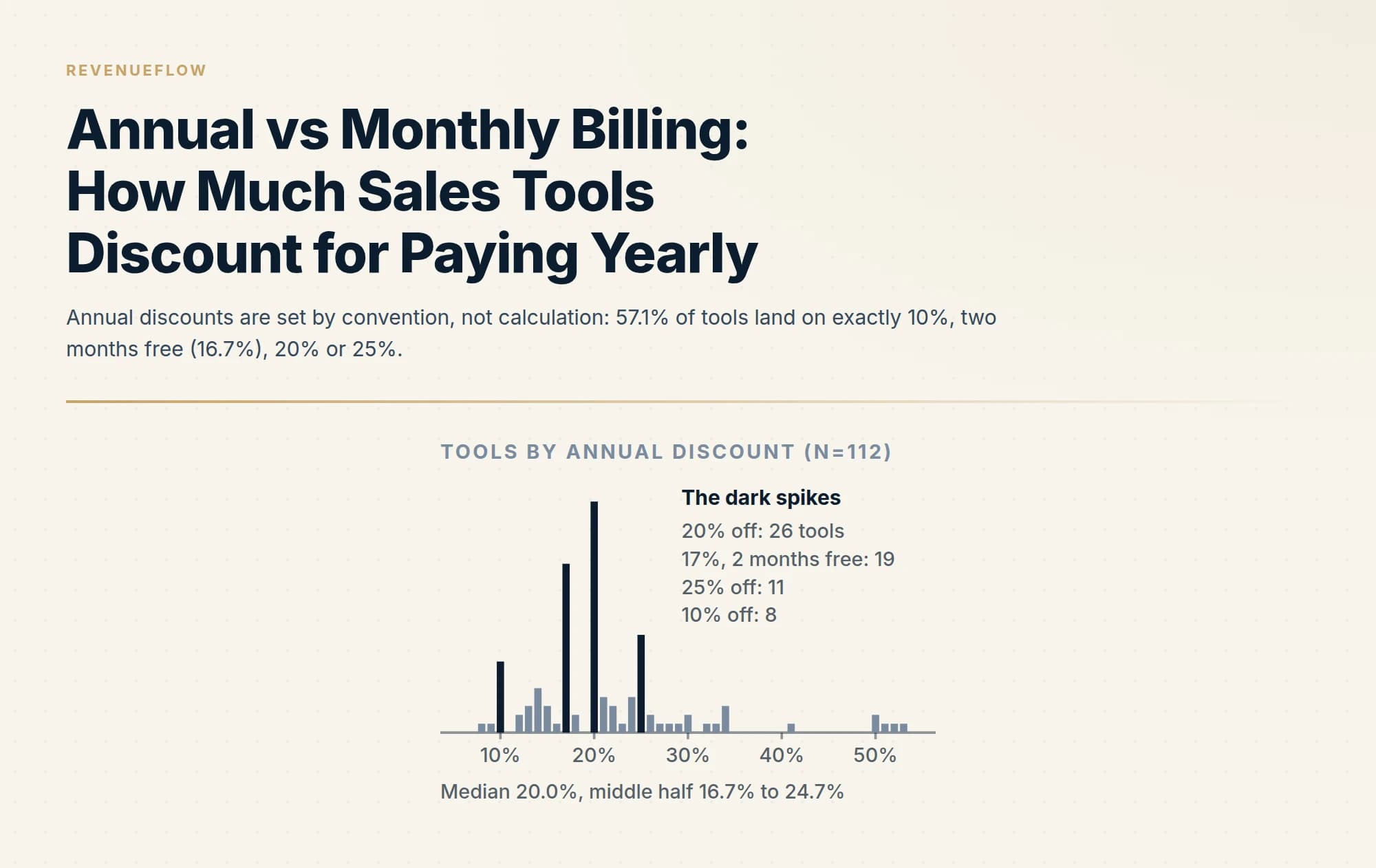
The median discount for paying yearly is 20.0% across 112 sales tools where both the monthly and annual rates are on record, and half of tools offer between 16.7% and 24.7%. At 20% an annual plan only beats monthly billing for a customer who stays past month 9.6. The median yearly saving on an entry tier is $104.52.
Key takeaways
- The median annual billing discount across 112 verified sales tools is 20.0%, with the middle half between 16.7% and 24.7%.
- 57.1% of tools land on exactly 10%, 17% (two months free), 20% or 25%: annual discounts are set by convention, with 26 tools at exactly 20%.
- At the median discount an annual plan is cheaper than monthly billing only after month 9.6, and a 10% discount does not pay off until month 10.8.
- 53 of 386 tools publish no month-to-month price at all, so the per-month figure on the page requires a twelve-month commitment.
Reviewed and updated September 16, 2026
The annual toggle is the most consequential switch on a pricing page. Flip it and every number drops, a "save 20%" badge appears, and the buyer is quietly asked to commit twelve months of budget to a tool they may have used for a week. Whether that trade is a good one depends on a number most buyers never compute: how big the discount really is, and how long they have to stay for it to pay off.
RevenueFlow's verified vendor dataset holds pricing records for 386 sales tools, each read from the vendor's own pricing page between 2026-08-28 and 2026-09-05. For 112 of those tools the record holds both the month-to-month rate and the annual plan's rate for the same tier. This study measures the gap.
The headline: the median discount for paying yearly is 20.0%, the middle half of tools offer between 16.7% and 24.7%, and the figure is set far more by convention than by arithmetic.
How common annual billing is
260 of the 386 tools (67.4%) mention an annual option somewhere on their pricing page. 53 tools go further and publish no month-to-month price at all: the only figure on the page is the annual plan's rate, usually expressed per month, which makes the plan look cheaper than any commitment a buyer can actually make for one month.
The discount can be computed for 112 tools, from 304 individual tiers. A tier counts when its record holds a month-to-month price and the rate for the same tier on the annual plan, either as a per-month figure ("$37.60 a month billed annually") or as a yearly total that was divided by twelve. The tool-level figure is the discount on the tool's cheapest such tier, since that is the decision most first-time buyers face. A further 33 tools state a percentage on the page without both prices being on the record. Those are reported separately below.
The size of the discount
| Annual discount | Tools | Share of 112 tools |
|---|---|---|
| under 10% | 3 | 2.7% |
| 10% to 14.9% | 19 | 17.0% |
| 15% to 17.9% (two months free is 16.7%) | 22 | 19.6% |
| 18% to 21.9% (the 20% cluster) | 31 | 27.7% |
| 22% to 29.9% | 25 | 22.3% |
| 30% and over | 12 | 10.7% |
The median is 20.0% and the mean is 21.2%. Only 3 tools offer less than 10%, and 12 (10.7%) offer 30% or more.
The shape of the distribution is more telling than its centre. Rounded to the nearest whole percent, 26 tools (23.2%) land on exactly 20%, 19 (17.0%) land on 17%, which is what "two months free" works out to, 11 land on 25% and 8 on 10%. Those four values account for 64 of the 112 tools, or 57.1%. Annual discounts in this market are round numbers chosen because competitors chose them. Nobody's cost of capital is exactly one sixth.
The 33 tools that only state a percentage tell the same story with a slightly lower centre: their median is 16.7%. Combining both groups gives 145 tools with a median of 20.0%.
By category the medians barely move.
| Category | Tools with both prices | 25th percentile | Median discount | 75th percentile |
|---|---|---|---|---|
| Email sending | 31 | 15.8% | 20.0% | 22.2% |
| Data enrichment | 34 | 16.7% | 20.4% | 25.0% |
| Email warmup | 11 | 18.6% | 21.1% | 24.6% |
| CRM | 20 | 16.1% | 20.0% | 25.1% |
| Sales engagement | 16 | 16.3% | 20.0% | 22.5% |
Every category's median sits between 20% and 21.1%. The discount is a feature of how software is sold, not of what the software does.
Named examples
Quoted from each vendor's own pricing page as verified on the date shown:
- Smartlead listed its Base plan at $39 month to month and $32.50 a month on the annual plan, a 16.7% discount (verified 2026-08-28).
- Instantly listed its Growth plan at $47 month to month and $37.60 a month on the annual plan, a 20.0% discount (verified 2026-08-28).
- Lemlist listed its Email plan at $69 month to month and $55 a month on the annual plan, a 20.3% discount (verified 2026-09-01).
- Lusha listed its Starter plan at $49.90 month to month and $37.45 a month on the annual plan, a 24.9% discount (verified 2026-08-28).
- Close listed its Solo plan at $19 month to month and $9 a month on the annual plan, a 52.6% discount (verified 2026-08-28).
The largest discounts on the record belong to Close (Solo, 52.6%), RocketReach (Essentials (Email Only), 52.2%), Meet Alfred (Basic, 50.8%), Flowlu (Essential, 50.0%). The smallest belong to SalesRobot (Growth (Email Automation), 8.5%), Verifalia (Starter, 9.1%), Clay (Launch, 9.7%). A discount near 50% makes the annual plan the real price and month-to-month billing a penalty rate. That is worth knowing when comparing entry prices across vendors: for such a tool the annual figure is the fairer comparison point.
Plan-by-plan detail for several of these vendors is in the Instantly pricing, lemlist pricing, Smartlead pricing and Close CRM pricing breakdowns.
The break-even month
A discount of d percent means the annual plan costs the same as 12 times (1 minus d) months of monthly billing. At 20% that is 9.6 months. A buyer who stays the full year saves 2.4 months of fees. A buyer who would have cancelled in month six has paid for 3.6 months of software they did not use.
At the median 20.0% discount the break-even is month 9.6. Across the middle half of tools it runs from month 9.0 (at 24.7%) to month 10.0 (at 16.7%). A 10% discount does not pay off until month 10.8, which makes it nearly worthless as a reason to commit. A 50% discount pays off after month 6.0.
In dollars the stakes on an entry tier are modest. The median yearly saving from choosing annual billing on a tool's cheapest paired tier is $104.52, with the middle half between $48 and $160.53. On Instantly's Growth plan the annual route costs $451.20 for the year and saves $112.80 against twelve monthly payments. The risk is asymmetric: the saving is capped at a couple of months of fees, and the possible loss is most of a year's fees on a tool that did not work out.
This matters more in outbound than in most software categories, because outbound stacks churn. Teams switch sequencers when deliverability practice changes, swap data vendors when match rates slip in their market, and add or drop warmup tools as mailbox counts move. The roundups of Instantly alternatives and lemlist alternatives exist because people switch.
Discounts are not uniform across tiers
95 tools have two or more tiers where both prices are on the record. In 48 of them (51%) the annual discount is the same on every tier, to within half a point: the vendor applied one percentage across the grid. Where it differs, it shrinks toward the top more often than it grows. 29 tools give a smaller discount on their most expensive paired tier than on their cheapest, and 18 give a bigger one.
Close is the clearest case of a shrinking discount. Its Solo plan is the 52.6% discount cited above, while its Scale plan was listed at $149 month to month and $139 on the annual plan, a 6.7% discount. The deep discount is an acquisition tool aimed at the smallest buyer. Reply.io's pricing page (verified 2026-08-28) shows the opposite pattern: 16.9% off its Email Volume plan and 37.5% off its AI SDR Starter plan, where the annual commitment is worth more to the vendor.
The practical point is to compute the discount on the tier actually being bought. The badge at the top of the page describes one tier, and it is usually the most flattering one.
When annual billing is worth it
Has the tool survived a full cycle on monthly billing?
If the trial or first month is still running, stay monthly. The discount is not worth buying before the tool has proved itself.
Will it still be in use after month 10?
At the median 20.0% discount, annual billing is cheaper only past month 9.6. A tool that might be replaced within the year is cheaper on monthly billing.
Is the tier stable?
Seats, mailboxes and credits change fastest in the first year of outbound. Lock in a plan size the team has already held for a quarter.
Three conditions make the discount a saving instead of a bet. The tool has already run for at least one full billing cycle on a monthly plan and earned its place. The team is confident it will still be using it after month ten, which is roughly where the median discount breaks even. And the plan size is stable, since an annual plan at the wrong tier either wastes capacity or forces a mid-year upgrade on the vendor's terms.
Waiting is cheap. A buyer who spends three months on monthly billing before switching to annual gives up only three months of the difference between the two rates. On Instantly's Growth plan that is $28.20, a small price for knowing the tool works before committing $451.20 to it. The same arithmetic holds for any tool in the dataset: the cost of a three-month look is a quarter of the annual saving.
For the core of a stack that has been stable for a quarter, such as the CRM and the primary sequencer, annual billing at around 20% is a reasonable saving. For anything still being evaluated, and for credit-based data tools where monthly needs swing with campaign volume, monthly billing is cheap insurance.
Teams that would rather not carry tool commitments at all can look at how RevenueFlow runs outbound as a service, starting with a free campaign.
Methodology
Population. The 386 tools in RevenueFlow's verified vendor dataset as of September 2026, each record read from the vendor's own pricing page and dated between 2026-08-28 and 2026-09-05.
Pairs. A pair is one pricing tier whose record holds both the month-to-month rate and the annual plan's rate. Three record shapes were read: a monthly price with a note giving the per-month rate when billed annually, a monthly price with a note giving a yearly total (divided by twelve), and an annual-plan price with a note giving the month-to-month rate. The discount is one minus the annual rate over the monthly rate.
Exclusions. A pair was used only when the discount fell between zero and 60%. 13 pairs were set aside: contracts where the yearly total equals twelve monthly payments, notes the reader could not parse cleanly, and one pair read by hand and found to compare two different plan sizes. All 112 tool-level pairs were read line by line against their source notes before use, and three were recomputed from the raw record files by a second method.
Tool-level figure. The discount on the tool's cheapest paired tier. Whole-percent clustering uses ordinary rounding of that figure.
Limits. List prices only. Multi-year terms, quarterly billing and promotional discounts were ignored. A vendor-stated percentage such as "save up to 30%" is an upper bound across tiers, which is why stated percentages are reported separately from computed ones.
Pricing verified between 2026-08-28 and 2026-09-05. Verify current terms with the vendor before relying on them.
Frequently asked questions.
Frequently asked questions- How much do you save with annual billing on sales software?
- The median discount is 20.0% across 112 tools where both rates are on the record, and half of tools fall between 16.7% and 24.7%. In dollars, the median yearly saving on a tool's cheapest paired tier is $104.52. Discounts cluster on round figures: 26 tools offer exactly 20%, 19 offer two months free, 11 offer 25% and 8 offer 10%.
- Is annual billing worth it for a cold email tool?
- Only if the tool will still be in use late in the year. At the median 20% discount, an annual plan costs the same as 9.6 months of monthly billing, so a team that cancels before month ten loses money. Outbound stacks change often, so annual billing suits tools that have already been stable for a quarter, not tools still being evaluated.
- Do all pricing tiers get the same annual discount?
- In about half of cases. Among 95 tools with two or more tiers where both rates are recorded, 48 apply the same discount to every tier. Where it differs, 29 give a smaller discount on the top tier and 18 give a bigger one. Close's pricing page is an example: 52.6% off its Solo plan and 6.7% off its Scale plan.
- Why do some tools only show annual prices?
- Because the annual rate is lower and looks better on the page. In RevenueFlow's dataset, 53 of 386 sales tools publish no month-to-month price anywhere, so the per-month figure shown is only available with a twelve-month commitment. When comparing vendors, check whether each price is a monthly rate or an annual plan's rate before ranking them.
About the author.

B2B cold email experts helping companies generate qualified leads through done-for-you outreach campaigns.
RevenueFlow Team
Explore more.
Ready to scale your outreach?
We build GTM engines that book real meetings. See the receipts.
Related articles.
What Cold Email and Sales Tools Actually Cost in 2026: Pricing Data From 386 Vendors
RevenueFlow's verified dataset of 386 sales tools puts the median starting price at $39.98 a month. Here is the spread by category, tier and billing model.
The Real Cost per 1,000 Emails, Verifications and Data Credits in 2026
Unit prices computed from verified vendor plans: $1.00 per 1,000 emails sent, $2.00 per 1,000 verifications and $19.60 per 1,000 enrichment credits.
Sales Engagement Platform Pricing in 2026: What 61 Tools Charge and Which Hide It
Sales engagement platforms start at a median of $75 a month, 70.5% carry a quote-only tier, and AI SDR platforms start at $204.50. Data from 61 verified tools.
Free Tiers and Trials in Sales Tools: What $0 Gets You Across 386 Vendors
37.0% of 386 verified sales tools have a permanent free plan. The median free data tier gives 50 credits and the median free sending plan 2,500 emails a month.
Which CRMs and Tools the Outbound Stack Connects To: Integration Data From 342 Sales Tools
HubSpot is named as an integration by 52.3% of 342 verified sales tools, Zapier by 50.3% and Salesforce by 43.3%. Here is the full map by category.
Airscale Pricing: Three Plans, One Credit, Four Rates
Airscale prints a different credit cost on every plan, and its advertised per-email price belongs to the custom one. The dated ladder and the rollover rules.