Smartlead Pricing: What It Costs at 10, 50 and 200 Mailboxes
Mailboxes are free on every Smartlead plan, so the price is the same at 10 or 200. What changes is send volume, contacts and verification. Here is the arithmetic.
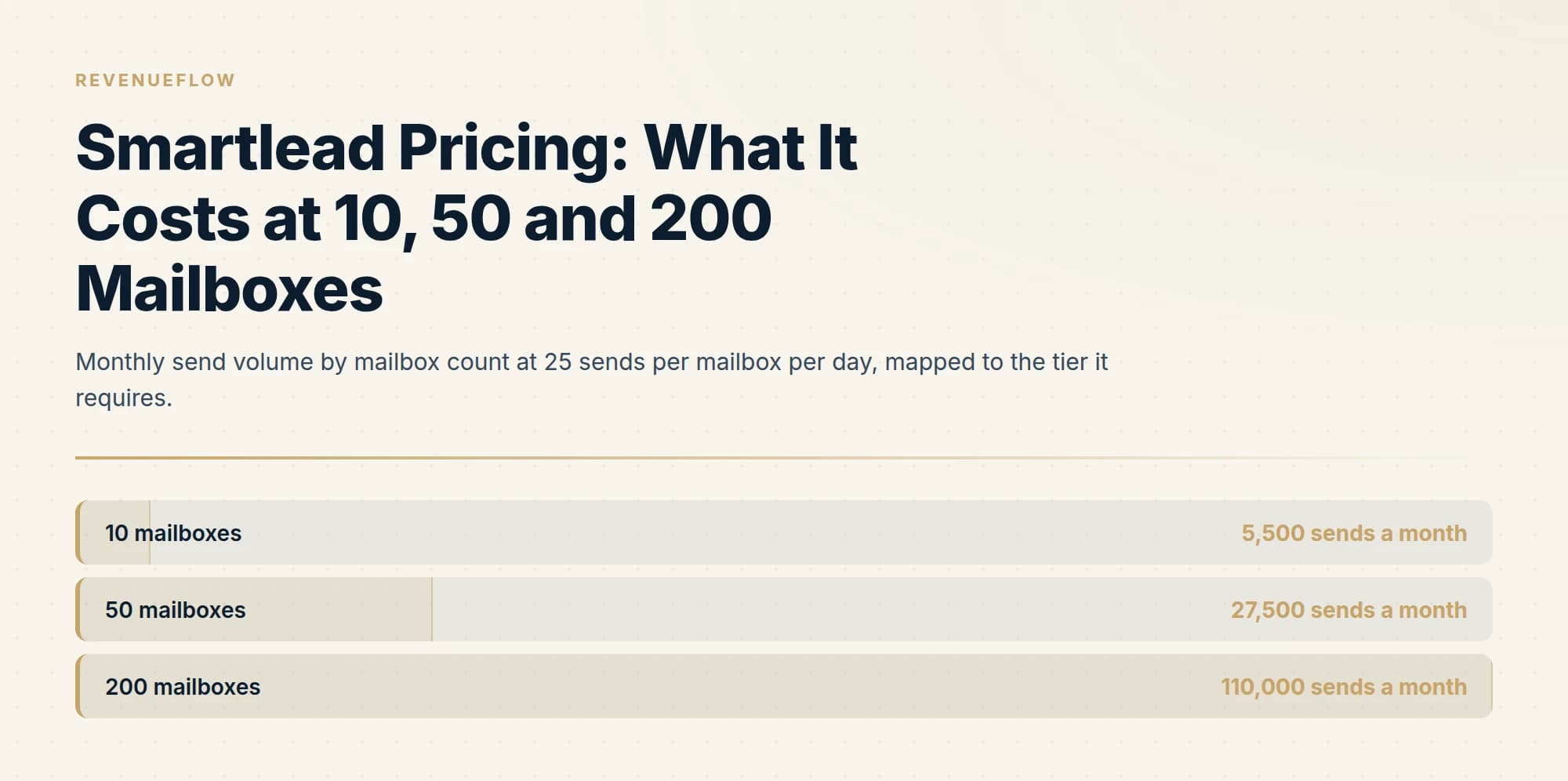
Smartlead includes unlimited mailboxes on every plan, so mailbox count never changes the subscription price. Send volume selects the tier: roughly 5,500 monthly sends at 10 mailboxes, 27,500 at 50, and 110,000 at 200, which maps to Base, Pro and Unlimited Smart.
Key takeaways
- Smartlead's plans cost the same at 10 mailboxes as at 200, because all tiers include unlimited email accounts at no extra cost.
- At 25 sends per mailbox per day, 200 mailboxes produces roughly 110,000 sends a month, which requires Unlimited Smart at US$174.
- Pro plus the US$59 verification add-on is US$153, only US$21 below Smart, which includes verification and unlimited contacts.
- At 200 mailboxes the platform is a rounding error against the mailbox seats and domains, which are bought elsewhere.
Reviewed and updated September 5, 2026
The question people bring to Smartlead pricing is what it costs at 10, 50 or 200 mailboxes. The answer is that it costs the same at all three, because Smartlead's own FAQ states that all plans include unlimited email accounts at no extra cost and that you can connect as many mailboxes as you need without paying per account.
That makes mailbox count the wrong axis. What actually scales your bill is send volume, contact storage and email verification, and what actually scales your total cost is the mailbox infrastructure you buy somewhere else. Here is the arithmetic at each size, verified against Smartlead's pricing page on 11 August 2026.
The plans
| Plan | Monthly | Yearly | Contacts | Sends per month | Verified emails |
|---|---|---|---|---|---|
| Base | US$39 | US$32.50 | 2,000 | 6,000 | 2,000 |
| Pro | US$94 | US$78.30 | 30,000 | 90,000 | 30,000 |
| Unlimited Smart | US$174 | US$144.50 | Unlimited | 150,000 | 50,000 |
| Unlimited Prime | US$379 | US$314.60 | Unlimited | 500,000 | 170,000 |
Yearly billing is advertised at 17% off. Verified prospect emails are an add-on at US$59 a month on Base and Pro, and included free on Smart and Prime. Prime adds 3 SmartServers with OAuth and multiple client workspaces.
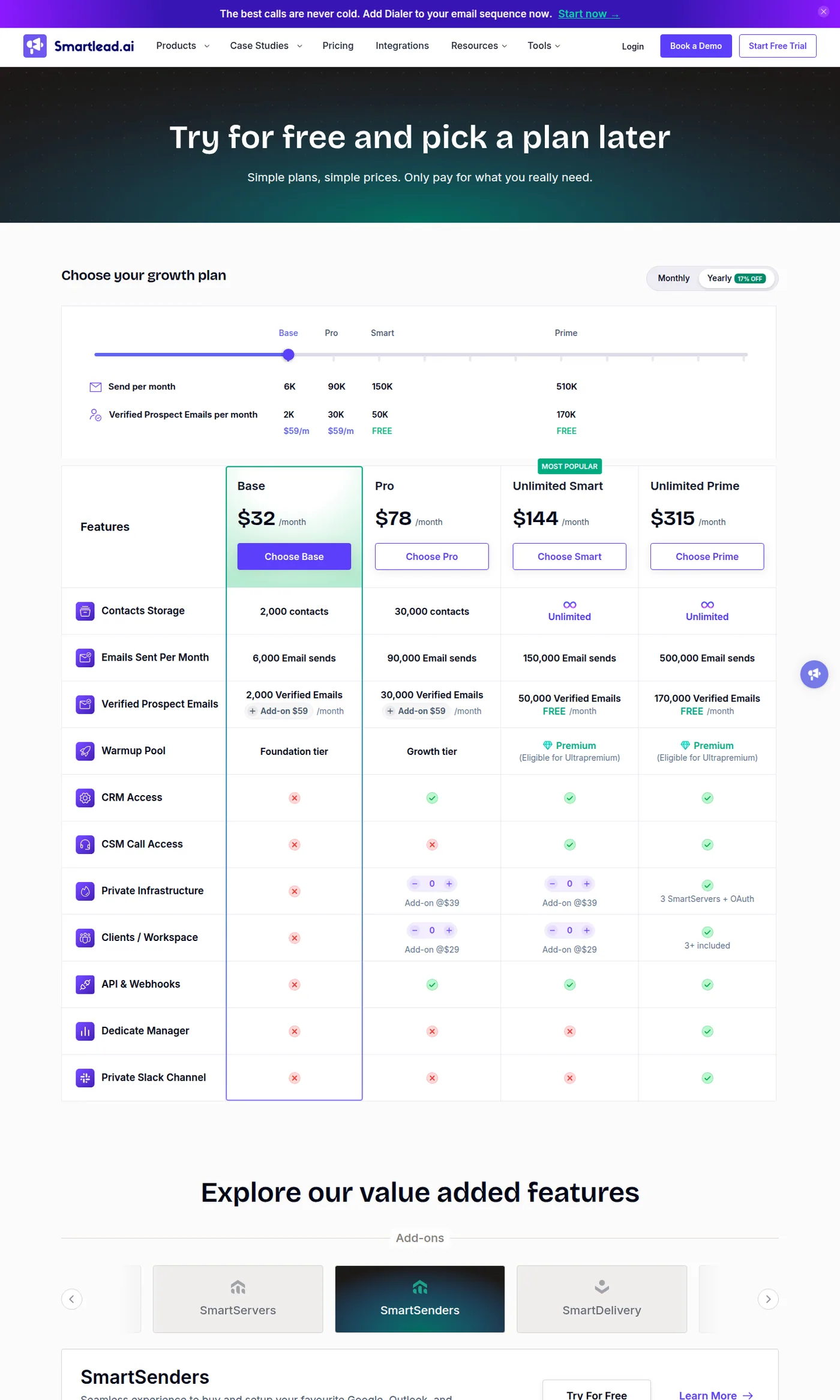
Two things worth noting when reading that capture against the table above. It is the Yearly view, so the card prices correspond to the yearly column, and Smartlead rounds them for display: the cards read US$32, US$78, US$144 and US$315 where the underlying figures are US$32.50, US$78.30, US$144.50 and US$314.60. Smartlead also states Prime's send allowance as 510K in the plan slider and 500,000 in the feature table on the same page, and this article uses the lower of the two.
What each mailbox count actually needs
Take a conservative 25 sends per mailbox per day, which is the pacing most operators settle on, and roughly 22 working days a month.
Just over Base's 6,000 ceiling, so Base fits only at lower pacing
Comfortably inside Pro at 90,000, well under a third of the ceiling
Above Pro, so Unlimited Smart at 150,000 is the tier
At 10 mailboxes you are sending around 5,500 a month, which brushes Base's 6,000 ceiling. Base at US$39 works if pacing stays conservative, and Pro at US$94 is the safe choice with headroom. The binding constraint at this size is usually contacts rather than sends: Base stores 2,000, which one campaign exhausts.
At 50 mailboxes you are around 27,500 sends a month, which sits comfortably inside Pro's 90,000. The question at this size becomes contact storage. Pro holds 30,000 contacts, and if your motion contacts each person once, 27,500 sends means roughly 27,500 contacts consumed monthly, so you will be at the Pro ceiling within a month or two of running.
At 200 mailboxes you are around 110,000 sends a month, above Pro and inside Unlimited Smart at 150,000. Smart is also where contacts become unlimited and where 50,000 verified emails a month arrive free, which at this scale is the reason to be there rather than the send ceiling.
Notice what did not appear in any of that: the mailbox count never changed the price directly. It changed the send volume, and the send volume selected the tier.
The corollary is that you can change your pacing without changing your bill. Running 200 mailboxes at 15 sends a day instead of 25 drops you to roughly 66,000 sends a month, back inside Pro. Whether that trade is worth US$80 a month depends on how much you value the headroom, and pacing more conservatively is rarely the wrong call.
The verification line changes the comparison
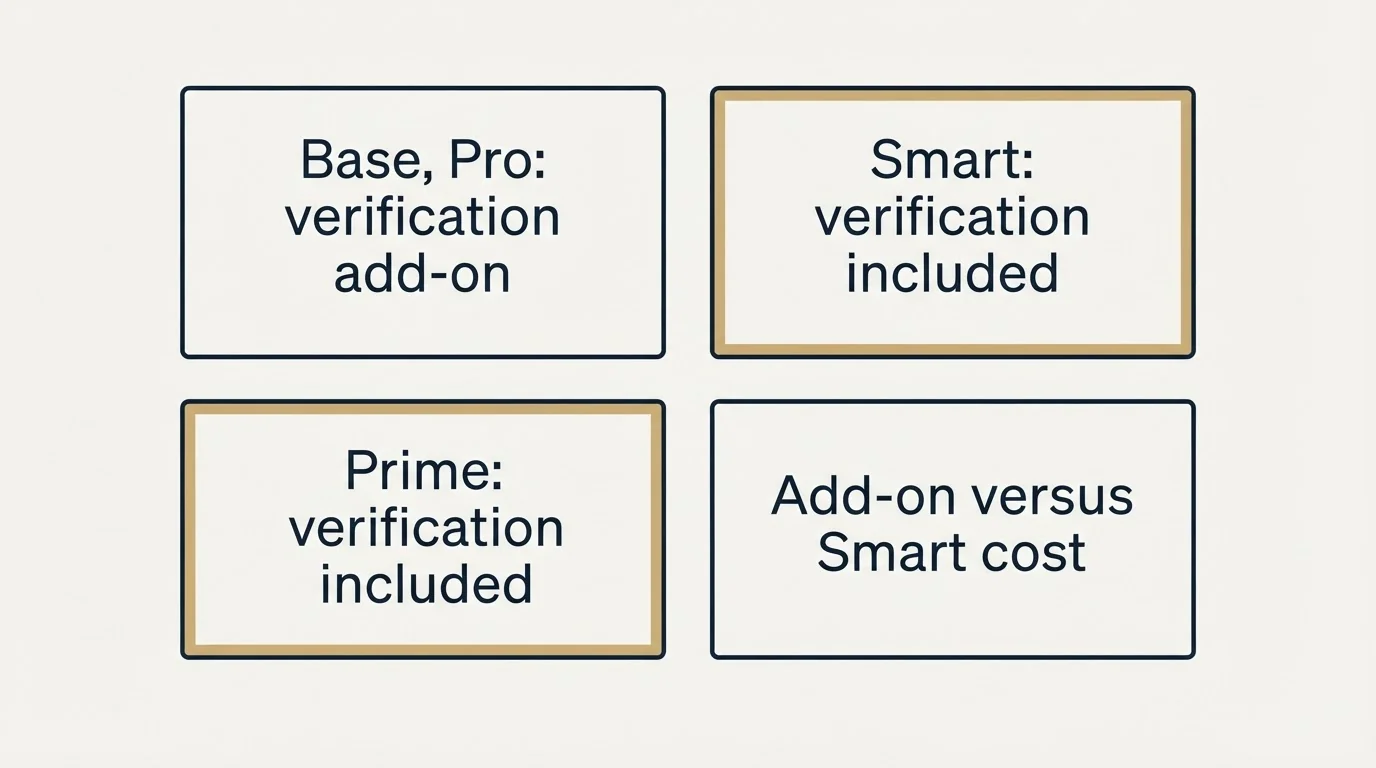
This is the detail that makes Smart better value than the price step suggests.
On Base and Pro, verified prospect emails cost an extra US$59 a month. On Smart and Prime they are free, at 50,000 and 170,000 a month respectively.
So Pro at US$94 plus the verification add-on is US$153 a month for 90,000 sends and 30,000 verified emails. Smart at US$174 is US$21 more for 150,000 sends, unlimited contacts and 50,000 verified emails. The real gap between those two tiers is much narrower than US$94 against US$174 implies, and the direction of value points at Smart for anyone already paying the add-on.
- US$94 for Pro, plus US$59 a month for verified prospect emails
- 90,000 sends a month
- 30,000 contacts stored
- 30,000 verified emails a month
- US$21 more than Pro with the add-on
- 150,000 sends a month
- Unlimited contacts
- 50,000 verified emails a month, included free
Whether bundled verification is worth it depends on whether you would otherwise buy verification separately. We would and do: verification belongs immediately before the send rather than at the moment a record was created, because addresses decay as people change jobs. A bundled allocation that covers your volume removes a vendor from the stack.
The cost that is not on Smartlead's invoice
At 200 mailboxes the sending platform is not your main expense, and it is not close.
Every mailbox is a real Google Workspace or Microsoft 365 seat on a real domain. Two hundred seats at standard business pricing runs into four figures a month before you count the domains, which are typically bought in blocks with several mailboxes each. Against that, Unlimited Smart at US$174 is a rounding error.
- Yes: Smartlead Unlimited Smart at US$174 a month
- Yes: 200 mailbox seats at Google Workspace or Microsoft 365 pricing
- Yes: Sending domains, bought in blocks and renewed annually
- Yes: Domain authentication and DNS configuration time on every domain
- No: Assuming unlimited mailboxes in the tool means cheap mailboxes in reality
- No: Buying mailbox capacity before you have a list that justifies it
- Depends: Whether bundled verification removes a separate vendor from your stack
That second "no" is the failure mode the unlimited-mailbox model quietly encourages. When the platform stops charging per inbox, the natural instinct is to add inboxes, and mailbox capacity without list quality just distributes a bad campaign across more sending reputation. Size the estate from how many well-qualified contacts you can genuinely reach, then buy that many mailboxes.
Contacts run out before sends on a one-touch motion
The tier tables pair a send ceiling with a contact ceiling, and which one binds depends entirely on how many times you contact each person.
Pro allows 90,000 sends and stores 30,000 contacts, a ratio of three to one. A team running a three-step sequence uses both ceilings at roughly the same rate. A team sending one message per contact, as we do, consumes 30,000 contacts to use 30,000 of the 90,000 available sends, which means two thirds of the send capacity is paid for and never touched.
That has a direct pricing consequence. On a single-touch motion the honest question is not which tier covers your sending, it is which tier stores your contacts, and Unlimited Smart is where contacts stop being a constraint at all. The jump from Pro to Smart buys unlimited contacts and bundled verification, both of which matter more to a one-touch operation than the extra 60,000 sends.
Worth checking your own ratio before choosing. Divide expected monthly sends by expected monthly new contacts, and compare it to the tier's built-in ratio. A large mismatch in either direction means you are paying for a dimension you do not use.
Rotation is why the mailbox count matters at all
Smartlead automatically rotates sending across all connected mailboxes within a campaign, which it describes as distributing volume evenly, protecting individual sender reputation, and avoiding high-volume spikes from a single address.
That is the mechanism that makes many-mailboxes-at-low-volume a sensible architecture rather than just a bigger number. It does not change the aggregate signals mailbox providers measure. Google requires spam rates in Postmaster Tools to stay below 0.30% and requires SPF, DKIM and DMARC above 5,000 messages a day to Gmail, and those are domain-level and account-level measures that no rotation scheme softens. The deliverability guide covers the layer underneath.
The agency case
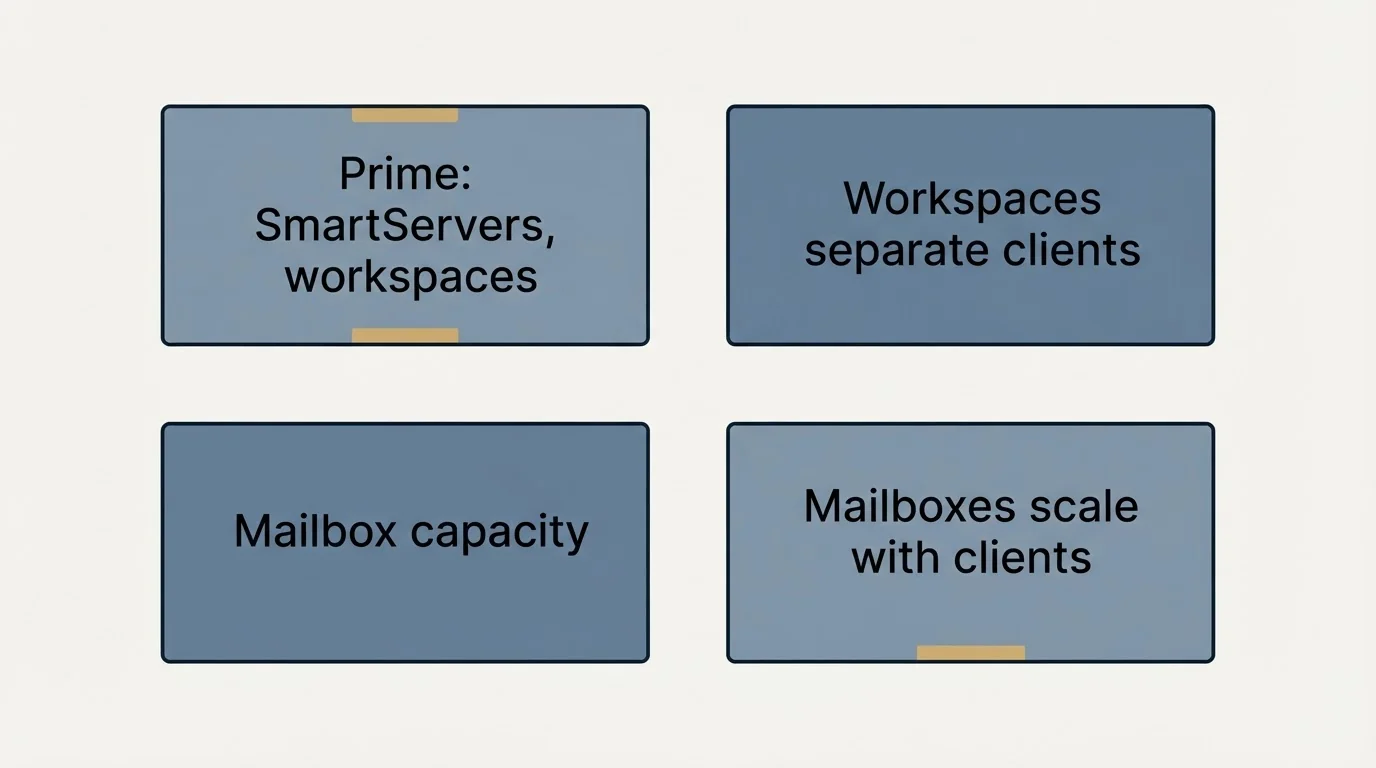
Prime includes 3 SmartServers with OAuth and multiple client workspaces, and for agencies that combination is usually the reason to be on it rather than the 500,000 send ceiling.
Client workspaces matter because they separate one client's data, campaigns and reporting from another's. Running several clients inside one workspace is workable until it is not: a suppression list applied to the wrong campaign, a report that mixes two clients' numbers, or an access problem when a client wants to see their own data.
The per-client arithmetic is what makes the unlimited-mailbox model attractive to agencies specifically. Ten clients at 20 mailboxes each is 200 mailboxes on one subscription, where a per-inbox competitor would charge for every one of them. Add bundled verification on the upper tiers and the platform cost per client becomes small enough to disappear into the retainer.
What does not scale as neatly is the mailbox estate itself, which is 200 real seats and the domains under them, plus the operational work of authenticating and maintaining each one. That is the line item agencies underestimate, and it grows linearly with client count while the platform cost does not.
Teams building out that mailbox estate often pair Smartlead with a dedicated warmup tool, and the InboxAlly warmup comparison explains how the two fit together.
Comparing across the category
Instantly runs the same unlimited-mailbox model at US$47, US$97 and US$358 monthly, metering contacts and sends the same way, without bundled verification. The Instantly pricing breakdown covers those ceilings. Lemlist prices per user with a sender cap per user on its Multichannel tier, which is a different shape entirely and is covered in the lemlist pricing breakdown.
For what Smartlead does beyond pricing, the review covers rotation and the caps, and the API guide covers the automation surface, including the fact that Smartlead does not publish its rate limits.
Unlike a single-platform breakdown, comparing Gong and Smartlead shows how a call-intelligence platform and a cold email tool serve different stages of the same outbound workflow.
We run outbound for clients on a pay-per-qualified-meeting basis, which means the mailbox estate, the domains and the platform subscription are our cost rather than a spreadsheet you have to build. You can see what a campaign would look like for your market.
Smartlead plan prices, ceilings, verification add-on pricing, the unlimited-mailbox statement and the rotation description are per Smartlead's pricing page, fetched 11 August 2026. Instantly figures are per Instantly's pricing page, same date. Google sender requirements are per Google's published guidelines. Send-volume figures at each mailbox count are arithmetic from a stated 25-per-mailbox-per-day assumption, not measured results. Prices exclude tax.
Sources: Smartlead pricing, Instantly pricing, Google email sender guidelines
Frequently asked questions.
Frequently asked questions- Does Smartlead charge per mailbox?
- No. Smartlead's pricing page states that all plans include unlimited email accounts at no extra cost, so connecting 10 or 200 mailboxes costs the same. The plans meter emails sent per month, contacts stored and verified prospect emails, and it is send volume that decides which tier you need.
- Which Smartlead plan do I need for 50 mailboxes?
- At a conservative 25 sends per mailbox per day, 50 mailboxes produces roughly 27,500 sends a month, comfortably inside Pro's 90,000 ceiling at US$94. The binding constraint at that size is usually contact storage rather than sends, since Pro holds 30,000 contacts and a one-touch motion consumes them at a similar rate.
- Is Smartlead's Unlimited Smart plan worth the jump from Pro?
- Usually, if you were paying for verification anyway. Pro at US$94 plus the US$59 verified-email add-on is US$153, while Smart is US$174 and includes 50,000 verified emails, unlimited contacts and a 150,000 send ceiling. The real gap between the tiers is US$21, not the US$80 the headline prices suggest.
- What does 200 mailboxes actually cost to run?
- Far more than the platform. Smartlead's Unlimited Smart is US$174 a month, while 200 Google Workspace or Microsoft 365 seats run into four figures monthly before the sending domains, which are typically bought in blocks. The sending tool is usually the smallest line in a cold email infrastructure budget.
About the author.

Tim Carden is CMO / CTO at RevenueFlow, which builds and operates outbound revenue engines for B2B companies. Studied at McGill University.
Tim Carden · CMO / CTO
Connect on LinkedIn →Explore more.
Ready to scale your outreach?
We build GTM engines that book real meetings. See the receipts.
Related articles.
Instantly.ai Pricing: What Each Tier Costs and What Caps You
Adding inboxes to Instantly costs nothing on any plan. What you pay for is contacts and monthly send volume, and here is where each tier actually runs out.
Smartlead Review: Unlimited Mailboxes and What the Plans Cap
Smartlead includes unlimited mailboxes on every plan and bundles verification on the upper tiers. What rotation does, what it cannot do, and where the ceilings bite.
Email Warmup Pricing in 2026: What 20 Tools Charge, and What 10 Mailboxes Cost
Email warmup tools start at a median of $29 a month, but warming ten mailboxes costs from $7.50 to $1,190 depending on how the vendor prices a mailbox.
Instantly.ai Review: What the Plans Include and Who It Suits
Instantly gives unlimited inboxes on every paid plan and meters contacts and send volume instead. What that changes, where each tier runs out, and who it fits.
ReachInbox Pricing: The Page Loads on Its Yearly Rate
ReachInbox's pricing toggle loads on the yearly side. Both ladders, the four meters behind unlimited accounts, and the fair use question the page leaves open.
Mailwarm Pricing: The Page Opens on Its Yearly Tab
Mailwarm's pricing tabs open on yearly and the plans meter daily volume rather than mailboxes. Both tabs, the overage rate, the no-trial rule and the per-mailbox cost.