Instantly.ai Pricing: What Each Tier Costs and What Caps You
Adding inboxes to Instantly costs nothing on any plan. What you pay for is contacts and monthly send volume, and here is where each tier actually runs out.
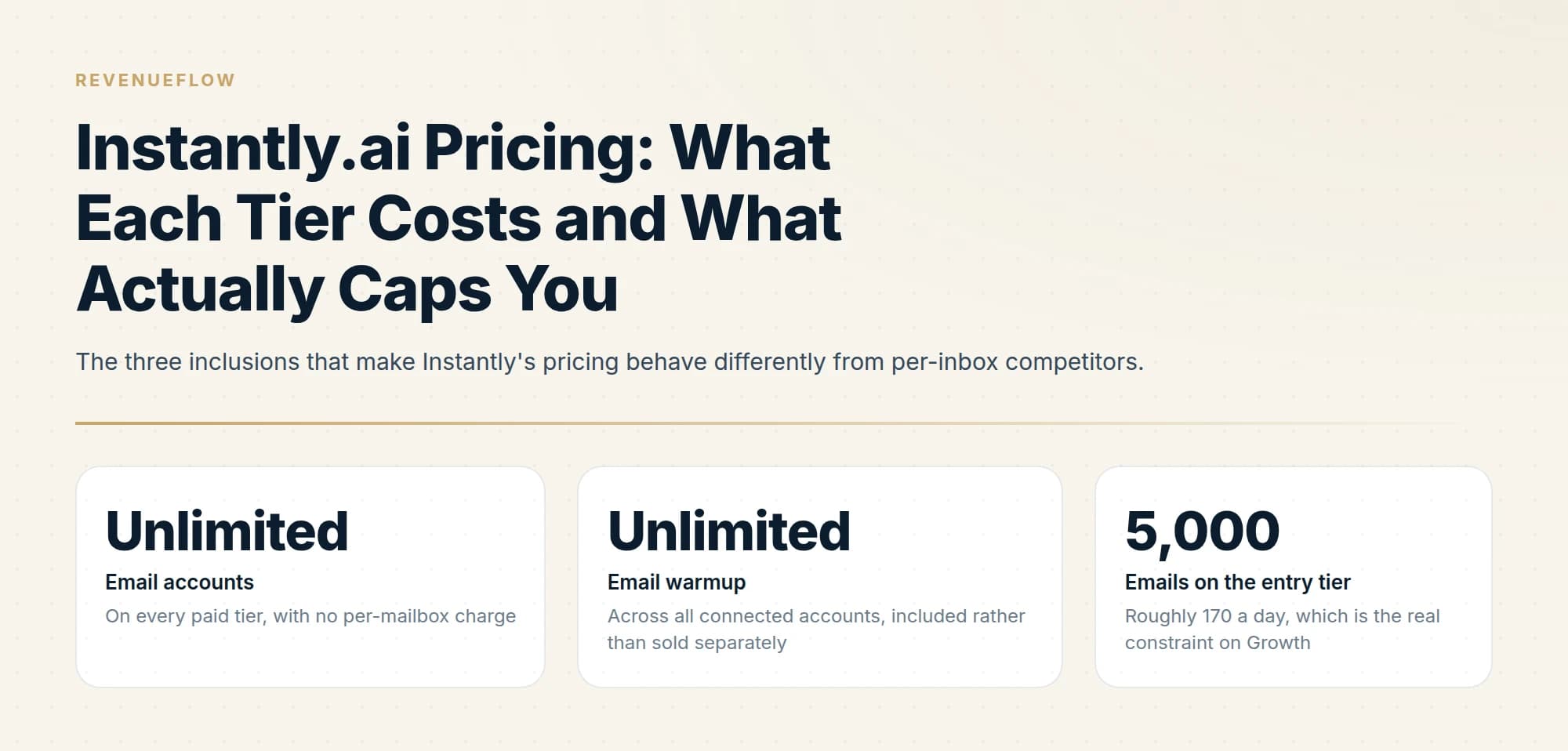
Instantly pricing starts at US$47 a month for the Growth outreach plan, with Hypergrowth at US$97 and Light Speed at US$358, or US$37.60, US$77.60 and US$286.30 on yearly billing. Every paid plan includes unlimited email accounts and warmup. Lead data is a separate Instantly Credits ladder that also starts at US$47.
Key takeaways
- Instantly pricing usually means the Outreach plans: Growth at US$47 a month, Hypergrowth at US$97 and Light Speed at US$358, with roughly 20% off on yearly billing.
- Adding inboxes costs nothing on any Instantly tier, so choosing a plan by mailbox count is the wrong axis; the plans meter uploaded contacts and emails a month.
- Instantly's pricing page gives Hypergrowth two send ceilings, 125,000 on the monthly card and 100,000 on the yearly card, the comparison table and the FAQ, so plan on 100,000.
- Lead data is a separate ladder, Instantly Credits, whose entry plan is also called Growth and also costs US$47, so a quoted sending price never includes data.
Reviewed and updated September 18, 2026
Instantly pricing starts at US$47 a month, and the most common question about it has an unexpected answer. People ask what each tier costs once they add inboxes, and the answer is that adding inboxes costs nothing, on any paid plan, at any count. Instantly includes unlimited email accounts and unlimited email warmup on Growth, Hypergrowth and Light Speed alike.
Since warmup is bundled into every tier, it helps to see how that built-in feature stacks up against a dedicated tool, covered in this warmup tool comparison guide.
The money is metered somewhere else, on contacts stored and emails sent per month, and those two ceilings are what decide which tier you need. Here is the full breakdown, taken from Instantly's own pricing page.
Instantly pricing: what Instantly.ai costs on each ladder
Instantly pricing usually means the Outreach plans, the sending product: Growth at US$47 a month, Hypergrowth at US$97 and Light Speed at US$358, or US$37.60, US$77.60 and US$286.30 a month on yearly billing. The same pricing page has two more tabs: Instantly Credits, a separate lead-data ladder that also starts at US$47, and VIP, a managed service quoted by sales.
Which ladder a price belongs to matters, because two of them reuse a name. Outreach is the tab the pricing page opens on, and it is the sending platform this article works through. Instantly Credits is the lead database and enrichment ladder, covered further down, and its entry plan is also called Growth and also costs US$47. VIP lists campaign setup and launch, domains and account setup, and a dedicated GTM engineer, at a custom price. The page's title still reads "Plans for Outreach, Leads, and CRM", but the page has no CRM tab, and Instantly's CRM product page publishes no price of its own.
The outreach tiers
| Plan | Monthly billing | Annual billing | Contacts | Emails per month |
|---|---|---|---|---|
| Growth | US$47 | US$37.60 | 1,000 | 5,000 |
| Hypergrowth | US$97 | US$77.60 | 25,000 | 100,000 or 125,000 |
| Light Speed | US$358 | US$286.30 | 100,000 | 500,000 |
| Enterprise | Custom | Custom | 100,000+ | 500,000+ |
Annual billing is shown as a lower monthly-equivalent figure on each tier, working out to roughly 20% off Growth and Hypergrowth.
One ceiling, two figures
Instantly's pricing page disagrees with itself on Hypergrowth's send ceiling. The US$97 monthly card reads 125 000 emails monthly. The US$77.60 yearly card reads 100 000, and so do the feature comparison table and the page's own FAQ, which asks what happens if you need to send more than 100,000 emails. Plan on 100,000 and treat the rest as headroom until your own account confirms it.
Support scales with the tier: chat support on Growth, premium live support on Hypergrowth. Light Speed adds the SISR system, and Enterprise adds a private deliverability network, a dedicated account manager and a shared Slack channel.
What is included at every level
The unlimited-accounts inclusion is the headline and the send cap is the reality. Unlimited mailboxes connected to a 5,000-emails-a-month pipe is unlimited connections to a metered channel, not unlimited capacity. Size your plan on volume.
Where each tier actually runs out

Work the numbers into daily terms and the tiers become much easier to place.
Growth, 5,000 emails a month, is about 170 a day across all mailboxes combined. At a conservative 25 sends per mailbox per day that is roughly seven mailboxes. It is a genuine starting point for a solo founder or a first campaign, and it is not a programme.
Hypergrowth, 100,000 emails a month on the lower of the page's two figures, is around 3,300 a day. That supports a real operation: about 130 mailboxes at 25 a day, or a smaller estate sending harder. On the monthly card's 125,000 it is around 4,100 a day and 165 mailboxes. For most teams running outbound seriously, this is the working tier, and the step up from Growth is 20 to 25 times the capacity for roughly twice the price.
Light Speed, 500,000 emails a month, is around 16,600 a day, or about 660 mailboxes at the same 25 a day. That is agency or high-volume territory, and the reason to be there is usually the SISR infrastructure rather than the raw ceiling.
The contact ceilings pair with those at four to five emails per contact. That ratio is the one to check against your own motion. If you contact each person once, as we do, the contact limit binds long before the send limit: Hypergrowth's 25,000 contacts at one message each uses 25,000 of at least 100,000 available sends, so you are paying for volume headroom you will never touch.
The gap between Hypergrowth and Light Speed
The step from US$97 to US$358 is the largest jump in the range, roughly 3.7 times the price for four to five times the send volume and four times the contacts.
On raw capacity that is fair value, and raw capacity is rarely why teams make the move. Most reach Light Speed for the SISR infrastructure rather than because they are sending 100,000 emails a month and need 500,000. The pricing page spells SISR out as Server and IP Sharding and Rotation: dedicated or private server and IP blocks assigned automatically, with flagged IPs swapped out. If your volume sits between the two, the honest question is whether infrastructure isolation is worth roughly US$260 a month on its own, because that is what you are buying.
Teams pushing the Hypergrowth ceiling often have a targeting problem rather than a capacity problem. Before upgrading a tier for headroom, check whether the ceiling is genuinely binding or whether volume has become a substitute for precision.
| Tier | A month | A day | Mailboxes |
|---|---|---|---|
| Growth | 5,000 | 170 | 7 |
| Hypergrowth yearly card, table, FAQ | 100,000 | 3,300 | 130 |
| Hypergrowth monthly card | 125,000 | 4,100 | 165 |
| Light Speed | 500,000 | 16,600 | 660 |
The lead database is a separate purchase
Instantly sells lead data as its own ladder, Instantly Credits, distinct from the sending plans and drawing on a database it describes as 450 million or more B2B leads. Its pricing page lists Growth credits at US$47 a month for 1,500 to 2,000 credits, Supersonic at US$97 for 5,000 to 7,500, and Hyper Credits from US$197 for 10,000 to 200,000, with a custom Enterprise tier above that. On yearly billing the page shows US$37.60, US$87.30 and US$177.30.
Outreach
Meters uploaded contacts and emails a month
- Growth US$47: 1,000 contacts, 5,000 emails
- Hypergrowth US$97: 25,000 contacts
- Light Speed US$358: 100,000 contacts, 500,000 emails
Instantly Credits
Meters lead-data credits a month
- Growth US$47: 1,500 to 2,000 credits
- Supersonic US$97: 5,000 to 7,500 credits
- Hyper Credits from US$197: 10,000 to 200,000 credits
The shared name is the trap. A line reading Growth at US$47 can mean 5,000 emails a month or 1,500 to 2,000 lead credits, and a team that wants both is paying US$94 before a single mailbox seat.
Two things follow. A quoted plan price does not include lead data, so a cost comparison against a tool that bundles data is not comparing like with like. And if you already have a data source, that line is optional, which makes the sending plans cheaper than they first appear relative to all-in-one competitors.
Annual billing, and whether to take it

Annual billing knocks roughly 20% off the lower tiers, bringing Growth to US$37.60 and Hypergrowth to US$77.60 a month, with Light Speed at US$286.30.
The saving is real and the commitment is the thing to weigh. This category moves quickly: teams outgrow tiers, switch platforms, or restructure their sending estate within months, and a year of commitment made in month one is made with the least information you will ever have.
The rule we would apply is to take annual billing only when the volume is stable and already proven on the platform. That usually means running monthly for a quarter first, and paying roughly US$60 extra over those three months on Hypergrowth for the option to leave. Against the cost of a wrong annual commitment, that is cheap.
The cost that is not on the invoice
This is the part a pricing page cannot show you, and at scale it dominates.
Unlimited inboxes in the platform does not mean free inboxes in the world. Every mailbox is a real Google Workspace or Microsoft 365 seat, on a real domain that you buy, authenticate and maintain. At typical seat prices, an estate of 50 mailboxes costs substantially more per month than the Hypergrowth plan those mailboxes are connected to.
So the honest way to read Instantly's pricing is that the sending platform is one of the smaller line items in a cold email budget. The larger ones are mailbox seats, domains, and the data or verification you feed it. A plan that advertises unlimited accounts is not making your infrastructure free; it is removing itself as the constraint on how much infrastructure you buy, which is useful and also a temptation.
What happens when you hit a ceiling

Worth planning for, because the two ceilings behave differently in practice.
The send ceiling is a hard stop on output. Reaching it mid-month means campaigns stop sending until the cycle resets or you upgrade, and a stalled campaign in the middle of a wave is worse than a smaller wave planned properly. Watch consumption against the ceiling weekly rather than discovering it.
The contact ceiling is a storage limit, which behaves differently: it stops you loading new leads rather than stopping sends. That is less disruptive in the moment and more insidious over time, because it quietly caps how much new audience you can bring in while your existing contacts get worked through.
The order in which you hit them tells you something about your motion. Hitting the send ceiling first means you are sending multiple messages per contact. Hitting the contact ceiling first means you are running a single-touch motion, in which case a meaningful share of the send capacity you are paying for goes unused every month, and a lower tier plus tighter targeting may be the better shape.
How this compares structurally
Three pricing models compete in this category and the differences matter more than the numbers.
Instantly and Smartlead both give unlimited mailboxes and meter contacts and send volume. Smartlead's tiers run US$39, US$94, US$174 and US$379 monthly, and its upper two bundle verified prospect emails free, which Instantly does not. The Smartlead pricing breakdown works through that comparison.
Lemlist prices per user on its Multichannel tier with a sender limit per user, which is a fundamentally different shape: it suits teams with several people each running modest sending, and it gets expensive fast for one operator running a large mailbox estate. The lemlist pricing breakdown covers it.
Comparing headline plan prices across those three models tells you very little. Compare the monthly cost at your actual send volume, with your actual mailbox count, including verification, and the ordering frequently reverses.
For what the platform does beyond pricing, the Instantly review covers the product, and the API guide covers the automation surface and its published rate limits.
A different angle worth weighing is how Instantly's cold email focus contrasts with sales engagement platforms, as explored in Groove versus Instantly comparison.
Another contrast worth weighing is how Instantly stacks up against a full sales engagement suite, a gap examined in Apollo versus Instantly comparison.
We run outbound for clients on a pay-per-qualified-meeting basis, which means the plan, the mailboxes and the domains are our cost rather than yours. You can see what a campaign would look like for your market.
Pricing and features are taken from the vendors' own pages. Verify current terms with the vendor before relying on them.
Sources: Instantly pricing, Smartlead pricing, Instantly API rate limits
Frequently asked questions.
Frequently asked questions- How much does Instantly.ai cost?
- Instantly's pricing page lists three Outreach plans: Growth at US$47 a month, Hypergrowth at US$97 and Light Speed at US$358, with an Enterprise tier quoted by sales. On yearly billing the page shows US$37.60, US$77.60 and US$286.30 a month. Lead data is priced separately on the Instantly Credits tab, from US$47 a month.
- How much does Instantly cost per inbox?
- Nothing. Unlimited email accounts and unlimited warmup are included on Growth, Hypergrowth and Light Speed alike. The plans meter uploaded contacts and emails sent per month instead. The real per-inbox cost is the Google Workspace or Microsoft 365 seat and the domain, both bought outside Instantly.
- Which Instantly plan do I need?
- Work from monthly send volume. Growth's 5,000 emails is about 170 a day, Hypergrowth's 100,000 is about 3,300 a day, and Light Speed's 500,000 is about 16,600. Then check the contact ceiling separately, because if you contact each person once, the contact limit binds long before the send limit does.
- Does the Instantly plan price include lead data?
- No. Lead data is sold on a separate Instantly Credits ladder: Growth at US$47 a month for 1,500 to 2,000 credits, Supersonic at US$97 and Hyper Credits from US$197, drawing on a database Instantly describes as 450 million or more B2B leads. If you already have a data source, that line is optional.
About the author.

Tim Carden is CMO / CTO at RevenueFlow, which builds and operates outbound revenue engines for B2B companies. Studied at McGill University.
Tim Carden · CMO / CTO
Connect on LinkedIn →Explore more.
Ready to scale your outreach?
We build GTM engines that book real meetings. See the receipts.
Related articles.
Instantly.ai Review: What the Plans Include and Who It Suits
Instantly gives unlimited inboxes on every paid plan and meters contacts and send volume instead. What that changes, where each tier runs out, and who it fits.
Smartlead Pricing: What It Costs at 10, 50 and 200 Mailboxes
Mailboxes are free on every Smartlead plan, so the price is the same at 10 or 200. What changes is send volume, contacts and verification. Here is the arithmetic.
Email Warmup Pricing in 2026: What 20 Tools Charge, and What 10 Mailboxes Cost
Email warmup tools start at a median of $29 a month, but warming ten mailboxes costs from $7.50 to $1,190 depending on how the vendor prices a mailbox.
Smartlead Review: Unlimited Mailboxes and What the Plans Cap
Smartlead includes unlimited mailboxes on every plan and bundles verification on the upper tiers. What rotation does, what it cannot do, and where the ceilings bite.
Manyreach Pricing: Credits Buy Sends and Warmup Alike
Manyreach prices in credits rather than seats: a one-time pack or a monthly refill. What a credit buys, the two IP figures on one page, and where a pack beats a plan.
ReachInbox Pricing: The Page Loads on Its Yearly Rate
ReachInbox's pricing toggle loads on the yearly side. Both ladders, the four meters behind unlimited accounts, and the fair use question the page leaves open.