Lemlist Pricing: Plan Tiers and Credit Costs vs Instantly
Lemlist prices per user with a sender cap where Instantly gives unlimited mailboxes. Which is cheaper depends on whether your constraint is headcount or mailboxes.
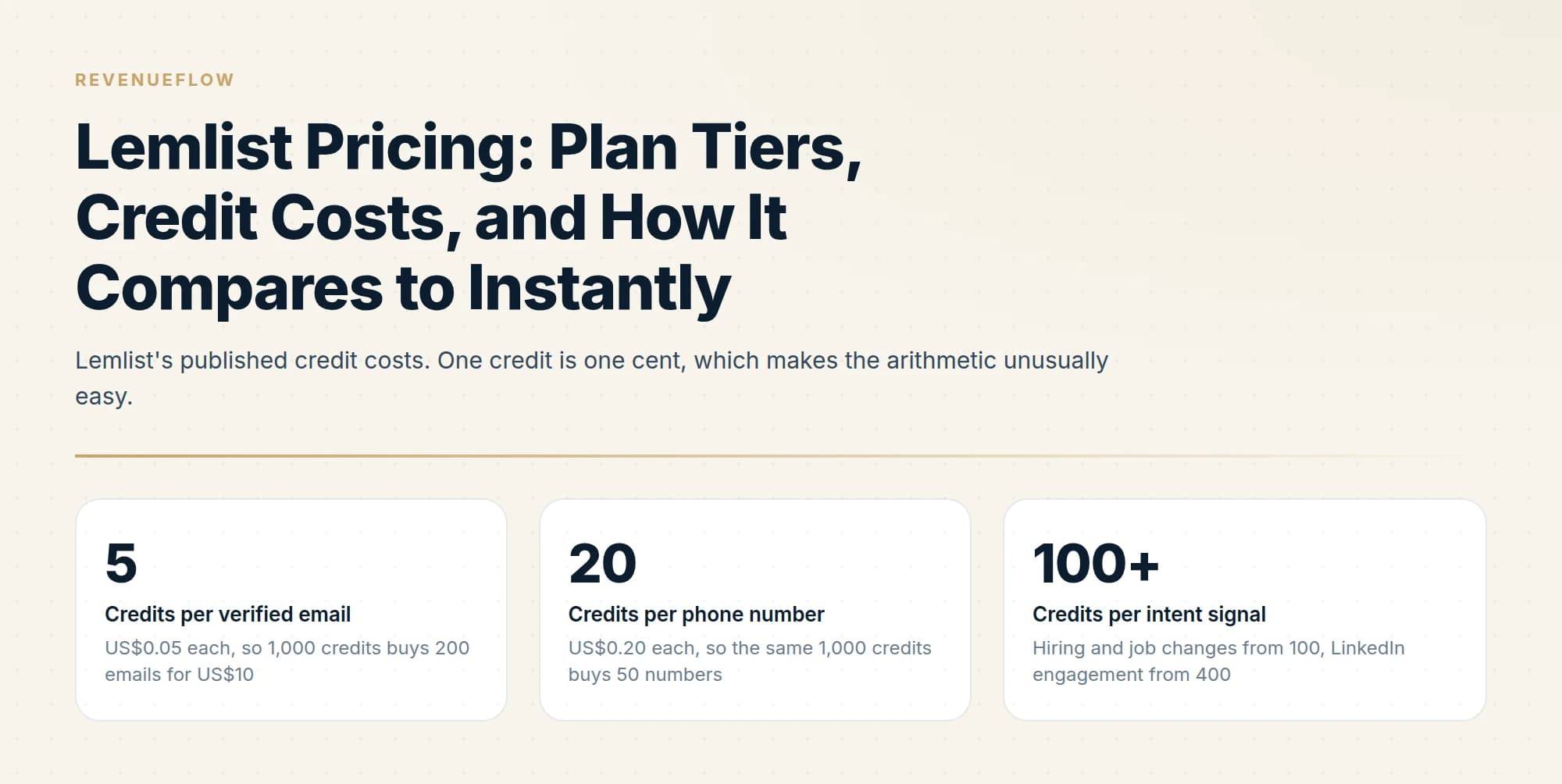
Lemlist prices its Email plan at US$69 a month, or US$55 yearly, with unlimited users and 50,000 emails, and its Multichannel plan at US$109 per user, or US$87 yearly, with five senders per user. Data is extra in credits at one cent each: five for a verified email, twenty for a phone number.
Key takeaways
- Lemlist's Email plan is US$69 a month or US$55 on yearly billing, with unlimited users and senders and a ceiling of 50,000 emails a month.
- Multichannel is US$109 per user a month or US$87 yearly, with five senders per user, so a 50-mailbox estate needs ten users.
- Data is a separate credit meter at one cent a credit: 5 credits per verified email, 20 per phone number and from 20 to 400 per intent signal.
- Instantly's Hypergrowth plan connects unlimited email accounts for US$97 a month, so lemlist costs more on mailbox count and earns its price on LinkedIn, SMS and calling.
Reviewed and updated September 21, 2026
Lemlist pricing works differently from the tools it is usually compared against, and the difference is structural rather than a matter of a few dollars. Instantly and Smartlead give you unlimited mailboxes and meter your send volume. Lemlist's Multichannel plan meters users and caps senders per user.
That means the honest comparison depends entirely on your shape. One operator running fifty mailboxes and a five-person team each running five are different customers, and the cheaper tool flips between them.
Here is lemlist's published pricing, read from its own pricing page, and where it lands against Instantly and Smartlead.
Lemlist pricing compared: the three plans
Lemlist sells three plans. Email costs US$69 a month, or US$55 on yearly billing, with unlimited users and email senders and 50,000 emails a month. Multichannel costs US$109 per user a month, or US$87 yearly, with five senders per user and unlimited emails and messages. Enterprise is priced on request, and data is bought separately in credits.
| Plan | Monthly, or yearly per month | What it meters |
|---|---|---|
| US$69, or US$55 | Unlimited users and senders, 50,000 emails a month | |
| Multichannel | US$109, or US$87, per user | 5 senders per user, unlimited emails and messages |
| Enterprise | On request | 5 or more senders per user, for teams of 5 or more |
Billing runs monthly, quarterly at 10% off, or yearly at 20% off. Lemlist advertises a 14-day free trial, which its FAQ describes as full access to the Multichannel plan with no credit card required.
Check the currency before you compare. Lemlist localises the currency to the visitor's region. The page as served carries dollars, and rendered in a browser on a connection it treated as British it showed the identical numerals in pounds, £69 and £109, so the symbol changes and the number does not. Its plan comparison lists local currency billing in dollars, euros or pounds on every plan. If you are outside the US, confirm what your own region is charged before comparing against a competitor quoted in dollars.
One inconsistency to flag rather than resolve, because it is on lemlist's own page. The Email plan card states "Unlimited Users & Email Senders", while the comparison table further down the same page describes the Email plan as "From $55 /user /mo". Those two statements disagree about whether the Email tier is priced per user. Confirm which applies before budgeting, because on a team of five it is the difference between US$55 and US$275 a month.
What each tier is actually for
The Email plan is a flat-rate sending tool with a 50,000-emails-a-month ceiling. It includes the email and phone number finder, a lead database lemlist describes as 650 million or more leads, unlimited contacts, a unified inbox, the Deliverability Hub and warm-up, CRM integrations with API access, lemlist's lemAgent AI agents and access to its MCP server. For pure cold email at moderate volume it is the relevant tier.
Multichannel adds the channels: LinkedIn automation, SMS automation, a WhatsApp add-on, a built-in call dialer with VoIP integrations, and task management. It also switches to per-user pricing with 5 senders per user, and lifts the email ceiling to unlimited.
Enterprise adds 5 or more senders per user, CRM-embedded use, custom roles and permissions, SSO and SAML, a dedicated account manager, 1:1 onboarding, priority support and custom terms of use.
Credits are a separate meter

Data is not bundled into the plan price. Lemlist runs a rechargeable credit system, and it publishes the rates plainly.
Intent signals are priced separately again: a company website visit costs 20 credits, hiring and job-change signals start at 100 credits, a fundraising signal costs 100 credits, and LinkedIn engagement signals start at 400 credits. At one cent a credit, a LinkedIn engagement signal is US$4, which is worth knowing before you switch several on across a large account list.
The clean way to read this: lemlist's plan price buys the sending and the software, and data is pay-per-success on top. That is more transparent than bundling, and it means a plan-price comparison against a tool that includes data is not a like-for-like comparison.
Where it beats Instantly, and where it loses
The sender cap is the pivot. Multichannel allows 5 senders per user, so a mailbox estate of 50 needs 10 users, which is US$1,090 a month on monthly billing or US$870 on yearly. Instantly's Hypergrowth plan, at US$97 a month on monthly billing, connects unlimited email accounts up to 125,000 emails a month, and its Light Speed tier at US$358 adds a system that assigns private server and IP blocks. At that shape the gap is not close.
Run it the other way and it reverses. A five-person sales team each sending from their own two or three mailboxes, wanting LinkedIn and calling alongside email, is paying US$435 a month on lemlist Multichannel for a genuinely multichannel workflow that Instantly's pricing page does not list for any plan.
So the useful question is whether your constraint is mailbox count or headcount. The Instantly pricing breakdown covers that side in detail, and Smartlead pricing covers the third model.
The multichannel question underneath the pricing
The per-user model is not arbitrary. It follows from what Multichannel actually is, and that is worth separating from the cost comparison.
The Gong versus lemlist comparison explains why these tools rarely compete directly, since one orchestrates outreach and the other handles deal intelligence and forecasting.
Multichannel bundles LinkedIn automation, SMS, a WhatsApp add-on and a built-in dialer alongside email. Those channels are person-shaped in a way email sending is not: a LinkedIn account belongs to a human, cannot be pooled, and carries account-level limits that no amount of software removes. Pricing per user with a sender cap reflects that reality rather than working against it.
So the comparison against Instantly is partly a comparison of different products. Instantly is an email sending platform with volume economics. Lemlist Multichannel is a sales-team workflow tool that happens to include email.
One caution on the LinkedIn side specifically, since it is the channel people buy Multichannel for. A LinkedIn message thread is permanent and visible, so a second message lands directly beneath the one the recipient already ignored. We do not run LinkedIn no-reply retargets for that reason, whatever the tool makes possible, and a platform's ability to automate a follow-up sequence is not an argument for running one. The LinkedIn automation guide covers the account limits that apply regardless of tooling.
What lemlist publishes about itself
Its pricing page displays a G2 rating of 4.7 out of 5 from 1,396 reviews, presented by lemlist rather than read from G2 directly, and states that more than 20,000 sales teams run their outbound in the product. Treat both as vendor claims, which is what they are, and read the review platforms yourself if the rating matters to your decision.
Deliverability features are included on all plans rather than sold up: Google, Microsoft and SMTP connections, in-app domain purchase, rotating IPs, a custom tracking domain, and a DNS setup test. The in-app domain purchase is a genuine convenience, and it is worth remembering that domains bought inside a sending tool are still domains you own and must authenticate properly. The SPF, DKIM and DMARC guide covers that.
Where credit pricing helps and where it hurts
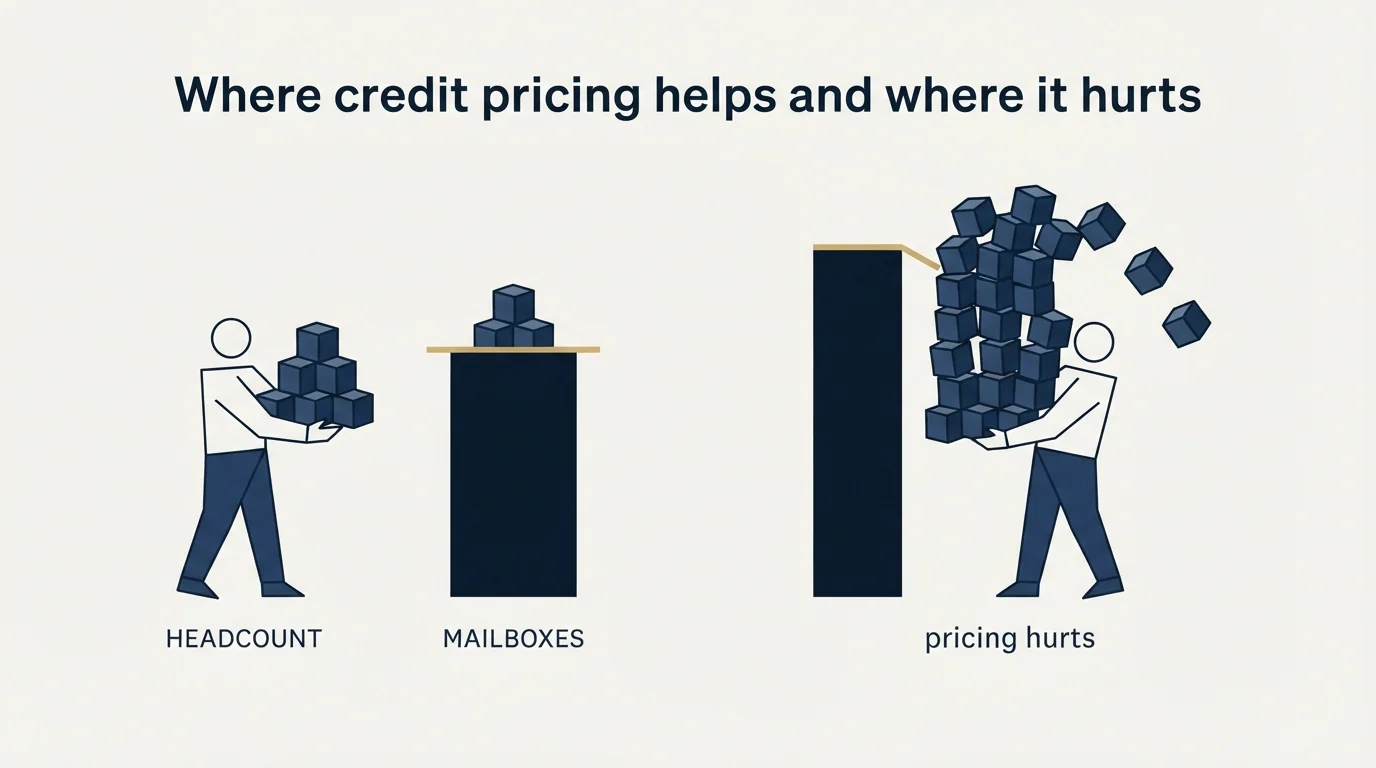
Pay-per-success data has a genuine advantage and a genuine trap, and which one you get depends on how variable your volume is.
The advantage is that you pay for what you use. A month with no sourcing costs nothing in credits, where a bundled allocation is paid for whether or not you touch it. That suits agencies with lumpy client work and teams that source in waves rather than continuously.
The trap is that costs scale linearly with no ceiling. Finding 20,000 verified emails a month at 5 credits each is 100,000 credits, or US$1,000, on top of the subscription. Smartlead's Unlimited Smart plan, at US$174 a month, lists 50,000 verified prospect emails alongside 150,000 email sends, and lemlist's credits alone reach US$174 at 3,480 verified emails a month. Credit pricing is cheap when you use little and expensive when you use a lot, and a team whose sourcing grows moves toward the expensive end.
The break-even is worth calculating once. Take your realistic monthly verified-email volume, multiply by five cents, add the plan, and compare against the bundled alternatives. If you are sourcing at any scale, the arithmetic usually favours a bundle. If your data comes from elsewhere and you only verify occasionally, credits win comfortably.
Intent signals deserve their own look before switching several on. At 400 credits, a LinkedIn engagement signal is US$4, so monitoring 500 accounts on that signal is US$2,000 if each fires once.
Working out your own number
Four inputs, in this order. How many people need access, because that is the multiplier on Multichannel. How many sending mailboxes, checked against the 5-per-user limit. Monthly email volume, checked against the Email plan's 50,000 ceiling. And data volume in credits, at 5 credits per verified email and 20 per phone number.
The multiplier on Multichannel: US$109 a month per user, or US$87 on yearly billing.
Checked against 5 senders per user. An estate of 50 needs 10 users.
Checked against the Email plan's ceiling of 50,000 a month.
5 credits per verified email and 20 per phone number, at one cent a credit.
Add the mailbox seats and domains you buy elsewhere, and compare totals rather than plan prices. Do the same calculation at the volume you expect in six months, not just today's, because the per-user model and the credit model both scale in ways a snapshot hides.
For the wider alternatives, we keep a list of lemlist alternatives. And whichever tool you land on, the deliverability guide covers the layer that decides whether any of it works.
We run outbound for clients on a pay-per-qualified-meeting basis, which puts the tool subscriptions, the mailbox estate and the data spend on our side. You can see what a campaign would look like for your market.
Lemlist plan prices, billing options, credit rates, intent-signal costs, feature inclusions and the G2 figure it displays are per lemlist's pricing page, read as served and rendered in a headless browser. Lemlist localises currency by region and the figures here are its US view; the rendered page showed the same numerals in pounds. Instantly and Smartlead figures are per their own pricing pages, on monthly billing unless stated. The Email plan's per-user basis is stated inconsistently on lemlist's page; confirm before purchasing. Prices exclude tax.
Sources: lemlist pricing, Instantly pricing, Smartlead pricing
Frequently asked questions.
Frequently asked questions- How much does lemlist cost?
- Lemlist's Email plan costs US$69 a month, or US$55 a month on yearly billing, with unlimited users and 50,000 emails a month. Multichannel costs US$109 per user a month, or US$87 yearly, with five senders per user and LinkedIn, SMS and calling. Enterprise is priced on request. Quarterly billing takes 10 percent off, and data is bought in credits.
- How do lemlist credits work?
- Credits are lemlist's currency for data and extras, charged only when an action succeeds, at one cent a credit. A verified email costs 5 credits and a phone number 20, so 1,000 credits buys 200 emails or 50 numbers for US$10. Intent signals cost 20 credits for a website visit, 100 for a fundraise and from 400 for LinkedIn engagement.
- Is lemlist cheaper than Instantly?
- It depends on your shape. On mailbox count Instantly is cheaper: its Hypergrowth plan connects unlimited email accounts for US$97 a month, while lemlist Multichannel needs one US$109 user per five senders. Lemlist earns its price when several people need LinkedIn, SMS and calling alongside email, which Instantly's pricing page does not list for any plan.
- Does lemlist charge per user on the Email plan?
- Lemlist's own page disagrees with itself. The Email plan card says unlimited users and email senders, while the comparison table lists the Email plan from US$55 per user per month. On a team of five that is the difference between US$55 and US$275 a month, so confirm which applies with lemlist before budgeting.
About the author.

Ben Carden is CRO at RevenueFlow, which builds and operates outbound revenue engines for B2B companies. Previously at Gartner Enterprise. Studied at London School of Economics.
Ben Carden · CRO
Connect on LinkedIn →Explore more.
Ready to scale your outreach?
We build GTM engines that book real meetings. See the receipts.
Related articles.
QuickMail Pricing: Volume Bands, Not Seat Counts
QuickMail charges on monthly sends and stored contacts rather than seats. The three bands, the missing annual option, and the inbox billing its own pages disagree about.
Email Tracking Software: Six Tools, Priced and Capped
Streak, Mailsuite, Right Inbox, Mixmax, Yesware and HubSpot compared on free-tier caps and published prices, plus what an open event still proves.
GMass Mail Merge: Sending Inside Gmail, and What It Costs
GMass runs the merge inside Gmail, which removes every setup step and hands your sending ceiling and your reputation to Google in the same move.
The lemlist MCP Server: When the Agent Can Launch Campaigns
lemlist's MCP server can create, start and pause campaigns, not just read them. The OAuth path, the credit meter, and the three database figures its pages disagree on.
Is GMass Free? The Trial Cap and the 2026 Prices
GMass has a free trial rather than a free plan: seven days, 50 messages a day, no external SMTP. Here is what the paid plans cost per mailbox after January 2026.
Yesware Email Tracking: What the Open Notification Proves
Yesware tracks opens, clicks and attachment views from inside Gmail and Outlook. What each event proves, what every tier costs, and why an open is not a trigger.