Free Tiers and Trials in Sales Tools: What $0 Gets You Across 386 Vendors
37.0% of 386 verified sales tools have a permanent free plan. The median free data tier gives 50 credits and the median free sending plan 2,500 emails a month.
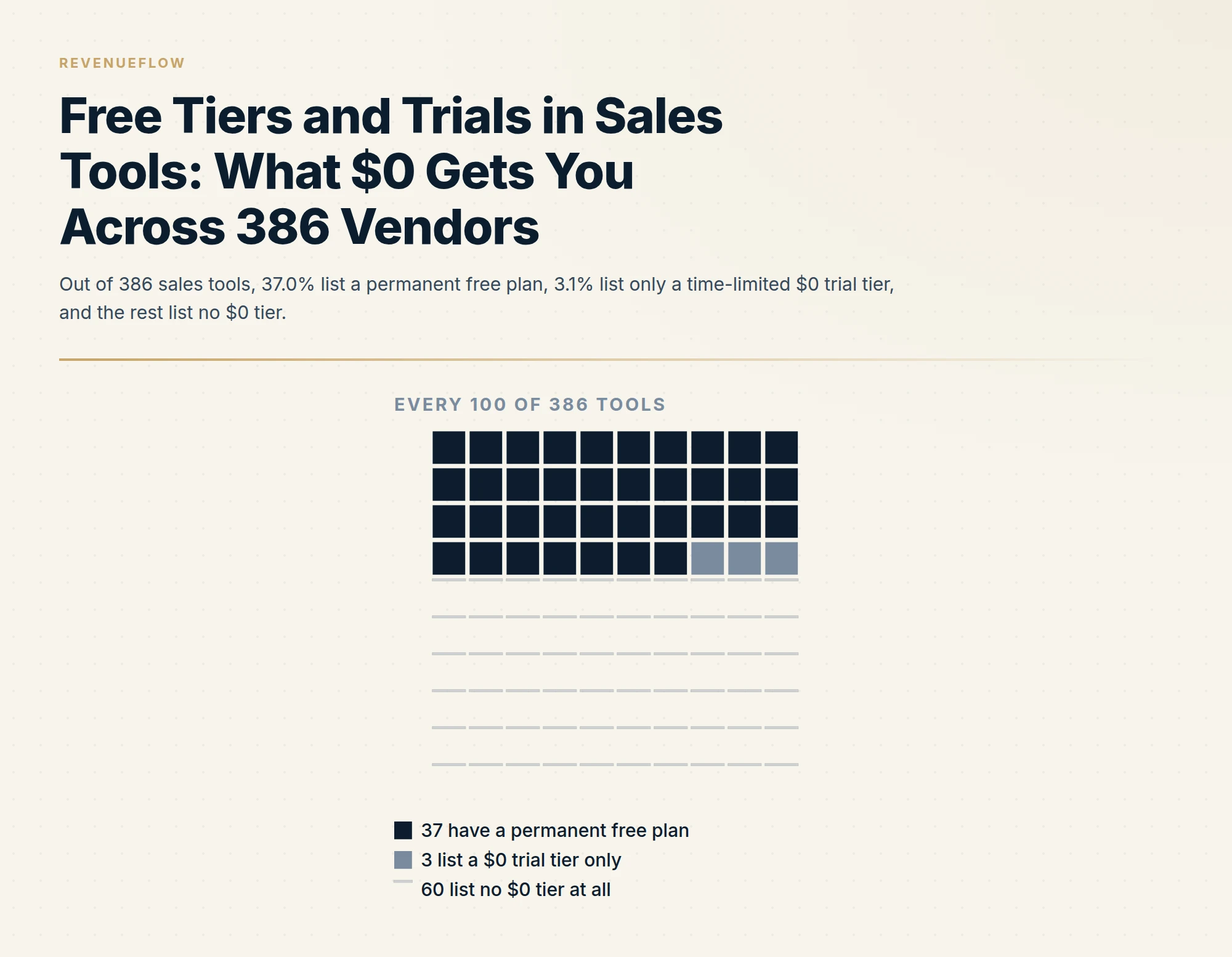
Of 386 verified sales tools, 155 (40.2%) list a $0 tier: 143 have a permanent free plan and 12 list only a time-limited trial tier. Data enrichment leads at 58.3% and email warmup trails at 15.0%. The median free data tier gives 50 credits, and the median free sending plan allows 2,500 emails a month.
Key takeaways
- 143 of 386 sales tools (37.0%) have a permanent free plan, and a further 12 (3.1%) list only a time-limited $0 trial tier.
- Free tiers are most common in data enrichment (58.3% of tools) and email sending (42.4%), and least common in sales engagement (18.0%) and email warmup (15.0%).
- The median free data tier gives 50 credits, and 57 of 65 free data tiers stop at 100 credits or fewer, enough to test match rates and not enough to build a campaign.
- Among 44 tools that state a trial length, 59.1% give 14 days and 25.0% give 7 days.
Reviewed and updated September 16, 2026
Most outbound stacks start with a free account. Somebody signs up for an email finder to check whether it can find the ten people they already know, connects a sequencer's free plan to one mailbox, and runs the first campaign before anyone has approved a budget. How far that gets depends on two things pricing pages make hard to compare: which tools actually have a free tier, and what each one includes.
RevenueFlow's verified vendor dataset records every pricing tier for 386 sales tools, including the $0 ones, with the limits each vendor states. Every record was read from the vendor's own pricing page between 2026-08-28 and 2026-09-05. This study counts the free tiers, separates real free plans from time-limited trials, and measures what $0 buys.
How common a free tier is
155 of the 386 tools (40.2%) list a $0 tier on their pricing page. That figure mixes two different things, so the study splits it.
A free plan is a $0 tier with no time limit: free forever, with caps. 143 tools (37.0%) have one. A trial tier is a $0 tier that the vendor names a trial or describes as time-limited, which puts it on the pricing grid as if it were a plan. 12 tools (3.1%) list one of those and no permanent free plan. A free plan that begins with a trial of paid features, which several vendors offer, counts as a free plan.
Separately, many vendors offer a trial of a paid plan without listing it as a tier. Those show up in plan notes and are covered in the trials section. 197 tools (51.0%) list no $0 tier and state no trial length anywhere on the record. That does not prove they offer no trial, only that their pricing page did not say so.
Free tiers by category
| Category | Tools | Free plan | Share with a free plan | Trial tier only | Share with any $0 tier |
|---|---|---|---|---|---|
| Data enrichment | 151 | 79 | 52.3% | 9 | 58.3% |
| Email sending | 85 | 35 | 41.2% | 1 | 42.4% |
| CRM | 69 | 15 | 21.7% | 2 | 24.6% |
| Sales engagement | 61 | 11 | 18.0% | 0 | 18.0% |
| Email warmup | 20 | 3 | 15.0% | 0 | 15.0% |
Free is a data-tool habit. 58.3% of data enrichment tools list a $0 tier and 52.3% have a permanent free plan. The reason is structural: the only way to judge an email finder or a contact database is to run real names through it, so free credits are the demo. This is also the category where trial tiers cluster (9 of the 12), usually a one-time grant of credits.
Email sending comes second at 42.4%. Most of those free plans belong to newsletter and transactional senders, where a capped free plan is the standard way to acquire a developer or a small list owner. CRM is at 24.6%.
Sales engagement (18.0%) and email warmup (15.0%, or 3 tools of 20) are the categories least likely to be free. Both sell a service that costs the vendor real money per active account, in seats and sending infrastructure, and neither has a natural "small" usage level to give away.
What $0 buys
Email sending free plans
2,500
emails a month at the median (20 plans with a monthly figure)
Middle half: 500 to 3,250. Largest: 15,000.
Data tool $0 tiers
50
credits at the median (65 tiers with a credit figure)
- 25 or fewer credits: 16 tools
- 26 to 100 credits: 41 tools
- 101 to 500 credits: 4 tools
- more than 500 credits: 4 tools
In email sending, the 20 free plans that state a monthly email allowance give a median of 2,500 emails a month, with the middle half between 500 and 3,250. A further 2 state only a daily cap. The largest allowances on the record are Sender (15,000 emails a month, verified 2026-09-04), EmailOctopus (10,000 emails a month, verified 2026-09-04) and Mailjet (6,000 emails a month, verified 2026-09-04). These are marketing and transactional senders. They are built for opted-in lists and their terms generally prohibit cold outreach, so a generous free plan here is not a free cold email tool.
In data tools, the 65 $0 tiers that state a credit figure give a median of 50 credits, with the middle half between 30 and 100. 16 tools give 25 credits or fewer, 41 give between 26 and 100, 4 give 101 to 500 and 4 give more than 500. So 88% of free data tiers stop at 100 credits or below. Only 22 of the 65 state that the credits renew every month. The rest are one-time grants or do not say.
Fifty credits is enough to answer one question: does this tool find the people on a short list that is already known to be good? It is not enough to build a campaign. Named examples show the range: Prospeo (100 credits a month, verified 2026-09-01), Bounceless (1,000 credits a month, verified 2026-09-04), and Apollo (900 credits per seat per year, granted monthly, verified 2026-09-01).
The practical approach is to treat free data credits as a match-rate test. Take thirty contacts whose emails are already known, run them through three tools, and compare hit rate and accuracy before paying anyone. The roundups of Hunter alternatives, Apollo alternatives and Lusha alternatives list the free allowance for each vendor they cover, and the Apollo pricing breakdown covers what changes on the first paid tier.
Free plans and the price of the first paid tier
A free plan is a customer acquisition cost, and one might expect vendors to recover it with a higher first paid tier. The data shows the opposite. Across all categories, tools with a free plan start charging at a median of $32.30 a month (119 tools) and tools without one start at $49 (193 tools).
The gap is largest in sales engagement, where tools with a free plan start at a median of $49 and tools without start at $89. In email sending it is $15.50 against $29, and in CRM $20 against $30. Data enrichment is the exception: $49 with a free plan and $50 without, which is no real difference.
The likely explanation is that a free plan and a low entry price are two expressions of one strategy. Vendors that sell bottom-up, to an individual with a credit card, need both. Vendors that sell top-down, to a team through a demo, need neither, and they price accordingly. 53 of the 143 tools with a free plan (37.1%) also carry a quote-only tier at the top, which is the full product-led ladder from $0 to a negotiated contract.
Trials: fourteen days is the standard
44 tools (11.4% of the dataset) state a trial length somewhere in their pricing notes. Among them, 26 (59.1%) offer 14 days and 11 (25.0%) offer 7 days. 3 offer 15 days, 3 offer 30 and 1 offers 60.
44 tools (11.4%) state on their pricing page that no credit card is required to start. Both figures are floors, because a record only captures what the pricing page said. A vendor whose trial terms live on a signup page is not counted.
Fourteen days is a poor fit for outbound tools in particular. A new sending mailbox needs a warmup period before it carries real volume, so a team that starts a 14-day sequencer trial with fresh mailboxes will spend most of the trial unable to test the thing it is evaluating. The workable order is to set up and warm mailboxes first, then start the trial. For warmup tools themselves, which rarely have a free tier, the Mailjet pricing page is a useful contrast from the marketing-email side, where free plans are the norm.
What the free tier leaves out
The limits that matter on a free plan are rarely the headline number. Three patterns recur in the plan notes across the dataset.
Vendor branding is one. 6 free plans state on the pricing page that the vendor's branding appears on outgoing email, and the true number is higher because most vendors mention it in documentation and not on the grid. For a newsletter that is a cosmetic cost. For sales email it is disqualifying.
Integrations and exports are the second. Free data tiers commonly allow lookups in the app and withhold CSV export, CRM push or API access, which turns a free plan into a viewer. The third is seats: free plans are almost always single-user, so they test the product and not the workflow.
Running a free-tier evaluation that answers something
A free tier is most useful when it is pointed at one question with a known answer.
- Data tools: test against contacts already verified. Thirty people whose current email addresses are known is enough. Run the same thirty through each candidate and compare how many each tool finds, and how many of those are correct. The median free tier of 50 credits covers that test with room to spare.
- Sending tools: test the workflow, not the volume. Connect one mailbox, build one campaign, send it to colleagues and check how replies are threaded, logged and pushed to the CRM. None of that needs more than a handful of sends.
- Record the limit that stopped the test. Whether it was credits, seats, exports or an integration locked to paid plans, that limit is the vendor's statement of where the product's value starts, and it is the feature the first paid tier is really selling.
None of this makes free tiers a bad deal. They are the cheapest due diligence available. The mistake is reading "free plan" as "free tool": for a team that intends to run outbound as a channel, the free tier is an evaluation stage, and the first paid tier is the real entry price.
Teams that would rather skip the evaluation phase altogether can see what a fully run campaign looks like with RevenueFlow's free campaign offer.
Methodology
Population. The 386 tools in RevenueFlow's verified vendor dataset as of September 2026, each record read from the vendor's own pricing page and dated between 2026-08-28 and 2026-09-05.
Definitions. A $0 tier is a pricing tier recorded with a free billing basis. It is a trial tier when the tier is named a trial, or when its notes say "trial" without also saying the plan is permanent ("free forever", "then limited free features", a trial "of paid features first"). Every other $0 tier is a free plan. Trial lengths were read from any tier note that states a number of days, taking the shortest when a record states more than one.
Allowances. Read from the $0 tier's stated limits: the first number followed by "emails" or "sends" for sending tools, and by "credits", "verifications", "searches", "leads" or "contacts" for data tools. Daily caps were counted separately and never converted to monthly figures. Allowances stated per year or per day were left out of the credit distribution.
Checks. The count of tools with a $0 tier was recomputed by a second reader over the raw record files and matched.
Limits. Counts of trials, "no credit card" statements and branding requirements are floors, because a record holds what the pricing page stated and nothing from signup flows or documentation. A credit is not a standard unit across data vendors.
Free tier details verified between 2026-08-28 and 2026-09-05. Verify current terms with the vendor before relying on them.
Frequently asked questions.
Frequently asked questions- Which sales tools have a free plan?
- In RevenueFlow's dataset of 386 verified sales tools, 143 have a permanent free plan. They cluster in data enrichment, where 52.3% of tools have one, and email sending at 41.2%. CRM is at 21.7%, sales engagement at 18.0% and email warmup at 15.0%. Free plans are capped by credits, emails, seats or features, and the caps differ by vendor.
- How many free credits do B2B data tools give?
- The median is 50 credits across 65 free data tiers that state a figure, with the middle half between 30 and 100. Sixteen tools give 25 credits or fewer, 41 give between 26 and 100, and only 8 give more than 100. Just 22 of the 65 say the credits renew monthly. The rest are one-time grants or do not say.
- How long are free trials for sales software?
- Fourteen days is the standard. Among 44 tools that state a trial length on their pricing page, 26 offer 14 days, 11 offer 7 days, 3 offer 15 days, 3 offer 30 days and 1 offers 60. For outbound tools that is short, because a new sending mailbox needs warmup before it can carry the volume a trial is meant to test.
- Do tools with a free plan cost more once you pay?
- No. Tools with a free plan start charging at a median of $32.30 a month, against $49 for tools without one. The gap is widest in sales engagement, at $49 against $89. Data enrichment is the exception, at $49 against $50. A free plan and a low entry price are two parts of the same bottom-up selling approach.
About the author.

B2B cold email experts helping companies generate qualified leads through done-for-you outreach campaigns.
RevenueFlow Team
Explore more.
Ready to scale your outreach?
We build GTM engines that book real meetings. See the receipts.
Related articles.
The Real Cost per 1,000 Emails, Verifications and Data Credits in 2026
Unit prices computed from verified vendor plans: $1.00 per 1,000 emails sent, $2.00 per 1,000 verifications and $19.60 per 1,000 enrichment credits.
What Cold Email and Sales Tools Actually Cost in 2026: Pricing Data From 386 Vendors
RevenueFlow's verified dataset of 386 sales tools puts the median starting price at $39.98 a month. Here is the spread by category, tier and billing model.
Annual vs Monthly Billing: How Much Sales Tools Discount for Paying Yearly
Across 112 verified sales tools with both rates on record, the median discount for annual billing is 20.0%, and it only pays off after month 9.6.
Sales Engagement Platform Pricing in 2026: What 61 Tools Charge and Which Hide It
Sales engagement platforms start at a median of $75 a month, 70.5% carry a quote-only tier, and AI SDR platforms start at $204.50. Data from 61 verified tools.
Lavender Pricing: Two Products, No Pricing Page
Lavender has no pricing page. The Email Coach ladder per seat at both billing states, the free routes, and the separate per-agent price for Ora.
TexAu Pricing: Four Tiers, Billed Only on a Match
TexAu charges credits only when a lookup succeeds. The four tiers at both billing states, the rollover cap, and three places the page disagrees with itself.