White Label SaaS Reseller: The Obligations Behind the Logo
Removing the vendor's brand is a priced feature and tier 1 support is yours by default. Licensing shapes, the support handoff, and the exit problem.
A white label SaaS reseller sells someone else's software under its own brand. Licences come per seat, per tenant or sub-account, or as OEM, and you earn either by buying at a discount and setting your own retail price or by referring for commission. Tier 1 support and the exit problem are yours.
Key takeaways
- White label SaaS is licensed per seat, per tenant or sub-account, or as OEM, and the first question in each is who the provider treats as its licensee.
- Resellers earn by buying at a discounted rate and setting their own retail price, or by referring clients for commission; ActiveCampaign's partner program offers both.
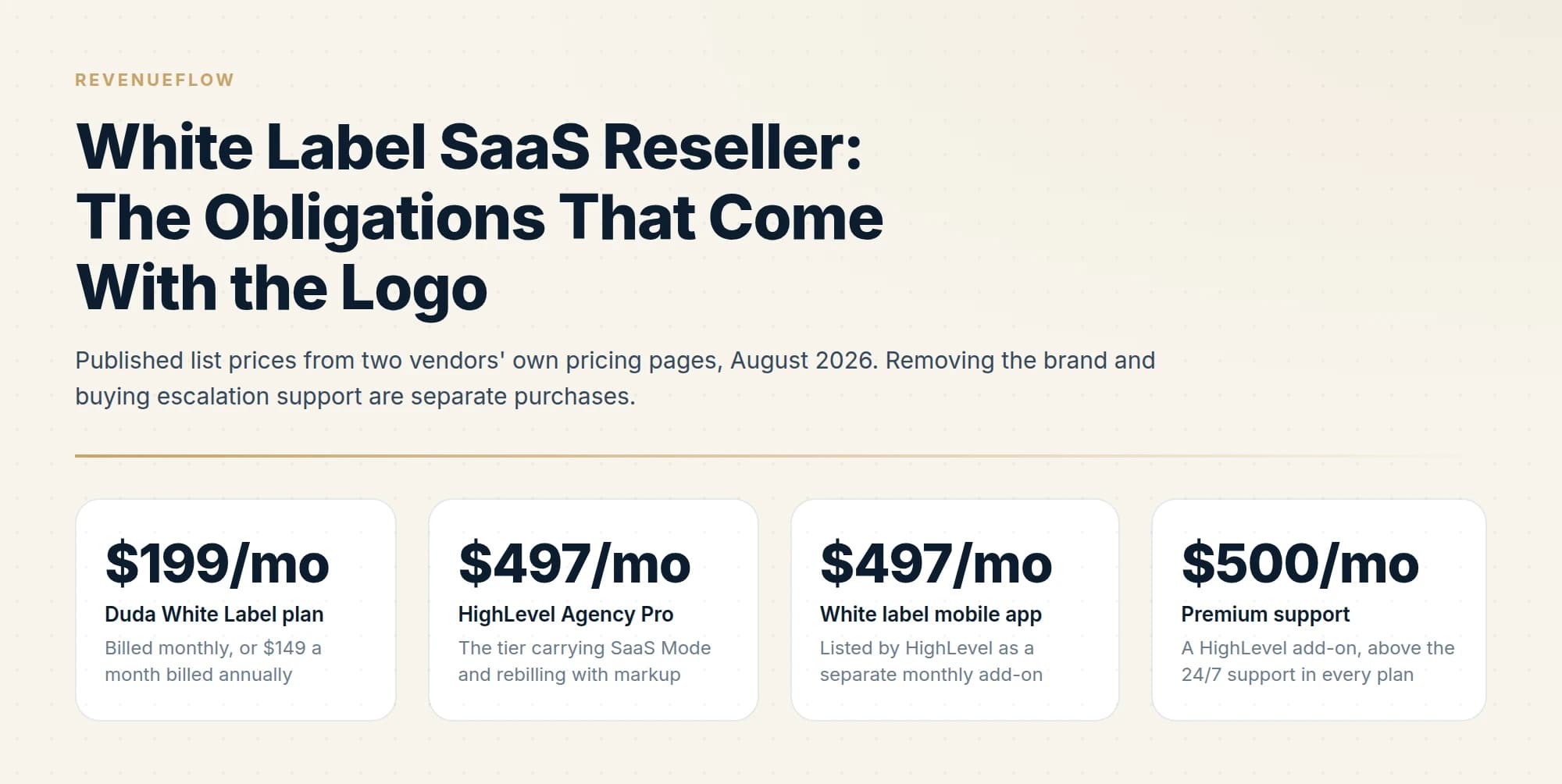
- Branding is sold by surface: Duda's White Label plan is $199 a month or $149 on annual billing, and HighLevel sells its white label mobile app as a $497 monthly add-on.
- Tier 1 support is always the reseller's, so the provider's response commitment above it and the data export at termination are the terms to negotiate hardest.
Reviewed and updated September 21, 2026
Anyone weighing a white label SaaS reseller arrangement should start with two price lists. Duda sells four named plans and the fourth one is called White Label. On its pricing page it lists at $199 a month billed monthly, or $149 a month billed annually, and the page's own FAQ says full platform white labelling is available with the White Label and Custom plans, alongside an unbranded self-service support portal so clients "won't even know you're using Duda." HighLevel draws a similar line in a different place: its pricing page puts SaaS Mode and the right to rebill phone and email usage with a markup on the $497 a month Agency Pro tier, while the $297 Unlimited tier can rebill those costs at no markup.
Two vendors, one lesson to take into any software resale conversation. The right to remove the provider's name and the right to make money on top of their pricing are both features, they are priced separately from the software, and they sit on lines of the price list most people skim.
That is the cheap part of the problem. The expensive part is the asymmetry underneath it: you carry the customer relationship for a product whose behaviour you do not control. Everything below is a consequence of that one sentence.
A white label CRM is the most commonly resold example of this and the one that exposes the trade-off fastest: the platform is somebody else's roadmap under your logo, so the margin is real, the differentiation is thin, and the support burden arrives on your desk while the fixes stay on theirs.
White label LinkedIn automation sits in the same trade-off with one addition worth pricing, because the account restriction risk stays on the client's own LinkedIn profile whatever branding the login page carries.
Licensing models: wholesale, revenue share and your own retail price
White label SaaS is licensed in three shapes, per seat, per tenant or sub-account, and OEM, and paid for in two ways. Either you buy at a wholesale or discounted rate and set your own retail price, or you refer customers and take a commission, which is a revenue share. ActiveCampaign's partner program offers both, and HighLevel's SaaS Mode lets you set the price.
The first question in each shape is who the provider considers its licensee.
In per-seat resale you buy licences and assign them. The provider's terms typically bind each named user, your cost scales with your customer's headcount, and price floors are common enough to be worth asking about explicitly.
In tenant or sub-account resale, which is what most agency programs actually are, you hold a master account and each customer is a tenant inside it. HighLevel's plan table is a clear example of the shape, with sub-accounts as the unit: three of them on the $97 Starter tier and unlimited on the $297 and $497 tiers. You are the licensee. Your customer is a user of your account, which is why their data lives inside a tenant you control rather than in a contract they hold, and why it is worth confirming in advance whether the provider will speak to them at all.
In OEM or embedded licensing the product disappears into yours as a feature. Terms are negotiated rather than published, control is highest, and so is the commitment, because your product now has a dependency.
Pricing freedom varies and is worth confirming in writing. HighLevel's own FAQ describes SaaS Mode as turning the platform into "your own sellable software product" where "you set the price." ActiveCampaign's agency partner page invites agencies to earn "by reselling ActiveCampaign at a discounted rate or referring clients for commission", and advertises custom billing flexibility so partners can invoice clients on their own terms with their own pricing and packages. Other programs hold resellers to a floor or to a published list price, which caps the margin before you have sold anything.
| Shape | Who is the licensee | Exit means |
|---|---|---|
| Per-seat resale | Each named end user, on licences you buy and assign | Seats converting to a direct contract |
| Tenant or sub-account | You, with your customer as a tenant inside your account | Migrating data out of your tenant |
| OEM or embedded | You, shipping the functionality as your own feature | Replacing a component your product depends on |
What a white label SaaS reseller pays for the logo
White labelling is a set of surfaces rather than a switch, and vendors sell the surfaces separately.
HighLevel's FAQ states you can white label the desktop web app so clients see your branding at login rather than HighLevel's. The mobile app is a different surface and appears in the add-on list at $497 a month, with a branded client portal app listed at $49 a month per sub-account. Its Enterprise tier bundles the white label mobile app into the purchase instead, which tells you the same capability moves between line items depending on the tier you land on.
So enumerate the surfaces before you promise a client that the product is yours. Login page and app shell, sending domain and email headers, the support portal, transactional and system notifications, the mobile app, the help documentation your customer will be linked to, the URL in the address bar, and anything the product exports as a PDF. Get a written list of which ones your plan covers, because the one you did not check is the one a customer will screenshot.
Recruiting teams that depend on outbound email to reach candidates can compare current platforms in email sending tools for recruiters.
Rebilling is the other half of the margin, and HighLevel's own page states it two ways. The plan cards put "Rebill Phone & Email (no markup)" on the $297 Unlimited tier and rebilling with markup on the $497 Agency Pro tier, while its FAQ says that on the Unlimited and Pro plans you can rebill these costs to clients, "often adding a markup to create your own profit." The add-on list adds that most add-ons "can be resold with your own markup in the Agency Pro plan." If passing vendor costs through at a margin is part of your model, get the rule for your tier in writing.
Support tiering is the operational core

Tier 1 is yours by definition, because your brand is on the login page and your customer has nobody else to message. The negotiation is about tier 2 and tier 3.
Three things decide whether that handoff works. The response commitment you are given, which is often the standard commercial one rather than a partner-specific one. Whether you can see the provider's ticket, or whether you are relaying status you cannot verify. And whether your customer ever learns the provider exists during an incident, which is a decision you should make deliberately at contract time rather than at 6pm during an outage.
Support is also frequently a purchase. HighLevel lists 24/7 support on every plan and sells premium support as a $500 a month add-on, bundling it into Enterprise along with a dedicated Slack channel. Read that as the shape of the category rather than as a criticism of one vendor: the level of access you will need as somebody else's front line is usually not the level included by default.
ZoomInfo Chat's examination of hidden costs shows how a chat widget's real expense lies in staffing rather than its list price, echoing the support-as-purchase pattern above.
The rule that saves the most pain is simple. An SLA you resell is only as good as the one you were sold, so put the two documents side by side before you sign either. Compare response time against resolution time, business hours against 24/7 coverage, and the severity definitions, which are where two documents that look identical usually diverge.
They message your brand, because your logo is on the login page. Your clock starts here.
Your team reproduces it and rules out configuration. This tier is yours in every licensing shape.
You open a ticket your customer cannot see, and the provider's response commitment governs the wait.
The provider closes the ticket. Someone still has to explain it in your voice, without naming them.
Churn attribution and renewals
Two questions here, and both are usually settled by default rather than by decision.
The renewal conversation belongs to whoever the customer pays. In a sub-account model that is you, which is good for control and bad for surprise, because your wholesale cost can move at your renewal while your customer's price is fixed until theirs. Line the two dates up so you are never carrying a cost increase you cannot pass on for eleven months.
Attribution is the harder one. When a customer leaves, you need to know whether they left your service or the product, and the provider holds the usage telemetry that answers it. Ask what per-tenant reporting you get, in what format, and whether you can pull it through an API rather than reading a dashboard. If the answer is thin, instrument something you control, even if it is only login frequency and the two or three actions that correlate with a customer sticking.
Roadmap dependency
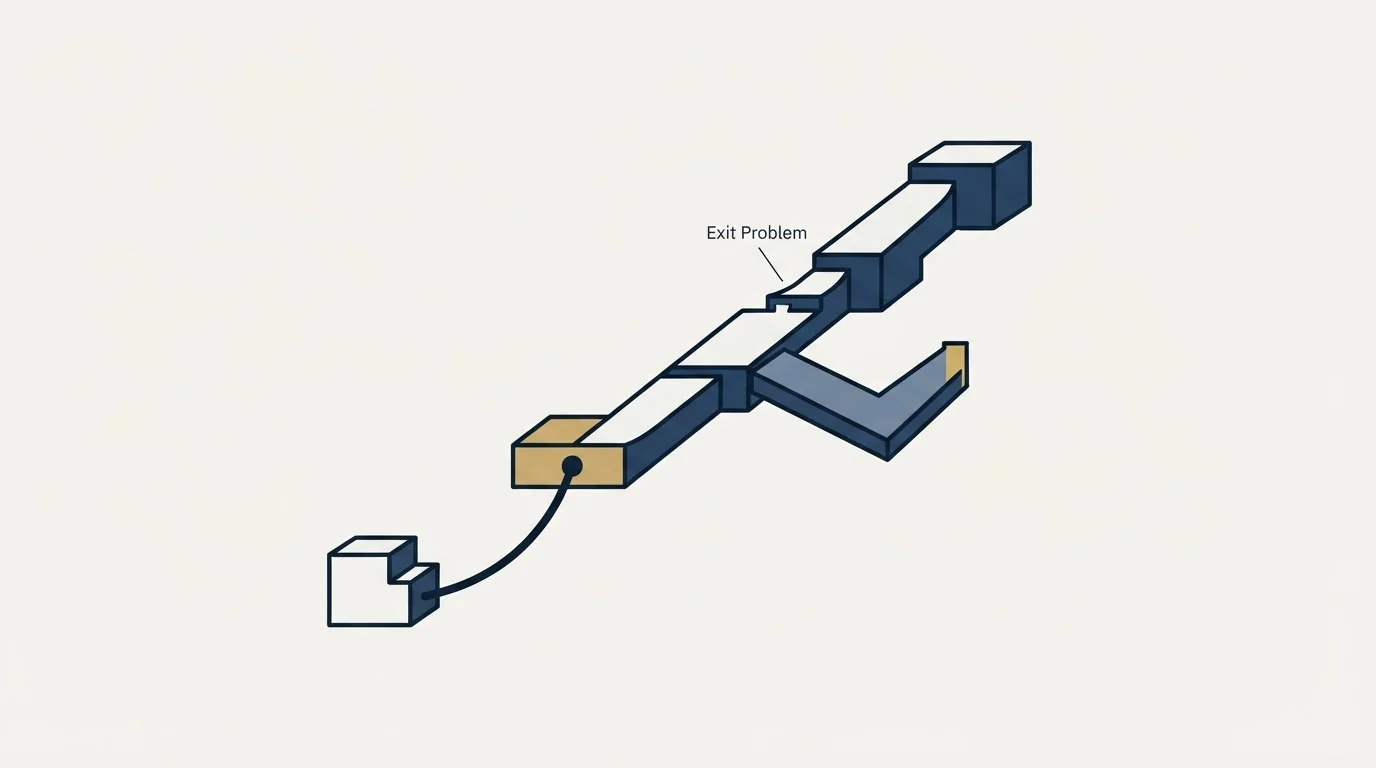
The product changes on their schedule. A feature you built a pitch around can be deprecated, an interface your customers trained on can be replaced, and the retraining lands on your team.
Packaging changes are the underrated version of this. A sizeable part of HighLevel's add-on catalogue is priced per sub-account rather than bundled into the plan fee: online listings management at $30 a month per sub-account, a premium prospecting tool at $29, WhatsApp integration at $10, SEO at $79, and AI Employee plans at $50 and $97, all per sub-account, with dedicated email IPs at $59 a month per IP on top. Whatever the vendor, when capability sits in per-tenant add-ons your cost per client tracks what you promised that client rather than your plan fee, and a repackaging changes your unit economics without changing your headline price.
Usage-metered components behave the same way. Duda's pricing FAQ describes AI Credits as consumption-based with a monthly allowance and paid top-ups when an account exceeds it. The economics of metered AI consumption in a resold product are covered in white label AI agents, and the wider question of which agent products actually sustain revenue is in what actually scales in AI agent ARR. The term to secure here is the notice period on price and packaging changes, plus whether your own customer contracts let you pass an increase through.
The exit problem
This is the real one. Your customers' data lives in someone else's product, so the switching cost is theirs and the churn is yours.
Ask about portability before signing, when you have leverage, rather than at the end when you have none. What exactly exports, in what format, and does it include the parts that took the longest to build: automations, templates, custom fields, files, call recordings, historical reporting. Who can trigger the export after termination, and for how long does the data remain retrievable. Whether the provider offers a migration path to a direct contract, which is worth knowing even though you will not enjoy it.
Then answer the question honestly for yourself. If you had to move every customer off this platform in ninety days, what would it cost and how many would you lose? That number is the size of the dependency you are taking on, and it belongs in the decision rather than in a future quarter.
Security and compliance pass-through
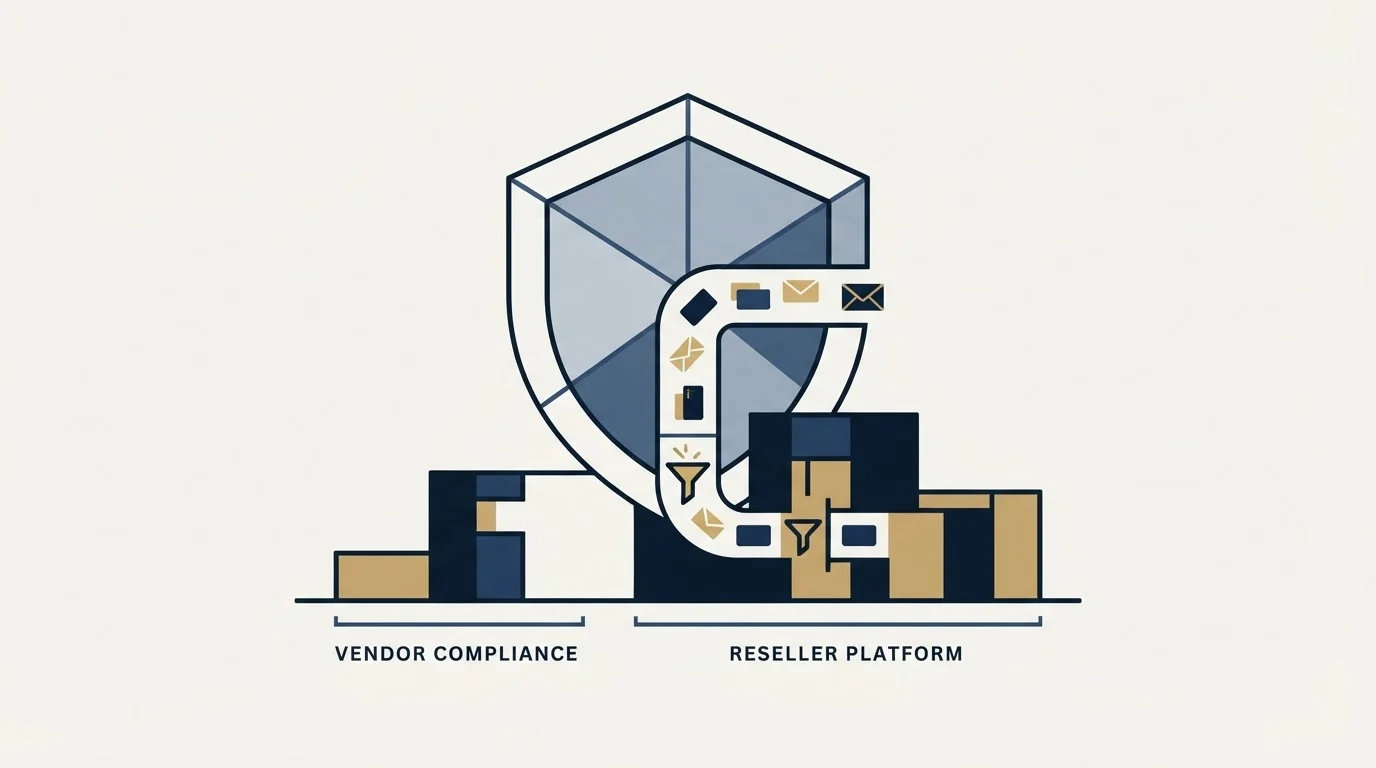
Your customer's security questionnaire arrives at you and can only be answered by the provider. Establish three things at contract time: which certifications and audit reports you are permitted to reference in your own name, whether you get the current subprocessor list and notice when it changes, and who signs a data processing agreement with your customer.
Compliance posture can also be a purchase. HighLevel lists HIPAA compliance as a $297 a month add-on and includes it in Enterprise, which is a useful reminder that a capability your customer assumes is standard may be a line item you have not bought.
Seven answers to secure while you still have leverage, the last two being the ones resellers usually discover during an outage:
- the export format, the fields it includes, and who can trigger it after termination;
- your tier 1 obligations, and the provider's written response commitment above them;
- whether you set your own price or are held to a floor;
- which certifications and subprocessor lists you may cite in your own name;
- the notice period on price and packaging changes, and whether you can pass them on;
- whether your customer ever learns the provider exists during an incident;
- an SLA that actually matches the one you sold, rather than one that only uses the same word.
The short version
Software resale puts your brand on a product whose roadmap, uptime and pricing belong to somebody else. The label is a priced feature, sold by surface: Duda gates full white labelling to its White Label and Custom plans, and HighLevel sells the mobile app version as a $497 a month add-on. Margin rights can be priced too, with rebilling at a markup sitting on HighLevel's $497 tier rather than its $297 one. Tier 1 support is yours whatever the contract says, so the handoff above it is the clause to negotiate hardest. And the exit problem outlasts every other term, because your customers' data is in a product you do not own.
If you are choosing between this and the other partner shapes, the taxonomy and the four questions that place any program are in white label reseller programs. If you are on the vendor side recruiting resellers rather than joining a program, cold email for reseller partnerships and partnership email templates cover the outreach.
Manufacturing teams running reseller outreach campaigns should also weigh deliverability, and email warmup tools built for manufacturers can keep those cold emails landing in inboxes rather than spam folders.
RevenueFlow is a service rather than a licence, and the equivalent questions get settled in writing before launch: we are paid on attended meetings against criteria agreed up front, and no meeting is charged without the client's written acceptance. You can see what a campaign would look like for your market.
Vendor pricing and terms checked against the vendors' own pages; the monthly total for a fully branded HighLevel setup is summed from its listed prices. All are subject to change; confirm current terms directly before contracting.
Sources: Duda pricing, HighLevel pricing, ActiveCampaign agency partner program
Frequently asked questions.
Frequently asked questions- What is a white label SaaS reseller?
- A business that sells another company's software under its own brand, usually from a master account in which each customer is a sub-account. The reseller owns the customer relationship and tier 1 support, while the provider controls the roadmap, uptime and pricing. Removing the provider's brand is typically a priced feature rather than a default.
- How do white label SaaS resellers make money?
- Two ways. Buy the software at a wholesale or discounted rate and set your own retail price, or refer customers and take a commission. ActiveCampaign's partner page offers both. HighLevel's SaaS Mode lets you set the price on its $497 Agency Pro tier and rebill phone and email usage at a markup.
- Can I rebill vendor costs to my clients?
- On some platforms, and the terms vary by tier. HighLevel's plan cards allow rebilling phone and email with a markup on Agency Pro and at no markup on Unlimited, while its FAQ says both plans can rebill, often with a markup. If passing costs through at a margin is part of your model, get the rule for your tier in writing.
- What is the biggest risk of reselling white label software?
- The exit. Your customers' data lives in someone else's product, so if you have to leave, the switching cost is theirs and the churn is yours. Before signing, confirm what exports, in what format, who can trigger it after termination and whether the provider offers a migration path to a direct contract.
About the author.

B2B cold email experts helping companies generate qualified leads through done-for-you outreach campaigns.
RevenueFlow Team
Explore more.
Ready to scale your outreach?
We build GTM engines that book real meetings. See the receipts.
Related articles.
Best Time to Cold Call: What the Studies Counted
The best time to cold call figures traced to their originals: one inbound study from six companies, three vendor call datasets, and what survives the read.
Best Time to Send a Sales Email: What Was Measured
The send time studies behind the midweek morning answer, what each one actually counted, and why a broadcast finding does not transfer to a sales email.
Is Clay Free? The Free Plan, the Trial and Where Each Stops
Clay's free plan, its 14-day trial and the no-charge-on-a-miss rule are three different things. What each holds and where it stops, from clay.com on 19 September 2026.
Video Prospecting Tools by Job: What Each One Is For
Ten video prospecting tools sorted by the job each vendor's own page describes: record and share, personalise at volume, avatars, hosting and interactive demos.
Seamless.AI Email Finder: How It Works, What a Credit Buys
How Seamless.AI's email finder resolves a contact in real time, what one Universal Credit buys, the Total AI score on every address, and what the Chrome extension reads.
Social Selling Tools by Job, and the Account-Risk Line
Fourteen social selling tools sorted into six jobs, split by whether each acts through your LinkedIn account or beside it, from the vendors' own pages.