Best Time to Send a Sales Email: What Was Measured
The send time studies behind the midweek morning answer, what each one actually counted, and why a broadcast finding does not transfer to a sales email.
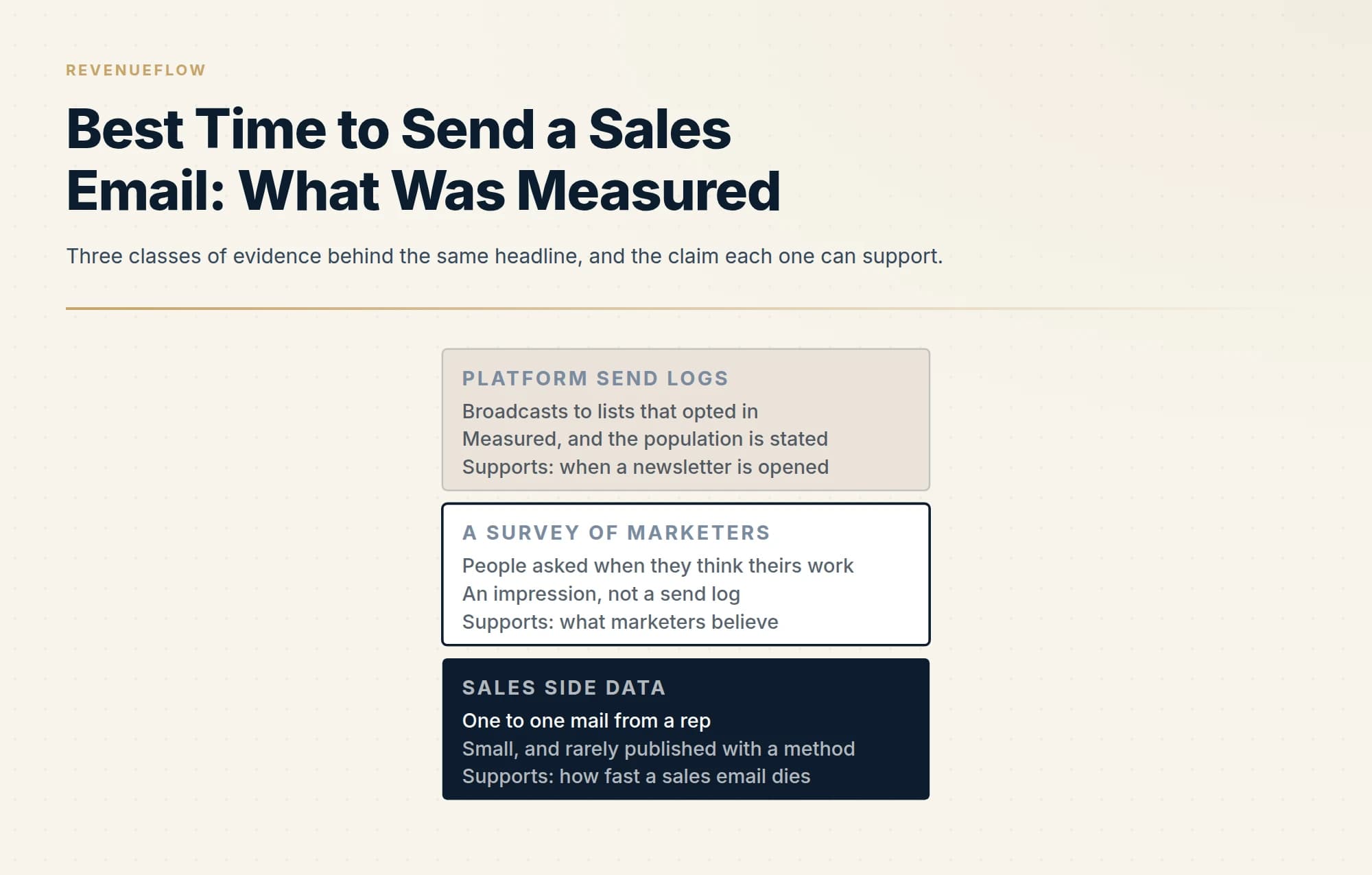
Three kinds of evidence sit behind the midweek morning answer: platform studies of marketing broadcasts, surveys of marketers reporting impressions, and a small body of sales side data. None measures a cold one to one email, so treat the consensus as a default, rank your own tests on replies, and use the recipient's local time.
Key takeaways
- Four email platforms publish send time analyses and all four state a population, but every one of those datasets is a broadcast to a list that opted in rather than a one to one sales message.
- The most quoted business to business answer comes from a survey of about one hundred and fifty marketers reporting their own impression, which is a different kind of claim from a send log.
- Almost every published send time ranking is decided on open rate, which mail providers corrupted when they began loading tracking images on the reader's behalf.
- The one useful sales side study is about decay rather than clocks: a sales email that gets answered is usually answered within the same working session.
Reviewed and updated September 21, 2026
Every page that answers this question says Tuesday morning, and almost none of them says what was measured to get there. Three completely different kinds of evidence are circulating under one heading. There are platform studies of marketing broadcasts, some of them enormous. There are surveys of marketers being asked when they think their own emails do best. And there is a much smaller body of data about one to one sales email, which is the only class that describes the message a rep is actually about to send.
Those three answer different questions and they are quoted interchangeably. This page separates them, says what each one counted and when, and then deals with the part nobody covers: whether a finding drawn from a broadcast to a subscribed list transfers to a single message sent to one stranger.
The platform studies, and how large they actually are
Four email platforms have published send time analyses off their own logs, and each states a population on the page. All four were read on 21 September 2026.
Campaign Monitor describes its dataset in one line: "We analyzed over 100 billion emails sent from across the globe during the past year." GetResponse is more specific about who was included: "We analyzed more than 4.4 billion messages sent by GetResponse customers in 2023", adding that "To keep things accurate, we focused on active senders with at least 500 contacts." MailerLite names the exact count and the window: "We analyzed over 2 million email marketing campaigns (2,138,817 to be exact!) sent through MailerLite from the US, UK, Australia, and Canada between December 2024 and November 2025". Omnisend states that it "analyzed approximately 26 billion emails".
Those are real measurements and the populations are stated plainly, which is more than the roundups quoting them manage. What they have in common is the thing that decides whether you can use them. Every one of those datasets is a broadcast: one message, sent by a business to a list of people who joined it, from a platform built for that job. Omnisend's is predominantly online retail. GetResponse's is filtered to senders with at least five hundred contacts. MailerLite's skews toward creators and small businesses in four English-speaking markets. None of them contains a cold, one to one message from a named person to a named person.
The survey class, which is not a measurement at all
HubSpot's page is the one most often quoted for the business to business answer, and it is a survey of opinion rather than an analysis of sends. Its own description is unambiguous: "We surveyed over 150+ marketing and advertising professionals in the U.S. and found the majority reported the highest engagement for their marketing emails occurred between 9 AM to 12 PM and 12 PM to 3 PM." The day answer comes from the same instrument: "27% of U.S. marketers said Tuesday, 19% said Monday, and 17% said Thursday." And the line that travels furthest, that B2B engagement peaks in the late morning, is reported as "47.9% of the B2B marketers we surveyed reported the most engagement between 9 AM and 12 PM."
One hundred and fifty people describing their own impression is a legitimate thing to publish and a poor thing to quote as though it were a hundred billion sends. The two get cited in the same sentence constantly. When a roundup lists five sources agreeing on Tuesday morning, check how many of the five are counting messages and how many are counting opinions.
Why a broadcast finding does not transfer
Three differences do the damage, and they all run the same way.
The first is who the sender is. A broadcast arrives from a brand the reader chose to hear from, so the decision is whether to read it now or later. A cold sales email arrives from a stranger, and the decision is whether it is worth anything at all. The window in which a subscriber gets round to a newsletter says nothing about the moment a stranger is most willing to engage with an unrequested request.
The second is the metric. Almost every published send time finding is ranked on open rate, and open rate stopped being a clean instrument when mail providers began loading tracking images on the reader's behalf. That argument in full, and what it does to any test decided on opens, is in cold email open rate benchmarks and in our subject line guide. A send time ranked on opens is ranked on an instrument that mixes human readers with machine prefetches in a proportion nobody can see.
The third is volume shape. A broadcast is one send to everybody, so the platform can compare hours cleanly. Outbound spreads the same list across mailboxes and days for deliverability reasons, which means a rep is not choosing an hour for a campaign so much as choosing a window for a schedule. What that constraint does to send windows and to the timezone problem is covered in email sequencing tools.
- A brand mailing its own list
- The reader subscribed first
- Ranked on opens, mostly
- One broadcast at one hour
- Often the sender's local time
- A named person writing to a stranger
- No prior consent of any kind
- Ranked on replies, or on nothing
- Spread across mailboxes and days
- Has to be the recipient's local time
What the sales side actually has
The honest answer is: less than you would like, and it is mostly about the life span of a message rather than the hour to press send.
Yesware published the most useful of it. Its study, read on 21 September 2026, states its own population: "we analyzed over 200,000 data points from sales reps and AE's email behavior in the past quarter to see how fast a sales email gets opened and replied to". What it found is about decay rather than about clocks: "In just the first hour, 75% of emails are opened and 42% of emails are replied to. And in the first 4 hours, 93% of emails are opened and 75% of emails are replied to." Read carefully, those are shares of the eventual opens and replies rather than of all messages sent, and the open half inherits the tracking pixel problem above. The reply half is the part worth keeping, and it says something no marketing study can: a sales email that is going to be answered is usually answered the same working session.
There is one widely repeated cold email figure, and it is a good example of why provenance matters. A sales tooling blog reports that an "Analysis of 16.5 million B2B cold emails across 93 business domains found that emails sent between 8-11 PM achieved the highest reply rates at 6.52%." The page names no publisher for that analysis. A second, unrelated page attributes the same 16.5 million cold email dataset to an outbound agency's own 2025 research. So the figure may well be real, and as published it cannot be checked, dated or scoped by the reader, which is the condition under which this site declines to carry a number as fact.
What to measure instead, and how little it takes
The useful version of this question is answerable from your own sending in a few weeks, and it needs no platform study at all.
Record, for every message, the recipient's local hour and weekday at the moment of delivery, not yours. Record whether a reply arrived and how long it took. Ignore opens entirely. Then group replies by local hour band rather than by exact hour, because the exact hour will be noise at any volume you have.
Here is the arithmetic, on invented figures used only to show the shape of the reading. Suppose a campaign sends four hundred messages spread evenly across four local hour bands, one hundred in each, and produces six replies in the eight to ten band, four in ten to twelve, three in one to three and five in three to five. That looks like a clear morning win. It is eighteen replies in total, and moving two of them between bands reverses the ranking. Those figures are invented and describe no campaign. The lesson generalises: a send time comparison needs more replies than most campaigns produce before it says anything, which is why the honest answer for most teams is to send inside the recipient's working hours and spend the attention on the premise instead. That is the argument how to write a cold email makes at length, and it is the reason the subject line gets written last.
- 1Find how many messages the publisher looked at. If the page does not say, stop there.
- 2Ask whether those were broadcasts to a subscribed list or one to one mail from a person, because only the second describes your send.
- 3Read the window the data covers rather than the year on the article; the two are often years apart.
- 4Check the ranking metric. A finding decided on opens alone is decided on an instrument that mixes readers with machine fetches.
- 5Confirm the times are the recipient's local time, since that is the only clock the reader is living in.
Where our own position changes the advice
We run one message per campaign, with no bumps and no thread replies, and a later approach is a separate campaign built on a new premise. That has two consequences for timing.
The first is that there is no second send to correct a bad slot, so the send window is a schedule decision made once, across the whole list, in the recipient's local time. The second is that it removes the most common use of send time advice, which is optimising the hour of message three in a sequence. We do not send message three.
What is left is small and worth doing: send inside the recipient's working hours in their own timezone, keep per mailbox volumes where deliverability requires them, and measure replies by local hour band over a quarter rather than a week. If the answer turns out to be that timing moved nothing, that is the usual answer, and the constraint is upstream.
The short version
Three classes of evidence share this headline. The platform studies are large and honest about their populations, and every one of them measures broadcasts to subscribed lists. The survey class is about one hundred and fifty marketers reporting an impression. The sales side has one useful published study, about how quickly a sales email is answered rather than when to send it.
None of them describes a cold, one to one message, so treat the midweek morning consensus as a sensible default rather than a finding, rank your own tests on replies rather than opens, use the recipient's local time, and accept that you will need more replies than one campaign produces before the comparison means anything. If you would rather see what a first message against your own market produces before tuning the hour it goes out, see what a first campaign produces.
Figures above were read on the publishers' own pages on 21 September 2026, with dated snapshots kept as evidence, and each is attributed to the page it appears on. This page carries no send time data of RevenueFlow's own. Verify current figures at source before relying on them.
Frequently asked questions.
Frequently asked questions- What is the best time to send a sales email?
- Inside the recipient's own working hours, in their timezone, on a midweek day. That is a sensible default rather than a finding, because every large study behind it measured marketing broadcasts to subscribed lists. If you want an answer for your own market, group your replies by the recipient's local hour band over a quarter and read that instead.
- Do email send time studies apply to cold outreach?
- Not directly. The published studies measure a brand mailing a list that chose to hear from it, ranked mostly on opens. A cold sales email arrives from a stranger and is ranked on replies. The sender, the consent, the metric and the send shape all differ, so the finding does not carry across without testing it on your own sending.
- Is Tuesday really the best day to send a sales email?
- Tuesday is the most common answer across the platform datasets and the marketer surveys, and the effects reported are small compared with the differences between audiences. Treat it as a default that costs nothing rather than as an edge. The premise of the message moves reply rate far further than the weekday does.
- Should I use open rate to test send times?
- No. Open rate is produced by a tracking pixel, and mail providers now load or block those images on the reader's behalf, so the number mixes human readers with machine fetches in a proportion the sender cannot see. Rank a send time test on replies, which are human decisions, and accept that you need more of them before the comparison means anything.
About the author.

B2B cold email experts helping companies generate qualified leads through done-for-you outreach campaigns.
RevenueFlow Team
Explore more.
Ready to scale your outreach?
We build GTM engines that book real meetings. See the receipts.
Related articles.
What Cold Email and Sales Tools Actually Cost in 2026: Pricing Data From 386 Vendors
RevenueFlow's verified dataset of 386 sales tools puts the median starting price at $39.98 a month. Here is the spread by category, tier and billing model.
The Real Cost per 1,000 Emails, Verifications and Data Credits in 2026
Unit prices computed from verified vendor plans: $1.00 per 1,000 emails sent, $2.00 per 1,000 verifications and $19.60 per 1,000 enrichment credits.
Free Tiers and Trials in Sales Tools: What $0 Gets You Across 386 Vendors
37.0% of 386 verified sales tools have a permanent free plan. The median free data tier gives 50 credits and the median free sending plan 2,500 emails a month.
Annual vs Monthly Billing: How Much Sales Tools Discount for Paying Yearly
Across 112 verified sales tools with both rates on record, the median discount for annual billing is 20.0%, and it only pays off after month 9.6.
Best Time to Cold Call: What the Studies Counted
The best time to cold call figures traced to their originals: one inbound study from six companies, three vendor call datasets, and what survives the read.
Is Clay Free? The Free Plan, the Trial and Where Each Stops
Clay's free plan, its 14-day trial and the no-charge-on-a-miss rule are three different things. What each holds and where it stops, from clay.com on 19 September 2026.