Best Time to Cold Call: What the Studies Counted
The best time to cold call figures traced to their originals: one inbound study from six companies, three vendor call datasets, and what survives the read.
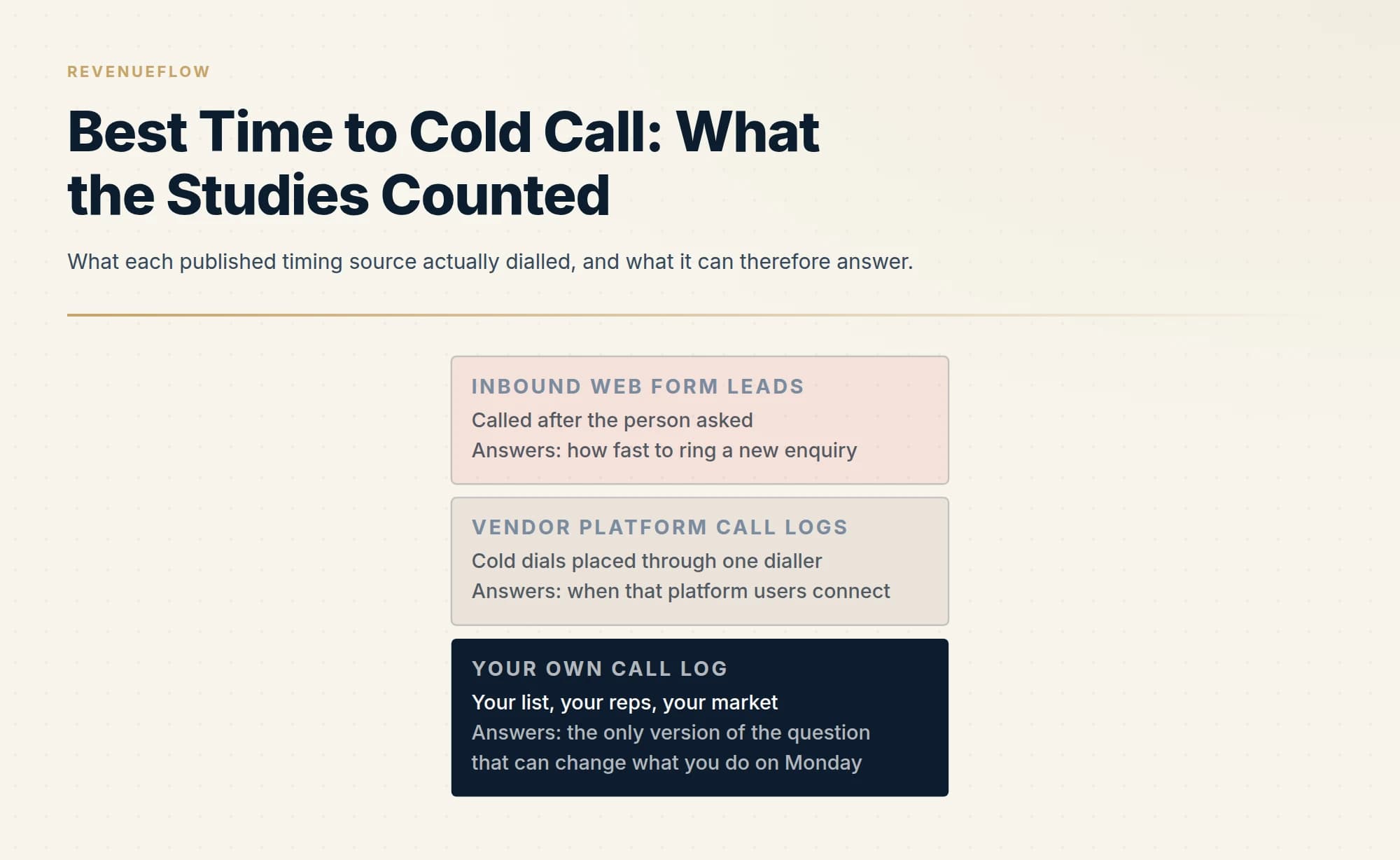
The most repeated best time to cold call figures come from a study of inbound web form leads at six companies. Three genuine cold calling datasets exist, each from a vendor with its size stated, and they disagree on the best day because they count different outcomes. The hours agree more than the days do.
Key takeaways
- The Wednesday and late afternoon answers that circulate as cold calling facts come from a study of leads obtained through web forms, where the person had already raised a hand.
- Three vendor datasets measure cold dialling and all three state a population, but one ranks demos booked while another ranks first attempt connections, which is why their best days differ.
- The hour findings cluster more tightly than the day findings, because a person between commitments is more reachable whatever outcome you are counting.
- Calling hours are regulated and several states run narrower windows than the federal floor, so a window that tests well may not be available on part of your list.
Reviewed and updated September 21, 2026
The study that most cold calling advice rests on was not a study of cold calls. It was an analysis of how quickly companies rang people who had already filled in a web form, run with a professor from MIT on data from six companies, and it is the source of the late afternoon and the Wednesday and Thursday answers that still circulate as facts about cold calling in 2026.
That is not a scandal. It is a good piece of research being asked a question it never asked itself. The useful version of this page is the same treatment cold calling statistics gives to success rates, applied to timing: take each published best time claim, find what produced it, and say what survives once you know what was counted.
The study underneath most of the advice
The Lead Response Management study is published on its own site and describes both its collaborators and its scope. Its stated aim was to work with "Professor Oldroyd from MIT" on research "crafted to ascertain the optimal timing for reaching out to web-generated leads, focusing on key metrics like the day of the week, time of day, and response intervals."
Its population is stated in the same paragraph: "We scrutinized three years of data from six diverse companies, analyzing over fifteen thousand leads and more than a hundred thousand call attempts." That is a real dataset with a real method, and the summary is where the familiar numbers come from. On days, the page reports that "Wednesday and Thursday emerged as the most effective days for initiating contact (49.7% more effective than the least productive day) and qualifying leads (24.9% more effective)". On hours, it reports that "Calling between 4 to 6 PM maximized contact chances (114% more effective than the least effective time)", with the eight to nine and four to five windows best for qualifying.
Now read the sentence that decides whether any of it applies to you. The study was "Focusing on leads obtained through web forms and contacted at least once". Every one of those fifteen thousand people had raised their hand. They were expecting a call, or at least would recognise why one was coming. A cold call reaches somebody who has done none of that, and the whole question of when they will pick up and how they will react is a different question. A nineteen year old measurement of inbound speed to lead is being quoted as the timetable for outbound dialling.
The datasets that are genuinely cold calls
Three publishers have put numbers behind cold dialling itself, and all three state a population, which puts them ahead of most of this literature. All three were read on 21 September 2026.
ZoomInfo publishes an analysis off its own platform and names the size in the same sentence as the finding: Tuesday and Wednesday "account for 44% of all demos booked in ZoomInfo's dataset of 1.4M+ outbound calls". It also splits the reason, reporting that Tuesday leads on connect rates while Wednesday leads on raw call volume, and it notes that in Europe, the Middle East and Africa the Wednesday figures improve.
CallHippo states its population in a data note: "The data referenced throughout this article was gathered by analyzing 72,000 call attempts over 90 weeks, collected from 3,000+ businesses across 20+ countries." Its day finding is that "Wednesday came out on top in our data as the strongest day for cold calling, with a 48% higher first-attempt connection rate compared to Monday", with Thursday second. Its hour finding names two windows, late morning and late afternoon, and reports the late afternoon window as sixty eight percent more effective than the late morning hour before noon, which it compares explicitly with the seventy one percent figure the industry repeats.
A third publisher reports on forty thousand outbound calls tracked through its own dialling and transcription stack, and lands on the same two windows, late morning and late afternoon, with the hours before ten and the lunch period performing worst.
So three cold calling datasets, and they do not agree on the day. ZoomInfo puts Tuesday first. CallHippo puts Wednesday first. The inbound study everyone borrows from puts Wednesday and Thursday first. The hours cluster more tightly than the days do, which is itself informative.
What was counted, which is where the disagreement lives
The three datasets are not measuring the same outcome, and once that is on the table the disagreement mostly dissolves.
A connect rate is dials that reach a human. A conversation rate is connects where the person stayed past the opening. A meeting or demo rate is the outcome anyone is paid for. Our cold calling tips page draws that split and argues that the first of the three is mostly a data and reputation question rather than a skill one. ZoomInfo's headline is about demos booked, so it is ranking the last of the three. CallHippo's day figure is a first attempt connection rate, which is the first. Those two can honestly disagree about the best day, because a day with the most people picking up is not necessarily the day with the most people willing to take a meeting once they have.
The hour findings survive better for the same reason in reverse: whatever you are counting, a person who is at their desk and between commitments is more reachable than one who is not, and late morning and late afternoon are when that is true in most office calendars.
- Called people who filled in a web form
- Counted contact and qualification
- Published with a named academic collaborator
- Best days given as midweek
- Not a study of cold calling
- Cold dials placed through one product
- One counts demos booked, another counts connections
- Each states how many calls it looked at
- Their best days do not agree
- Published by companies selling to callers
- Your list, your reps, your market
- You choose which outcome to count
- Needs several reps pooled to read
- Accumulates across a quarter
- The only version that detects your own changes
The age problem, and the vendor problem
Two further discounts apply before any of this reaches a dialling plan.
The first is age. The inbound study is from the era when a desk phone was where a business call landed. Since then the direct dial has largely become a mobile, spam labelling has arrived on the receiving handset, and the working day has stopped being the same shape for everybody. A finding about when people are at their desks is not obviously portable to a world where the phone is in a pocket. None of the pages repeating those numbers says when they were produced.
The second is that every publisher of a cold calling timing figure sells something to people who make cold calls. That does not make the measurements wrong; it decides which ones get published and repeated. A dialler vendor has a commercial reason to find that timing matters a lot, because the product that reports timing is the one being sold. Treat a vendor finding as a named vendor's finding, which is how it is quoted above, and be more careful with the ones that arrive with a recommendation attached.
There is a third constraint that overrides all of it and is not about performance. Calling hours are regulated, the federal floor is not the whole picture, and several states run narrower windows than the federal one. What that means in practice, and which layer binds, is in when cold calling is against the law. A window that tests well and sits outside a permitted calling hour is not available to you.
- Yes: The dataset is named and its size is stated
- Yes: The calls were cold rather than follow ups to an enquiry
- Yes: The outcome counted is named: connects, conversations or meetings
- Yes: The year the data was collected is given, not just the article year
- Yes: Times are the prospect's local time rather than the caller's
- No: A nineteen year old inbound study is being quoted as cold calling data
- No: The window sits outside a permitted calling hour in a state on your list
Measuring it yourself, which takes a fortnight
Your own call log answers this better than any of the sources above, because it is measured on your list, your reps and your market, and it is the only version that can detect your own changes.
Record four counts and keep them separate, as cold calling statistics argues: dials attempted, connects, conversations and meetings booked. Stamp each with the prospect's local hour and weekday. Then read connects by hour band rather than by exact hour, because the exact hour is noise at any volume a small team produces.
Here is the shape of the reading on invented figures, offered only to show how thin the base usually is. Suppose a rep places six hundred dials in a fortnight, spread across four hour bands, and connects with thirty six people in total: eleven in the late morning band, seven at lunch, eight in the early afternoon and ten in the late afternoon. Those figures are invented and describe no team. Eleven against ten is not a finding, and a fortnight of one rep's dialling will almost never produce one. Two things help. Pool several reps before reading anything, and accumulate across a quarter rather than a week, because the same four counts over three months say something the same four counts over a fortnight cannot.
The other reason to measure rather than inherit is that your best window is a property of who you call. Owner operated businesses, shift based operations and corporate offices are reachable at different hours, and no published average can tell you which one your list resembles. That is the argument our cold calling tips page makes about inheriting a window from a listicle.
The short version
The most repeated best time to cold call figures come from a study of inbound web form leads at six companies, published with its population and its scope stated, and quoted for nineteen years as though it were about cold calls. Three genuine cold calling datasets exist, each from a vendor, each stating its size, and they disagree about the best day because they count different outcomes.
The hours agree more than the days do: late morning and late afternoon, in the prospect's local time, inside permitted calling hours. Treat that as a default, measure your own connects by hour band across a quarter with several reps pooled, and keep the four counts separate so the number that moves points at the thing that caused it. What cold calling is and where it still works is the wider frame. If the honest answer is that you need more conversations rather than better timed ones, see what a first campaign produces on the written channels.
Figures above were read on the publishers' own pages on 21 September 2026, with dated snapshots kept as evidence, and each is attributed to the page it appears on. RevenueFlow runs email and LinkedIn rather than phone and holds no calling data of its own. Verify current figures at source before relying on them.
Frequently asked questions.
Frequently asked questions- What is the best time of day to cold call?
- Late morning and late afternoon in the prospect's local time is where the cold calling datasets agree, and it is a reasonable default. Treat it as a starting point rather than a finding, because your own best window is a property of who you call. Owner operated businesses, shift based operations and corporate offices are reachable at different hours.
- Which day of the week is best for cold calling?
- The published answers disagree. One platform dataset of more than a million outbound calls puts Tuesday and Wednesday first for demos booked; another of seventy two thousand call attempts puts Wednesday first for first attempt connections. They are ranking different outcomes, which is the likeliest reason they differ, so pick the outcome you are paid for.
- Where does the 4 to 6 PM cold calling advice come from?
- From the Lead Response Management study, run with a professor from MIT on three years of data from six companies. Read its own description and it was about reaching out to web generated leads, people who had filled in a form. It is quoted as cold calling guidance, which is a different act with a different recipient.
- How do I find the best calling window for my own list?
- Stamp every dial with the prospect's local hour and weekday, keep dials, connects, conversations and meetings as four separate counts, then read connects by hour band rather than by exact hour. Pool several reps and accumulate across a quarter. A fortnight of one rep's dialling almost never produces a difference you can act on.
About the author.

B2B cold email experts helping companies generate qualified leads through done-for-you outreach campaigns.
RevenueFlow Team
Explore more.
Ready to scale your outreach?
We build GTM engines that book real meetings. See the receipts.
Related articles.
UserGems Pricing: Three Annual Tiers, Published
UserGems publishes an annual rate card where most of its category publishes nothing. The three tiers, the one time fees, and why the credit number is not the unit.
CloudTalk Pricing: Four Tiers and Three Metered Add-Ons
CloudTalk publishes four seat tiers and prices its dialers separately. The seat rate is the smallest number on the page, and the currency depends on where you read it.
Best Time to Send a Sales Email: What Was Measured
The send time studies behind the midweek morning answer, what each one actually counted, and why a broadcast finding does not transfer to a sales email.
Is Clay Free? The Free Plan, the Trial and Where Each Stops
Clay's free plan, its 14-day trial and the no-charge-on-a-miss rule are three different things. What each holds and where it stops, from clay.com on 19 September 2026.
Seamless.AI Email Finder: How It Works, What a Credit Buys
How Seamless.AI's email finder resolves a contact in real time, what one Universal Credit buys, the Total AI score on every address, and what the Chrome extension reads.
Social Selling Tools by Job, and the Account-Risk Line
Fourteen social selling tools sorted into six jobs, split by whether each acts through your LinkedIn account or beside it, from the vendors' own pages.