UserGems Pricing: Three Annual Tiers, Published
UserGems publishes an annual rate card where most of its category publishes nothing. The three tiers, the one time fees, and why the credit number is not the unit.
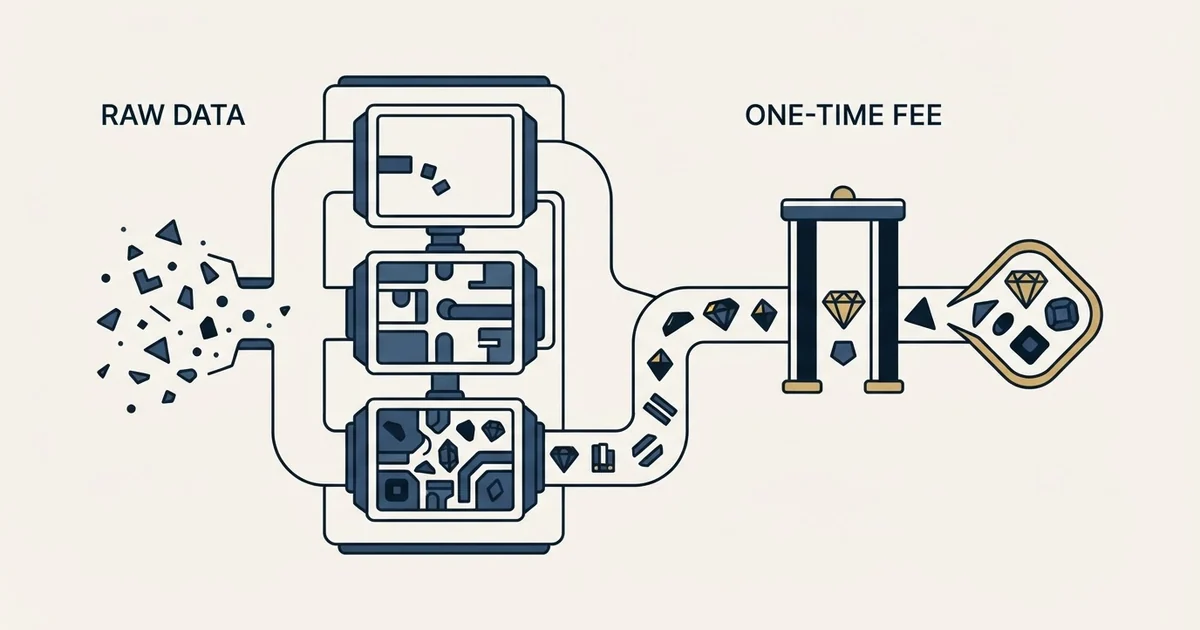
UserGems pricing is published: Core at $40k a year, Advanced at $75k and Elite at $150k, shown as $3,333, $6,250 and $12,500 a month, which are the annual figures divided by twelve. Users are unlimited, implementation is a one time $3k, $5k or $10k, and every tier carries a money back revenue guarantee of 1x, 2x or 3x.
Key takeaways
- UserGems' pricing page publishes Core at $40k a year, Advanced at $75k and Elite at $150k, with monthly equivalents that are simply those figures divided by twelve and no separate monthly billing state.
- The credit allowances convert at a fixed 100 credits per data action and 10 per AI action, so 4,000,000 credits on Core is 40K data actions, and the account coverage band per tier is the faster sizing check.
- One time implementation fees of $3k, $5k and $10k put the first year at $43k, $80k and $160k as arithmetic on the published figures, and a retroactive job change backfill is an optional $3k on every tier.
- Every published agent, feature and integration is on the entry tier; the tiers differ in volume, coverage band, support level and the guarantee multiple, so the choice is a sizing decision.
Reviewed and updated September 19, 2026
Revenue intelligence vendors almost never publish a rate card, and UserGems pricing is the exception: its pricing page publishes three tiers, with an annual figure and a monthly equivalent beside each, plus the one time fees, the support tier and a contractual revenue guarantee that changes by tier.
That is unusual enough to be the headline. The more useful part is underneath: the credit number on the page is not the unit anybody is buying, and reading it as one produces an estimate that is wrong by two orders of magnitude.
UserGems pricing: how much does it cost?
UserGems pricing is $40k a year for Core, $75k for Advanced and $150k for Elite, shown on the pricing page as $3,333, $6,250 and $12,500 a month. Those monthly figures are the annual figures divided by twelve rather than a separate monthly billing state. Every tier is Contact Us, users are unlimited, implementation is a one time $3k, $5k or $10k, and Enterprise is quoted.
The three tiers, as the pricing page publishes them
As published on UserGems' pricing page on 2 September 2026, the ladder runs three named tiers with an enterprise route above them.
The page lists Core at $3,333 a month, or $40k a year. It lists Advanced at $6,250 a month, or $75k a year, and Elite at $12,500 a month, or $150k a year. Each tier carries a Contact Us button rather than a checkout, and the page adds a line inviting a conversation for enterprise pricing above the three.
The monthly figures are the annual figures divided by twelve. Forty thousand over twelve is $3,333.33, which the page rounds down to $3,333. On the same page, seventy five thousand over twelve is exactly $6,250 and a hundred and fifty thousand over twelve is exactly $12,500. So there is one price per tier and two ways of writing it, rather than a monthly route and an annual route at different rates.
That is worth stating plainly because it removes a question that consumes most pricing evaluations in this category. There is no monthly billing option published here, no annual discount to negotiate against a monthly baseline, and no per seat line. Admin users and end users are both listed as unlimited on all three tiers.
The credit number is not the unit
Every tier publishes a credit allowance, and the numbers are large enough to be misleading on their own.
Core carries 4,000,000 credits. Advanced carries 10,000,000. Elite carries 25,000,000. Beside each, the page translates the same allowance into the units a buyer can actually reason about: Core is 40K data actions or 400K AI actions, Advanced is 100K data actions or 1M AI actions, and Elite is 250K data actions or 2.5M AI actions.
Divide those out and the conversion is fixed. Four million credits over forty thousand data actions is one hundred credits per data action, and four million over four hundred thousand AI actions is ten credits per AI action. The same two ratios hold at every tier: ten million over a hundred thousand, and ten million over a million. Twenty five million over two hundred and fifty thousand, and over two and a half million.
So the credit is an accounting unit rather than a purchasable one, and a data action costs ten times an AI action. A comparison against another vendor's credit allowance is meaningless until both are converted into actions, and a headline of twenty five million credits describes two hundred and fifty thousand data actions.
Headline numbers mislead in the same direction elsewhere, where CloudTalk's seat tiers and metered add ons leave the seat rate as the smallest figure on the page.
The page adds a third translation that is more useful still. Each tier states a total addressable market coverage: 2-4k accounts on Core, 4-10k on Advanced and 10k or more on Elite. That is the vendor telling a buyer how to pick the tier without doing the credit arithmetic at all, and it is the line to check your own account list against first.
The fees the subscription does not cover

Two one time fee lines sit under the subscription on the same page, and both scale with the tier; a third line, filed under customer services, runs the other way.
Implementation is published at $3k on Core, $5k on Advanced and $10k on Elite. Retroactive job change leads are published as optional at $3k, and that figure is the same on all three tiers rather than scaling with them.
The retroactive line is worth understanding rather than skipping. A job change tracking product watches your contacts from the day you connect it. The retroactive option is a backfill of moves that already happened, which is a one time data purchase rather than a subscription feature, and it is the difference between a platform that starts producing signal on day one and one that starts producing it as your contacts start moving.
That third line is not a fee at all. A sponsored sales incentive is published at $300 on Core, $500 on Advanced and $1,000 on Elite, described on the page as a UserGems sponsored incentive. That is the vendor funding an internal adoption push, which is a rollout mechanism rather than a cost, and it is included in the tier rather than added to it.
Adding the published subscription and the published implementation fee gives a first year commitment that is materially above the annual rate on every tier: $43k on Core, $80k on Advanced and $160k on Elite, as illustrative arithmetic on the page's own figures, which is the number to take into a budget conversation rather than the headline.
The guarantee is a published term, not a sales line
Each tier carries a revenue guarantee that scales with it: one times return on Core, two times on Advanced and three times on Elite, with the page stating a money back guarantee if a customer does not see the return in closed won revenue.
A commercial term published on a public pricing page rather than negotiated in a contract is genuinely uncommon, and it is the single most decision relevant thing on this page after the prices.
It also raises the questions any performance term raises, and none of them are answered on the pricing page. What counts as closed won revenue attributable to the platform, and by whose attribution model. Over what period the multiple is measured. What the refund actually returns, and whether implementation fees are inside or outside it. Whether the guarantee survives a downgrade or a mid term change of scope.
Those are contract questions rather than pricing questions, and they are the right use of the first call. A guarantee whose measurement definition is agreed after signature is a guarantee about the vendor's attribution reporting rather than about your pipeline.
Not on the list: budgeting per seat, since admin and end users are published as unlimited.
What the tiers do not separate

The feature grid is the quiet finding on this page. Read down it and the agent and feature list is the same across all three tiers.
List building with enrichment, account and contact scoring, automated campaigns, a writing agent, a research agent, a co-pilot, a browser extension, reporting and analytics, a model context protocol server, advertising audience sync, calendar capture, contact level intent with web deanonymisation, buying stages and CRM hygiene are all present on Core. The integration list is likewise common: CRM connections to Salesforce and HubSpot, sales engagement connections to Outreach, Salesloft and Gong Engage, advertising platform connections to LinkedIn, Meta and Google, single sign on, custom integrations and a Salesforce sandbox.
What changes between tiers is volume, account coverage, support level and the guarantee multiple. Nothing in the published grid is withheld at the entry tier.
That is a meaningfully different shape from the rest of this category, where the entry tier routinely excludes the capability the product is bought for. It also means the tier decision is genuinely a sizing decision, which is easier to get right and harder to argue down.
Core
- $40k a year, shown as $3,333 a month
- 4,000,000 credits: 40K data actions or 400K AI actions
- Coverage band 2k to 4k accounts
- Core support, 1x ROI guarantee
- Implementation $3k; retroactive leads $3k; incentive $300
Advanced
- $75k a year, shown as $6,250 a month
- 10,000,000 credits: 100K data actions or 1M AI actions
- Coverage band 4k to 10k accounts
- Advanced support, 2x ROI guarantee
- Implementation $5k; retroactive leads $3k; incentive $500
Elite
- $150k a year, shown as $12,500 a month
- 25,000,000 credits: 250K data actions or 2.5M AI actions
- Coverage band 10k or more accounts
- Elite support, 3x ROI guarantee
- Implementation $10k; retroactive leads $3k; incentive $1,000
Admin and end users: unlimited on every tier. Agents, features and integrations: the same published grid on every tier.
Where this sits against the alternatives
At a published floor of $40k a year plus implementation, UserGems is priced as a platform, and the comparison that decides it is rarely against another job change tracker.
The real alternative is usually a set of narrower purchases plus some operational discipline: a contact data provider that flags job changes, a CRM hygiene routine, and whatever alerting the sales engagement platform already does. That stack costs less and produces a coordination problem, which is the trade the category exists to sell against. 27 intent signal APIs covers the connection layer for teams assembling rather than buying, and waterfall enrichment covers the data half at unit cost.
Where the platform under consideration is an account based marketing suite rather than a signal tracker, account based marketing tools compares eleven of them on what each one publishes, and 6sense alternatives separates which capability each option actually replaces.
The failure mode at this price point is the one every platform purchase carries. A tool that tells a team which accounts warmed up does not help a team that cannot reach the buying group afterwards, and it does not help a team with no capacity to work the list it produces. Hiring more reps is the expensive mistake covers the capacity half of that argument, and cost per lead in B2B covers the arithmetic the whole purchase eventually reports into.
The short version

UserGems publishes Core at $40k a year, Advanced at $75k and Elite at $150k, with monthly equivalents that are simply those figures divided by twelve, unlimited users on every tier, and one time implementation fees of $3k, $5k and $10k. The credit allowances convert at a fixed one hundred credits per data action and ten per AI action, so the useful number is the action count and the account coverage band, not the credit total.
Every published feature and integration is available on the entry tier, which makes the choice a sizing exercise against your own account list. Take the guarantee seriously and ask how closed won revenue is attributed before treating the multiple as a floor.
If the constraint is the supply of qualified conversations rather than the supply of signal, see what a first campaign produces against a qualification standard agreed in writing before launch.
Pricing and features are taken from the vendors' own pages. Verify current terms with the vendor before relying on them.
Source: UserGems pricing, the page carrying every tier price, credit allowance, one time fee and guarantee term quoted above.
Frequently asked questions.
Frequently asked questions- How much does UserGems cost?
- UserGems' pricing page lists Core at $3,333 a month or $40k a year, Advanced at $6,250 a month or $75k a year, and Elite at $12,500 a month or $150k a year, each behind a Contact Us button, with enterprise pricing on request above them. The monthly figures are the annual figures divided by twelve, so there is one price per tier rather than a monthly and an annual route.
- Does UserGems charge per seat?
- No. The pricing page lists admin users and end users as unlimited on all three tiers, so headcount does not move the bill. What changes between tiers is the credit allowance, the account coverage band, the support level and the guarantee multiple. One time implementation fees of $3k, $5k and $10k sit under the subscription, and a retroactive job change backfill is an optional $3k.
- What is a UserGems credit worth?
- A credit is an accounting unit rather than something you buy. The page translates each allowance into actions: Core's 4,000,000 credits are 40K data actions or 400K AI actions, so a data action costs 100 credits and an AI action 10, and the same two ratios hold on Advanced and Elite. Compare vendors on actions, never on a credit headline.
- Is the UserGems revenue guarantee real?
- It is a published term: 1x return on Core, 2x on Advanced and 3x on Elite, with the page stating a money back guarantee if you do not see the return in closed won revenue. What the page does not state is how closed won revenue is attributed, over what period, or whether implementation fees are refunded, so settle those in the contract before treating the multiple as a floor.
About the author.

B2B cold email experts helping companies generate qualified leads through done-for-you outreach campaigns.
RevenueFlow Team
Explore more.
Ready to scale your outreach?
We build GTM engines that book real meetings. See the receipts.
Related articles.
Best Time to Cold Call: What the Studies Counted
The best time to cold call figures traced to their originals: one inbound study from six companies, three vendor call datasets, and what survives the read.
Snitcher Pricing: The $49 Table Is the Annual Rate
Snitcher's visible price table is the annual-billing ladder. The ten bands at both billing states, the unique-company meter, and the rules on a help page.
The Real Cost per 1,000 Emails, Verifications and Data Credits in 2026
Unit prices computed from verified vendor plans: $1.00 per 1,000 emails sent, $2.00 per 1,000 verifications and $19.60 per 1,000 enrichment credits.
What Cold Email and Sales Tools Actually Cost in 2026: Pricing Data From 386 Vendors
RevenueFlow's verified dataset of 386 sales tools puts the median starting price at $39.98 a month. Here is the spread by category, tier and billing model.
TexAu Pricing: Four Tiers, Billed Only on a Match
TexAu charges credits only when a lookup succeeds. The four tiers at both billing states, the rollover cap, and three places the page disagrees with itself.
Twain Pricing: Credits per Lead, Three Research Modes
Twain sells credits, not seats, and a lead costs 1 to 14 of them depending on the research mode. The two ladders, the four expiry clocks and the cap.