ZoomInfo Chat: What the Insent Acquisition Became
ZoomInfo bought Insent in June 2021 and the admin console still answers on the old domain. What the chat product does, and the staffing bill nobody quotes.
ZoomInfo Chat is the conversational marketing product ZoomInfo acquired from Insent in June 2021. Its page describes live chat with alerts into a collaboration channel, a chatbot routing on firmographics and intent, and a real-time meeting scheduler. No price is published, and the largest real cost is having someone available to answer.
Key takeaways
- ZoomInfo's acquisition hub records the June 2021 purchase of Insent, filed under Conversational Marketing and described as a platform that identifies website visitors to start real-time conversations.
- The product page describes three parts: live chat with instant alerts into a collaboration channel, a chatbot that routes on attributes such as revenue, company size and location alongside intent signals, and a real-time meeting scheduler.
- Identification behind the widget resolves an IP address to a company rather than to a person, so it belongs in routing rules and never in the visible greeting, where a wrong guess fails in front of the customer.
- A scheduler on a widget books whoever clicks. Hold chat-sourced meetings to the same written qualification bar as every other source rather than a lower one because they were easy to get.
Reviewed and updated September 1, 2026
The admin console for ZoomInfo Chat still answers at dashboard.insent.ai. The page title reads "ZoomInfo Chat" and the meta description underneath it reads "Insent admin panel", which is a five-year-old acquisition showing through the paintwork in a single HTML head.
That detail is a fair introduction to the product. ZoomInfo Chat is a conversational marketing tool the company bought rather than built, wired into a contact database, and sold as part of a platform whose main business is data. Understanding which of those three things you are actually buying decides whether it is worth a line on the contract.
What it is, and where it came from
ZoomInfo's acquisition hub records the purchase directly. In June 2021 ZoomInfo acquired Insent, filed under Conversational Marketing, described as "a powerful conversational marketing platform that identifies website visitors to initiate real-time conversations and increases conversions". The entry adds that the combination of ZoomInfo's business intelligence and "Insent's A.I.-driven routing capabilities" was meant to help go-to-market teams engage and convert more website visitors.
The product page today describes the result as "a data-powered chat tool that's tech-stack friendly, easy to use, and developed to accelerate sales pipeline", under the headline "Turn your website into a digital storefront". It sets out three components.
Live chat, which the page describes as sending "instant alerts when ideal leads or existing customers are on your website", with the seller able to start the conversation "from your favorite collaboration channel" rather than from a separate console.
A chatbot, which the page describes as steering the conversation based on what the visitor is looking for, using "Intent signals and company news to drive conversations, and attributes like annual revenue, company size, and location to route leads".
A real-time meeting scheduler, described as an automated meeting and demo scheduler that lets a person or the chatbot book with prospects on the fly.
Read as a whole, the pitch is that the widget knows who it is talking to before the visitor says anything, because the same platform that sells you contact data is also identifying the traffic.
The data underneath is the differentiator and the constraint
Every chat vendor can put a box on a page. What ZoomInfo is selling is the enrichment behind the box: an anonymous session resolved to a company, so a routing rule can treat a Fortune 500 account differently from a student doing research.
That is genuinely useful, and it inherits an important limit. Visitor identification on this platform works by resolving an IP address to an organisation, which is an account-level fact rather than a person-level one, and it degrades on home and shared connections in ways the vendor's own documentation acknowledges. A chatbot that greets a visitor by naming their employer is acting on an inference, and when the inference is wrong the error happens in front of the customer rather than inside a dashboard.
The practical rule is to let the identification drive routing and priority, where a mistake costs a misrouted conversation, and to keep it out of the visible greeting, where a mistake costs credibility in the first sentence. The same reasoning applies to the research signals the chatbot description names as a conversation input, and what those signals can carry is set out in our B2B intent data guide.
- Step 1Visitor arrives
A session starts and the platform attempts to resolve it to a company. Home and shared connections are the weak case.
- Step 2Rule fires
The page describes routing on attributes like annual revenue, company size and location, plus intent signals and company news.
- Step 3Alert or bot
Either a seller is alerted in a collaboration channel or the chatbot opens. Which one happens is a staffing decision, not a product setting.
- Step 4Conversation
The exchange only converts if someone competent is available inside the visitor's patience, which is measured in seconds.
- Step 5Booking
The real-time scheduler places a meeting. Booked is not the same as qualified, and the difference is yours to enforce.
Live chat is a staffing commitment wearing a software price tag
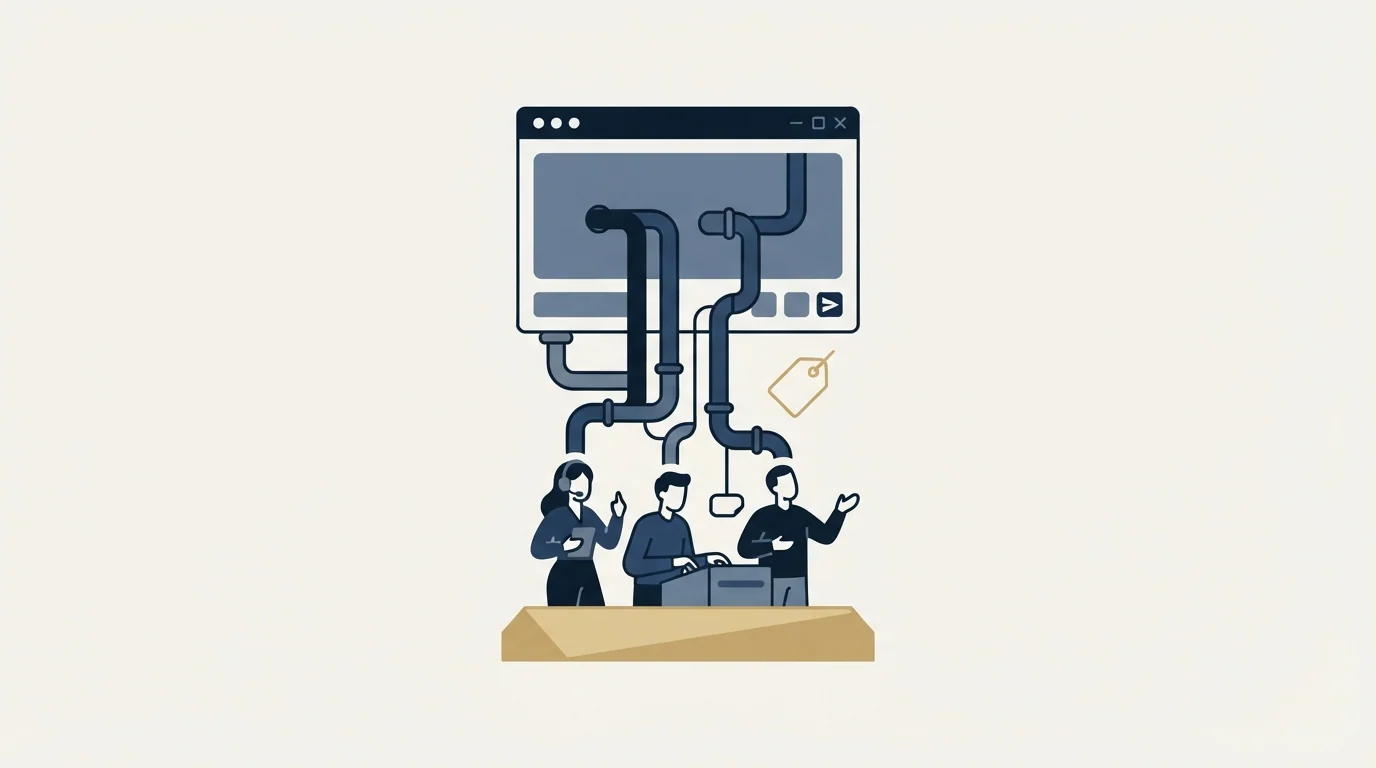
The most expensive part of a chat programme is not the licence. It is that somebody has to be there.
A live chat widget sets an expectation the moment it appears, and an unanswered widget is worse than no widget, because the visitor has now been ignored by a company rather than merely left alone by a website. The instant-alert design ZoomInfo describes, pushing the notification into a collaboration channel, is the right answer to that problem and it does not solve it. A notification in a busy channel at 4pm on a Friday is a notification nobody opens.
So the honest question before buying is not which vendor has the better builder. It is who answers, during which hours, at what response time, and what happens outside those hours. Teams that answer it end up with either a genuinely staffed window and a bot outside it, or a bot-only implementation that is upfront about being one.
- Converts because a human handles the unscripted question
- Needs named coverage, hours and a response-time target
- Fails quietly when the rota slips and nobody notices
- Worth it when a small number of high-value accounts visit
- Converts by routing and booking, not by persuading
- Needs maintenance as products and pages change
- Fails visibly, which is easier to catch and fix
- Worth it when volume is high and questions are repetitive
Booked is not qualified
The meeting scheduler is the component most likely to be shown in a demo and most likely to create a problem downstream, because it moves the booking decision to whoever clicks.
A scheduler attached to a chat widget will book students, competitors, job seekers, consultants and vendors, all of whom are on your website for reasons that are not buying. Every one of those meetings occupies a slot, appears in a pipeline report, and depresses whatever conversion figure the team is judged on. Routing rules using firmographic attributes reduce that, and they cannot eliminate it, because the attributes describe the company rather than the intention.
The workable arrangement is to write down what qualifies a meeting before the widget goes live, and to hold the chat channel to the same bar as every other source rather than a lower one because the meeting was free to obtain. Our own practice is exactly that, as a matter of documented policy: meetings are qualified against criteria agreed in writing before launch, and a meeting that does not meet them is not counted as one whatever channel produced it.
Measure the conversation, not the widget

Chat products report conversations started, and that number rises whenever the greeting gets more aggressive. It is the metric most likely to be quoted in a quarterly review and the least likely to mean anything.
Three numbers say more. The share of conversations that reach a person, which tells you whether the staffing answer is holding. The share of booked meetings that pass your written qualification bar, which tells you whether the routing rules are selecting or just collecting. And the share of identified accounts that were correctly identified, sampled against sessions where you independently know who the visitor was, which tells you whether the data layer under the widget is earning its place.
Run the third one during the trial rather than after signature, because it is the number that decides whether the product is a chat tool with useful enrichment or a chat tool with confident guesses attached.
The commercial picture, and what the testimonials quietly tell you
ZoomInfo publishes no price for Chat. The product page routes to "Request Demo" and "Get Pricing", which is consistent with the rest of the platform, where the quote is built from seats, credits, data depth, add-ons and term. The practical consequence for this product is that it usually arrives as a line inside a larger data contract rather than as a standalone purchase, and the wider field of what that contract buys is in the ZoomInfo alternatives roundup.
ZoomInfo Copilot's bundled components get the same treatment, separating the data layer from the signal and AI layers before any quote gets negotiated.
That bundling is the thing to think about hardest. A chat tool is one of the easier pieces of a stack to swap, since the integration surface is a script tag and a routing rule. Bundled into a data contract it stops being easy to swap, because leaving means renegotiating the part of the contract you actually depend on.
The bundling worry above looks different once ZoomInfo's data role is set against a CRM's pipeline tracking, a contrast the CRM and data tool comparison lays out in detail.
The testimonials on the page make the same point from the other direction. One quoted customer describes migrating off a competing chat vendor. Another claims 30% more engagement than a previous vendor. Both are customer claims hosted by the seller rather than measured results, and what they usefully show is a category where teams change vendors often. Buy accordingly, and keep the exit cheap.
- Yes: Named coverage: who answers, in which hours, against what response time
- Yes: A written qualification bar the chat channel is held to, agreed before launch
- Yes: Routing rules tested against sessions where you already know the account
- Yes: A cookie and consent review, since the widget identifies visitors before they interact
- Yes: An exit plan: what breaks if this is removed at renewal
- No: Greeting copy that names the visitor's employer back to them
- No: Counting booked meetings as qualified ones because the widget produced them
The consent item is not boilerplate. A widget that identifies a visitor and pushes an alert to a seller is processing information about someone who has not filled in a form or agreed to anything, and the obligations attached to that sit with you rather than with the vendor. Where those obligations come from, and why a supplier's compliance posture never transfers to your use of the data, is covered in is ZoomInfo legit.
Where it fits

ZoomInfo Chat suits teams with meaningful traffic from identifiable companies, a staffing answer, and a reason to prefer buying the widget from the vendor that already supplies the data behind it. That last reason is real: a chat tool fed by the same account intelligence your sellers use is more coherent than two products stitched together with a webhook.
It suits teams poorly when traffic is thin, when nobody owns the rota, or when the actual constraint is that too few of the right companies visit at all. A chat product converts demand that has already arrived. It creates none, which is the same boundary that applies to every capture tool on the platform, and the wider category case is in chatbot lead generation. Where an automated responder should and should not act on its own is covered in AI sales agents.
If the constraint is the arriving half rather than the converting half, that is a different purchase. RevenueFlow builds and runs the outbound and charges per qualified meeting, against criteria agreed in writing before launch, and you can see what that looks like on your own market with a free campaign.
Product descriptions here were verified against raw page bytes from zoominfo.com and its acquisition hub in mid-2026. The vendor publishes no price for this product. Verify current terms and availability with the vendor before relying on them.
Frequently asked questions.
Frequently asked questions- What is ZoomInfo Chat?
- It is ZoomInfo's website chat product, acquired from Insent in June 2021. The product page describes it as a data-powered chat tool with three components: live chat that alerts sellers in their collaboration channel when target accounts are on the site, a chatbot that routes conversations using firmographic attributes and intent signals, and an automated meeting scheduler.
- How much does ZoomInfo Chat cost?
- ZoomInfo publishes no price for it. The product page routes to a demo request and a pricing request, the same pattern as the rest of the platform, where a quote is built from seats, credits, data depth, add-ons and term. In practice it usually appears as a line inside a larger data contract rather than as a standalone purchase.
- Is a chatbot enough, or do we need people answering?
- Decide that before you install anything, because an unanswered widget is worse than no widget. A bot-only implementation converts by routing and booking and needs maintenance as pages change. Staffed live chat converts by handling the unscripted question and needs named coverage, defined hours and a response-time target that somebody owns.
- Should the greeting mention the visitor's company?
- No. The identification behind it resolves an IP address to an organisation, which is an inference rather than an observation, and it degrades badly on home and shared connections. Let it drive routing and priority, where a mistake costs a misrouted conversation, and keep it out of the visible copy, where a mistake costs credibility immediately.
About the author.

B2B cold email experts helping companies generate qualified leads through done-for-you outreach campaigns.
RevenueFlow Team
Explore more.
Ready to scale your outreach?
We build GTM engines that book real meetings. See the receipts.
Related articles.
RingLead vs LeanData: ZoomInfo Operations Compared
RingLead is now ZoomInfo Operations. How it compares with LeanData on matching, routing, deduplication and enrichment, read from each vendor's own pages.
Is Clay Free? The Free Plan, the Trial and Where Each Stops
Clay's free plan, its 14-day trial and the no-charge-on-a-miss rule are three different things. What each holds and where it stops, from clay.com on 19 September 2026.
Video Prospecting Tools by Job: What Each One Is For
Ten video prospecting tools sorted by the job each vendor's own page describes: record and share, personalise at volume, avatars, hosting and interactive demos.
Seamless.AI Email Finder: How It Works, What a Credit Buys
How Seamless.AI's email finder resolves a contact in real time, what one Universal Credit buys, the Total AI score on every address, and what the Chrome extension reads.
Social Selling Tools by Job, and the Account-Risk Line
Fourteen social selling tools sorted into six jobs, split by whether each acts through your LinkedIn account or beside it, from the vendors' own pages.
Autobound Pricing: One-Time Credit Packs, Not Seats
Autobound's pricing page sells one-time credit packs for a signal data API, not seats. The six packs, the per-endpoint meter, and what a company costs.