RingLead vs LeanData: ZoomInfo Operations Compared
RingLead is now ZoomInfo Operations. How it compares with LeanData on matching, routing, deduplication and enrichment, read from each vendor's own pages.
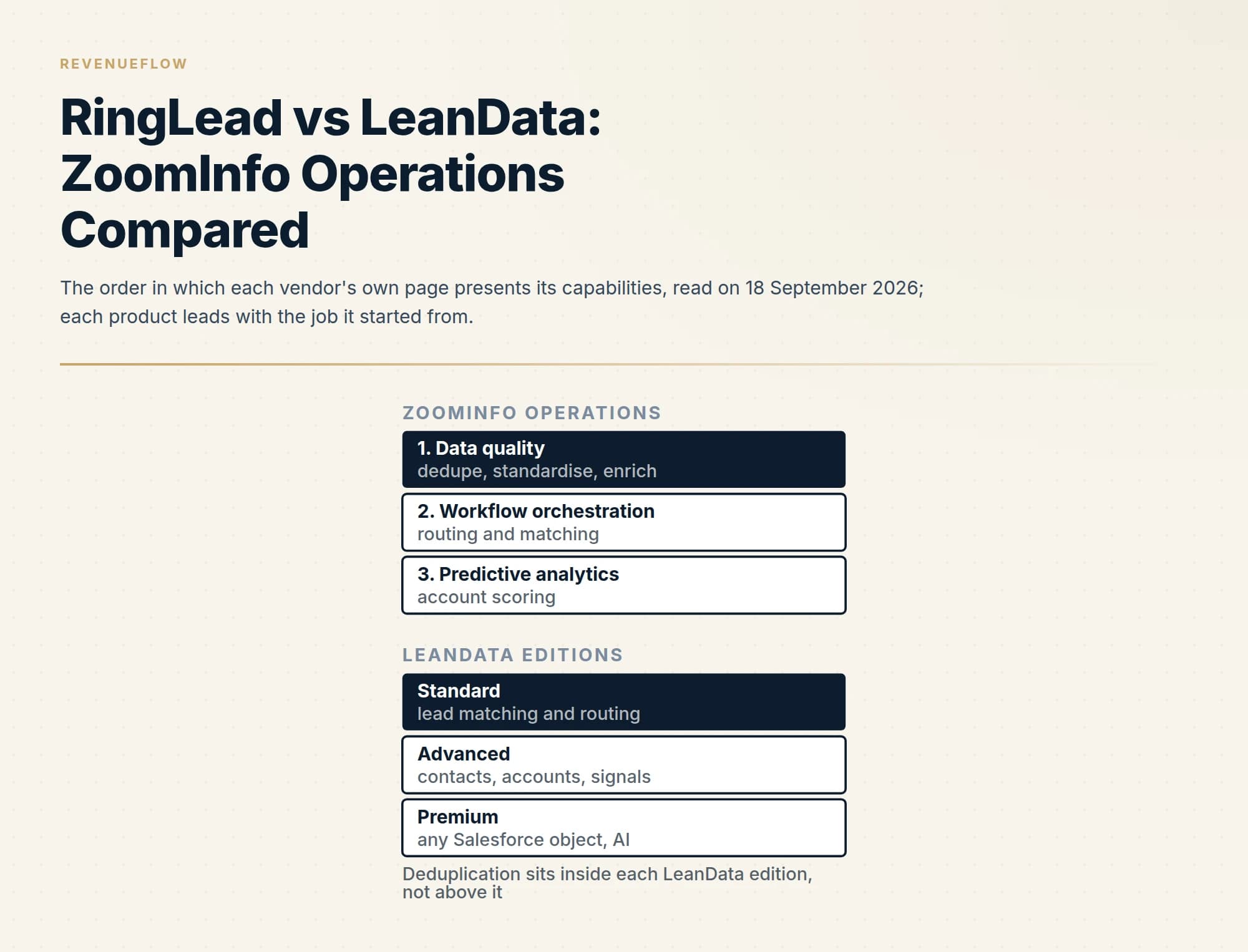
RingLead is now ZoomInfo Operations, acquired in September 2021 according to ZoomInfo's own acquisitions page. As read on 18 September 2026, Operations leads with data quality and added routing, while LeanData leads with matching and routing as a Salesforce-native package with deduplication inside each edition. Neither vendor publishes a price, so compare packaging and test matching on your own records.
Key takeaways
- ZoomInfo's acquisitions page dates the RingLead purchase to September 2021, and ringlead.com redirected to the ZoomInfo Operations page on 18 September 2026.
- ZoomInfo's Operations page leads with deduplication, standardisation and enrichment; LeanData's packaging page leads with lead-to-account matching and routing.
- LeanData describes itself as a Salesforce-native managed package priced on features, objects and Salesforce users or queues; ZoomInfo describes a hub across several systems.
- Neither page prints a price, and LeanData's claims about its rival's match rates are a competitor's claims to test on your own records.
Reviewed and updated September 18, 2026
Type ringlead.com into a browser and ZoomInfo loads. On 18 September 2026 both the RingLead homepage and its old pricing address redirected to zoominfo.com/products/operations, a page that sells a product called ZoomInfo Operations and does not use the word RingLead once. So the first job in any RingLead vs LeanData comparison is establishing what is being compared, because one side of it no longer has a website.
ZoomInfo's own acquisitions page supplies the date: "In September 2021, ZoomInfo acquired RingLead, an industry leader in data orchestration and revenue operations automation." The product RingLead users knew now lives inside ZoomInfo as Operations, and the history of that change is laid out in our piece on RingLead and ZoomInfo. This page takes the next step. It compares RingLead, now ZoomInfo Operations, with LeanData on the four jobs the two overlap on, using only what each vendor's own pages said on 18 September 2026, and it marks clearly where the only available statement about one vendor comes from the other.
Two products that grew toward each other
Both vendors now claim matching, routing, deduplication and enrichment. They arrived at that overlap from opposite ends, and each product page still leads with where it came from.
ZoomInfo's Operations page is built in three blocks, in this order: Data Quality, then Workflow Orchestration, then Predictive Analytics. The first block is the inheritance. It opens with "Match and merge duplicates - Automatically identify and consolidate duplicate records with customizable matching rules", then standardising formats, then "Enrich missing data - Append company and contact attributes automatically with multi-vendor enrichment and waterfall logic", then continuous verification. Routing and matching arrive in the second block, and the third is account scoring, where the page offers to "Apply 300+ firmographic, technographic, and intent attributes to rank accounts most likely to convert."
LeanData's pricing and packaging page runs the other way. Its entry edition, Standard, opens with "Intelligent lead-to-account matching" and "Basic lead routing and assignment rules (round robin, territory, account-based)", and deduplication appears third in the list as "Standard lead deduplication and enrichment". Everything the higher editions add is more routing: more objects, more criteria, more automation.
That ordering is more than page layout. It tells you which problem each company has spent longest solving, and therefore which side of each product is likely to be deepest.
Matching and routing
This is LeanData's home ground, and its packaging page describes it as a ladder of objects. Standard routes leads. Advanced adds "Advanced matching and routing for contacts and accounts" multi-criteria assignment across leads, contacts and accounts, and "Signal-driven workflow automation" that acts on buyer signals. Premium extends to "Routing and matching for any standard or custom Salesforce object (opportunities, cases, and more)", with international and territory matching and scheduled recurring automations, and it is the edition where the page places "All AI capabilities". SLA tracking with escalations and dashboards arrives at Advanced.
LeanData's own comparison post, dated May 14 2026 on the page, adds two descriptions of its method: "Fuzzy matching across six fields with configurable tie-breakers" and a "Visual FlowBuilder with drag-and-drop logic." Those are a vendor describing itself, which is fair evidence of what it sells.
ZoomInfo's page describes the same two jobs in one bullet each. Routing: "Route inbound leads to the right rep with round-robin distribution, workflow-based territory rules, and conditional logic". Matching: "Automatically match leads to existing accounts using company hierarchies and domain intelligence". The page says nothing about which objects beyond leads can be routed, and nothing about SLA tracking. That is silence on a marketing page, which is different from a missing feature, and it is the first thing to ask in a demo.
The matching inputs are worth a second look, because they differ in kind. ZoomInfo names company hierarchies and domain intelligence, which is reference data it owns as a data company. LeanData names fuzzy matching across fields in your own records. One brings outside knowledge about which subsidiary belongs to which parent. The other reasons harder about the rows you already hold. Which helps more depends on why your leads fail to match today, and the underlying problem is set out in our glossary entry on record matching.
Deduplication and enrichment
Here the positions reverse. ZoomInfo's page gives data quality four bullets and a separate feature called perimeter protection, described as the ability to "Prevent duplicates at point of entry with validation rules and real-time data quality checks". It also states governance features in the same block: GDPR and CCPA compliance management with automated suppression lists and audit trails.
LeanData lists deduplication as one line per edition: standard lead deduplication at the bottom, then "Enhanced deduplication (contacts, accounts)" at Advanced. Enrichment is handled differently again. ZoomInfo enriches from its own database and from other vendors through a waterfall. LeanData's Advanced edition lists "Integrations: sales engagement tools, enrichment/intent data, gifting", which means it connects to enrichment providers rather than being one.
| Job | ZoomInfo Operations page | LeanData packaging page |
|---|---|---|
| Lead-to-account matching | Company hierarchies and domain intelligence | In every edition; contacts and accounts from Advanced |
| Routing | Round-robin, territory rules, conditional logic; objects beyond leads not stated | Leads in Standard; any Salesforce object in Premium |
| Deduplication | Match and merge with custom rules; blocks duplicates at entry | Leads in Standard; contacts and accounts from Advanced |
| Enrichment | Own data plus multi-vendor waterfall | Through integrations with enrichment providers |
| SLA tracking | Not stated | From Advanced, with escalations and dashboards |
Where the work happens
The sharpest architectural difference is one only LeanData states outright. Its comparison post describes LeanData as "a GTM orchestration platform built natively inside Salesforce" and as a "100% Salesforce native managed package. Data never leaves your CRM." Its packaging FAQ is consistent with that, since it prices on "features, objects, and number of Salesforce users or queues." LeanData is a Salesforce product. If your CRM is anything else, the comparison ends here.
ZoomInfo's page describes the opposite shape: "Cross-system orchestration - Connect data and actions across CRM, marketing automation, sales engagement, and data warehouses", with native integrations and APIs across those systems. It positions Operations as a hub between several systems rather than as an app inside one.
LeanData's post goes further than describing itself. It makes specific claims about its rival: that ZoomInfo Operations processes records outside Salesforce, that it matches only at record creation, and it puts numbers on the two products' match rates. Those are a competitor's statements about a competitor. ZoomInfo's Operations page neither confirms nor addresses any of them, and we do not repeat the figures here. They are useful as a list of questions, because each one is testable: ask ZoomInfo where processing happens and what its security review covers, then run both products against a sample of your own unmatched leads and count.
Pricing and packaging: no number on either side
LeanData's page is headed Pricing and Packaging and publishes packaging only. Three orchestration editions, Standard, Advanced and Premium, with Advanced flagged as best value. A scheduling family of three products, BookIt for Forms, BookIt Handoff and BookIt Links. And Journeys, the buying group product, which the page says is "Purchased as an add on to Premium Orchestration". The FAQ states the meter, quoted above, and adds that BookIt and certain add-ons are available standalone. No figure appears anywhere on the page as fetched on 18 September 2026. Our LeanData pricing guide covers how that meter behaves as a team grows.
ZoomInfo publishes less about Operations. The product page ends in a demo request and links labelled Browse Our Packages and View Pricing. ZoomInfo's pricing address returned an access-denied response to both of our fetch routes on 18 September 2026, so this page makes no claim about what it shows. What can be said is that the Operations page itself prints no price and names no editions.
LeanData's post also describes ZoomInfo offering to "bundle Operations into your data renewal at a discounted rate". That is again a rival's account, and a plausible one for a data vendor. If it happens to you, treat the bundle as a routing purchase made on a data buyer's timeline, and evaluate it as you would a standalone tool.
Which one fits
Four questions decide most cases.
- Yes: Is your CRM Salesforce? LeanData prices on Salesforce users or queues and runs inside the org.
- Yes: Is the bigger problem dirty records or slow, wrong assignment?
- Yes: Do you route only leads, or contacts, accounts and opportunities too?
- Yes: Do you already buy ZoomInfo data, and is Operations being offered inside that renewal?
- Yes: Do you need SLA tracking and escalations, which only LeanData's page lists?
If the pain is duplicate and inconsistent records arriving from several systems, and you already buy ZoomInfo's data, Operations is the product built from that problem outward. If the pain is that the right record reaches the wrong person slowly inside Salesforce, LeanData's whole ladder is about that, and its SLA and any-object routing have no stated equivalent on ZoomInfo's page. Teams with both problems should price both and notice that they are buying two different cores with overlapping edges.
LeanData has other rivals than this one, sorted by the job they replace in our guide to LeanData competitors, and the question of what native Salesforce assignment rules can do before you buy anything is covered in Salesforce lead routing.
A last point from the outbound side. Routing tools exist mainly to answer inbound volume. In an outbound programme the ownership of an account is decided before the campaign, so the records that need a rule are replies. Our own practice keeps that requirement small: one message per campaign, no bumps and no thread replies, so a reply is a single event with one owner. If the constraint is too few conversations rather than misrouted ones, you can see what a first campaign produces before buying routing for traffic you do not yet have.
The short version
RingLead is now ZoomInfo Operations: ZoomInfo's acquisitions page dates the purchase to September 2021, and ringlead.com redirected to the Operations page on 18 September 2026. Operations leads with data quality and added routing; LeanData leads with matching and routing inside Salesforce and lists deduplication within each edition. LeanData states it is a Salesforce-native managed package priced on features, objects and Salesforce users or queues, while ZoomInfo describes a hub across CRM, marketing automation, engagement and warehouse systems. Neither page prints a price. The claims LeanData makes about its rival are a rival's claims, and the way to settle them is a test on your own records.
Product capabilities, packaging and the acquisition date above were read from zoominfo.com and leandata.com on 18 September 2026, from stored snapshots of the served pages; the redirects were observed the same day. ZoomInfo's pricing address could not be read from our fetch routes that day. Verify current terms with each vendor before relying on them.
Sources: ZoomInfo Operations, ZoomInfo acquires RingLead, LeanData pricing and packaging, LeanData vs ZoomInfo Operations (RingLead), LeanData blog
Frequently asked questions.
Frequently asked questions- Is RingLead the same as ZoomInfo Operations?
- Yes, in the sense that matters to a buyer. ZoomInfo's acquisitions page states that it acquired RingLead in September 2021, and on 18 September 2026 both ringlead.com and its old pricing address redirected to the ZoomInfo Operations product page. That page does not use the RingLead name in its visible copy, so comparison posts naming RingLead are describing Operations.
- What is the main difference between LeanData and ZoomInfo Operations?
- Where each started and where each runs. ZoomInfo's page leads with data quality, meaning deduplication, standardisation and enrichment, and describes connecting several systems. LeanData's page leads with lead-to-account matching and routing, extends that to any Salesforce object at its top edition, and the vendor describes the product as a managed package running inside Salesforce.
- Does LeanData work without Salesforce?
- Its own pages point to no. LeanData's packaging FAQ says pricing is based on features, objects and the number of Salesforce users or queues, its top edition is defined by routing any standard or custom Salesforce object, and its comparison post describes a Salesforce-native managed package. A team on another CRM should confirm with the vendor before going further.
- How much do LeanData and ZoomInfo Operations cost?
- Neither vendor published a price on the pages read on 18 September 2026. LeanData's page lists three orchestration editions, a scheduling family and a buying group add-on, with pricing based on features, objects and Salesforce users or queues. ZoomInfo's Operations page links to packages and a demo request, and its pricing address could not be read from our fetch routes that day.
About the author.

B2B cold email experts helping companies generate qualified leads through done-for-you outreach campaigns.
RevenueFlow Team
Explore more.
Ready to scale your outreach?
We build GTM engines that book real meetings. See the receipts.
Related articles.
Twain Pricing: Credits per Lead, Three Research Modes
Twain sells credits, not seats, and a lead costs 1 to 14 of them depending on the research mode. The two ladders, the four expiry clocks and the cap.
Lavender Pricing: Two Products, No Pricing Page
Lavender has no pricing page. The Email Coach ladder per seat at both billing states, the free routes, and the separate per-agent price for Ora.
The Real Cost per 1,000 Emails, Verifications and Data Credits in 2026
Unit prices computed from verified vendor plans: $1.00 per 1,000 emails sent, $2.00 per 1,000 verifications and $19.60 per 1,000 enrichment credits.
Snitcher Pricing: The $49 Table Is the Annual Rate
Snitcher's visible price table is the annual-billing ladder. The ten bands at both billing states, the unique-company meter, and the rules on a help page.
What Cold Email and Sales Tools Actually Cost in 2026: Pricing Data From 386 Vendors
RevenueFlow's verified dataset of 386 sales tools puts the median starting price at $39.98 a month. Here is the spread by category, tier and billing model.
Airscale Pricing: Three Plans, One Credit, Four Rates
Airscale prints a different credit cost on every plan, and its advertised per-email price belongs to the custom one. The dated ladder and the rollover rules.