LeanData Competitors: Sorted by the Job They Replace
The LeanData shortlist hides two different problems. Sorting the field by the job each product replaces cuts it down faster than any feature grid.
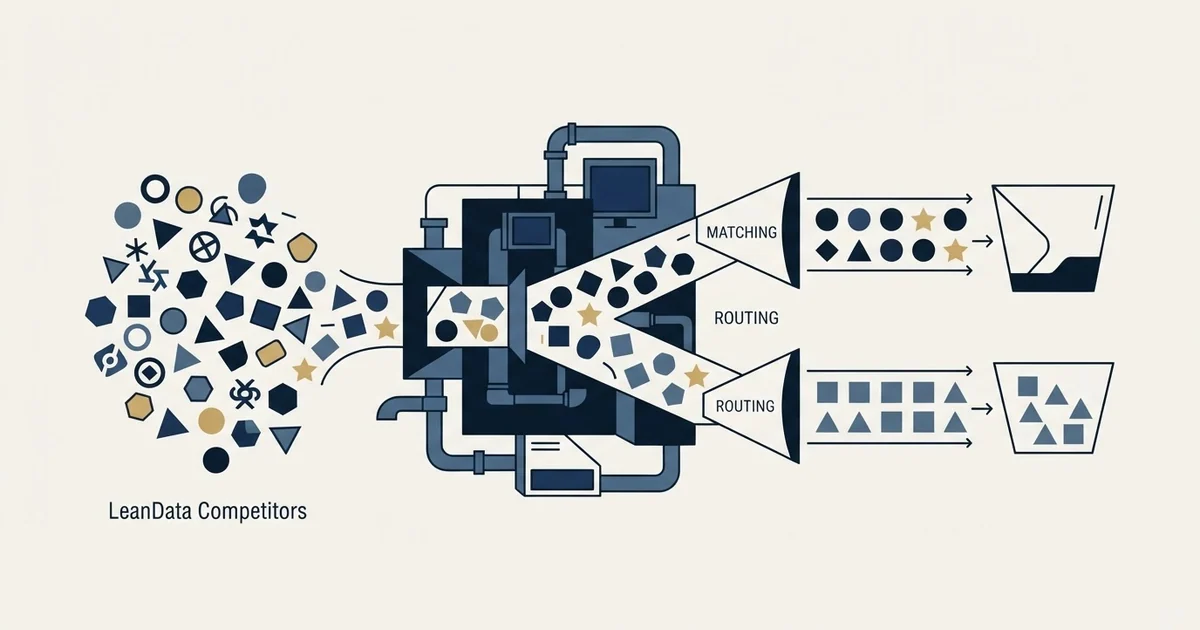
The best LeanData alternatives depend on the job: Kubaru and Traction Complete for routing inside Salesforce, Chili Piper and RevenueHero for getting demo requests onto calendars, and Default for consolidating several tools. Kubaru publishes 20 dollars per user a month; LeanData prices on features, objects and Salesforce users or queues.
Key takeaways
- LeanData's pricing page sells three orchestration editions and a BookIt scheduling family, and prices packages on features, objects, and Salesforce users or queues, with no published figure.
- Kubaru publishes 20 dollars per user a month with every feature included, and its page claims LeanData starts at 39 dollars per user, a competitor's figure to check against a real quote.
- Chili Piper's Routing and Scheduling starts at 1,250 dollars a month with 15 seats included and 45 dollars a seat after that, billed annually only.
- Default now publishes its pricing: Growth at 1,250 dollars a month billed annually, plus 45 dollars per user a month for each Routing + Scheduling seat.
Reviewed and updated October 1, 2026
Default's homepage does something competitors rarely do in public. Under Lead Routing the caption reads "Replaces LeanData and Traction Complete", and under Inbound Automation it reads "Replaces tools like Chili Piper and LeanData". As served on 2 September 2026 those two lines sit on the same page, naming LeanData twice for two different jobs.
That is the useful thing about a search for LeanData alternatives. People arrive at it holding one of two problems, and the shortlist that solves one is close to useless for the other. Sorting the field by the job it replaces produces a much shorter list than sorting it by feature.
What are the best LeanData alternatives?
The best LeanData alternative depends on the job. For routing inside Salesforce, Kubaru, at 20 dollars per user a month with every feature included, and Traction Complete are the closest. For getting a demo request onto a calendar, Chili Piper and RevenueHero. For consolidating several tools, Default, whose pricing page starts at 1,250 dollars a month. And if nothing has broken yet, native CRM assignment may be enough.
What LeanData is, before you look for a replacement
LeanData's own pricing and packaging page sets out an orchestration platform in three editions, and what each edition adds tells you which competitor is actually comparable.
Standard Edition is captioned "Best for organizations building a strong foundation and accelerating speed to lead", and its listed contents are intelligent lead to account matching, basic lead routing and assignment rules covering round robin, territory and account based, standard lead deduplication and enrichment, audit logs and routing insights, notifications and out of the box managed reports.
Advanced Edition adds matching and routing for contacts and accounts, multi criteria assignment across leads, contacts and accounts, signal driven workflow automation, enhanced deduplication, SLA tracking with escalations and dashboards, and integrations with sales engagement, enrichment and intent, and gifting tools.
Premium Edition adds routing and matching for any standard or custom Salesforce object including opportunities and cases, advanced international and territory matching, scheduled recurring automations, complex cross object assignment, and support for channel and partner motions. The AI capabilities sit at this edition, and Journeys, the buying group product, is listed as an add on to Premium Orchestration.
Alongside the three editions the page lists a separate scheduling family, BookIt for Forms, BookIt Handoff and BookIt Links, and its FAQ states that BookIt and certain add ons are available standalone. The buying group product carries its own placement line, "Purchased as an add on to Premium Orchestration".
Two things follow. The product is scoped to Salesforce objects, and the ladder is about which objects and how many of them. So the first question in any replacement search is which object you are actually routing, and the second is whether the answer has to live inside Salesforce.
The Salesforce native engines

Kubaru publishes a single rate and no tiers. Its pricing page states 20 dollars per user per month with every feature included, and puts the packaging in one line, "No tiers, no add-ons, and free lifetime support included". It points to its AppExchange listing for a free 30 day trial. The same page also makes a claim about LeanData itself, that LeanData starts at 39 dollars per user per month for its Standard plan and reaches 59 dollars for Premium. LeanData's own pricing page publishes no figure, so treat those numbers as a competitor's claim to check in a LeanData quote, not as LeanData's price. The feature list on its own site names round robin, load balancing, territory management, skill management, a shark tank for unclaimed leads, duplicate matching, scheduling that assigns to available users only, weights and limits per user, and reassignment of unassigned records. Its use cases page names lead routing, case assignment, opportunity routing, custom object routing and SLA management, which is the same object breadth LeanData reaches at its top edition.
Traction Complete publishes no price on the pages fetched. As served on 2 September 2026 its homepage describes itself in its own title as an "Agentic data management suite for Salesforce", with products named Complete Hierarchies, Complete Leads, Complete Clean, Complete Influence, Complete AI, Complete Discover and Complete Schedule, and use cases covering lead routing, lead to account matching, account hierarchies, deduplication, relationship mapping and mass territory reassignment. Every route from that page is a demo booking. Account hierarchies are the emphasis that separates it from a pure routing tool, which matters if your matching problem is really a parent and subsidiary problem.
Quote-gated vendors still publish something worth reading, and across sales compensation platforms that name no rate the unit counted and the implementation fee are stated even where the price is not.
Both of these keep the decision inside the CRM, which is the property that makes them comparable to LeanData rather than to a scheduling product.
A third comparison buyers ask about is RingLead, which is now ZoomInfo Operations and approaches routing from the data-quality side, and RingLead vs LeanData covers that pair.
Two concepts sit underneath every product on this page and are worth reading on their own terms before any demo: deciding whether two rows are the same company, and the round-robin assignment that most of them fall back on for fairness.
The scheduling first products
Chili Piper publishes a floor and a seat rate. Its pricing page lists Routing and Scheduling starting at 1,250 dollars a month with up to 15 seats included and 45 dollars per seat per month after that, and its own calculator renders that as 15,000 dollars a year. Experiences starts at 3,500 dollars a month with up to 30 seats included and 50 dollars per seat after that. A standalone ChiliCal is listed at 12 dollars per user per month with a minimum of 200 seats. The page also carries a contract length selector offering discounts at two, three and four years, introduced as "Pick your tier and set your seats", and states an annual AI credit allowance against each tier. Its FAQ adds that monthly billing is not available: every plan is billed annually. Our Chili Piper pricing breakdown works through what that seat floor means for a small team, and Chili Piper alternatives covers the field from that anchor.
The head-to-head reading of that ladder against LeanData's three editions is in Chili Piper against LeanData.
RevenueHero publishes a platform fee plus a per user rate. Its pricing page shows Essentials at a fixed platform fee of 79 dollars a month plus 25 dollars per month per user on one billing state, and 99 dollars plus 35 dollars on the other, with an Enterprise tier at 79 dollars plus 35 dollars on the annual side. Both billing states render into the same document with the yearly and monthly labels adjacent, so the safe reading is that the lower pair is the annual commitment, and it is worth confirming with the vendor rather than reading off a page showing both at once. Its own summary of the job is "Instantly qualify, schedule, route leads to any sales rep", and its Enterprise feature list names fuzzy matching, matching on any custom property, collective round robin and fallback redistribution.
These are the wrong comparison if what you need is to route a contact record that arrived through an integration rather than a form. They are the right comparison if the thing failing is the time between a demo request and a booked slot.
The platform replacement, and the option you already own

Default sells the consolidation case explicitly. Its homepage lists Inbound Automation, Data Enrichment, Meeting Scheduling, Lead Routing, Outbound Automation and CRM Hygiene as separate modules, each captioned with the tools it replaces, and describes the routing module as one that will "Route leads across territories and segments with logs of which rule decided". Default now publishes a pricing page. Its Growth plan is 1,250 dollars a month, or 15,000 dollars a year billed annually, with 24,000 enrichment credits and 200,000 workflow runs a year, and seats are added on top: 45 dollars per user a month for a Routing + Scheduling seat and 20 dollars for a Scheduling seat. Scale is 3,000 dollars a month and adds migration services, described as engineers who move your routing, scheduling and enrichment off your current tools before you cut over. A consolidation purchase is a different decision from a routing purchase, because it moves several renewals and several owners at once.
The option almost nobody prices honestly is the routing already sitting in the CRM. Native assignment rules, workflows and round robin handle territory and field based assignment competently, and our guide to lead routing software sets out the four boundaries where that stops being true: lead to account matching on a free text company name, live capacity, rules that must run in a defined order, and being able to explain six weeks later why a specific record went to a specific person. If you have not hit one of those, a replacement search is premature. Salesforce lead routing covers what rule order does inside the org you already pay for.
Name the object. Leads only, or contacts and accounts, or opportunities and custom objects too.
Decide where the logic lives. Inside the CRM as a native app, or beside it as an external platform.
Separate routing from scheduling. A booked calendar slot and an assigned owner are two products in most of this field.
Test matching on your own records. Two hundred real inbound leads, not the vendor's demo data.
Ask what the routing log retains. An assignment nobody can explain later becomes a commission dispute.
What actually separates them
Feature grids in this category converge on the same nouns, so three questions settle it faster than a table does.
Feature-grid fatigue is not unique to routing, and the same shortcut works among response platforms sorted by billing unit, where the unit each vendor charges on settles the shortlist.
Which objects can it route. This is the axis LeanData itself prices on, and it is the one that silently decides your edition. If you only ever route inbound leads, the top of anybody's ladder is money spent on capability you will not configure.
Where does the matching happen. A Salesforce native app evaluates inside the org, which keeps the audit trail and the permission model in one place. An external platform holds the logic in its own system and writes the outcome back, which is more flexible and adds a system with an opinion about ownership. Neither is better in the abstract, and the answer usually follows from who administers the stack.
What does the meter measure. Chili Piper and RevenueHero both price on seats, so their cost tracks the size of the team receiving the routed records. Kubaru prices per user at a flat rate. LeanData's own FAQ says "Package pricing is based on features, objects, and number of Salesforce users or queues", which is a third meter again. Two vendors quoting similar totals can diverge sharply the year your headcount moves.
| Vendor | What the meter counts |
|---|---|
| LeanData | Features, objects, and Salesforce users or queues; no published price |
| Kubaru | 20 dollars per user a month, every feature included |
| Chili Piper | 1,250 dollars a month with 15 seats, then 45 dollars a seat; annual only |
| RevenueHero | A platform fee plus a per-user rate, 79 plus 25 dollars on yearly billing |
| Default | 1,250 dollars a month, plus 45 or 20 dollars per seat |
| Traction Complete | No price on the pages fetched; every route is a demo |
A worked example makes the meters concrete. The arithmetic is illustrative: the team is invented, the prices are list prices on annual terms, and the products do not include the same things. Twenty reps who all receive routed records would cost 20 times 20, or 400 dollars a month, on Kubaru. On RevenueHero Essentials at the yearly rate the same team is a 79 dollar platform fee plus 20 times 25, or 579 dollars. On Chili Piper, whose base covers 15 seats, it is 1,250 plus 5 extra seats at 45, or 1,475 dollars. On Default's Growth plan, if every rep takes a Routing + Scheduling seat, it is 1,250 plus 20 times 45, or 2,150 dollars, with enrichment credits and workflow runs included that Kubaru does not sell. LeanData's pricing page names no price to set beside these.
Where this sits in an outbound programme
Routing exists to answer inbound. On the outbound side ownership is decided before the campaign rather than on arrival, so the records that need a rule are the replies, and they arrive as a trickle rather than a flood. That trickle still deserves an owner, because a positive reply sitting in a shared inbox is the same silent leak as an unassigned inbound lead and costs more per record.
Our own practice keeps the requirement smaller than a sequence based programme would. Every campaign carries exactly one message, with no bumps and no thread replies, so a reply is a single unambiguous event rather than one turn in a thread whose ownership may already have moved. Much of what routing products handle in a multi step motion is thread state a one message programme never creates.
For the wider category context, AI GTM platforms covers how six products wearing one label divide up this territory, including where LeanData's own homepage places itself. And if the real problem is that too few companies are willing to take a meeting at all, routing is downstream of it: we will build the first campaign and you can read the arithmetic off your own market.
Pricing and features are taken from the vendors' own pages. Verify current terms with the vendor before relying on them.
Frequently asked questions.
Frequently asked questions- What are the best alternatives to LeanData?
- It depends on which job you need done. For routing inside Salesforce, Kubaru and Traction Complete are the closest. For turning demo requests into booked meetings, Chili Piper and RevenueHero. For replacing several tools at once, Default. If none of LeanData's four boundaries has been hit, the assignment rules already in your CRM may be enough.
- How much does LeanData cost?
- LeanData publishes no price. Its pricing page says package pricing is based on features, objects, and number of Salesforce users or queues, and asks buyers to contact sales. Kubaru's pricing page claims LeanData starts at 39 dollars per user a month for Standard, but that is a competitor's figure, so confirm it in a LeanData quote.
- Is Chili Piper a LeanData competitor?
- For inbound scheduling, yes. Chili Piper's Routing and Scheduling plan starts at 1,250 dollars a month with 15 seats included and competes with LeanData's BookIt products. For routing contacts, accounts, opportunities or custom objects inside Salesforce, it is the wrong comparison, because its product starts from a form and a calendar rather than from the object.
- What is the cheapest LeanData alternative?
- Among the vendors with published prices, Kubaru is the cheapest per routed user at 20 dollars a month with every feature included and a free 30-day trial from its AppExchange listing. For 20 reps that is 400 dollars a month on list prices. Chili Piper and Default both start at 1,250 dollars a month before extra seats.
About the author.

B2B cold email experts helping companies generate qualified leads through done-for-you outreach campaigns.
RevenueFlow Team
Explore more.
Ready to scale your outreach?
We build GTM engines that book real meetings. See the receipts.
Related articles.
LeanData Pricing: Three Editions and No Published Rate
LeanData's pricing page carries three editions, a scheduling family and no currency figure. What it does publish is the meter, and that is estimable.
Salesforce Lead Routing: Rule Order Is the Policy
Assignment rules stop at the first matching entry, so sort order is your routing policy. Salesforce ships no round robin, so fair distribution is a build.
Reply.io Salesforce Integration: The Sixteen Sync Steps
Reply's support article lists sixteen sync steps, two profiles, required field mappings and a two-hour cadence. What the native Salesforce integration moves.
Salesforce API Integration: Pick the Interface, Then Code
Salesforce sells programmatic access as a line item and publishes four interfaces. Which one each job belongs on, and what breaks in production but never in a sandbox.
The Attio API: Two Rate Limits, Only One Behaves
Attio caps its API at 100 reads and 25 writes per second, then prices list queries by complexity score. That second limit grows as your workspace does.
RevOps Agency Pricing: What the One Published Rate Card Says
A published RevOps agency ladder runs from $9,850 to $27,000 a month, priced by hours per week. What that unit tells you, and what to keep in-house anyway.