White Label AI Agents: What You Are Reselling
Three different products share the name, four vendors meter four different units, and the branding stops at more surfaces than the feature grid admits.
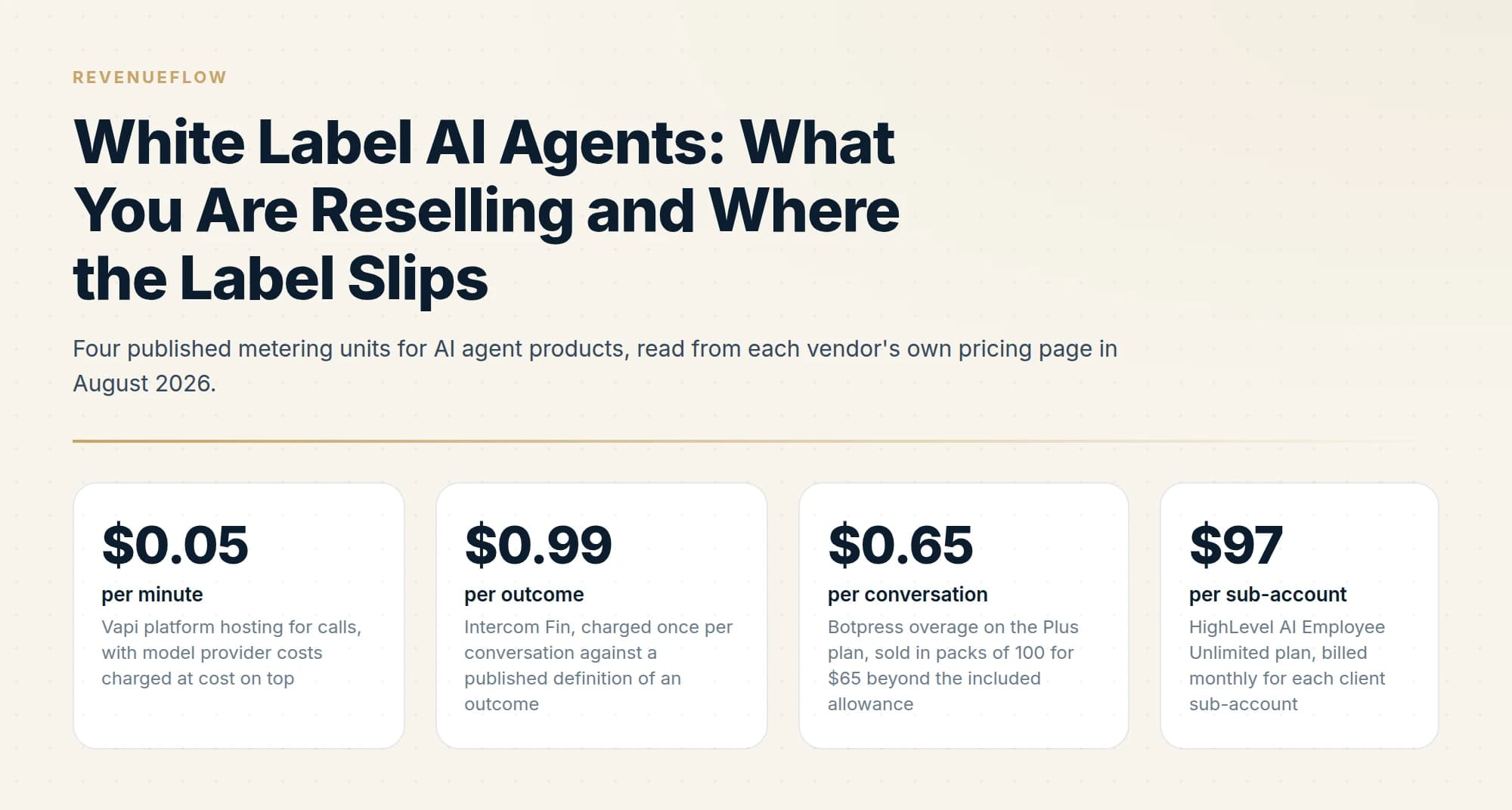
A white label AI agent is an AI product resold under the reseller's brand, usually an embedded chat or voice agent, an outbound agent, or an agent building platform. The difference from software resale is that usage is a variable cost, so margin moves with client behaviour. Published metering units include per minute, per outcome, per conversation and per sub-account.
Key takeaways
- Four vendors meter four different units: Vapi lists $0.05 per minute of platform hosting, Intercom lists $0.99 per Fin outcome, Botpress sells conversation overage at $0.65, and HighLevel lists $97 per month per sub-account.
- Ask whether model inference is included or passed through. Vapi states model provider costs are charged at cost on top, while Botpress bundles $0.10 of AI usage into each conversation.
- The right to mark up pass-through usage can be a paid feature. HighLevel lists rebilling without markup on its $297 plan and rebilling with markup on its $497 plan.
- Your evidence window is a plan setting. Vapi lists 14 days of raw data retention on its usage tier, 30 days on its $29 Core package and 180 days on Pro, which decides what you can prove weeks after a complaint.
Reviewed and updated September 21, 2026
An agency signs three clients onto a rebranded AI agent at the same monthly price. Two are quiet and profitable. The third turns the agent on across their whole support inbox, and by week three the usage bill is larger than the retainer. Nothing broke. The agency priced a variable cost as if it were a fixed one.
That is the difference between reselling an AI agent and reselling ordinary software, and it is worth understanding before the logo goes on. The licensing, support and exit questions common to all software resale are covered in white label SaaS reseller, and the program shapes across every category are in white label reseller programs. This piece is about the parts specific to agents: what is in the box, what the meter counts, and where your branding stops.
White label AI reselling: three products share the name
"White label AI agent" is used for at least three things, and the reseller carries different obligations in each.
| Product | What you inherit | Where the label leaks |
|---|---|---|
| Embedded chat or voice agent | Tone, accuracy and escalation, in public and immediately | The widget and caller ID |
| Outbound agent | Deliverability, compliance and the sending cadence | Headers, footer and unsubscribe path |
| Agent builder platform | Onboarding, enablement, tier one support, unpredictable usage | The login page and the docs |
The buyer-side question of what these tools actually replace is a separate one, and we cover it in AI SDR and in SDR versus AI SDR versus GTM engineer. What matters when you are the reseller is narrower: which of the three you are selling determines who sees a failure first, and whether you can even see it happen.
The metered unit is the whole commercial question

Vendors in this category do publish pricing, and the striking thing when you read several pages side by side is that they are not counting the same thing. Four vendors, four units.
| Vendor | Published unit | What sits on top |
|---|---|---|
| Vapi | $0.05 a minute of hosting | Models, voices and telephony, passed through at cost |
| Intercom Fin | $0.99 per outcome | Helpdesk seats, billed separately |
| Botpress Plus | $0.65 a conversation over the allowance | Nothing for AI up to $0.10 a conversation |
| HighLevel | $97 a month per sub-account | The agency platform plan |
Read those units carefully, because two of them hide a second bill.
Vapi starts on usage with no package, at $0.05 a minute of Vapi hosting, and states on its pricing page that models pass through at cost, with provider costs carrying no markup. Its own calculator itemises those costs separately: a Deepgram transcriber at $0.0095 to $0.0099 a minute, an OpenAI model at $0.0077 to $0.0452 and an ElevenLabs voice at $0.0146 to $0.0238, before telephony. The usage tier includes 4 concurrent calls and the $29 Core package 10, with extra lines at $10 per line per month. So the per minute figure is the platform's cut rather than the price of a minute.
Retell publishes a range instead of a single number, $0.07 to $0.31 per minute for voice agents and $0.002 and up per message for chat agents, and its itemised tables show where a minute goes: Retell's voice infrastructure at $0.055 a minute, its platform voices at $0.015, and language models from under a cent upward, GPT 4.1 at $0.045. Put together, a GPT 4.1 agent on a platform voice comes to $0.115 a minute before telephony. A range is honest, and it is also a range you cannot quote to a client as a fixed rate.
Intercom meters Fin at $0.99 per outcome and, unusually, publishes what an outcome is: the customer confirms their issue is resolved, or they do not ask for more help after Fin responds, or Fin completes a workflow including handoffs, charged once per conversation however many questions were answered. Seats are billed separately from outcomes on top of that, so the metered rate is not the whole cost. The per-seat figure is worth reading off the page yourself, because Intercom renders it as an animated counter rather than as text, and it moves with the annual and monthly toggle.
Botpress meters conversations rather than resolutions, and argues the case for it on its own pricing page: resolution pricing "creates disputes over what 'resolved' means and, perversely, raises your bill when your bot gets smarter." Its Plus plan is $150 a month billed annually with 250 conversations included and overage sold in packs of 100 for $65, and it bundles model spend into the conversation, stating that every conversation includes $0.10 of AI usage.
HighLevel sells the agency-facing version of the same thing, listing an AI Employee Growth plan at $50 per month per sub-account and an AI Employee Unlimited plan at $97 per month per sub-account, on top of agency platform plans at $97, $297 and $497 a month.
What to ask before you set a price
Four questions, and none of them is answered by the headline rate.
What exactly does the meter count, and what resets it? A conversation, an outcome, a minute and a message are four different denominators, and a heavy client will find whichever one you priced loosely.
Is model inference included or passed through? Vapi says passed through at cost, Botpress says bundled with an allowance per conversation. Those are opposite exposures and the same category.
What is the overage rate, and is it worse than the included rate? Botpress publishes both sides of that, at $150 for 250 included conversations against packs of 100 for $65, which is the arithmetic to run before quoting an unlimited plan to a client.
Can the provider change the model or the price mid-term, and with what notice? Model swaps change cost and behaviour at once, which makes this both a commercial and a quality question.
Run the answers through your own client list before you publish a price. A flat monthly rate over a consumption meter means your margin is set by your client's behaviour rather than by your price list, and the same rate that is comfortable on a quiet account is loss making on a busy one. Two defences work. Publish tiers with a stated included allowance and a stated overage, mirroring how the vendors themselves price, so a heavy client pays for being heavy. Or hold a monthly rate and cap it, with an explicit threshold at which the conversation reopens. What does not work is a flat unlimited price set from the average, because averages in usage-based products are dragged upward by exactly the accounts you cannot afford to lose.
Enterprise marketing suites go the other way entirely, where four Marketo packages published without a rate leave third-party roundups reconstructing a price list the vendor never printed.
One more that only bites resellers: are you permitted to mark up the usage you pass through? HighLevel makes this explicit and tiered. Its Unlimited plan at $297 a month lists "Rebill Phone & Email (no markup)" while the Agency Pro plan at $497 a month lists "Rebill Phone & Email with Markup". The right to profit on pass-through consumption is itself a paid feature, and its absence quietly caps your margin at whatever you charge for the platform.
Where the label slips
White labelling is rarely all or nothing. It is a list of surfaces, each of which is either yours, theirs, or an upgrade away from being yours.
Check yourself
- The chat widget: Botpress sells whitelabel webchat on its paid plans
- The login page and the apps: HighLevel white labels the desktop web app and sells its white label mobile app as a $497 a month add-on
- Sending domain, headers, footer and unsubscribe link
- Caller ID, voicemail greeting and number registration
- Reports, PDF footers, notifications and support addresses
Do not assume
- That a white label tick covers every surface above
- That branding settings control what the agent says when asked who it is
The fifth item is the one with no technical fix. A customer eventually asks the agent whether it is a person, or which model it runs on, and the answer comes from a system prompt rather than from your branding settings. Find out whether you can set that answer, whether the provider's terms require a particular one, and test it yourself with the exact question a suspicious customer would ask.
Adjacent to that is a legal question this article deliberately will not answer. Whether you are obliged to tell a person they are speaking with an automated system, and in what words, varies by jurisdiction and by channel, and it has been moving. Treat it as a question for your counsel and your client's counsel, get the answer in writing before launch, and ask the provider what their platform can enforce, since a disclosure obligation you cannot configure is one you cannot meet.
If you are reselling an outbound agent specifically, add one more configuration question: what does it do when nobody replies. Some send a sequence by default. We run one message per campaign with no bumps and no thread replies, on the view that a second unanswered message costs more in reputation than it returns, so if the agent's default is a five touch cadence you are inheriting a policy rather than a tool. Find the setting before the first send rather than after the first complaint.
Accountability when the agent is wrong

The agent will say something wrong to a customer. Your client will call you, not the vendor, because your name is on it.
Three things decide how that call goes, and all three are contractual rather than technical.
What the contract says about output. Find the clause covering generated content in your provider's terms and read it as the customer, because in a resale arrangement you are the customer. Any obligation it places on the customer to review or supervise output lands on you, and it only reaches your client if you pass it through explicitly in your own paper. The public signal is usually visible before you get to the contract: HighLevel prints a disclaimer on its pricing page stating that its AI features are software functionality that requires setup, configuration and ongoing human oversight, and that results vary by use case, configuration and business practices. Assume a similar position exists in the terms and go looking for it.
What logging you get, and for how long. This is where an evidence window becomes a plan feature. Vapi's pricing page lists 14 days of raw data retention on its usage tier, 30 days on the $29 Core package and 180 days on Pro. If a complaint reaches you five weeks after the conversation, the record deciding who was right may already be gone. Ask what is retained, for how long, whether you can export it on a schedule, and whether you can see the prompt as well as the transcript.
Who can see what during an incident. Decide in advance whether your client can be put on a call with the provider, since an undisclosed arrangement makes that impossible and turns every technical explanation into a relay. This is the same escalation problem every resale arrangement has, and the AI version is worse only because the failure is harder to explain and easier to screenshot.
For the wider question of which agent categories are actually working as businesses, what actually scales in AI agent revenue is the sober read, and AI appointment setter covers the booking-specific version of the same product.
The short version

Decide which of the three products you are reselling, because it determines who sees a failure first. Price against the meter rather than the headline, since a minute, an outcome, a conversation and a sub-account are four different denominators and two of them hide a second bill for model usage. Check every branded surface yourself on a live account. Get the disclosure question answered by counsel rather than by a vendor's marketing page. And find out how long the logs live before you need them.
We run outbound ourselves rather than licensing an agent to resell, one message per campaign, and we are paid on attended meetings against criteria agreed in writing before launch. See if you qualify.
Vendor pricing and terms are taken from the vendors' own pages. All are subject to change; confirm current terms directly before contracting.
Sources: Vapi pricing, Retell AI pricing, Intercom pricing, Botpress pricing, HighLevel pricing
Frequently asked questions.
Frequently asked questions- What does white label AI agent actually mean?
- It means reselling somebody else's AI product under your own brand. In practice it covers three different things: a chat or voice agent embedded in your client's site or phone line, an outbound agent that drafts and sends, and an agent building platform you sell as your own product. Your obligations differ sharply across the three.
- How should I price a resold AI agent?
- Price against the meter rather than the headline rate. Establish what the unit is, whether model inference is included or passed through, what the overage rate is, and whether you may mark up pass-through usage. Then publish tiers with a stated allowance and overage, because a flat unlimited price set from the average loses money on your heaviest accounts.
- Do I have to tell people they are talking to an AI agent?
- Treat that as a question for counsel rather than something to settle from a vendor page. Obligations vary by jurisdiction and by channel and they have been changing. Get the answer in writing before launch, and separately ask the provider what the platform can enforce, since a disclosure requirement you cannot configure is one you cannot meet.
- Who is responsible when a resold AI agent says something wrong?
- Commercially, you are, because your client calls you. Contractually it depends on the clause covering generated content in your provider's terms, which you should read as the customer, since that is your role in the arrangement. Check the logging too: retention windows decide whether you can reconstruct the conversation weeks later.
About the author.

B2B cold email experts helping companies generate qualified leads through done-for-you outreach campaigns.
RevenueFlow Team
Explore more.
Ready to scale your outreach?
We build GTM engines that book real meetings. See the receipts.
Related articles.
Alta Pricing: No Rate Card, a Quote in Hours
Alta publishes no price. What its plans page, FAQ and blog disclose about how the platform is priced, the inputs that set a quote, and the numbers to ignore.
Gojiberry AI Pricing: One Plan, Then a Quote
Gojiberry AI publishes one plan and quotes the rest. The dated price, the meters it names, the billing terms, and the look-alike domain that is not the vendor.
Sales Automation Software for Small Business: Four Buys
One search returns four unrelated products, and on at least one vendor's published plan list the automation is gated above the tier a small team buys.
Avoma Pricing: Recorder Seats, Free Viewers, and the Add-Ons
Avoma charges only for people whose meetings get recorded and makes viewers free, so the seat count to price is smaller than the team and the add-ons are larger.
Calendly Pricing: Every Plan and What Changes With Seats
Calendly's published rates read as annual by default. What each tier unlocks, why the same page shows three currencies, and where the non-profit discount lives.
Chili Piper Pricing: Seat Floors and What Each Rep Costs
Chili Piper publishes its floors, seat allowances and overage rates. What the $15,000 entry tier includes, and why the standalone calendar costs almost twice as much.