Account-Based Marketing vs Traditional: What Changes
Switching from lead-based demand generation to account-based work breaks the count, the handoff, attribution, the forecast and often the comp plan. Fix those first.
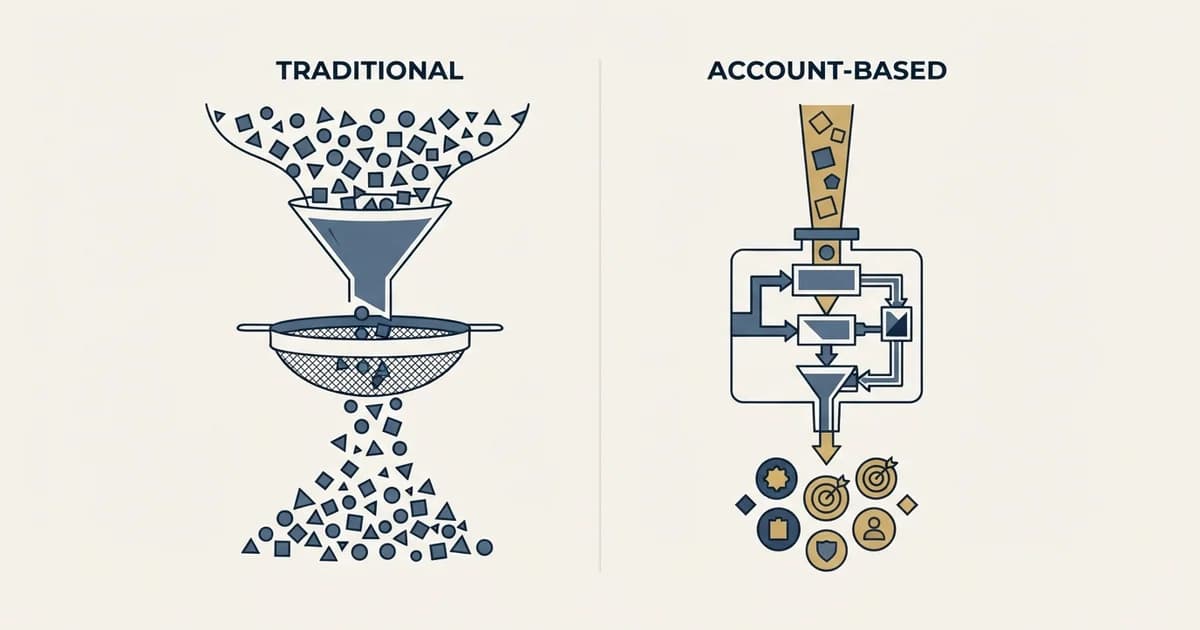
Traditional B2B marketing counts people through a funnel and assumes volume. Account-based work counts named companies and produces small numbers by design. The change breaks five things: the count, the sales handoff, attribution, the forecast and the comp plan. Positioning, copy quality and deliverability are unaffected.
Key takeaways
- The first thing an account-based programme breaks is the monthly report, because account-based numbers are small by construction rather than by failure.
- A lead score threshold does not survive the switch, since readiness becomes a property of a buying group; replace it with an observable event both teams accept.
- Whatever influence rule you write will determine your attributed results, so write it once and keep it fixed rather than revising it when numbers disappoint.
- Duplicate company records are harmless under lead-based reporting and fatal under account-based reporting, because engagement splits across the duplicates.
Reviewed and updated September 2, 2026
The first thing an account-based programme breaks is not the campaign. It is the monthly marketing report.
A team running lead-based demand generation reports a number of qualified leads, a conversion rate through a funnel, and a cost per lead. Switch the unit to the account and every one of those becomes either wrong or uninterpretable. Twelve replies from twelve target companies is a strong quarter for a two-hundred-account programme and it reads as catastrophic next to four hundred downloads. Nothing about the work went badly. The measuring instrument stopped fitting.
Demandbase names the change on its own explainer, describing ABM as flipping "the traditional B2B funnel on its head" and requiring a shift "from lead-based metrics to account-centric metrics such as engaged accounts, pipeline, and revenue" (Demandbase). That sentence is usually read as a slogan. It is actually a work order, and this is what the work consists of.
What "traditional" means in this comparison
Not billboards. In a B2B context the comparison is against lead-based demand generation: content and advertising aimed at a broad qualifying audience, forms that capture interested individuals, a scoring model that promotes some of them, and a handoff to sales at a defined threshold. It is a genuinely good machine when it fits, and its defining assumption is volume. You need enough people entering the top for the proportions to be stable.
That capture step has its own buying decision, and Formstack and Jotform meter submissions differently, which decides the bill more than any feature comparison does.
Account-based work removes that assumption and everything downstream of it has to be rebuilt.
Five things that change, in order of how much trouble they cause
- Count: qualified leads per month
- Handoff: score threshold crossed
- Attribution: first or last touch on a person
- Forecast: leads times conversion rate
- Coverage: not measured, volume substitutes for it
- Count: named accounts progressing
- Handoff: a person at a target account replied
- Attribution: contribution across a buying group
- Forecast: accounts times deal size times win rate
- Coverage: how much of each buying group is reached
The unit of counting. This is the change everything else follows from, and it is arithmetical rather than philosophical. Account-based numbers are small. A programme against two hundred accounts cannot produce four-figure anything, and a leadership team that has been reading four-figure numbers for three years will read the new report as a collapse unless somebody reframes it before the first one lands. Do that reframing in advance, in writing, with the expected magnitudes stated. It is much harder to do in the meeting.
The handoff. A score threshold does not survive the move, because scores accumulate on individuals and an account's readiness is a property of the group. The workable replacement is an event: a named person at a target account replied to a human. That is unambiguous, it is a record in a system, and it does not require both teams to trust a model neither of them built.
Attribution. This is where the trouble concentrates. First-touch and last-touch models assign credit to a person's interaction, and in an account-based programme the interactions are spread across five to ten people whose individual paths mean nothing on their own. Most teams respond by inventing an influence rule, and the rule quietly determines the results. One published case study reports that one hundred percent of closed-won deals carried the platform's attribution, and explains on the same page that the figure moved because the ICP was redefined so sales stopped pursuing accounts outside it (AdRoll). The metric changed because the population changed. Whatever influence rule you write will have the same property, so write it down and keep it fixed.
The forecast. Lead-based forecasting multiplies volume by historic conversion. Account-based forecasting multiplies a small number of accounts by deal size by win rate, and small numbers are volatile. Two accounts slipping a quarter is noise in a lead-based forecast and is the entire variance in an account-based one. Forecast in ranges and say so, or the first miss becomes an argument about the programme rather than about the two accounts.
Compensation. The quietest and the most decisive. Where marketing is compensated on lead volume, an account-based programme is a request to be paid less for doing harder work, and no amount of strategic alignment survives that. If the comp plan is not changed, the programme will be run as a side project by whoever has spare time, which is the failure mode that gets described afterwards as poor execution.
The transition, in the order that works
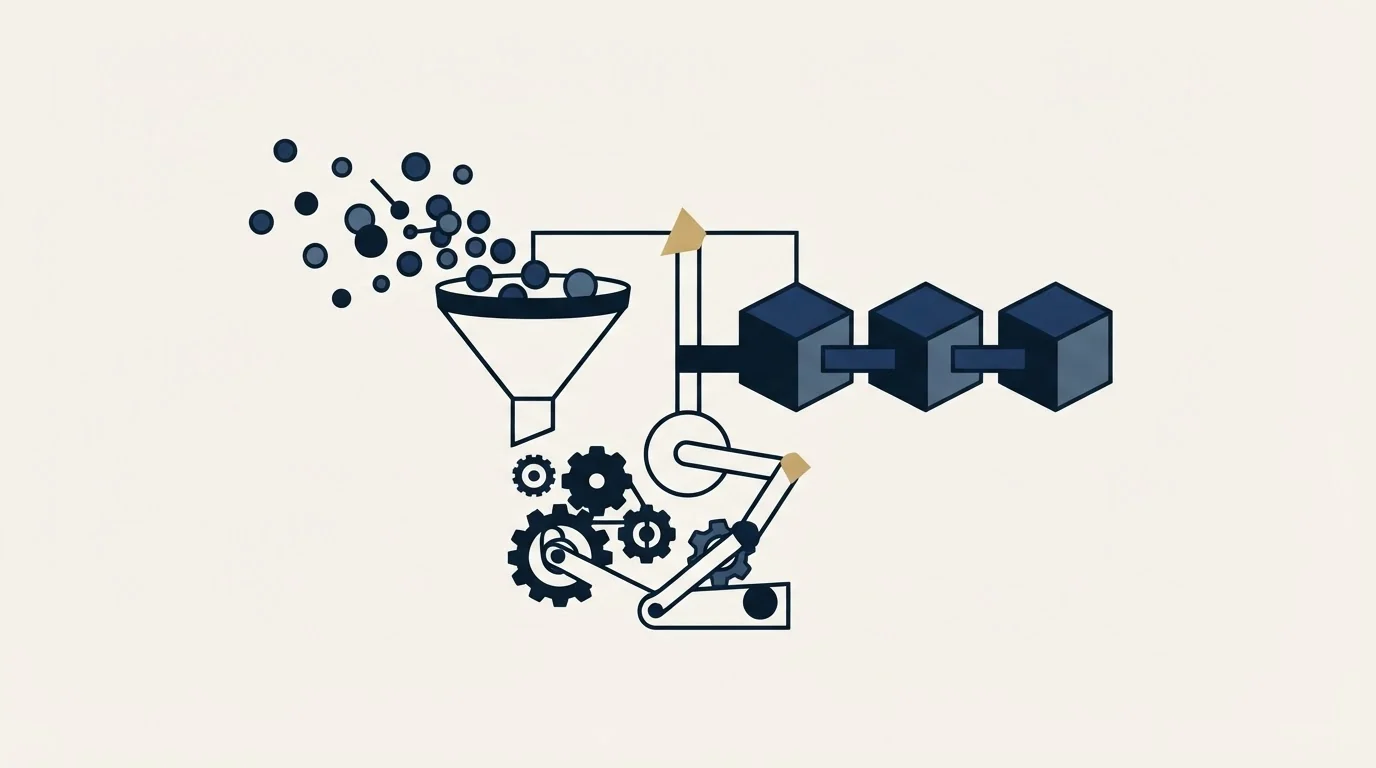
- Step 1Agree the target list
Named companies, as rows, with an owner. Nothing downstream is meaningful without it.
- Step 2Restate the metrics
Write the new report format and its expected magnitudes before the first campaign, not after.
- Step 3Fix the handoff event
Replace the score threshold with an observable event both teams accept.
- Step 4Write the influence rule
Define it once, in writing, and resist changing it when the numbers are inconvenient.
- Step 5Then launch
The campaign is the easy part and it is the part most teams start with.
Most account-based programmes run these in reverse, launching first and discovering the reporting problem at the end of the quarter when someone asks for the numbers. By then the programme is being defended rather than measured, and the reporting change looks like an excuse.
The plumbing nobody budgets for
Counting by account requires your systems to agree on what an account is, and in most CRMs they do not. Duplicate company records are ordinary, created by imports, by sales reps typing a name slightly differently, and by acquisitions bringing their own databases. Under lead-based reporting this is untidy and mostly harmless, because the unit being counted is the person. Under account-based reporting it is fatal, because engagement splits across the duplicates and every account looks less engaged than it is.
The scale of this is easy to underestimate. One published customer story describes a company arriving at the problem with six account records for every real account after merging four businesses, and treats the subsequent deduplication as a headline result in its own right (Demandbase). That is an unusual case and the direction is normal.
Two practical consequences. Run a duplicate check on your target list against the CRM before launch rather than after, because the fix is cheap in advance and awkward once reporting has started. And decide the rule for subsidiaries and business units in the same pass: whether a division of a parent company is one account or several determines both your list size and every coverage number you will report.
Buying a platform makes that clean-up unavoidable, since an ABM platform needs deduplicated CRM account records before any of its reporting means anything.
What does not change

Worth saying, because the category's marketing implies a total rebuild.
Positioning does not change. If your argument is unclear it will be unclear to two hundred named companies as reliably as to twenty thousand anonymous ones, and account-based work makes bad positioning more expensive rather than less visible.
Copy quality does not change. The same things make a message worth reading. Account-based work adds specificity about the recipient's situation, which helps, and it does not rescue a message with nothing to say.
Deliverability does not change. Reaching two hundred companies still requires messages that arrive, and a smaller list makes each undelivered message proportionally more costly. A programme reporting no response from an account that never received anything is the most avoidable failure in this whole field.
And the qualification standard should not change. Whatever counts as a real conversation should count the same way in both approaches, agreed in writing before launch, with budget and timing kept out of it.
When traditional is the right answer
- Yes: Average contract value does not fund per-account research
- Yes: The addressable market is large and you cannot name it
- Yes: Buyers actively search for the category
- Yes: One person can decide and sign
- Yes: Existing volume through the funnel is stable and predictable
- No: You want smaller numbers on the board next quarter
Single-decision-maker purchases are the clearest case. Account-based work exists to solve the problem of a group deciding together, and where there is no group it adds cost and no mechanism. Plenty of good B2B companies should not run ABM, and the honest version of the comparison says so.
For the neighbouring question of whether inbound or account-based work fits a specific pipeline gap, ABM versus inbound marketing covers the diagnostic. The vocabulary that all of this reporting depends on is in ABM meaning in marketing, the stage definitions in the account-based customer journey, and the plays worth running first in B2B account-based marketing.
How we handle the measurement problem
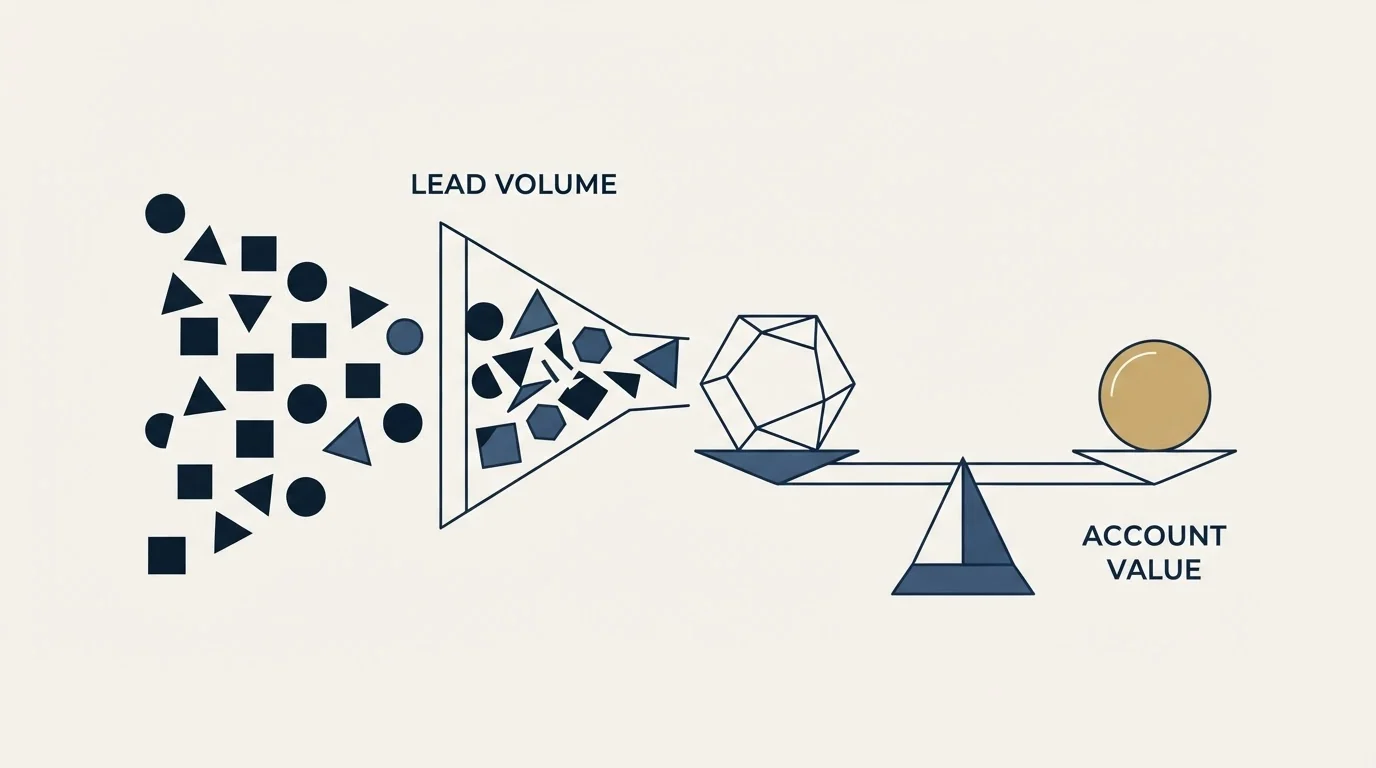
We report account-based work in the units it actually produces: accounts contacted, buying-group coverage, replies from named people, and meetings held against a written standard. The standard is agreed before launch, and budget, timing and authority are never conditions of it, because a meeting with the right person at the right company is the thing the programme is for.
One message per campaign, with nothing chasing it, is part of the same discipline. It keeps the reply rate readable as a verdict on the argument rather than on persistence, which is the number the reporting change is supposed to give you. The case studies carry the definitions next to the numbers, and a free campaign produces the first version of that report against your own account list.
The short version
Traditional lead-based marketing counts people through a funnel and assumes volume. Account-based work counts named companies and cannot produce volume by design. Changing the unit breaks the count, the handoff, attribution, the forecast and often the comp plan, and those need fixing before launch rather than after the first quarter's numbers land. Positioning, copy quality, deliverability and the qualification standard stay exactly as they were.
Vendor claims and definitions verified against each vendor's own pages as of mid-2026, from stored snapshots of the served bytes. The Total Expert figures are AdRoll's published claims about its customer. Verify current terms with the vendor before relying on them.
Sources: Demandbase, Account-Based Marketing 101, AdRoll Total Expert case study, Demandbase Navisite case study.
Frequently asked questions.
Frequently asked questions- What is the main difference between ABM and traditional marketing?
- The unit of counting. Traditional B2B demand generation counts qualified individuals moving through a funnel and depends on enough volume for the proportions to be stable. Account-based work counts named companies progressing, which produces much smaller numbers, and every downstream report, handoff rule and forecast built on volume has to be rebuilt around that.
- Do we still need MQLs if we move to ABM?
- Not as the handoff mechanism. A score accumulates on one person, while an account's readiness sits across five to ten people, so the threshold stops meaning anything useful. The practical replacement is an event: a named person at a target account replied to a human. It is unambiguous, it is a record, and neither team has to trust a model.
- Is ABM better than traditional marketing?
- Neither is better in general. Account-based work exists to solve the problem of a group deciding together, so where one person can decide and sign it adds cost and no mechanism. Stay lead-based when contract values do not fund per-account research, the market is large and unnameable, and buyers actively search for the category.
- What should we fix before launching an account-based programme?
- Agree the target list as rows with owners, write the new report format and its expected magnitudes before the first campaign, replace the score threshold with an observable handoff event, define the influence rule in writing, and check the comp plan. Launching first and discovering the reporting problem at quarter end is the common order and the expensive one.
About the author.

Ben Carden is CRO at RevenueFlow, which builds and operates outbound revenue engines for B2B companies. Previously at Gartner Enterprise. Studied at London School of Economics.
Ben Carden · CRO
Connect on LinkedIn →Explore more.
Ready to scale your outreach?
We build GTM engines that book real meetings. See the receipts.
Related articles.
5 ABM Campaign Examples and How Each One Is Built
Five worked account-based campaign examples, each built on the same five fields: account set, tier, plays in order, owner and handoff, and the exit condition.
ABM vs ABX: What Demandbase Added to the Model
One of these terms belongs to a vendor. What Demandbase says ABX adds, the three things that genuinely change, and the three that stay identical.
ABM Metrics: Coverage Decides Every Other Number
Every published ABM metric is a ratio whose denominator somebody chose. Six numbers, the denominator each one needs, and the comparison that settles it.
Allbound: Merging Inbound and Outbound
Allbound runs inbound and outbound as one motion. Merging them creates two decisions: what a signal may trigger, and who is credited when both touched the deal.
Deal Registration: Who Owns a Contested Deal
Deal registration lets a partner claim an opportunity before pursuing it. The policy is tested once, in public, on the first deal your direct team also wants.
Market Development Funds: What the Money Buys
MDF is discretionary marketing money a vendor grants its channel. The allocation model decides how much of it is ever claimed, and how much is unspent.