Account-Based Marketing vs Inbound Marketing: Which Gap
ABM and inbound answer two different failure modes. A six-question diagnostic for choosing, what each one costs, and how to run both without them competing.
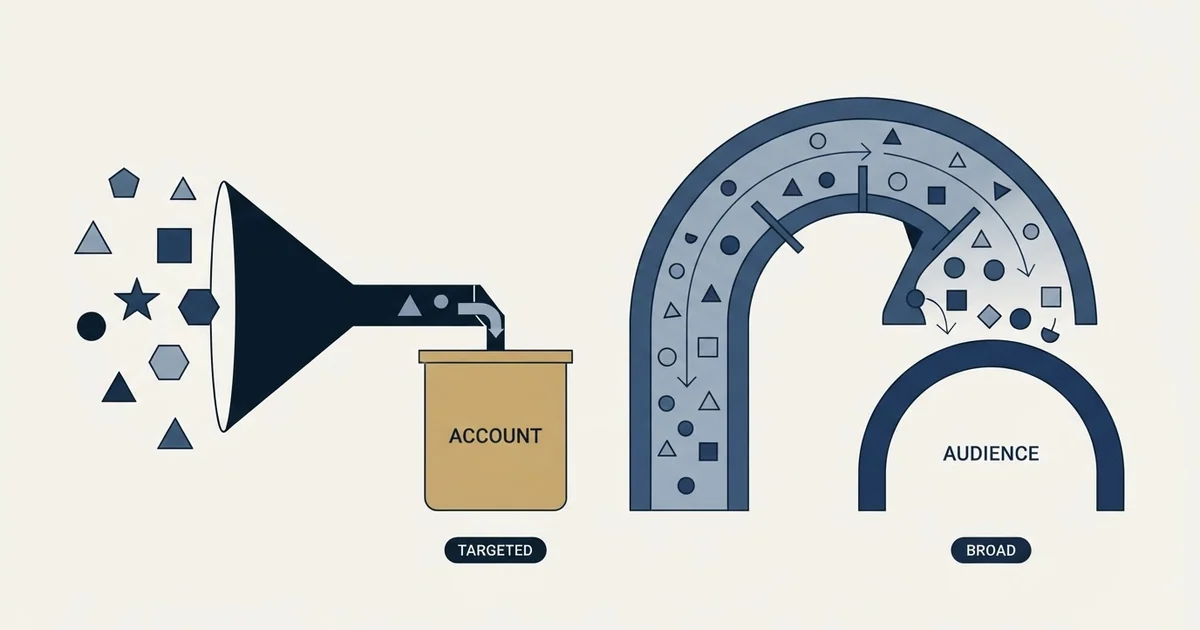
Inbound suits companies you cannot name in advance and who will find you if you are visible. Account-based marketing suits a finite list of named companies that will not. Decide by whether somebody can send that list as rows today, whether landing five of those names would change the year, and which speed profile the team tolerates.
Key takeaways
- The choice is diagnostic rather than strategic: inbound fixes companies who have never heard of you, ABM fixes named companies who are not paying attention.
- Inbound is an asset build that compounds; account-based work is an operating expense that stops producing the month it stops being funded.
- A team that cannot produce its target account list as rows has an ICP rather than a list, and starting ABM in that state produces a quarter of list-building.
- Run both by splitting the population rather than the channel: account-based work owns the named list end to end, inbound owns everything else.
Reviewed and updated September 2, 2026
A marketing lead with a pipeline gap gets two pieces of advice in the same week. Start doing ABM, because the deals you want are enterprise and enterprise deals need account-based work. And double down on inbound, because the content engine is the only thing producing anything at all. Both are defensible, they compete for the same budget and the same three people, and nobody in the room has said out loud which problem they are trying to fix.
Account-based marketing and inbound marketing are not rival philosophies. They are answers to two different failure modes, and picking correctly is a diagnostic question rather than a strategic one. This piece is the diagnostic.
The two failure modes
Inbound fixes: the right companies exist and have never heard of you. You cannot list them, they are numerous, they self-identify by researching a problem, and your job is to be present and credible when they do. Content, search, and a path from reading to talking. The defining property is that you do not know who they are in advance, and that is fine, because there are enough of them that a proportion arriving is a workable business.
ABM fixes: you know exactly which companies you need and they are not paying attention. The list is finite, often under two hundred names, and waiting for them to research their way to you is not a plan, because in any given quarter almost none of them will. Your job is to reach specific people at specific companies with an argument aimed at them.
Once the diagnostic points that way, the tooling question follows, and the enterprise ABM vendors publish no price, so an evaluation has to run on the model.
Demandbase puts the distinction plainly on its own explainer: ABM "flips the traditional B2B funnel on its head", focusing on a defined set of high-value accounts rather than "marketing broadly and hoping leads convert" (Demandbase). The word doing the work in that sentence is defined. If your set is not defined, you are not choosing between the two approaches yet.
The diagnostic
- Depends: Can somebody send the list of companies we want, as rows, today?
- Depends: Is that list under a few hundred names?
- Depends: Would landing five of them change the year?
- Depends: Do we already know the named people who decide inside them?
- Depends: Is anyone in that list actively searching for what we sell this quarter?
- Depends: Are we prepared to wait two quarters for the first meaningful signal?
Mostly yes on the first four points at ABM. Mostly no, with a yes on the last two, points at inbound. A mix, which is the common answer, means the two approaches should be running against different populations rather than competing for the same one.
Three of those deserve elaboration.
The list test is the sharpest. A team that cannot produce the target list as rows has an ICP and not a target account list, and starting ABM in that state produces a quarter of list-building described as a campaign. The distinction is covered in ABM meaning in marketing, and it is the single most common reason an account-based programme produces nothing.
Deal size decides whether the arithmetic works. Account-based work has a real per-account cost in research and in senior attention. Where the average contract is small, that cost does not clear, and the honest answer is broader marketing with better targeting. Where landing five named companies would change the year, almost any per-account cost clears.
Patience is a real input. Inbound compounds and is slow to start. Account-based work produces its first signal quickly, replies within weeks, and produces revenue slowly because enterprise cycles are long. Teams often choose the approach whose speed profile they cannot actually tolerate, then abandon it a quarter before it would have shown anything.
What each one actually costs you

- Cost is content production and time
- Compounds: assets keep working after they are paid for
- Slow to first signal, months rather than weeks
- Scales without more headcount once it works
- Tells you nothing about a specific account you want
- Weak when your buyers do not search
- Cost is research, data, and senior attention per account
- Does not compound: stopping stops the programme
- Fast to first signal, replies inside weeks
- Scales only by adding accounts and people
- Tells you precisely which named accounts responded
- Weak when the list is wrong, and expensively so
The row that decides most arguments is compounding. Inbound is an asset build and account-based work is an operating expense, so they behave differently under budget pressure. Cutting inbound leaves you with assets that keep producing for a while, which is why it is easy to cut and hard to notice. Cutting account-based work stops the pipeline the same month, which is why it survives cuts and why it never accumulates anything.
Neither behaviour is better. Knowing which one you are buying prevents the specific mistake of expecting an operating expense to compound, or expecting an asset build to fill a quarter.
Where they genuinely conflict
The content team. Inbound wants volume across topics; account-based work wants a small number of arguments aimed at specific clusters. The same writer cannot do both well in the same week, and asking them to produces broad content with account names inserted, which is the worst output of the two approaches combined. ABM content strategy covers what a small account-based programme actually needs, and it is fewer pieces than most teams expect.
The metric. Inbound is measured in volume through a funnel; account-based work is measured in named-account progress. Running both against one dashboard forces one of them to be reported in the other's units, and the account-based programme always loses that translation because its numbers are small by design. Twelve replies from twelve target companies is an excellent quarter and looks like nothing next to four hundred downloads.
The definition of a lead. In inbound, a form fill from an unknown company is a lead. In account-based work it is a distraction unless the company is on the list. Where both run through one lifecycle, sales inherits a queue mixing the two and works whichever arrived most recently.
The tool collecting those form fills is chosen on its meter rather than its features, and Formstack and Jotform count genuinely different units.
Running both without them fighting

The workable arrangement is to split by population rather than by channel.
Name the target accounts explicitly and let account-based work own them end to end, including any inbound activity from those companies, which routes straight to the account owner rather than into the general queue. Everything not on the list belongs to inbound and follows the normal path. Review the list quarterly, and let accounts that inbound surfaces repeatedly become candidates for it.
That arrangement costs one afternoon to agree and removes most of the recurring friction, because the two approaches stop competing to claim the same responses. It also makes the comparison legible after two quarters: the target list has its own numbers and the rest of the market has its own.
For the broader question of what changes when the account becomes the unit of measurement across the whole reporting stack, ABM versus traditional marketing takes it directly. For the plays worth running first once you have chosen, B2B account-based marketing is the starting point.
The version that disappoints everyone
There is a middle path that gets proposed in most of these debates: keep doing inbound, but personalise it for target accounts. Website personalisation for known visitors, account-specific landing pages, targeted advertising to the list.
It is not a bad tactic and it is a poor strategy, for one reason. It still requires the account to come to you. Personalising the experience of a visitor from a target company only helps if someone from that company visits, and on a finite list of two hundred accounts the number who visit in a given quarter is small. The tactic improves conversion of traffic you already have. It does not create contact with companies that are ignoring you, which was the problem you started with.
Use it as an addition to direct contact rather than as a substitute for it, and expect it to help at the margin.
There is a budgeting version of the same error worth naming. Advertising to a target list is often presented as the account-based option because it is the one that can be bought with a card and launched this week, while identifying buying groups and writing to them is slower to stand up. The speed is real. What you get for it is reach into accounts rather than contact with people, and reach only converts into pipeline where somebody follows it with a direct approach. Budget the advertising as support for that approach, not in place of it, or the programme reports impressions for two quarters and produces no conversations.
What we do
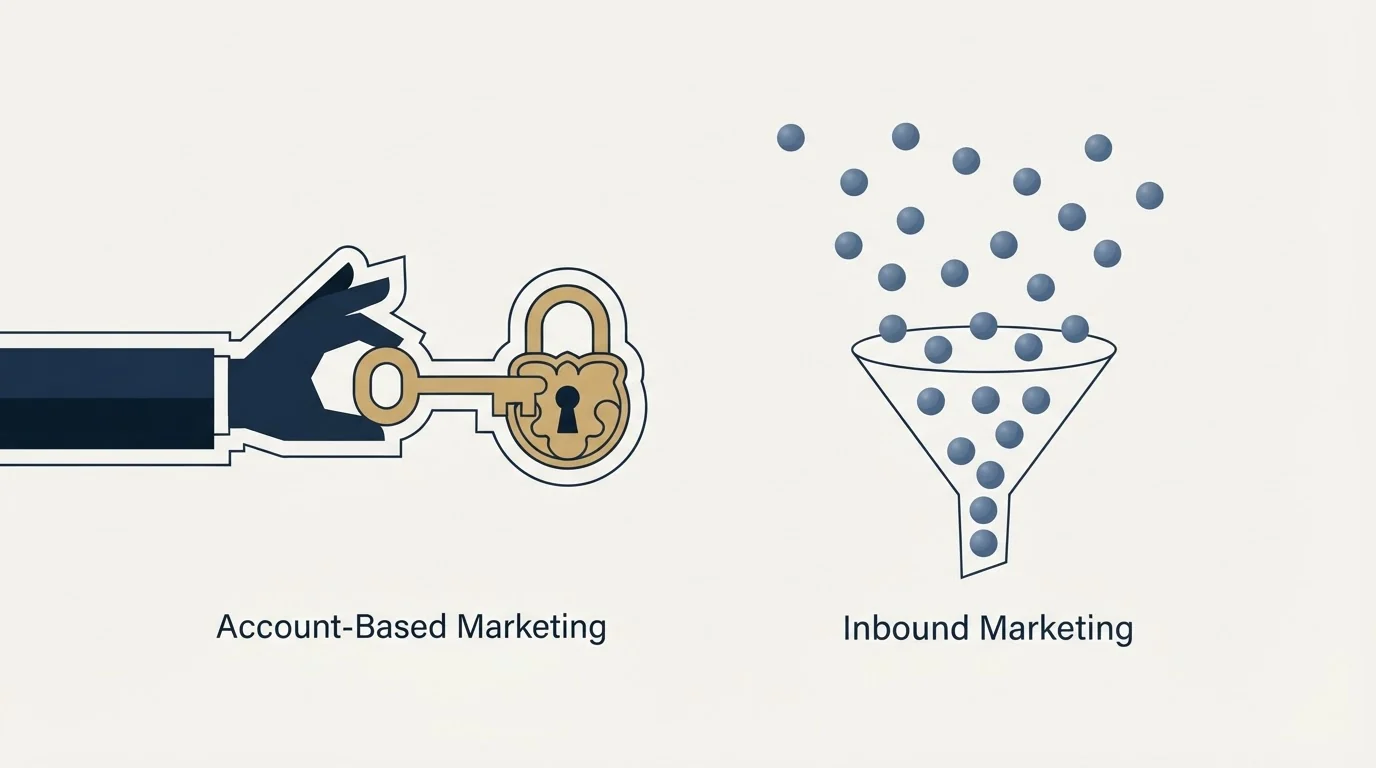
We run the direct-contact half: a defined target list, the buying group inside each account identified with verified addresses, and one message per campaign with nothing chasing it. That constraint is deliberate. It makes the reply rate a clean read on whether the argument works for that list, which is exactly the diagnostic an account-based programme is supposed to produce and often does not.
The case studies show the numbers with the qualification criteria attached, and a free campaign tests your target list directly, which is usually a faster answer to the ABM-or-inbound question than another planning cycle.
The short version
Inbound is for companies you cannot name and who will find you if you are visible. Account-based marketing is for companies you can name and who will not. Decide by asking whether somebody can send the list as rows today, whether landing five of those names would change the year, and which speed profile the team can actually tolerate. Run both by splitting the population rather than the channel, and treat personalised inbound as an addition to direct contact rather than a replacement for it.
Vendor definitions verified against the vendor's own pages as of mid-2026, from stored snapshots of the served bytes. Verify current terms with the vendor before relying on them.
Sources: Demandbase, Account-Based Marketing 101.
Frequently asked questions.
Frequently asked questions- Can you run ABM and inbound at the same time?
- Yes, if you split by population rather than by channel. Name the target accounts and let account-based work own them completely, including inbound activity from those companies, which routes to the account owner rather than the general queue. Everything else follows the normal inbound path. This removes most of the recurring friction over who claims a response.
- Which is cheaper, ABM or inbound?
- They are not comparable on cost alone, because inbound buys assets that keep producing and account-based work buys activity that stops when funding does. Inbound's cost is content production and time. Account-based cost is research, data and senior attention per account, which clears easily when landing five named companies would change the year and does not clear on small contracts.
- How quickly does each one show results?
- Account-based work gives a first signal fast, with replies inside weeks, and revenue slowly because enterprise cycles are long. Inbound is the reverse: months before meaningful traffic, then a compounding effect. Teams often pick the approach whose speed profile they cannot tolerate, then stop it a quarter before it would have shown anything.
- Is personalising inbound for target accounts the same as ABM?
- No, and the gap matters. Account-specific landing pages and website personalisation only help if someone from that account visits, and on a finite list of a couple of hundred names very few will in a given quarter. It improves conversion of traffic you already have without creating contact with companies that are ignoring you.
About the author.

Ben Carden is CRO at RevenueFlow, which builds and operates outbound revenue engines for B2B companies. Previously at Gartner Enterprise. Studied at London School of Economics.
Ben Carden · CRO
Connect on LinkedIn →Explore more.
Ready to scale your outreach?
We build GTM engines that book real meetings. See the receipts.
Related articles.
ABM vs ABX: What Demandbase Added to the Model
One of these terms belongs to a vendor. What Demandbase says ABX adds, the three things that genuinely change, and the three that stay identical.
5 ABM Campaign Examples and How Each One Is Built
Five worked account-based campaign examples, each built on the same five fields: account set, tier, plays in order, owner and handoff, and the exit condition.
Define Content Syndication: Two Purchases Behind One Word
One budget line, two different purchases. Republication buys reach; lead syndication buys contact records produced by a download. The deliverable tells you which.
ABM Metrics: Coverage Decides Every Other Number
Every published ABM metric is a ratio whose denominator somebody chose. Six numbers, the denominator each one needs, and the comparison that settles it.
On-Demand Webinars: What Changes When You Take the Date Away
A live webinar earns most of its value from the date. Removing it keeps the topic signal and the address, and loses the deadline, the burst and the room.
Allbound: Merging Inbound and Outbound
Allbound runs inbound and outbound as one motion. Merging them creates two decisions: what a signal may trigger, and who is credited when both touched the deal.