High-Ticket Appointment Setting in B2B: Pace the List
The term covers two almost unrelated jobs. In B2B the deal size makes the list finite, the buying group a committee, and a burned account a permanent loss.
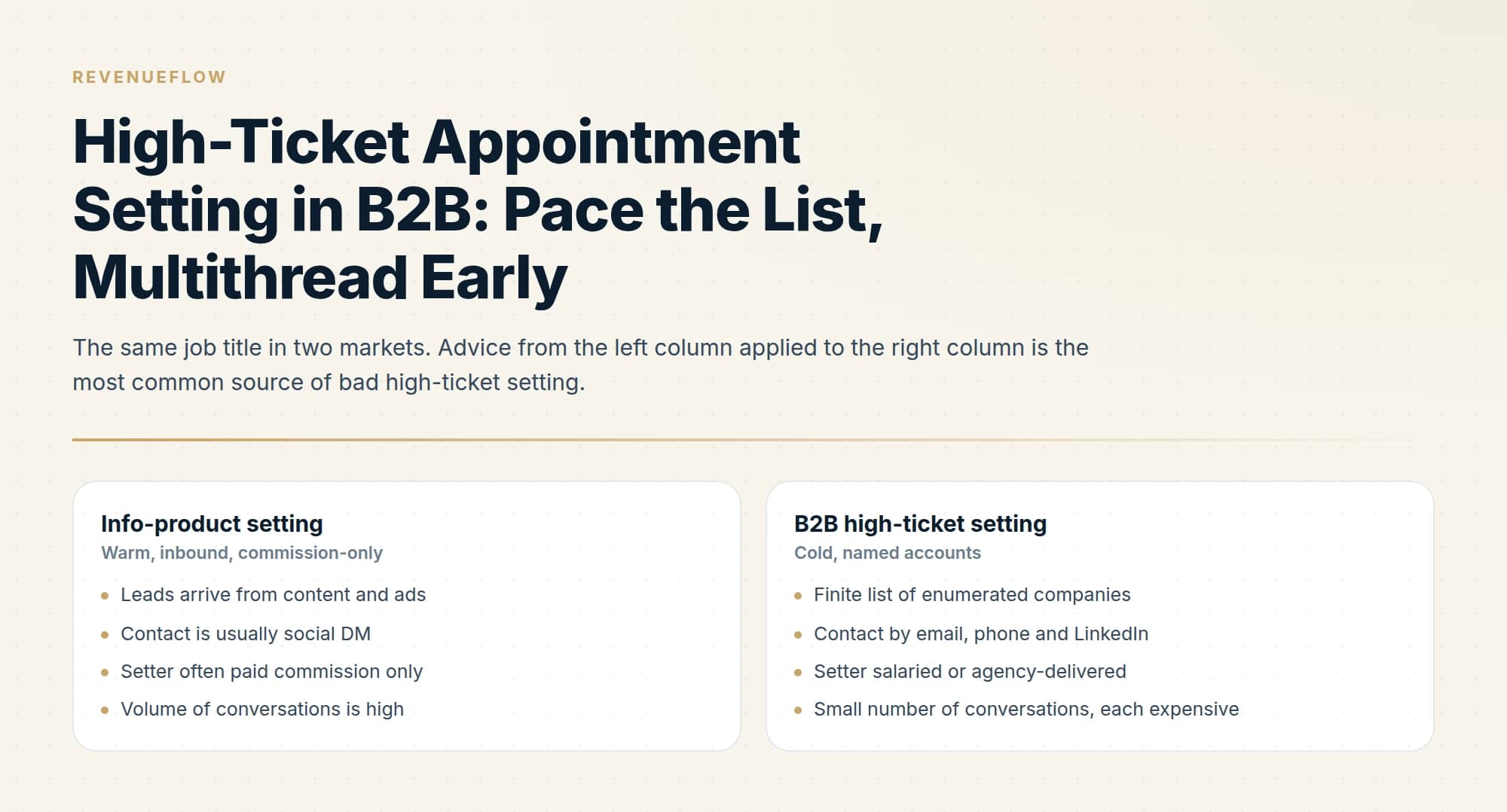
High-ticket appointment setting in B2B works a finite list of named companies where one conversation can outweigh fifty poor ones. Quality dominates volume, the buying group is a committee rather than one enthusiastic contact, and a burned account is a permanent loss rather than a rounding error.
Key takeaways
- The commission-only social-DM version of this job comes from the info-product world, and importing its pay structure into a finite named list produces exactly the wrong behaviour.
- Research until you can state one specific checkable reason this company should care right now, then stop, because a first message can only carry one idea.
- Identifying the likely buying group during research rather than after a meeting is booked is the change that most protects a large deal.
- Twenty meetings from a volume motion and three from a named-account motion can represent the same pipeline value, so report pipeline from target accounts alongside the count.
Reviewed and updated September 1, 2026
"High-ticket appointment setter" means two almost unrelated jobs depending on who is hiring. In the coaching and info-product world it usually means a commission-only setter working warm inbound from social content. In B2B it means someone booking meetings for deals large enough that a single meeting is worth real money.
The advice written for the first is widely available and mostly wrong for the second. This is about the second, with a clear note on where the two genuinely differ.
What changes when the deal is large
Deal size changes the arithmetic of the entire function, and three things follow from it.
Each meeting is worth more, so quality dominates volume. At a large contract value, one well-targeted conversation can outweigh fifty poor ones. That inverts the usual volume logic and justifies research time per account that would be indefensible on a small deal.
The buying group is a committee. Large purchases involve several people, so a meeting with one enthusiastic person is the start rather than the outcome. Setters who treat a single booking as the finish line hand over deals that stall.
The target list is finite and named. You can enumerate the companies worth winning, which means a burned account is a permanent loss rather than a rounding error. That single fact should change how a setter is measured, trained and paced.
- Leads arrive from content and ads
- Contact is usually social DM
- Setter often paid commission only
- Volume of conversations is high
- Single decision maker, fast cycle
- Finite list of enumerated companies
- Contact by email, phone and LinkedIn
- Setter salaried or agency-delivered
- Small number of conversations, each expensive
- Committee decision, long cycle
Research per account, and how much is too much
At high deal values, per-account preparation genuinely pays. It also has a point past which it stops paying and starts consuming the day.
The useful boundary: research until you can state a specific, checkable reason this company should care right now. Once you have that, stop. Further reading produces a more informed setter and does not produce a better first message, because the first message can only carry one idea anyway.
What that reason should be built from, in rough order of usefulness: a trigger event that changed something for them recently, an observable fact about how they currently operate, and a pattern you have seen in comparable companies. What it should not be built from is anything the model or the researcher could not point at a source for, because a confident wrong detail in a first contact with a named account costs the account.
Multithreading from the first meeting

The single biggest difference in execution is that one contact is not enough, and the work of adding contacts starts before the first meeting rather than after it.
A deal with one engaged person dies when that person changes job, loses an internal argument, or simply goes quiet. On a small deal you absorb that. On a large one it is a quarter of your pipeline.
Practically, the setter should be identifying the likely buying group during research, not after a meeting is booked: whoever owns the problem, whoever owns the budget, and whoever will evaluate whether it works. Contacting more than one of them requires care, because visibly identical messages arriving at three colleagues on the same morning reads as automation. Different angle per person, different reason each one specifically should care.
- Yes: A specific, checkable reason this account, this quarter
- Yes: The likely buying group identified, not just one contact
- Yes: Verified contact details for the people who matter
- Yes: The account checked against suppression and live opportunities
- Yes: A different angle prepared per person at the same company
- No: The same message going to three colleagues at once
- Depends: Whether the account is worth a second attempt later if this one lands badly
Paying a high-ticket setter
This is where the two worlds diverge most sharply, and where importing the wrong model does real damage.
Commission-only setting works in the info-product world because lead volume is high, cycles are short and the setter can generate enough conversations to earn from a percentage. In B2B against a finite named list, commission-only produces exactly the wrong behaviour: a setter who needs volume to earn will push marginal accounts into the calendar, and marginal meetings on a named list are worse than no meetings because they spend the account.
The structure that fits is a base plus a component tied to held and qualified meetings against criteria written down before contact begins. That aligns the setter with the thing the business actually needs, which is a small number of good conversations rather than a large number of any.
The qualification definition carries more weight here than anywhere else, because each disputed meeting is worth more. Ours, since we are paid this way, requires that the company is in the agreed audience, the participant has responsibility for or influence over the relevant area, they agree to a relevant business conversation, they attend and participate, and they were not already a customer or live opportunity. Budget, timing and authority are deliberately excluded, because they are rarely knowable before the conversation and using them as gates disqualifies good early-stage deals.
Pacing, and the reason to go slower
The counterintuitive discipline in high-ticket setting is deliberately low volume.
If the list is 200 named companies and the programme burns through it in six weeks with mediocre execution, there is no second list. Working 20 accounts a week properly, with real research and a genuine reason for contact, covers the same list in ten weeks and leaves the accounts that did not respond still approachable.
That argues for a specific management posture: measure the setter on accounts worked well rather than accounts touched, review the actual messages before they go out during ramp, and treat a burned account as a cost rather than as a neutral outcome. The training sequence that supports this is in SDR training and ramp.
The handoff, which is where large deals leak

At high deal values the handoff from setter to closer is worth more than at any other price point, and it is usually the least designed part of the process.
A booked meeting with no context forces the prospect to repeat everything they told the setter. On a small deal that is mildly annoying. On a large one it signals that the two people they are dealing with do not talk to each other, which is precisely the concern a committee has about a vendor.
What should transfer, at minimum: the reason the account was contacted, what the prospect said in their own words, what triggered their interest, who else they mentioned, and any constraint they named. That is five bullet points and it takes the setter four minutes to write.
Two habits make it happen. Make the handoff note a condition of the meeting counting, so it is part of the work rather than an afterthought. And have the closer read it before the call rather than during, which sounds obvious and frequently does not happen when calendars are full.
The other side of the handoff matters too. A setter who never hears what happened in the meetings they booked cannot improve their targeting, because the feedback loop is broken at exactly the point where the useful information appears. A short weekly exchange between closer and setter about which meetings were worth having, and why, is the cheapest quality mechanism available in a high-ticket programme.
- Step 1The reason for contact is already written
Gathered during research rather than reconstructed after a meeting appears in the calendar.
- Step 2The setter writes the note
Why the account was contacted, what the prospect said in their own words, what triggered their interest, who else they mentioned, and any constraint they named. Five bullet points, four minutes.
- Step 3The note is a condition of the meeting counting
That makes it part of the work rather than an afterthought competing with the next account.
- Step 4The closer reads it before the call
Before, not during. Making a committee buyer repeat everything signals that the two people they are dealing with do not talk to each other.
- Step 5The closer reports back weekly
Which meetings were worth having, and why. Without this the feedback loop breaks at exactly the point where the useful information appears.
Where it sits among the alternatives
If the list is finite and each conversation is worth a lot, this is the shape you want, and the question becomes whether to build it or buy it. The evaluation questions specific to buying it are in choosing an SDR company, and the wider decision about outsourcing the function at all is in outbound sales outsourcing.
Choosing a vendor also means scrutinizing what they actually charge, which a pricing discrepancy breakdown covers for one appointment setting provider whose published rates disagree with each other.
The model that does not fit here is volume dialling, for the reasons above. A call-centre floor paid on bookings against a named enterprise list will produce bookings and consume the list, and that comparison is set out in call-centre appointment setting.
Judging the programme on the right timescale

High-ticket programmes get killed early for a predictable reason: the meeting count looks thin against a target set using small-deal arithmetic.
Twenty meetings a month from a volume motion and three meetings a month from a named-account motion can represent the same pipeline value, and frequently the second represents more. If the reporting line only sees the count, the second programme looks like it is failing while it is working.
Two adjustments prevent that. Report pipeline value from target accounts alongside the meeting count, so the comparison is like for like. And set the review point at a horizon that includes the cycle, since a market with a six-month decision process cannot demonstrate closed revenue inside a quarter no matter how well the setting is done.
The leading indicator worth watching in the meantime is buying-group depth: distinct engaged contacts per target account, trended. It moves months before pipeline does, it reflects exactly the behaviour that makes large deals close, and it is computable from a CRM without buying anything.
The short version
High-ticket appointment setting in B2B is a different job from the commission-only social-DM version the term usually describes online. Deal size makes quality dominate volume, makes the buying group a committee, and makes the target list finite, so a burned account is a permanent loss. Research until you have one specific checkable reason and then stop, identify the buying group before the first meeting rather than after, pay on held and qualified meetings rather than commission on bookings, and deliberately pace the programme so the list is not consumed before it is understood.
If you want those conversations without building the function, we work on a pay-per-qualified-meeting basis with the definition agreed in writing first, and you can see what a campaign would look like for your market.
Frequently asked questions.
Frequently asked questions- How is high-ticket appointment setting different in B2B?
- Three things follow from deal size. Each meeting is worth more, so quality dominates volume and per-account research becomes defensible. The buying group is a committee, so one enthusiastic contact is a start rather than an outcome. And the target list is finite and enumerable, which makes a burned account a permanent loss and changes how the setter is measured, trained and paced.
- How should a high-ticket setter be paid?
- Base plus a component tied to held and qualified meetings against criteria written down before contact begins. Commission-only works in the info-product world because lead volume is high and cycles are short. Against a finite named list it pushes a setter to move marginal accounts into the calendar, and a marginal meeting there is worse than no meeting because it spends the account.
- How much research is too much per account?
- Research until you can state a specific, checkable reason this company should care right now, and then stop. Further reading produces a better-informed setter and not a better first message, since the message can carry one idea. Build the reason from a recent trigger event, an observable fact about how they operate, or a pattern seen in comparable companies.
- What should transfer at the handoff to the closer?
- The reason the account was contacted, what the prospect said in their own words, what triggered their interest, who else they mentioned, and any constraint they named. That is five bullet points and four minutes of work. Make the note a condition of the meeting counting, and have the closer read it before the call rather than during it.
About the author.

B2B cold email experts helping companies generate qualified leads through done-for-you outreach campaigns.
RevenueFlow Team
Explore more.
Ready to scale your outreach?
We build GTM engines that book real meetings. See the receipts.
Related articles.
Multi-Threading in Sales: Who the Second Contact Should Be
Six contacts on an opportunity and one real relationship is still single-threaded. Which second person to add, when to ask, and how to tell whether it worked.
Fractional SDR: When a Shared Seat Works and When It Stalls
A shared seat keeps the machinery around the rep and gives up exclusive ownership of the person. The conditions that decide whether that trade works.
No Show Email Template: What to Send After a No Show
A no-show accepted the meeting, so writing to them is correspondence rather than a bump. The checks to run first, what to send, and the policy behind it.
Superhuman Prospecting Pricing: Two Entry Prices, Two Pages
The pricing page starts at $1,998 a month and the appointment setting page says as low as $1,125. Both are live, and the gap is the useful part.
Cold Call Appointment Setting: The First Ten Seconds
The opening decides the call, and what wins it is a specific reason for phoning this person today. That is a property of the list before it is a property of the script.
Inbound vs Outbound Sales: How the Two Motions Differ
Inbound and outbound sales compared as motions: what the rep knows at first touch, what each costs, the team each needs, and the metrics that belong to each.