Economic Buyer vs Champion: Which One You Actually Have
Economic buyer against champion, from MEDDICC Ltd's own pages and the publishers who write about confusing them: what each has, the four confusions, and the tests.
The economic buyer, in MEDDICC Ltd's words, has the overall authority in the buying decision and says yes when others say no; the champion has power, influence and credibility inside the account and acts for you; one is defined by authority over money, the other by willingness to act, and one move tests both: ask the champion for an introduction.
Key takeaways
- MEDDICC Ltd defines the economic buyer by veto power over the deal and the champion by power, influence and a vested interest; neither property implies the other, so each field in a deal review needs its own evidence.
- The publishers describe four confusions: a champion who claims the decision, a budget holder mistaken for the buyer, the most senior person in the room, and a fan recorded as a champion.
- Both roles are proved by behaviour: who approved the last comparable purchase, and what the contact has already done for the deal when the seller was absent; asking the champion to introduce you to the buyer tests both at once.
- One person can hold both roles, usually in a small company or when an executive initiates the purchase; Spotlight says to record it as a single-role deal because losing that person kills the deal.
Reviewed and updated September 21, 2026
A deal review records the same senior contact in two fields, champion and economic buyer, because the contact is enthusiastic, senior-sounding and engaged, and the deal reaches contract stage before anyone notices that neither field was ever tested. That is the failure every publisher of the two terms describes, and it is the reason the comparison deserves its own page rather than two definitions. This page takes each role from the publisher of the framework that made both of them standard fields, MEDDICC Ltd, and from the sales publishers who write about confusing them, and sets out what each role has that the other does not, the four ways they get confused, the tests that prove which one you have, and what to do when one person is both. The definitions on their own are the glossary entries for the economic buyer and the sales champion; this page does not restate them.
What each role has that the other does not
MEDDICC Ltd's own page for the E in MEDDPICC (fetched 21 September 2026) defines the economic buyer by a single property: "The Economic Buyer is the person with the overall authority in the buying decision. They have the power to say yes when others say no, and say no when others say yes." The same page gives the observable signs: "They will have veto power to push the project forward or to stop it, regardless of what other stakeholders do.", profit and loss responsibility, and access to funds that are not budgeted.
Its page for the C is built on a different property altogether: "A Champion is a person who has power, influence, and, subsequently, credibility within the customer's organization and who is willing and able to assist you in making progress with your deal." The page names three criteria, power and influence, acting as an internal seller, and a vested interest in the seller's success, and states the consequence of lacking one as a slogan: no champion, no deal.
So the two roles are defined on different axes. The economic buyer is defined by authority over money, whatever their enthusiasm; the champion is defined by willingness and standing to act for you, whatever their authority. Salesmotion's guide (published 30 September 2025, modified 11 June 2026) puts the buyer's side plainly: "the economic buyer is the only one with absolute veto power. If they say no, the deal is dead." New Breed's buying-roles post (published 4 March 2020, modified 25 March 2026) puts the champion's: "Champions help you navigate the organization and sell on your behalf." One controls whether the purchase happens; the other works to make it happen. Neither property implies the other.
The four ways they get confused
Spotlight's post on the pair (published 16 April 2026) opens on why the confusion is natural: "The confusion is understandable: sometimes the same person holds both roles." The publishers between them describe four distinct mistakes, and each has a different cure.
The champion who says the decision is theirs. MEDDICC Ltd's economic-buyer page warns that the role announces itself to nobody: "The Economic Buyer is unlikely to raise their hand and tell you they're the EB. It is your job to identify them." MySalesCoach's guide (published 9 June 2025), quoting its coach Richard Bounds, gives the tell for a contact who claims the role and does not hold it: "If they don't know who holds the budget or can't describe the process, that's a red flag."
The budget holder taken for the economic buyer. MEDDICC Ltd's separate article on qualifying the role (published 28 November 2022, modified 27 May 2026) draws a line most sellers do not: "Be mindful not to mix up the Economic Buyer with the budget holder - the Economic Buyer is the one who decides who holds the budget." And the failure it produces: "A seller might find the Budget Holder and assume that person is naturally the Economic Buyer. This is rarely the case."
The most senior person in the room. The same article names the opposite error: "A CEO will have access to budgets and the authority to use them, but is very rarely the Economic Buyer in practice." Spotlight makes the same point from the other direction: "Economic Buyers are not always senior. In some organizations, a Director of Finance holds more budget authority than a VP of Sales."
The enthusiastic contact with no stake. This is the champion-side error, and Spotlight names the figure: "A fan has no authority and no skin in the game. A relationship with a fan feels like deal progress and produces none." MEDDICC Ltd's champion page calls the helpful contact who lacks a criterion a coach: "Typically, they lack the power and influence to be a Champion, but they can still give you helpful insight into the deal and introduce you to important stakeholders." A coach is useful and is recorded as a coach; the error is recording one as a champion.
Spotlight's account of how the four combine is the post-mortem most deal reviews eventually write: a senior-seeming contact is classified as both roles, the deal reaches contract, a budget freeze or a procurement step arrives from somebody the seller never spoke to, and "The Economic Buyer was never identified. The Champion was never developed."
Ask who holds the budget and how the last comparable purchase was approved; a contact who cannot describe the process does not hold the role (MySalesCoach).
The economic buyer decides who holds the budget and can move funds that are not budgeted; the budget holder manages access to it (MEDDICC Ltd).
A chief executive rarely holds the role in practice, and a finance director can hold more budget authority than a sales vice president (MEDDICC Ltd, Spotlight).
A fan or a coach gives insight and introductions and is recorded as such; a champion has power, sells internally and has a vested interest (MEDDICC Ltd, Spotlight).
The tests that prove which one you have
Both roles are proved by behaviour rather than by title or by what a contact says about themselves, and the publishers supply a test for each.
For the economic buyer, MEDDICC Ltd's qualifying article lists five criteria, the first of which subsumes the rest: "They have the power and authority to veto project progress and the influence to stop/start it, regardless of your Champion"; the others are a primary objective tied to the organisation's goals and its planning cycle, access to funds not attached to budgets, responsibility for profit and loss, and a place in the contractual process as the person who authorises sign-off. MySalesCoach's practical version is a question about the past rather than a claim about the present: "Who had to approve the last solution you bought?"
For the champion, Spotlight's three tests are all about things the contact has already done: they have provided access to stakeholders or information you did not have; "They have advocated for your solution when you were not present" and you have evidence of it; and "They have a personal business outcome tied to the success of this purchase." MEDDICC Ltd adds that the test is repeated rather than passed once: "It's also important to continually test your Champion throughout the sales process to ensure that they are properly qualified to act as your Champion".
The two tests meet in one move, and it is the most useful sentence on either MEDDICC page: "If your Champion is unwilling or unable to introduce you to the EB, this could be a signal that they aren't a true Champion, and you have work to do." Asking the champion for the introduction tests the champion's standing and finds the economic buyer at the same time. A contact who can make that introduction has passed the champion test; the person they introduce is the candidate for the other one.
| The question | Economic buyer | Champion |
|---|---|---|
| Who says they hold the role? | Nobody announces it; the seller identifies them | A fan volunteers; a champion is proved by acts |
| What have they done? | In the sign-off for the last comparable purchase | Advocated when you were absent, with evidence |
| What can they move? | Funds not attached to a budget; the project itself | Other people, and a meeting with the buyer |
| What do they carry? | Profit and loss, and the sign-off | A personal outcome tied to the purchase |
| The one move that tests both | Ask the champion to introduce you to the economic buyer | |
When one person is both
The same-person case is real and it is not the default. Spotlight's answer to the question is direct: yes, especially in smaller organisations or when a senior executive initiates the purchase, and "When this is the case, note it explicitly as a single-role deal rather than assuming the person fills both functions. The risk in a single-role deal is that losing that person kills the deal entirely." MEDDICC Ltd's qualifying article adds the other edge case: "In some cases, the Economic Buyer is not a single individual but a committee, board, or advisory group.", which is a deal where the champion's job is to carry the case into a room the seller never enters.
Three practical consequences follow. A single-role deal is recorded as one, so that the review sees one point of failure rather than two roles filled. A founder-led buyer, where the person with the problem and the person with the money are the same, is the common form of the case and the one that makes small companies faster to sell to and harder to forecast. And where the buyer is a committee, the champion test gets stricter, because advocacy in a meeting the seller cannot attend is the whole of the champion's job. The wider set of roles around the two, and why it has to be inferred rather than read off an org chart, is on the buying committee entry.
What the mixed states cost
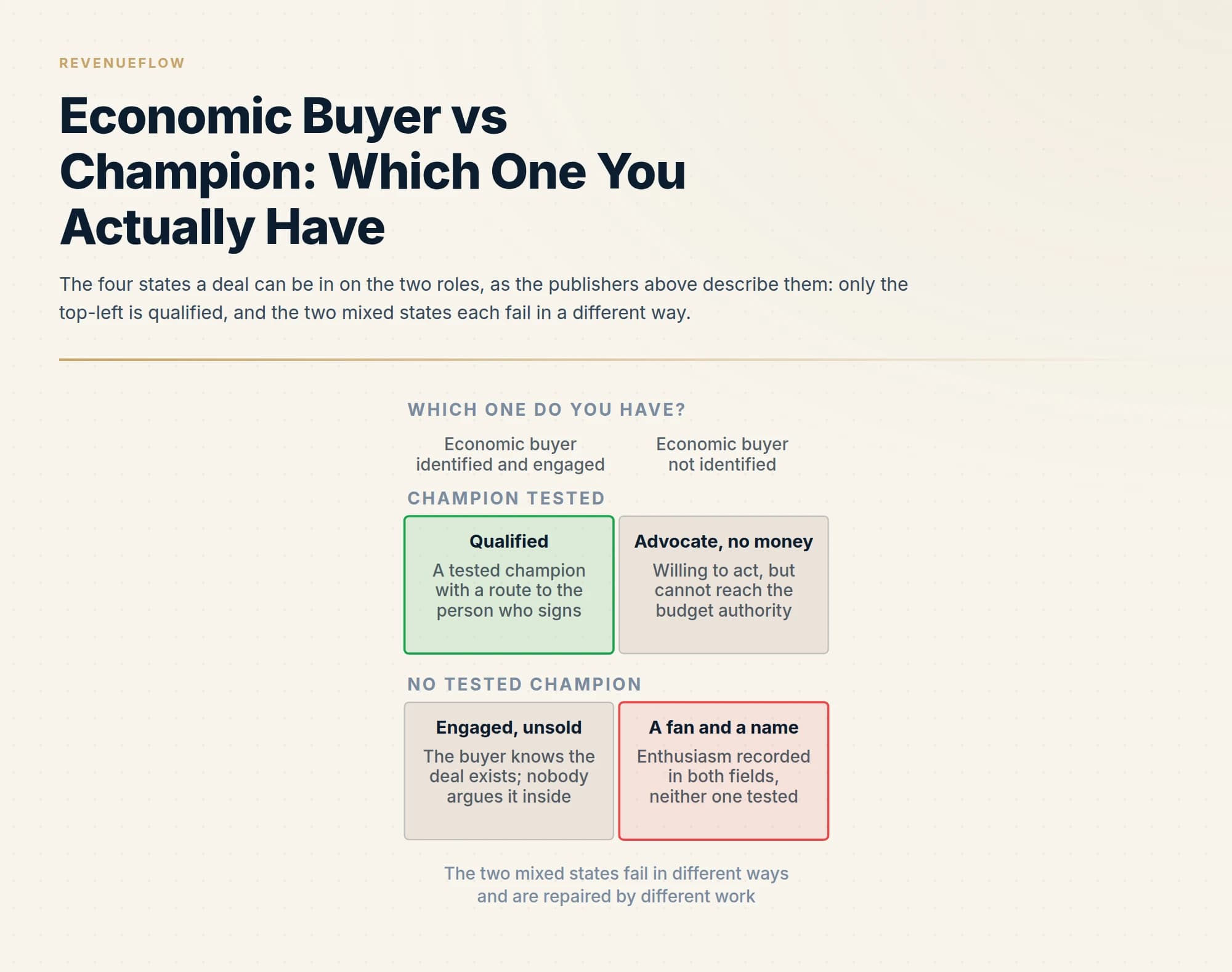
The two mixed states in the grid above fail differently, and Spotlight's answers to its own questions cover both. A deal with a champion and no identified economic buyer is unqualified whatever the champion's strength: "A deal without an identified Economic Buyer is not qualified." The post adds that it may still be won, and that the seller is operating without visibility into the most important approval in the cycle. A deal where the economic buyer has been identified and not engaged is the other half: "Identified but not engaged is a qualification gap that warrants a score reduction." and "The Economic Buyer knowing your deal exists is very different from them actively supporting it."; the post's rule is that the deal should not reach a commit forecast until the buyer's position is documented.
The repair for each is different work. The first is repaired by the introduction test, run through the champion; the second is repaired by a conversation in the economic buyer's own terms, which MEDDICC Ltd's page says are cost, time to value and how confident the team is in the initiative. Who the second contact in an account should be, and when, is the subject of multi-threading in sales, and the call where both roles first come into view is the discovery call.
Where our own practice differs
Both roles are established inside a conversation, and our work is producing that conversation: a first meeting with the right person at a company chosen in advance. Two positions follow from the doctrine above.
A meeting we book is qualified against criteria agreed in writing before launch, and being the economic buyer is never one of them. The person has real responsibility for the area the campaign is about, they agreed to a relevant business conversation, and they attended; budget, timing and authority are never conditions of a meeting having counted, because they are rarely knowable at a first conversation and the publishers above are clear that the economic buyer rarely identifies themselves. Which role the person turns out to hold is discovered on the call, not asserted by the campaign. The mechanics of reaching senior people in the first place are on finding and reaching decision makers.
And we do not manufacture a second contact from a first contact's silence. Our campaigns send one message per person, on one premise, and a later approach to a colleague is a separate campaign with a separate premise, never an escalation over a quiet champion's head; the reasoning is on the Agoge sequence. Covering distinct roles at the start of a pursuit is coverage; approaching the economic buyer because the champion stopped replying is pressure applied through a colleague, and it damages the champion the deal depends on.
The short version
The economic buyer, in MEDDICC Ltd's words, is the person with the overall authority in the buying decision, who can say yes when others say no; the champion is the person with power, influence and credibility inside the account who is willing and able to act for you. One is defined by authority over money and the other by willingness to act, and neither implies the other. They get confused four ways: a champion who claims the decision, a budget holder mistaken for the buyer, the most senior person in the room, and a fan recorded as a champion. Each role is proved by behaviour, and one move tests both: ask the champion to introduce you to the economic buyer. When one person holds both roles, record the deal as single-role and know it has one point of failure.
If the constraint is that too few of those first conversations exist for either role to be found, that is a supply question: a first campaign is where a client finds out who in their market will take the meeting.
Every quotation above is from the named page as fetched on 21 September 2026: MEDDICC Ltd's Economic Buyer and Champion element pages (undated) and its article on qualifying the economic buyer (published 28 November 2022, modified 27 May 2026); Spotlight (published 16 April 2026); MySalesCoach (published 9 June 2025); Salesmotion (published 30 September 2025, modified 11 June 2026); New Breed (published 4 March 2020, modified 25 March 2026). Publishers revise these pages; confirm the current text before relying on it.
Frequently asked questions.
Frequently asked questions- What is the difference between an economic buyer and a champion?
- The economic buyer is the person with overall authority over the purchase, who can say yes when others say no and veto the project regardless of the champion, in MEDDICC Ltd's definition. The champion is a person inside the account with power, influence and credibility who is willing and able to help the deal progress and sells internally on your behalf. One controls whether the purchase happens; the other works to make it happen.
- Can the champion and the economic buyer be the same person?
- Yes, and Spotlight says it happens especially in smaller organisations or when a senior executive initiates the purchase. Its advice is to record it explicitly as a single-role deal rather than assuming one person fills both functions, because the risk in a single-role deal is that losing that person kills the deal entirely. MEDDICC Ltd adds the opposite edge case, where the economic buyer is a committee or board.
- How do you test whether a contact is really the economic buyer?
- By what they have done rather than what they say. MEDDICC Ltd's criteria are veto power over the project, a primary objective tied to the organisation's goals, access to funds not attached to budgets, responsibility for profit and loss, and a place in the contractual sign-off. MySalesCoach's question is who had to approve the last comparable purchase; a contact who cannot describe that process is a red flag.
- How do you tell a champion from a fan?
- Spotlight's three tests are all about past acts: the contact has given you access to stakeholders or information you did not have, has advocated for you when you were not present with evidence of it, and has a personal business outcome tied to the purchase. A fan is enthusiastic and produces none of those. MEDDICC Ltd's one-move test is to ask for an introduction to the economic buyer; a champion can make it.
About the author.

B2B cold email experts helping companies generate qualified leads through done-for-you outreach campaigns.
RevenueFlow Team
Explore more.
Ready to scale your outreach?
We build GTM engines that book real meetings. See the receipts.
Related articles.
BANT vs MEDDPICC: Four Letters Onto Eight, From the Sources
BANT against MEDDPICC from the two artefacts behind them: IBM's own form and the MEDDPICC publisher's own mapping of four letters onto eight, and the deal each fits.
Lead Generation for IoT Companies: A B2B Playbook
Written for the IoT vendor, not the agency: who decides an IoT purchase, why the pilot is a pipeline stage, the dated regulatory clocks and shows to write against.
Sales Prospecting for Consulting Firms: Find the Event
Prospecting for a consulting firm: where triggers are published by practice, who inside the firm reads them, why alumni and referrals come first, when to skip it.
Physician Email Lists: The Row, Its Sources and Its Gaps
The anatomy of a physician email list: the six field groups, which CMS, AMA and state board records hold each, what vendors claim, the rules, and the order to verify.
Telemarketing Laws by State: 13 Statutes, Read
Thirteen states' own telemarketing statutes and agency pages, read first-hand: what each one keys on, and which of them reach a business to business call.
B2B Lead Lists for Utilities: Three Registries, One Gap
The anatomy of a utilities lead list: the EIA-861 census, PHMSA annual reports and SDWIS enumerate electric, gas and water utilities; vendors sell the field they lack.