Finding and Reaching Decision Makers in Outbound
In cold outbound the title on the record is the only evidence you have, and it is weak. How to select on accountability instead, and where coverage ends.

Select the person accountable for the area your message is about rather than filtering on a seniority band. Titles are not standardised, authority depends on the amount as well as the person, and senior titles delegate the work the message asks about. The contact list is therefore downstream of the premise, so two campaigns want two selections.
Key takeaways
- A title filter selects on a string that means different things at different companies, and it optimises for authority against proximity to the problem.
- Because the right contact depends on what the message says, the contact selection sits downstream of the premise and changes when the premise changes.
- A forward to the right person is the strongest outcome a message to the wrong person can produce, and whether it survives one is decided by how it is written.
- Covering distinct roles once each is coverage of a buying group; contacting a second person because the first went quiet is escalation, and the two are decided before the send.
Reviewed and updated October 1, 2026
Finding and Reaching Decision Makers in Outbound: When You Cannot Ask
A list is filtered to director level and above, enriched, verified and sent. The replies that come back are from a product manager, an operations lead and somebody whose title contains none of the words in the filter. Every one of them is closer to the problem than the people the filter selected.
That outcome is the ordinary result of the way most outbound lists are built, and it points at the thing that makes this problem different from qualification inside a live deal. In a conversation you can establish who approves what by asking how the last comparable purchase was approved. In cold outbound there is no conversation yet, so the only evidence on the record is a title, and a title is a weak predictor of both authority and interest.
The title is the weakest field you are relying on
Three properties make it unreliable, and they compound.
Titles are not standardised across companies. The same five words describe a person with budget at one organisation and a coordinator at another, and there is no registry that reconciles them. A filter written in title language is therefore selecting on a string rather than on a role.
Authority is a property of a person and an amount together. The person who signs a small commitment is frequently not the person who signs a large one at the same company, so a single seniority band cannot be right for every deal size you sell. That relationship, and why an org chart cannot settle it, is worked through in economic buyer.
And seniority moves inversely with proximity to the problem. The more senior the title, the more likely the person delegates the area entirely, which makes them harder to reach and less able to answer the specific question your message is asking. A list built on seniority alone optimises for the wrong end of that trade.
- Selects on a string that means different things per company
- Optimises for authority and against proximity to the problem
- Produces one list regardless of what the message is about
- Cannot tell a delegating title from an owning one
- Fails silently, because the non-replies look like non-interest
- Selects the person who gets asked about this specific area
- Changes with the premise, so two campaigns want two lists
- Accepts a lower title where the lower title owns the work
- Treats the approver as somebody the contact brings in later
- Fails visibly, because wrong-shape replies arrive early
Match the person to the premise, not to the org chart
The same question arrives as what titles to target in outreach, with the observation that titles differ by industry, and the premise test above is what survives that variation where a fixed title list does not.
Buyers ask what job titles and decision makers to target as though the answer were a list, and the answer is a test instead: the person who owns the premise you are writing about, which is frequently not the title the org chart nominates.
This is also the answer to the three questions buyers ask about seniority: whether meetings can be booked with senior decision makers, how to identify decision makers at scale, and whether to filter for the chief executive or the finance chief. Selecting a title band answers none of them. Selecting on accountability matched to the premise answers all three, and it scales because the premise is what does the selecting rather than a human reading each record.
The useful reframing is that outbound is not trying to reach the person who signs. It is trying to reach the person who would be embarrassed not to have an opinion about the thing in the message.
That person is identifiable from the premise itself. A message about a specific operational problem should go to whoever gets asked about it on a Tuesday, which is often a level or two below the approver and is reachable in a way the approver is not. A message about a strategic commitment goes higher, and it has to be written to survive being forwarded downward for an opinion.
Two consequences follow, and both are list-build decisions rather than copy decisions.
The first is that the contact list is downstream of the premise rather than upstream of it. If two campaigns carry two different premises, they want two different contact selections at the same companies, and building one list and pointing both campaigns at it discards the only mechanism you had for matching person to message.
The second is that a forward is a good outcome rather than a failure. The strongest thing a message to the wrong person can do is get passed to the right one with a sentence of endorsement attached, and whether it can do that is decided by how the message is written rather than by who received it. A message that only makes sense to somebody with budget cannot survive the forward. A message that names a problem clearly can.
Where the record came from changes what it is worth

The same title on two records can carry very different reliability, and the difference is provenance rather than accuracy at the moment of purchase.
Provenance also gets asked for directly by the recipient, and the answer that lives on the row exists only if it was recorded when the list was built.
A database record was accurate when it was collected, and contact data decays continuously as people change roles and companies. A self-maintained professional profile is current for the person and frequently aspirational about the scope. A company's own site is authoritative and covers only the small number of people it chooses to list. None of those is wrong; they age differently and they are wrong in different directions.
The practical rule is to treat employer as the field most likely to be stale and the most expensive to get wrong, because a message that names somebody's previous employer is not a near miss. It is evidence the sender did not check, delivered to somebody you wanted to impress. Verification immediately before the send, rather than at collection or at enrichment, is the step that catches it, along with the rest of the pipeline set out in list hygiene.
The work between an acquired name and a person worth writing to is real and usually unowned, which is the subject of lead prospecting. In a title-led build that work is skipped by construction, because the filter has already declared the question answered.
- Step 1Fix the premise first
One observation that is true of every company in the segment. Until this exists there is no way to say which role should receive it.
- Step 2Name the accountable role
Whoever gets asked about this area internally, described as a responsibility rather than as a title string.
- Step 3Resolve people against that role
Accept adjacent titles that carry the responsibility and reject matching titles that do not. This is judgement, and it is the step a filter cannot perform.
- Step 4Check the employer is current
The field most likely to be stale and the most expensive to get wrong. Verify close to the send rather than at collection.
- Step 5Decide coverage per company
One contact, or several distinct roles each written to on their own terms. Decide before the send rather than after the silence.
Coverage and escalation look similar and are not the same act
Teams who want to expand the list with multiple decision makers at the same account are choosing coverage, and the distinction above decides whether that reads as thoroughness or as pressure, because the same two messages can be either depending on what each one says.
Writing to more than one person at a company is where this gets uncomfortable, and the distinction that keeps it honest is decided before anything sends rather than in reaction to silence.
Covering distinct roles is legitimate. A finance lead, an operations lead and a technical lead are accountable for different things, and a message written for one of them genuinely is not the message another needs. Contacting each on their own terms, once, with a premise written for that person's own accountability, is coverage of a buying group and it reads as thoroughness.
Approaching a second person because the first went quiet is a different act. It uses a colleague as pressure, it is visible inside the company in a way the sender cannot see, and it costs the relationship it was trying to build. Our own outbound runs one message per campaign, sent once. That rule is what stops coverage from turning into escalation, because it removes the mechanism by which it would happen.
The same logic applies more strictly on LinkedIn, where a second message lands in the same thread directly beneath the one that was ignored, so it reads as a nudge whatever the campaign structure calls it. We do not send it.
Adding a second contact once a conversation exists is a different question again, governed by whether the deal needs a second perspective rather than by whether the first one replied, and it is covered in multi-threading in sales.
What to do when the right person genuinely cannot be reached
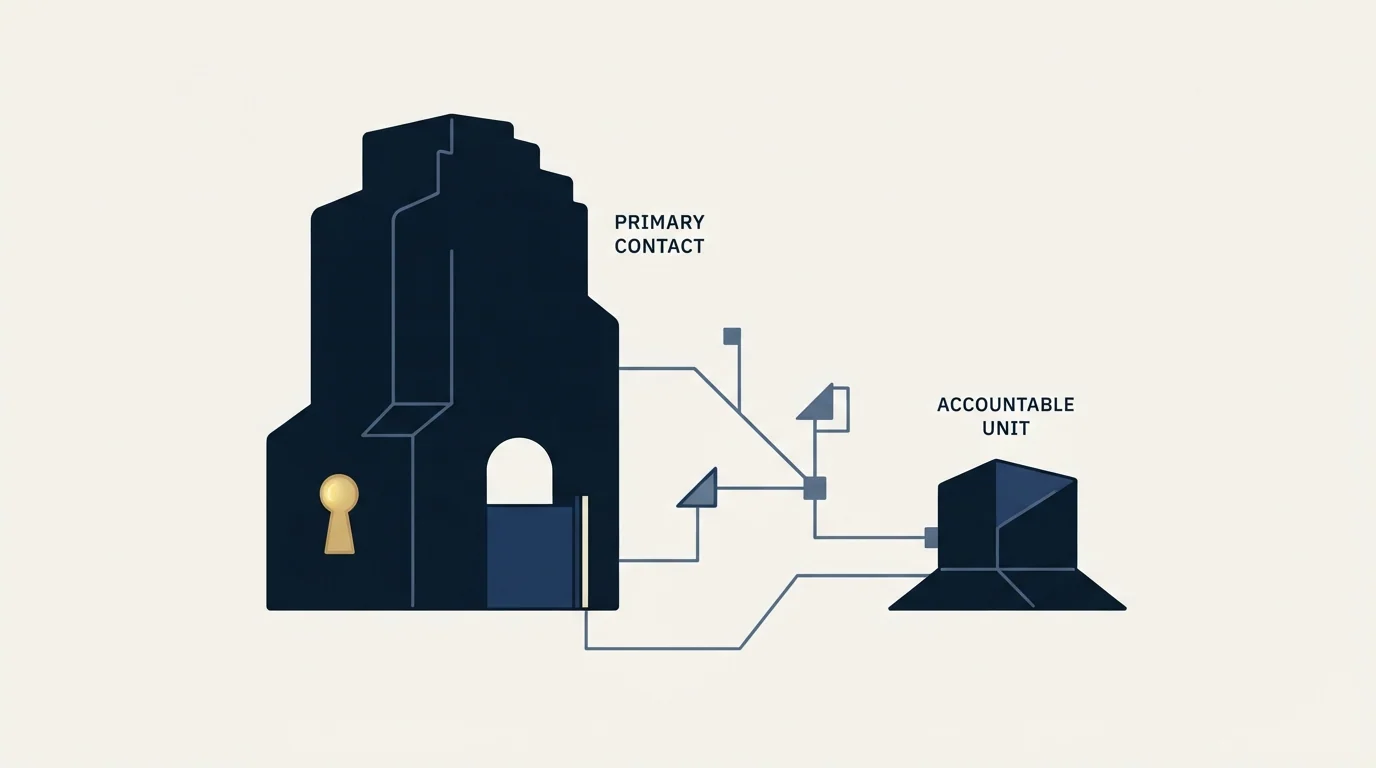
Some roles are structurally hard to reach cold, and pretending otherwise produces campaigns that send volume at people who will never answer.
The honest options are narrow. Write to the person who briefs them, with a message built to be forwarded. Wait for an event that changes the account and makes a specific conversation timely, which is the difference between a filter and a signal set out in B2B prospecting. Or accept that the account is reachable through a channel other than a cold message and stop spending outbound capacity on it.
What is not available is repeated contact. A person who did not answer a relevant message aimed at their own accountability is not going to answer the same message again, and the second attempt is charged to the sending infrastructure that every other campaign depends on.
The check that catches this before the send
- Yes: You can state the responsibility this person holds, not just their title
- Yes: The premise of the message is about that responsibility
- Yes: The employer on the record has been checked recently rather than at collection
- Yes: If they are not the approver, the message survives being forwarded to one
- Yes: Coverage of other roles at the company was decided before the send
- No: The contact was selected by a seniority filter and nothing else
- No: A second person will be contacted if this one does not reply
The first line is the one that does the work, and it is also the cheapest test available. If nobody can name the responsibility in one line, the list was built on a title string, and the reply rate that comes back will be read as a message problem for the rest of the quarter.
Sizing the effort honestly
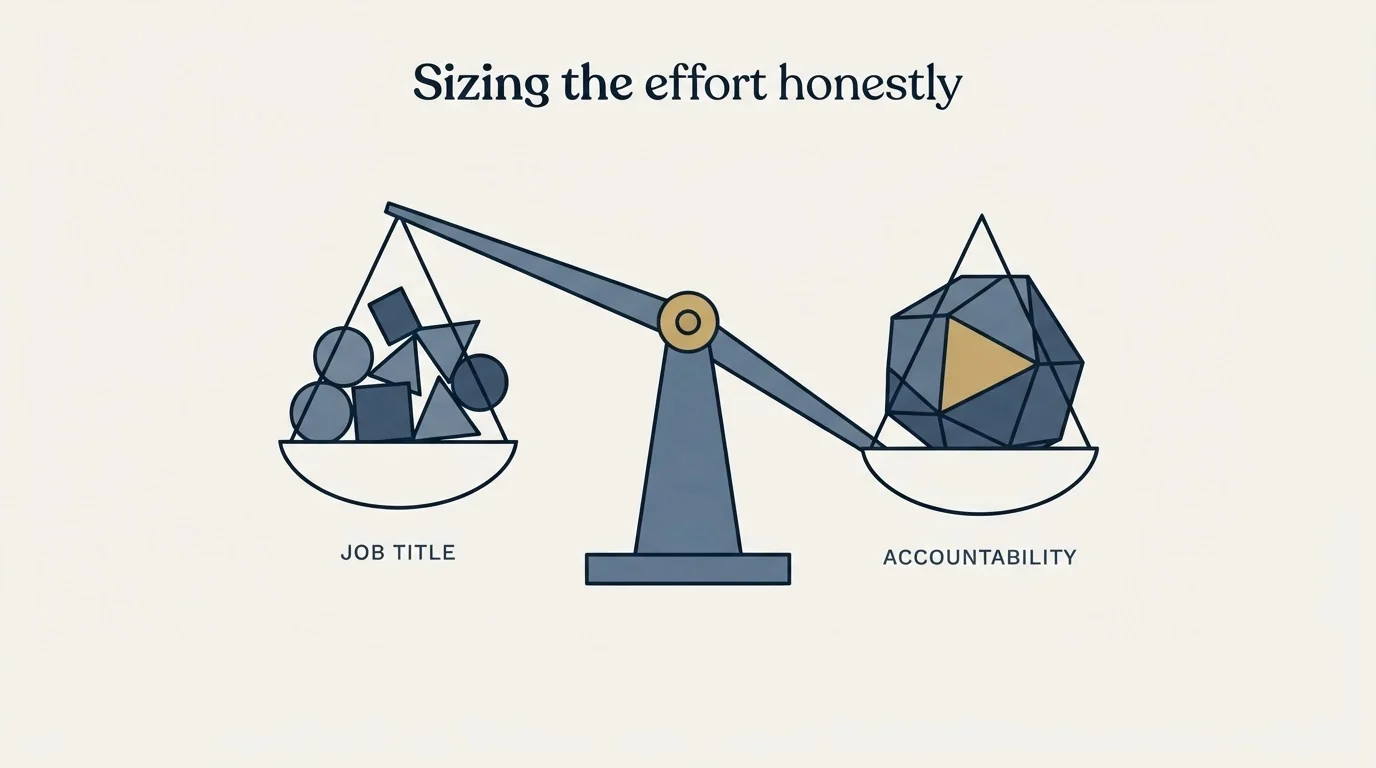
Accountability-led selection is more expensive per contact than a title filter, and that cost is the usual argument against it. The cost is real. The comparison that resolves it is not cost per contact but cost per contact who could plausibly answer, and a title filter that selects three wrong people for every right one has already spent the difference.
It also constrains list size, which is usually the objection dressed as a practicality. A narrower list is the intended outcome rather than a side effect, because the fit between person and premise is what the whole approach is buying. What that means for volume, and how a persona definition earns its place by changing what you send, is in buyer persona.
The short version
In cold outbound you cannot ask who decides, so the title on the record is the only evidence available and it is a weak one: titles are not standardised, authority depends on the amount as well as the person, and seniority moves inversely with proximity to the problem.
Select on accountability instead, matched to the premise of the specific message, which means the contact list is downstream of the premise and two campaigns want two selections. Accept adjacent titles that hold the responsibility and reject matching titles that do not. Treat a forward as a good outcome and write for it.
Verify the employer close to the send, because a stale employer is not a near miss. Decide coverage of multiple roles before anything sends, and never let it become a second approach to somebody who stayed quiet.
If you would rather see a list built against accountability and one message written to it, you can see what a first campaign looks like.
Frequently asked questions.
Frequently asked questions- How do you find the decision maker without being able to ask?
- Work from the premise backwards. Name the responsibility the message is about, then find whoever holds that responsibility, accepting adjacent titles that carry it and rejecting matching titles that do not. That is judgement rather than a filter, which is why a seniority band cannot do it, and it is the step most list builds skip entirely.
- Should I target the most senior person I can find?
- Rarely, because seniority moves inversely with proximity to the problem. The more senior the title, the more likely the area is delegated, which makes the person both harder to reach and less able to answer the specific question. Aim at whoever gets asked about the area internally, and write so the message survives being passed upward.
- Is it acceptable to contact several people at the same company?
- Yes when they hold genuinely distinct responsibilities and each receives a message written for their own accountability, once. That is coverage of a buying group. Contacting a second person because the first did not reply is a different act, it is visible inside the company, and it uses a colleague as pressure. Decide which you are doing before the send.
- What is the most common data error on a decision-maker list?
- A stale employer. Contact data decays continuously as people change roles and companies, and a message naming somebody's previous employer is not a near miss. It is evidence to the reader that nobody checked. Verify immediately before the send rather than at collection or enrichment, because the pass that matters is the one closest to sending.
About the author.

B2B cold email experts helping companies generate qualified leads through done-for-you outreach campaigns.
RevenueFlow Team
Explore more.
Ready to scale your outreach?
We build GTM engines that book real meetings. See the receipts.
Related articles.
Appointment Setting for Business Brokers: The Seller Meeting
What a bought meeting with a business owner has to be for a brokerage: the three-part qualification, the confidentiality rules, the licence line and the owner's reasons.
SDR Outsourcing for Business Brokers: The Fee Timing
Whether a success-fee brokerage should rent sales development at all: the fee timing, the texts that limit what an outside person may say about value, and who signs.
SDR Outsourcing for Logistics Companies: The Brokerage Line
What an outside sales development team may do in a freight company's name, the calling and email rules it inherits, and which arrangement survives a bid-shaped market.
LinkedIn Outreach for Banks: A Regulated Message
How a bank's relationship managers use LinkedIn to reach business owners: what the FFIEC guidance, FINRA's notices and LinkedIn's own rules require, and where to stop.
Cold Calling for PPC Agencies: What You Can See First
A paid media prospect is partly readable before the call and has already been told by the platform what to do when a stranger rings about its ads.
SDR Outsourcing for Financial Services: The Third Party
What a bank, broker-dealer, adviser or agency's regulators say about an outside team that speaks for it, the licensed line, and which arrangement survives due diligence.