List Hygiene: What It Means and Why the Textbook Definition Misleads
List hygiene keeps an email list accurate as the population underneath it changes: verify immediately before sending, suppress every bounce and opt-out permanently, re-verify anything that has aged, and handle accept-all and role addresses by a written rule. Bounce and complaint rates are list properties first.
Key takeaways
- Verification is a moment, not a durable property: the result decays from the day it was run.
- A clean list is not an interested one; hygiene prevents damage rather than creating demand.
- Bounce rate is a lagging indicator, and file age is available before anything is sent.
- Verification cannot detect spam traps, and it removes the population traps are drawn from.
List hygiene is the ongoing practice of keeping an email list accurate: verifying addresses before they are used, removing the ones that fail, honouring every bounce and opt-out permanently, and re-checking the whole thing as it ages. It exists because a list is a snapshot of a population that changes continuously, and the gap between the snapshot and reality is paid for in bounces, in sender reputation, and eventually in placement.
The word "hygiene" suggests tidiness, which sells it short. Every signal that governs whether your mail reaches an inbox is downstream of who is on the list. Bounce rate, complaint rate and trap exposure are all list properties before they are deliverability properties, and no amount of work on authentication or copy compensates for a list that has stopped being true.
Email hygiene is the same practice under a different name, and where the two phrases are distinguished at all it is only to separate this list-side work from housekeeping inside a sender's own mailbox.
What the practice actually consists of
Verification before sending. A verification pass checks that an address is syntactically valid, that its domain resolves and accepts mail, and, where the receiving server allows it, that the specific mailbox exists. It is the cheapest intervention available and the one with the largest effect on bounce rate.
Bounce processing. A hard bounce is a receiving server telling you an address is dead. Writing that address to a suppression list every future campaign checks is what turns the instruction into a permanent change rather than a line in a report.
Opt-out and complaint handling. Both are permanent removals, and both carry obligations. The FTC's CAN-SPAM compliance guide requires an opt-out to be honoured within 10 business days, with the mechanism working for at least 30 days after a message is sent, and states plainly that the law makes no exception for business-to-business email.
Re-verification with age. Contact data decays continuously as people change roles and companies. A file verified six months ago and sent today has drifted, and the drifted portion is exactly the population that produces hard bounces and, later, recycled trap hits.
Deciding what to do with the ambiguous rows. Accept-all domains answer yes to every address, so verification returns an inconclusive result rather than a verdict. Role addresses are valid and have no individual owner. Neither is automatically wrong to keep, and both need a decision made deliberately rather than by default.
- Step 1Verify
Check syntax, domain and mailbox immediately before the send, not months earlier.
- Step 2Send
Contact only rows that passed, with ambiguous categories handled by an explicit rule.
- Step 3Process
Convert every hard bounce, complaint and opt-out into a permanent suppression entry.
- Step 4Age out
Re-verify anything old enough to have drifted before it is used again.
Where the textbook definition misleads
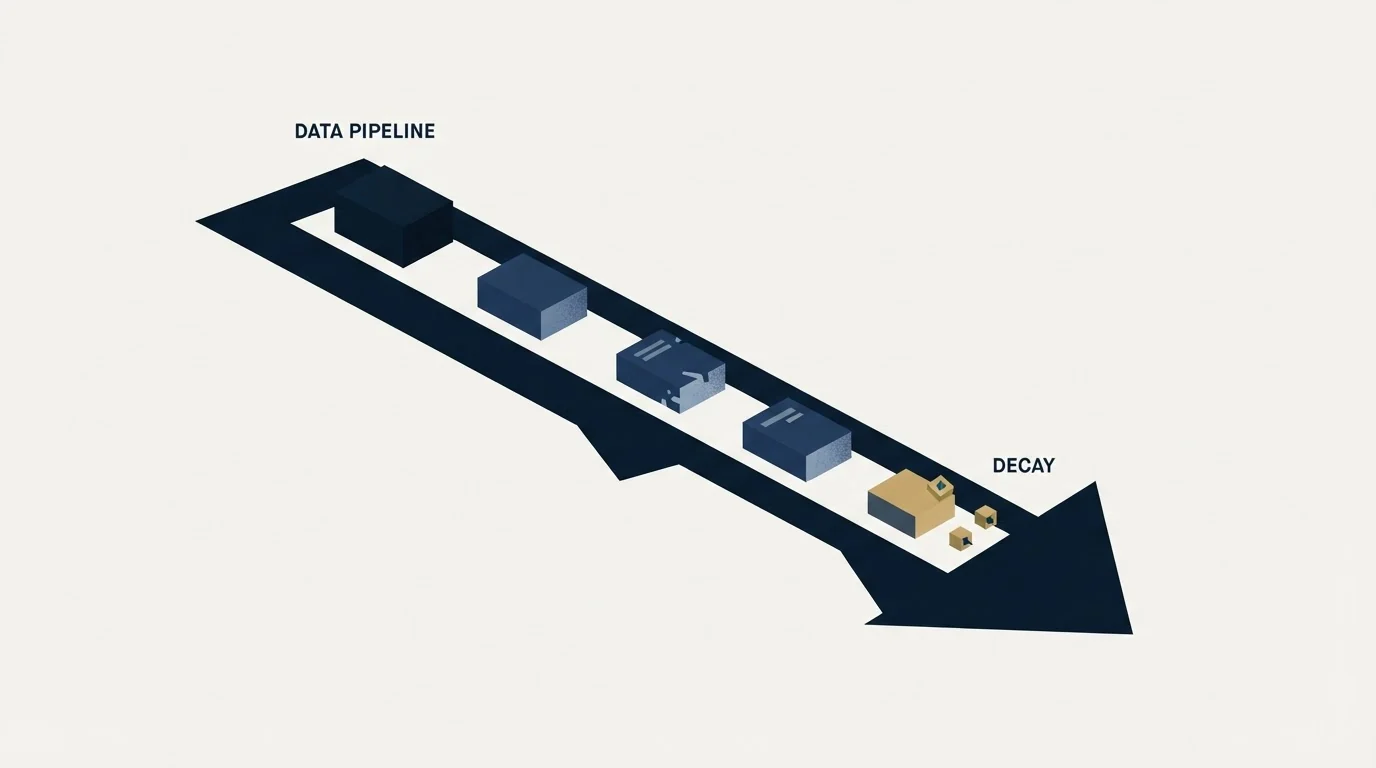
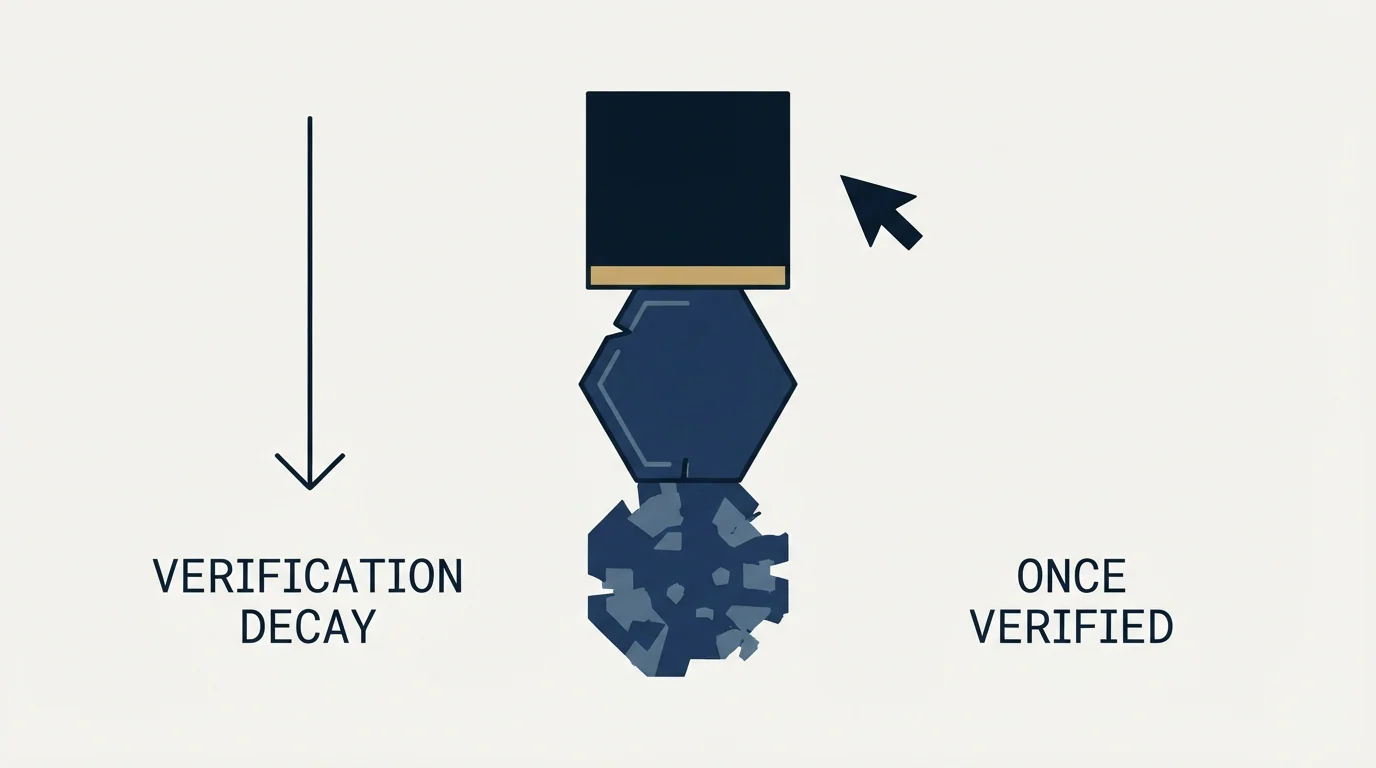
Verification is a moment, not a state. An address is not verified; it was verified, at a time. The result is a claim about a mailbox on a particular day, and its value decays from that day forward. Treating a verification result as a durable property of a row is the single most common hygiene mistake, and it is why the same file gets sent repeatedly with worsening bounce rates.
Clean does not mean interested. A perfectly verified list of people who have no use for what you sell will bounce at a healthy rate and generate complaints anyway. Hygiene protects against a class of damage; it says nothing about whether the audience was worth contacting.
Bounce rate is a lagging indicator of a problem that started earlier. By the time the bounce rate on a campaign is visibly elevated, the sends that caused the reputation damage are already made. The leading indicator is the verification result and the file's age, both available before anything is sent.
A verification pass cannot see traps. No service can, because trap addresses are secret by design. What verification does is remove invalid and abandoned addresses, which is where recycled traps come from, so it reduces exposure without ever detecting one. Any product claiming to detect traps is describing something else.
A verification service reports on the mailbox, not on the person. A valid result means mail will be accepted at that address today. It does not mean the person still holds the role you sourced them for, still works there, or ever did. Role accuracy decays on its own schedule, faster than deliverability does in most markets, and it is the failure that produces a delivered message aimed at somebody who left eighteen months ago.
Deduplication is part of it, and it is not only about waste. The same person appears twice under two employers, or twice under a personal and a work address. Contacting them twice in one programme reads as carelessness to the recipient, whatever it does to the numbers.
Hygiene is a property of the process, not of the file. A cleaned file degrades the moment it is set aside. What keeps a programme healthy is the pipeline that verifies close to send, suppresses on receipt, and re-verifies on age, running whether or not anybody is paying attention to it.
- Verification removes invalid and dead addresses
- Suppression check removes anyone previously excluded
- Deduplication prevents contacting one person twice
- Domain checks drop parked and expired organisations
- Hard bounces become permanent suppression entries
- Complaints become permanent suppression entries
- Opt-outs are honoured within the legal window
- Bounce patterns are read by receiving platform, not averaged
What this means when you are running outbound

The economics are worth stating because they decide the argument. Verification costs a fraction of a cent per address. A degraded sending domain costs the time of every campaign that runs on it afterwards, and reputation recovers over weeks rather than days. The cheap step protects the expensive asset, which makes skipping it to save on verification credits one of the worse trades available.
Verify immediately before the send. Not at collection, not at enrichment, and not when the file was purchased. The pass that matters is the one closest to the moment the messages leave.
Make suppression automatic. Bounce processing that depends on a person exporting a report is bounce processing that will lapse. The pipeline should write entries without anybody deciding to.
Set an explicit age limit. Pick a number of months after which a file is re-verified rather than reused, and enforce it in the build rather than in a habit. The number matters less than having one.
Decide the ambiguous categories in advance. Write down what happens to accept-all domains and to role addresses, per programme, and apply it consistently. A rule you can state is auditable; a judgment made per campaign is not.
Where hygiene meets the rest of the programme
Two connections are worth making explicit, because teams often treat these as separate workstreams and then wonder why fixing one does not help.
The first is that hygiene and sender reputation are the same problem observed at different points. Reputation is built largely from bounces, complaints and engagement, and all three are functions of who is on the list. A programme with a strong hygiene pipeline is doing reputation management whether or not anybody calls it that, and a programme without one cannot fix its reputation by any other means, because the damage arrives faster than it heals.
The second is that shared infrastructure spreads the cost. Where several campaigns run on the same sending domains and mailboxes, a single unverified file damages an asset that everything else depends on, and the other campaigns experience it as an unexplained decline. That is the argument for the standard being uniform rather than proportionate to a campaign's importance: the cost of a lapse does not land on the campaign that caused it.
Reading a bad batch correctly
When a file comes back with a high failure rate, the useful question is which stage failed, because the answers point in opposite directions. A high invalid rate on a freshly sourced file suggests the sourcing method is generating addresses rather than finding them. A high invalid rate on an old file suggests ordinary decay and nothing more sinister. A high inconclusive rate usually means the population is concentrated on accept-all domains, which is a property of the industry rather than a defect in the file.
The mistake to avoid is reading an aggregate rate without checking what it was computed over. A rate calculated only on rows that survived an earlier filter describes the survivors, and if that earlier filter rejected almost everything, the surviving rate can look excellent while the batch is unusable. Check the denominator before you read the percentage, and confirm the number of rows that actually reached the stage you are measuring.
- Yes: Verification runs immediately before the send
- Yes: Hard bounces are written to suppression automatically
- Yes: Opt-outs and complaints are permanent and honoured inside the legal window
- Yes: An explicit age limit forces re-verification of older files
- Yes: Accept-all and role addresses have a written, consistent rule
- No: Reusing a file cleaned months ago because it was cleaned once
The short version
List hygiene is the pipeline that keeps a list true as the world underneath it changes: verify late, suppress permanently, re-verify on age, and decide the ambiguous cases by a written rule rather than in the moment. None of those steps is difficult, and every one of them is the sort of thing that lapses quietly when it lives in somebody's routine rather than in the build.
It is unglamorous and it is upstream of nearly everything else in deliverability. A clean list makes authentication and domain warmup worth doing, because those investments accrue to a domain that is not being damaged faster than it can recover. A dirty list makes them irrelevant. If your bounce rate is drifting upward across campaigns, that is the hygiene pipeline reporting a fault, and verification tooling is where the fix starts rather than a deliverability audit.
RevenueFlow builds and verifies its own lists, and runs cold email and LinkedIn campaigns for B2B teams on infrastructure we monitor ourselves. See how a campaign is put together.
Regulatory requirements verified as of mid-2026 against the FTC's published CAN-SPAM guidance. Verify current obligations with counsel and with the source before relying on them.
Frequently asked questions.
Frequently asked questions- How often should I re-verify an email list?
- Set an explicit age limit and enforce it in the build rather than as a habit. Contact data decays continuously as people change roles and companies, so a file verified months ago and sent today has drifted, and the drifted portion is exactly what produces hard bounces. The specific number matters less than having one.
- When in the process should verification run?
- Immediately before the send. Not at collection, not at enrichment, and not when the file was purchased. The pass that matters is the one closest to the moment messages leave, because everything between the check and the send is time for the answer to stop being true.
- What should I do with catch-all domains and role addresses?
- Decide in advance and apply it consistently. Accept-all domains answer yes to every address, so verification returns an inconclusive result rather than a verdict. Role addresses are valid and have no individual owner. Neither is automatically wrong to keep, and a written rule is auditable where a per-campaign judgment is not.
- Why is my verification failure rate suddenly high?
- Check which stage failed, because the answers point in opposite directions. A high invalid rate on a fresh file suggests the sourcing method is generating addresses rather than finding them. On an old file it is ordinary decay. A high inconclusive rate usually means the population sits on accept-all domains, which is an industry property.