Go-to-Market Playbook: Five Fields That Make a Play Runnable
A playbook is a set of plays, and a play is a trigger, entry criteria, a written premise, an owner with a volume, and an expiry date.
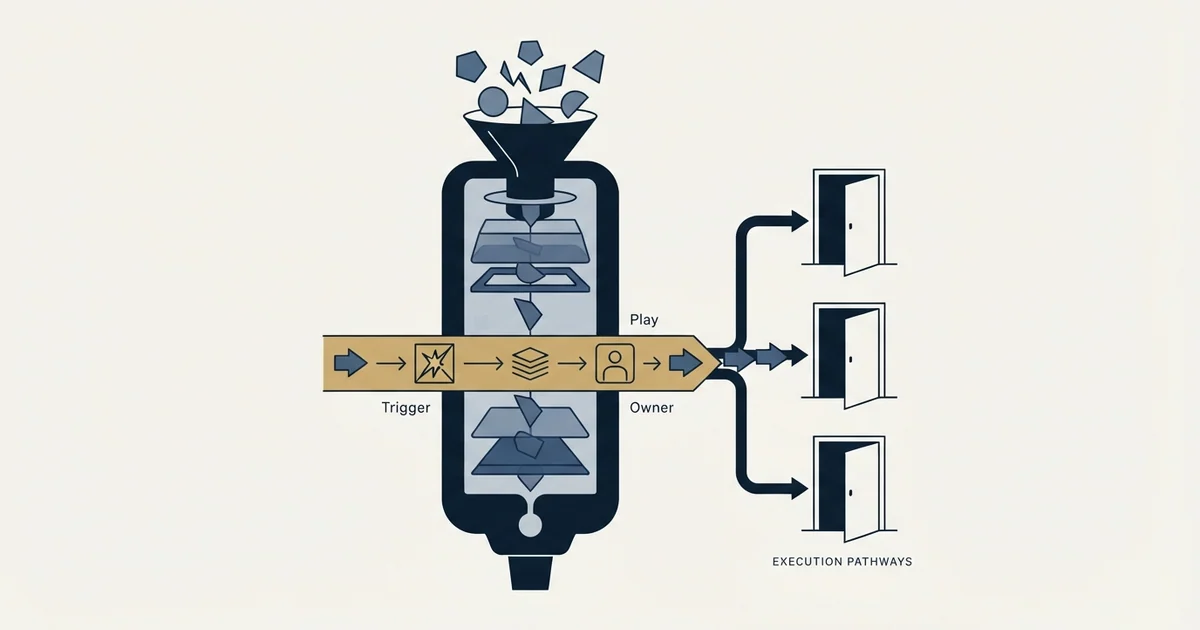
A go-to-market playbook is a set of plays. Each play carries five fields: an observable trigger, entry criteria including disqualifiers, a premise written as one sentence, one owner with a weekly volume, and an exit with an expiry date. A collection of documents organised by type answers a different question.
Key takeaways
- The trigger is what separates a play from a segment. A segment is a group of companies; a play is a group of companies plus a dated, observable reason to write today.
- Run fewer plays than you want to. Below a certain volume a play produces an unreadable result rather than a smaller one, and the team then files a judgement call as evidence.
- Take triggers from the closed-won pattern of the last twenty accounts, entry criteria from the losses, and treat detectable market events as the easiest source to over-read.
- Test every play by handover before it enters the rotation. Each question the new person asks names a field that is not finished.
Reviewed and updated September 22, 2026
Ask a revenue team for the go-to-market playbook and what usually arrives is a folder: a positioning deck, three case studies, an objection sheet, a pricing one-pager and a link to the CRM guide. Every document in it is real work. None of it tells a person what to do on Monday with the forty accounts in front of them, which is the thing a playbook is supposed to settle.
A playbook is not a library. It is a set of plays, and a play is a specific, repeatable motion with a trigger that starts it, criteria that decide who is in it, a message, an owner and a condition under which it ends. The document is the container. The play is the unit, and a playbook with no plays in it is an archive with an ambitious name.
A GTM playbook is that library of plays and nothing else, so a folder of decks filed under the name is an asset kit wearing a playbook label.
What a play in a go-to-market playbook contains
Five fields, and a play is unusable when any one of them is missing.
The observable, dated event that puts an account into the play: a funding round, a new executive in a named seat, a hiring pattern.
What else has to be true: size band, geography, relationship status, and the disqualifiers that keep customers and live deals out.
The premise as one written sentence, true of every account the trigger admits, in the buyer's own words.
One name, and how many accounts a week the play can carry. A play with three owners has none.
What ends an account's part in the play, and the date the play itself is reviewed.
The trigger field is what separates a play from a segment. A segment is a group of companies. A play is a group of companies plus a reason to write today, and the reason is the part that decays. A hiring signal from four months ago is history, and a play built on it is contacting people about a situation that has already resolved.
A channel strategy is the same decision one level up, naming which routes carry the plays at all, and a playbook built before that decision produces plays with nowhere agreed to run them.
Why the folder version fails
The asset library and the play library look similar from a distance because both are collections of documents. They fail differently, and the failure of the library is the one that goes unnoticed for longer.
| Asset kit | Play library | |
|---|---|---|
| Organised by | Document type | Trigger |
| Size | Grows on request, never retires | Capped at what the team can run |
| Ownership | No owner, no date | One owner, a weekly volume |
| Use | Read | Run on a schedule |
| Can be wrong | Never | Each play has a stopping figure |
| Reviewed | When the drive is reorganised | On its own expiry date |
The kit is never wrong, which sounds like a strength. Nothing in it makes a claim specific enough to be contradicted by a quarter, so nothing in it ever gets removed, and the collection grows until search across it degrades and people rebuild what they need from memory. A play library has the opposite property: each play asserts that a particular trigger predicts a particular problem, and the quarter can settle that.
How many plays a team should run
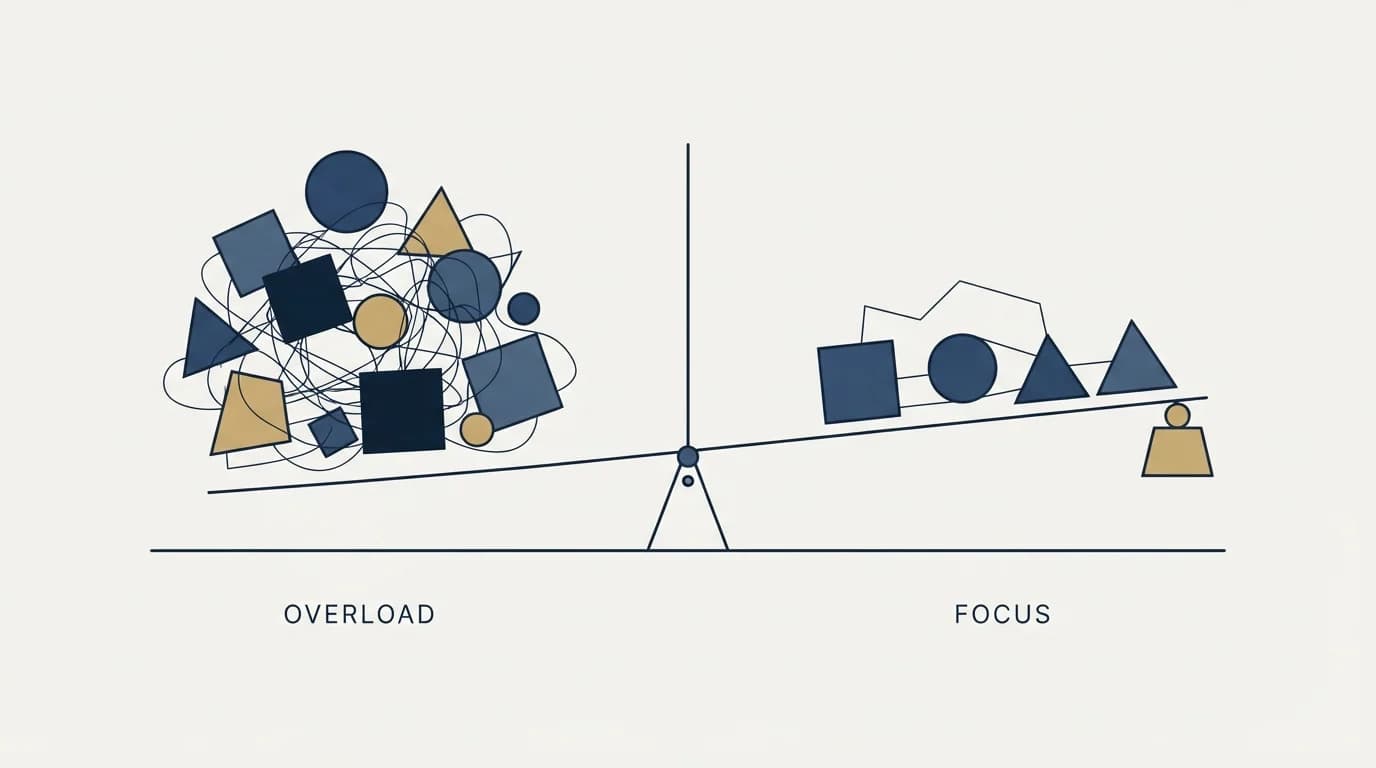
Fewer than it wants to. The constraint is not creativity, it is that every play consumes the same scarce resources: list-building attention, sending capacity, and the reply handling that follows.
Three plays running at a volume where their results are readable beat nine plays running below that threshold. Below a certain volume a play does not produce a smaller version of its result, it produces an unreadable one, and the team then makes a judgement call and files it as evidence. The number of accounts a play needs before its reply counts mean anything is a function of your own rates, and the arithmetic for it is the same funnel arithmetic that sizes a campaign, covered with the counts shown in the ideal customer profile guide.
A practical ceiling for most teams is one play per owner, plus one experiment. When a fourth idea arrives, it goes in a queue behind an expiry date rather than into the rotation, and the honest version of adding a play is naming which existing play it replaces.
Where the plays come from
Three sources, in descending order of reliability.
Closed-won pattern. Take the last twenty accounts that bought and ask what was happening at each of them in the ninety days before the first conversation. Where a situation repeats, that is a trigger with evidence behind it. This source is the most reliable and the most often skipped, because it requires reading deals rather than inventing plays.
Closed-lost pattern, inverted. Losses tell you the entry criteria, which is the field most plays get wrong. An account that reached a meeting and died on a constraint that was visible from outside should have been excluded by the play rather than discovered by a person.
Observable market events. Funding, leadership changes, hiring, expansion, regulatory dates, competitor moves. These are the easiest triggers to detect and the easiest to over-read, because a detectable event is not the same as a predictive one. What various signal types genuinely predict, and which decay fastest, is set out in the B2B intent data guide.
The distinction underneath all three is between a filter and a signal, which is the highest-leverage idea in prospecting and is covered directly in B2B prospecting.
Writing the play so somebody else can run it
The test is handover. Give the play to a person who was not in the room and ask them to produce this week's list and the first message. If they come back with questions, the play is a description rather than an instruction, and every question they ask names a field that is not finished.
Two failure modes account for most of the questions. The trigger is stated in a form nobody can check, so membership becomes a judgement call that drifts week by week. And the message is stated as a theme rather than a sentence, so each person writing from it produces a different premise and the play stops being one play.
It is a play when
- Someone outside the team can build this week's list
- The trigger is observable and dated
- The premise is one written sentence
- One owner, a weekly volume, an expiry date
It is still a description when
- Membership is a judgement call
- The premise is a theme
- Disqualifiers miss customers and live deals
- Nobody owns it, or three people do
What a quarter of plays looks like

Plays interact through shared capacity, which is the part a play-by-play view hides. Three things have to be true across the set rather than within any one of them.
No account sits in two plays at once. Two plays running through overlapping lists is how one person receives two different pitches in a week, and it is invisible from inside either play. The suppression rule is that an account belongs to exactly one live play, with the tie broken by whichever trigger is more recent.
The plays do not all peak together. Triggers arrive at different rates. A funding-round play produces a trickle and a hiring-signal play can produce a flood the week a segment starts scaling, and if both are owned by the same person at the same volume, the flood week is the week the trickle stops being worked.
One slot is reserved for the experiment. A rotation with no room for a new play produces a team that stops generating them, and the closed-won pattern that supplies the good triggers keeps moving. The experiment slot exists to be wrong cheaply, which means it carries the same five fields and a shorter expiry.
The failure that these three prevent is the common one where a playbook is technically current, every play is defensible on its own, and the quarter still produces an unreadable result because the plays were competing for the same capacity and the same accounts.
It is also why a borrowed list of GTM plays is worth less than it looks. A play is portable as a shape and not as a trigger, because the trigger that earned its place came out of somebody else's closed-won pattern and their capacity. Read another team's plays for the shape, then derive your own triggers from your own last twenty wins.
The retirement rule
The habit that keeps a playbook usable is retirement, and it needs to be mechanical rather than discretionary. Every play carries a review date. On that date the play either produces its numbers and continues, or it stops. A play that is kept because removing it would feel like giving up is a play that will still be there next year, consuming capacity that the closed-won pattern has since pointed somewhere else.
Retirement also protects the thing a playbook is for, which is that the same motion runs the same way twice so its result means something. A library that only ever grows loses that property, because the plays at the bottom of it are being run occasionally by whoever remembers them, in slightly different forms, producing results nobody can compare.
Where we differ from standard practice

The single-channel version of all of this, written out as an operating model rather than as a framework, is the outbound sales playbook. One thing in it is ours rather than the market's and it changes how plays are constructed.
We run one message per campaign. No bumps, no thread replies, no scheduled second attempt inside the campaign. When an account stays quiet and there are no new accounts left to reach, it can be approached again later in a separate campaign that re-sends the same message, never as a reminder underneath the original and never as a rewritten angle. In play terms, a play ends at the send. A genuinely new reason to write, because something changed at the account, is a different play with its own trigger rather than position two of the same one.
The cost of that policy is fewer touches per account, which pushes the work into the trigger and the premise. The full argument for the policy, including what it costs us, is in why we stopped using follow-ups. Where the sourcing is what is missing rather than the plan, RevenueFlow builds and runs the outbound engine and is paid only for meetings that are actually attended. See if you qualify.
The short version
A go-to-market playbook is a set of plays, and a play is a trigger, entry criteria, a written premise, one owner with a weekly volume, and an exit with an expiry date. A collection of documents organised by type is an asset kit, which is a useful thing that answers a different question.
Run fewer plays than you want to, because a play below its readable volume produces a judgement call rather than a result. Take triggers from your closed-won pattern first, entry criteria from your losses, and treat detectable market events as the easiest source to over-read.
Test every play by handover before it enters the rotation, and retire on a date rather than on a feeling. The decisions the plays inherit, including who is in the target set at all, belong on the one page that a go-to-market strategy produces.
Frequently asked questions.
Frequently asked questions- What belongs in a go-to-market playbook?
- Plays, each with a trigger, entry criteria, a written premise, one owner with a weekly volume, and an exit with an expiry date. Positioning decks, case studies and objection sheets are useful assets, but a folder of them cannot be run, which is why teams holding one still have no answer to what happens on Monday.
- How many plays should a team run at once?
- A practical ceiling for most teams is one play per owner plus one experiment slot. Every play consumes the same scarce resources: list-building attention, sending capacity and reply handling. Three plays running at a readable volume beat nine running below the threshold where their reply counts mean anything.
- How do you know a play has stopped working?
- Give each play a review date and a stopping figure when it is written. On the date, the play either produces its numbers and continues or it stops. Triggers decay, so a play kept because removing it would feel like giving up will still be consuming capacity a year later.
- Can two plays target the same account?
- They should not. An account belongs to exactly one live play, with the tie broken by whichever trigger is more recent. Two plays running through overlapping lists is how one person receives two different pitches in a week, and the collision is invisible from inside either play.
About the author.

B2B cold email experts helping companies generate qualified leads through done-for-you outreach campaigns.
RevenueFlow Team
Explore more.
Ready to scale your outreach?
We build GTM engines that book real meetings. See the receipts.
Related articles.
Appointment Setting for Business Brokers: The Seller Meeting
What a bought meeting with a business owner has to be for a brokerage: the three-part qualification, the confidentiality rules, the licence line and the owner's reasons.
Win Rate Benchmarks: Which Figures State a Population
A catalogue of the published average sales win rates, sorted by whether the page names the population behind its own number. Most do not.
LinkedIn Outreach for Banks: A Regulated Message
How a bank's relationship managers use LinkedIn to reach business owners: what the FFIEC guidance, FINRA's notices and LinkedIn's own rules require, and where to stop.
Sales Kickoff Agendas: Five Published, Session by Session
Five publishers print a sales kickoff agenda. They agree on four blocks and disagree on session length, rehearsal and where the agenda comes from.
SDR Outsourcing for Logistics Companies: The Brokerage Line
What an outside sales development team may do in a freight company's name, the calling and email rules it inherits, and which arrangement survives a bid-shaped market.
SDR Outsourcing for Business Brokers: The Fee Timing
Whether a success-fee brokerage should rent sales development at all: the fee timing, the texts that limit what an outside person may say about value, and who signs.