Outside Sales Rep vs Inside Rep: What the Split Decides
Desk against field stopped describing the two roles once buyers went remote. Three differences survived, and they decide coverage per account rather than per seller.
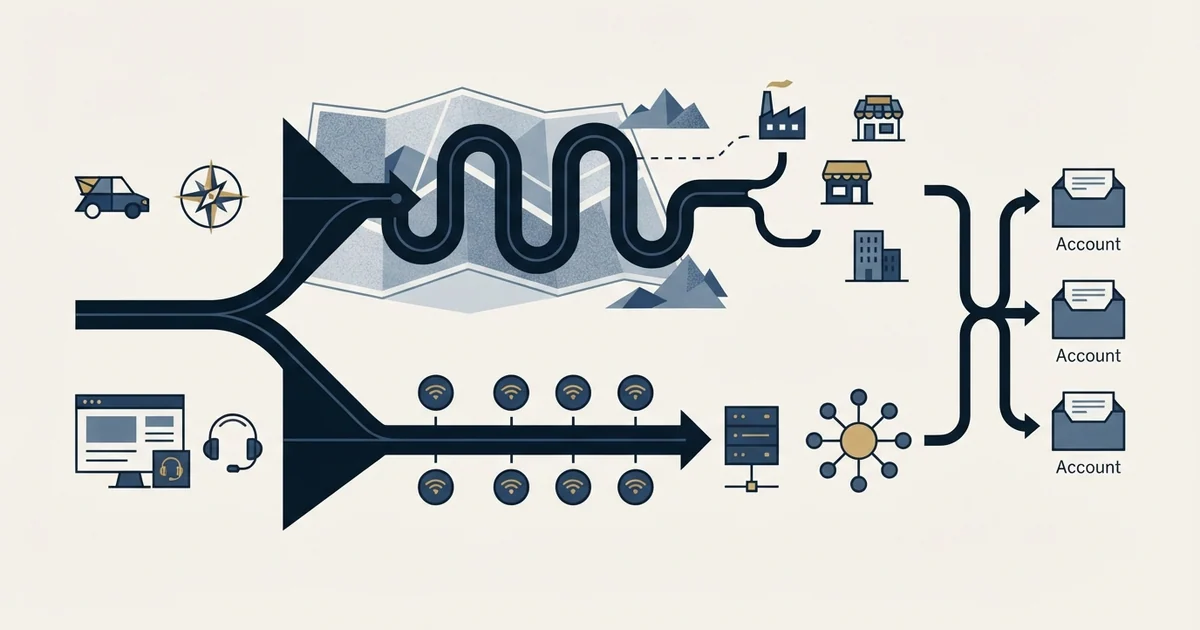
The desk against field description no longer separates the roles, because most field selling now happens remotely. Three differences survived: the time cost of a visit against a call, whether the decision involves a committee whose disagreements surface only in a room, and whether the market expects to be visited at all.
Key takeaways
- A visit consumes a half day once travel is counted honestly, and consumes it whether the meeting goes well or badly. That ratio against a one-hour call is the entire economics of the choice.
- The real driver of field coverage is how many people have to agree and whether their disagreements will surface in a scheduled call, not deal size, which is only a proxy for it.
- Treat the choice as a coverage decision per account rather than a role decision per seller, with the condition for travel written down before it is booked.
- Both titles now cover several different jobs. Ask what the seller owns at the end of the cycle and who fills their calendar, because those separate roles more reliably than the labels.
Reviewed and updated September 1, 2026
The standard answer is that an outside sales rep travels to the customer and an inside sales rep works from a desk. That was a useful distinction when it described two genuinely different working weeks. It stopped predicting very much once buyers started taking the meeting by video whether or not anyone offered to fly, and the job boards have not caught up: the same duties now appear under both titles at companies in the same industry.
The split still decides real things, and the things it decides are worth separating from the things it no longer does. What follows is the version that survives, and how to use it when deciding who covers which accounts.
What is inside sales, in the sense the question is usually meant, is the half of this pairing defined by not travelling, and what is considered inside sales has widened so far since the labels were coined that the definition below is the part that still predicts anything.
An inside sales CRM is not a separate product category, it is an ordinary CRM chosen for a desk-based team, so the selection question is the general one about fit, adoption and what the record has to support.
What the labels were built to describe
The original division was about where the selling happened, because where it happened determined almost everything else. Field selling meant travel, a territory drawn on a map, a small number of accounts, long cycles and relationships maintained in person. Inside selling meant a phone, a much larger account list, shorter cycles and smaller deals, and it existed largely to serve the accounts that could not justify a visit.
Two changes hollowed that out. Buyers became comfortable running an entire evaluation without meeting anybody, so the visit stopped being the price of a serious conversation. And the tooling that made a remote seller productive, meaning the dialer, the CRM, the sending tools and the conferencing, became the tooling every seller uses. The result is that a field rep today spends most of the week doing what an inside rep does, and travels for the small number of moments where being in the room changes the outcome.
The three differences that survived
Cost per conversation, which is a time cost before it is a money one. A visit consumes a half day at minimum once travel is counted honestly, and a bad one consumes it just as thoroughly as a good one. A remote meeting consumes the hour it takes. That ratio is the entire economics of the choice, and it means field coverage is only rational where the value of being present exceeds the several conversations the same time would otherwise buy.
Deal complexity, and specifically how many people have to agree. Remote selling is efficient at reaching individuals and poor at reading a room. Where a decision involves a group whose members disagree with each other, and where the disagreement is not going to surface in a scheduled call, physical presence still produces information nothing else does. That is a property of the buying committee rather than of the deal size, although the two correlate enough that deal size gets used as the proxy.
Where a committee's disagreement shapes the room, the definition of a buyer persona clarifies what each stakeholder in that meeting actually needs to hear.
What the buyer expects. In some markets an unvisited supplier reads as an uncommitted one, and no amount of efficiency argument changes the perception. Manufacturing, industrial distribution, medical devices and much of the public sector still work this way. In most software markets the expectation runs the other way, and offering to fly out reads as slightly odd.
RFP in sales explains why frozen requirements, a restricted question window and an uncountable competitive field change how a committee purchase gets won.
- Many accounts, short cycles, high meeting volume
- Strong on reach, speed and repeatability
- Weak on multi-party rooms and unspoken objections
- Scales by adding sellers or improving conversion
- Few accounts, long cycles, low meeting volume
- Strong on complex committees and entrenched incumbents
- Weak on coverage breadth and on speed of iteration
- Scales by adding territory, which adds travel
- Remote by default, in person at decision moments
- Coverage designed per account rather than per title
- Requires a written trigger for when travel is warranted
- Fails when the trigger is left to the seller's preference
The arithmetic that decides coverage
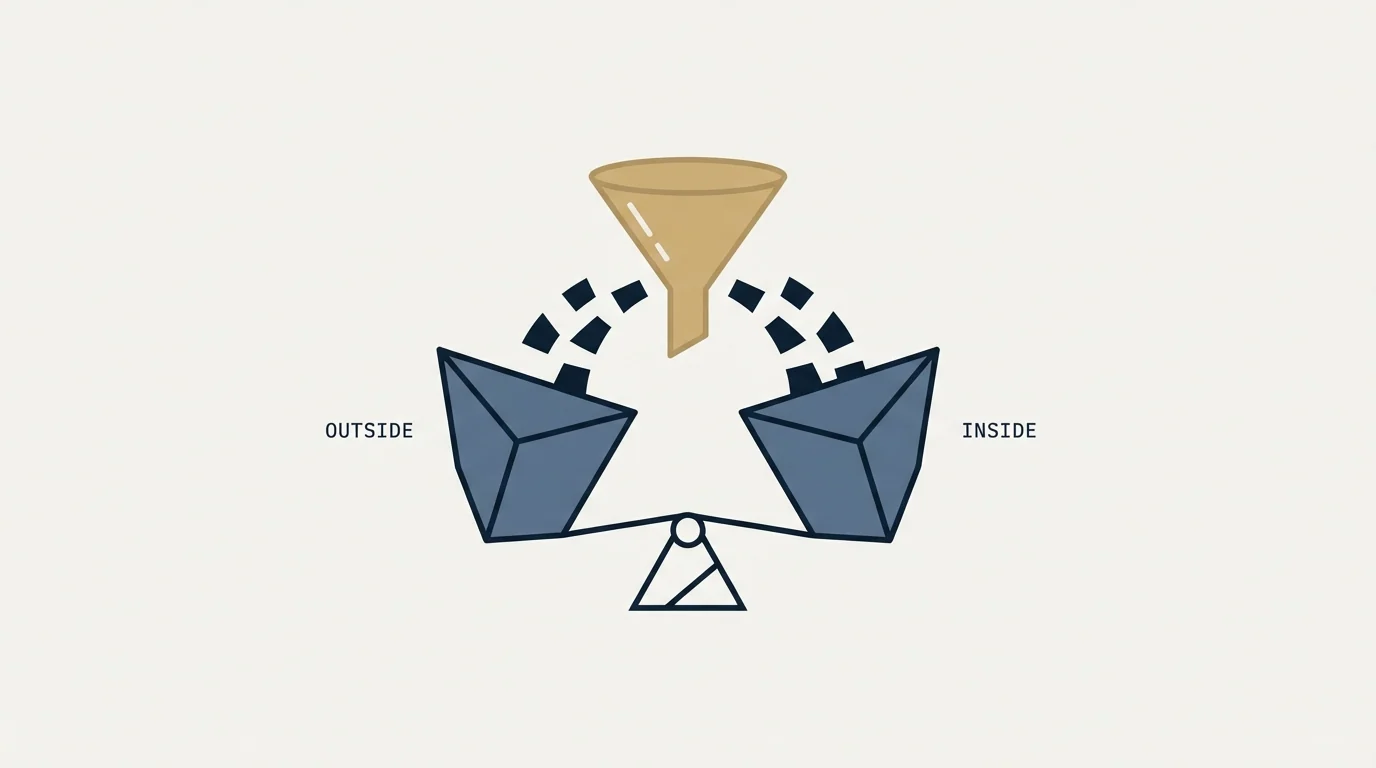
The comparison people reach for is compensation, and it is the wrong one, because the difference in salary between the two roles is small next to the difference in how many conversations each can hold.
The following figures are invented for the example and describe no real company. Suppose a field seller can hold six substantive meetings in a week once travel is accounted for, and a remote seller can hold eighteen. Over a quarter that is roughly seventy-eight conversations against two hundred and thirty-four. For the field model to produce the same outcome, each of its conversations has to be worth three of the other kind, in win rate, in deal size, or in some combination of the two.
Sometimes it genuinely is. A committee that will only assemble for a visitor, an incumbent relationship that only breaks in person, a technical evaluation that needs the product on site: these are real, and in those situations the three-to-one hurdle is cleared comfortably. What does not clear it is travelling because the account is important, which is the reason field time is most often spent.
Illustrative figure, field against remote
What a field meeting must be worth to break even
Consumed whether the meeting goes well or badly
The practical use of that hurdle is as a test applied per account rather than per seller. Write down what has to be true for a visit to be worth the three conversations it displaces, and the coverage model designs itself. Left undefined, travel allocates itself to the accounts a seller enjoys visiting, which correlates with relationship comfort rather than with revenue.
The hunter and farmer split is the same kind of coverage decision drawn along a different axis, new logos against existing accounts rather than field against desk, and it is worked through in what the hunter and farmer split decides.
Titles, and why they mislead when hiring
Neither title tells you much about the work any more, which matters most when reading a job description or writing one.
An inside sales role can mean a seller who runs full cycles remotely, an account manager who farms existing customers, or a prospecting seat that books meetings for somebody else. Those are three different jobs with three different skill profiles, and the third is closer to a sales development representative than to either of the others. An outside sales role can mean a field seller running complex cycles or a territory manager whose week is service visits and reordering.
The reliable questions are what the seller is responsible for at the end of the cycle, how many accounts they hold, and who generates the conversations. That last one separates roles more cleanly than the inside and outside labels do, because a seller expected to fill their own calendar and a seller handed meetings are doing different jobs regardless of where they sit.
Read that way, inside sales strategies are coverage decisions rather than a separate discipline, and the three questions above decide more about a remote seller's week than any tooling choice does.
Writing the travel trigger down
The hybrid model is what almost every team actually runs and almost none of them defines, which is why it produces inconsistent results from apparently similar sellers.
A workable trigger has three parts. A condition that has to be met before travel is booked, stated in terms of the deal rather than the account: a named second stakeholder has agreed to attend, or a technical evaluation requires the product on site, or an incumbent relationship has been identified and the buyer has agreed to discuss it. A cap on how much field time exists in a month, so the trigger is rationed rather than aspirational. And a note, written afterwards, of what the visit produced that a call would not have. That last part is the one everybody skips and the one that makes the rule improve over a year, because it turns each trip into evidence about which conditions are worth the displacement.
Teams that adopt a trigger usually find field time falls and its yield rises, and they usually find the biggest single category of eliminated travel was visits to the accounts the seller already had the strongest relationship with. Those visits feel productive, which is exactly why they survive an undefined policy.
Moving a seller between the models
The two roles look adjacent enough that companies move people between them casually, and the transitions fail in opposite directions.
A field seller moved to remote coverage inherits a much larger account list and usually keeps working it like a small one. The instinct is to research every account deeply before contact, which was correct when the patch held a few dozen accounts and becomes a coverage failure when it holds several hundred. The retraining is about triage and pace rather than about selling.
A remote seller moved to the field inherits a small list and a long cycle, and the pattern that failed is the opposite one: they keep the volume habit, chase activity across the patch, and never build the depth with a committee that the model exists to provide. Both transitions take a quarter and both are usually diagnosed as a motivation problem when they are a pacing problem.
Where the conversations come from is the same problem either way
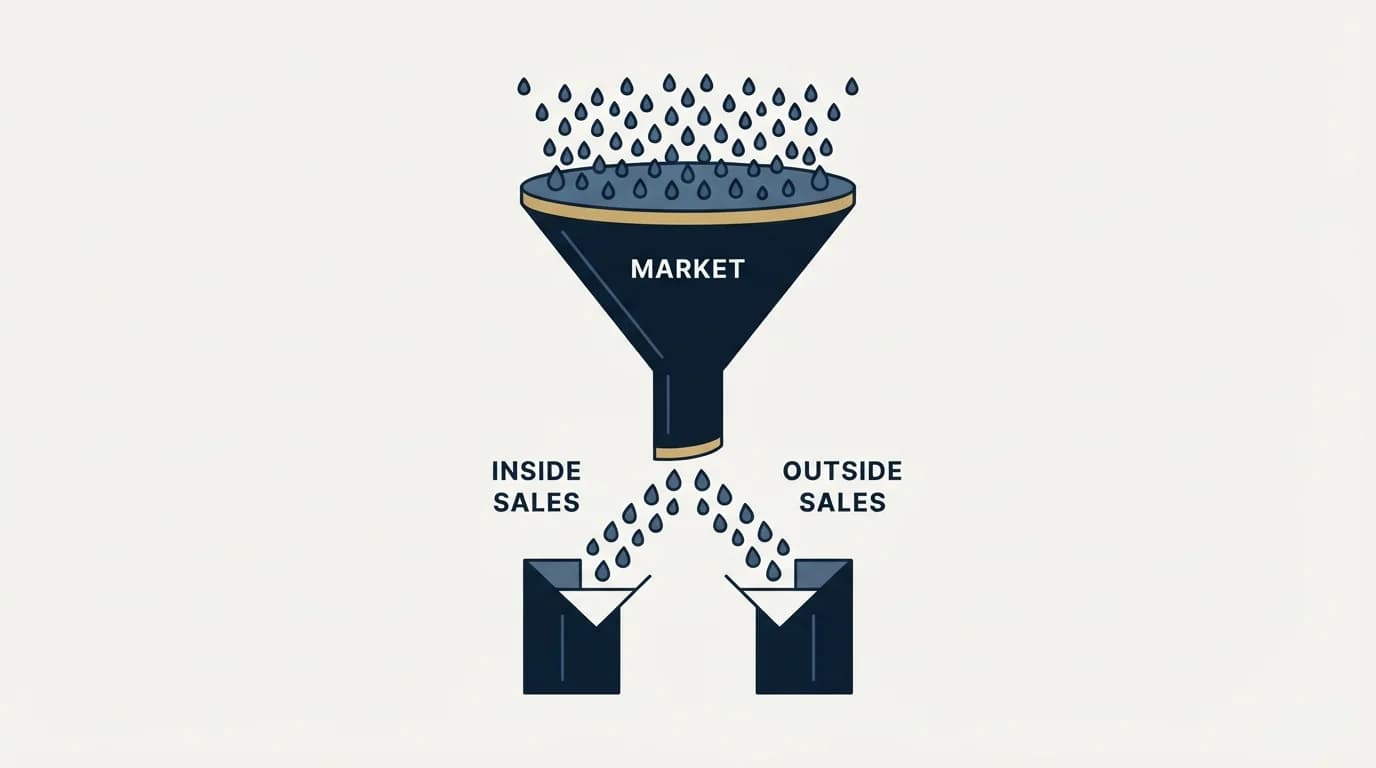
Both models depend on a supply of qualified conversations, and neither creates that supply as a by-product of good selling.
The field model is more exposed to this, because a small number of accounts and a long cycle leave very little room to absorb a bad quarter of demand. The remote model hides it for longer, since a seller with a large list can always find more calls to make, which is precisely how a demand problem gets diagnosed as an effort problem. In both cases the honest first question is whether the constraint is the number of qualified conversations reaching the team or what happens inside them, and the two want opposite responses. Where the answer is supply, the choice between building a development function and buying its output is arithmetic rather than preference, and it is worked through in outsourced SDR versus in-house. Appointment setting compared with lead generation covers what you are actually buying when the answer is supply, and running discovery so that it disqualifies well covers the other half.
Our own practice is stated in the same terms wherever it appears on this site. Campaigns carry exactly one message, with no bumps and no thread replies, so a further approach is a new campaign with a new angle rather than a follow-up under the first. Meetings are qualified against criteria agreed in writing before launch, which keeps the definition settled before anybody has a result to argue about.
The short version
The desk-versus-field description no longer separates the two roles, because most field selling now happens remotely and travels only for specific moments. Three differences survived: the time cost of a visit against a call, whether the decision involves a committee whose disagreements surface only in a room, and whether the market expects to be visited.
Treat the choice as a coverage decision made per account rather than a role decision made per seller. The test is whether a visit is worth the several conversations it displaces, written down in advance so that travel does not allocate itself by preference. Read job titles carefully, because both labels now cover several genuinely different jobs, and ask what the seller owns at the end of the cycle and who fills their calendar.
Where the constraint is the supply of qualified conversations rather than the coverage model, neither answer fixes it: see what a first campaign produces.
Frequently asked questions.
Frequently asked questions- What is the difference between an inside sales rep and an outside sales rep?
- Originally where the selling happened, which determined account count, cycle length and deal size. After remote selling became normal, what survives is the time cost of travel, whether the buying decision involves a committee that only assembles in person, and whether the market treats an unvisited supplier as an uncommitted one.
- Is outside sales still worth it?
- Where the account genuinely needs it. A field seller holds far fewer conversations per week than a remote one, so each field meeting has to be worth several remote ones in win rate or deal size. Committees that will only assemble for a visitor and entrenched incumbent relationships clear that hurdle. Visiting because an account feels important does not.
- Which pays more, inside or outside sales?
- Compensation is the comparison most people reach for and the least useful one, because the difference in pay between the two is small next to the difference in how many conversations each can hold. Design the coverage model on that second gap, then set compensation to fit it rather than the other way round.
- How do you decide which accounts get field coverage?
- Write a trigger with three parts: a condition stated in terms of the deal rather than the account, a monthly cap so field time is rationed, and a note afterwards recording what the visit produced that a call would not have. Left undefined, travel allocates itself to the accounts a seller already knows best.
About the author.

B2B cold email experts helping companies generate qualified leads through done-for-you outreach campaigns.
RevenueFlow Team
Explore more.
Ready to scale your outreach?
We build GTM engines that book real meetings. See the receipts.
Related articles.
Appointment Setting for Business Brokers: The Seller Meeting
What a bought meeting with a business owner has to be for a brokerage: the three-part qualification, the confidentiality rules, the licence line and the owner's reasons.
SDR Outsourcing for Logistics Companies: The Brokerage Line
What an outside sales development team may do in a freight company's name, the calling and email rules it inherits, and which arrangement survives a bid-shaped market.
SDR Outsourcing for Business Brokers: The Fee Timing
Whether a success-fee brokerage should rent sales development at all: the fee timing, the texts that limit what an outside person may say about value, and who signs.
LinkedIn Outreach for Banks: A Regulated Message
How a bank's relationship managers use LinkedIn to reach business owners: what the FFIEC guidance, FINRA's notices and LinkedIn's own rules require, and where to stop.
LinkedIn Lead Generation for Financial Services Firms
A LinkedIn message from a regulated firm is a communication the rulebook already defines, and the definition turns on how many people receive it within thirty days.
Cold Calling for PPC Agencies: What You Can See First
A paid media prospect is partly readable before the call and has already been told by the platform what to do when a stranger rings about its ads.