The B2B Sales Process: When Nobody Can Decide Alone
A process that works for one signer falls over when four people have to agree. What changes, which checks the committee forces, and where the process starts.
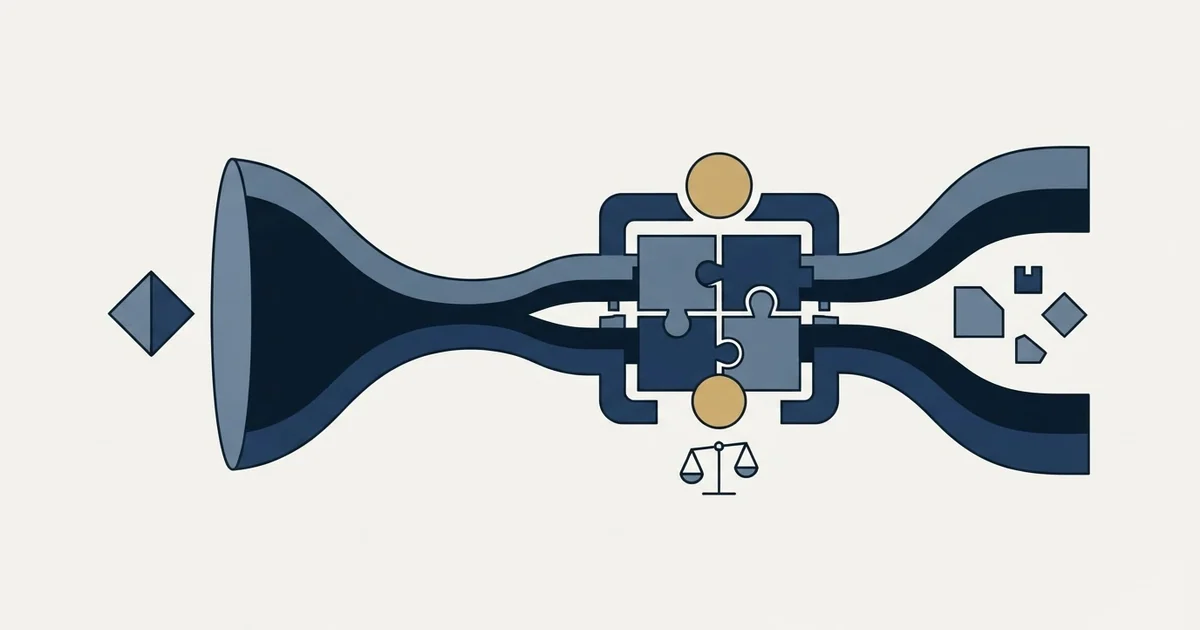
A B2B sales process is built around the fact that several people must agree and most of the deciding happens without the seller present. Its shape is set by how many people must agree, whether the money crosses an approval threshold, and what breaks if the buyer switches.
Key takeaways
- Three properties of the purchase set the shape of a B2B process: the number of people who must agree, whether the spend crosses an approval threshold, and the switching cost.
- At least one step needs an exit criterion that cannot be satisfied by the first contact alone, or the process cannot tell a supported deal from a friendly conversation.
- The route from a verbal yes to a signature is a separate process with its own owners and queues, and it is answerable in week two rather than week ten.
- The entry point is a definition rather than a fact: an acceptance test against criteria written down before anyone was contacted, with rejections recorded against a fixed list.
Reviewed and updated August 28, 2026
A process that works beautifully for a purchase one person can approve tends to fall apart on the first deal that needs four people to agree. Nothing obvious breaks. The meetings still happen, the demo still lands, the proposal still goes out, and then the deal sits for two months while a conversation the seller is not part of decides whether it happens at all.
That is the whole difference between a generic sales process and a business to business one. A B2B sales process has to work when the decision is made by several people at different times, most of it while nobody from your company is in the room. Every design choice worth making follows from that single fact.
Published B2B sales examples usually illustrate the transaction rather than the process, a supplier selling materials to a manufacturer or software to an operations team, and the shape those examples share is the one above, several people agreeing at different moments with most of it out of the seller's sight.
A complex sales process is this same purchase named from the buying side: several people have to agree, the money crosses an approval threshold, and a formal evaluation sits between interest and signature.
Three properties of the purchase, and none of them is the seller
Most of the variation between B2B processes is explained by three properties of what is being bought. They are worth establishing before designing anything, because they decide how many steps the process needs and how long it will take.
How many people have to agree. This is the dominant term. A decision one person can make moves at the speed of that person. A decision requiring four moves at the speed of the slowest calendar, and each additional participant adds more delay than any technique removes. The group is rarely a formal committee, which is part of why it is underestimated. The buying committee is the term for the people whose agreement the deal actually needs.
Whether the money crosses a threshold. Every organisation has approval bands, and crossing one adds a review, a signature or a procurement process. A deal priced slightly above a threshold can take twice as long as the same deal priced slightly below it, which is occasionally a reason to change what gets proposed.
What breaks if they switch. Selling into an empty slot is a shorter conversation than displacing something already embedded, because migration, retraining and risk are all borne by the buyer. Their caution scales with what stops working if the change goes badly.
A fourth thing worth knowing is which stage of their own journey the buyer has reached, and buyer journey stages sets out what a seller can and cannot see of that from outside.
- Meetings held and who attended
- Questions asked on those calls
- Documents sent and opened
- Stated timelines and stated budgets
- The champion's confidence
- An internal conversation comparing this against two other priorities
- A finance view of what the money displaces
- A technical or security opinion formed from a questionnaire
- The cost of the last vendor decision that went wrong
- Whether anyone wants to own the change
The champion is doing the selling you cannot do
Since the deciding conversation happens internally, the person arguing for you in it matters more than any technique applied to the calls you attend. That person is usually not the economic buyer, and treating the two as interchangeable is the most common expensive error in B2B selling.
A sales champion has a stake in the outcome and the standing to spend credibility on it. An enthusiast has neither, and the difference is invisible on a call, since both are pleasant, engaged and encouraging. The distinguishing test is behavioural rather than attitudinal: a champion introduces you to people, tells you what the internal objection is, and warns you about the process. An enthusiast agrees with you and then goes quiet.
The practical implication for the process is that at least one step has to have an exit criterion involving somebody other than your original contact. If a deal can reach the proposal stage having only ever produced evidence from one person, the process is unable to distinguish a well-supported deal from a friendly conversation. The economic buyer is the specific check most frameworks add for this reason.
The route from yes to money is a separate process
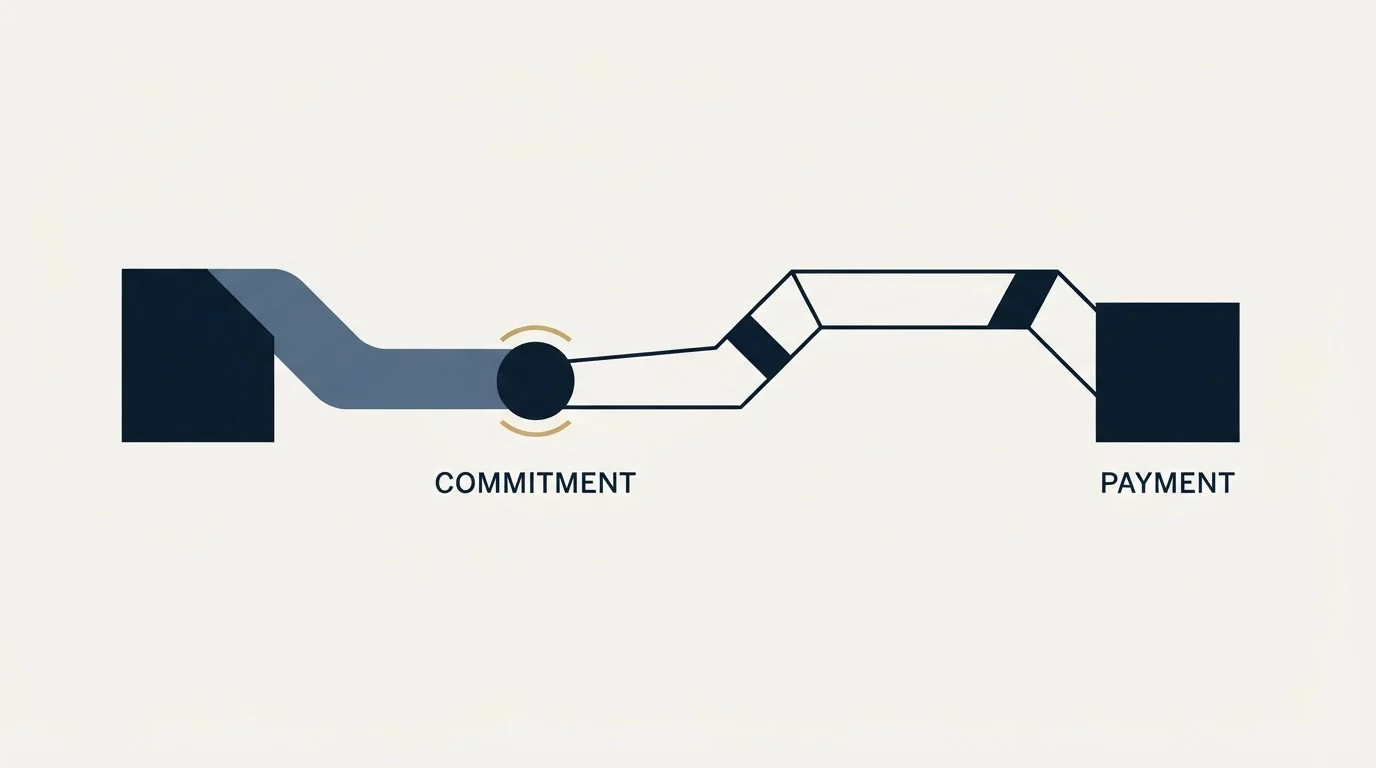
The second thing a B2B process needs that a simpler one does not is a map of the administrative path between agreement and payment. Security review, vendor onboarding, procurement thresholds, legal redlines, data processing agreements, purchase order creation and the internal signature chain each have an owner, a queue and a typical duration, and none of them appears in a demonstration.
Deals lost to this are not lost. They slip, which is worse for planning because they stay in the forecast. The fix is unglamorous and cheap: ask in week two rather than week ten, ask the owner of each gate rather than only the champion, and ask what happened on the buyer's most recent comparable purchase, since people describe a past process readily and commit to a future one reluctantly. MEDDPICC is the framework that made this a named check, and its paper-process letter exists because of exactly this failure.
That is also why the honest answer to how long a qualified lead takes to become cash is longer than the sales cycle: the administrative path runs after the yes, and invoicing and payment terms run after that again.
Where the process starts, and why it is a definition
In most B2B companies the people who create conversations and the people who close them are different, so the process needs a defined entry point rather than an assumed one.
- Step 1Targeting
Who is worth contacting, decided against a written profile rather than by whichever data was available
- Step 2Conversation agreed
A specific person agreed to a specific business conversation
- Step 3Meeting held
They attended and participated, which is the first event only the buyer can produce
- Step 4Accepted
The account meets criteria written down before the campaign started, and sales takes the deal on
- Step 5Rejected
Recorded against a reason from a fixed list, and the distribution of reasons is read as a targeting instruction
The acceptance test is where the arguments live, because the two sides are measured on opposite quantities. Whoever generates the meetings is measured on how many, and whoever receives them is measured on what closes. When the criteria are not agreed in advance, the bar moves with whichever number is short that quarter and neither side can prove anything. The boundary two teams negotiate covers what the acceptance step asserts, and the profile the criteria come from is the same one the targeting uses, which is worked through in building an ICP with the arithmetic attached.
Our own commercial position is a version of this rule made contractual. A meeting counts when the company matches the audience agreed in writing before launch, the person has genuine responsibility for the area, they agreed to a relevant business conversation and they attended. Budget, timing and authority sit deliberately outside that definition, because a real conversation with the right person should not be voidable afterwards on a fact that changes every quarter. What a booked meeting actually costs is the arithmetic behind that position.
What the steps have to be made of
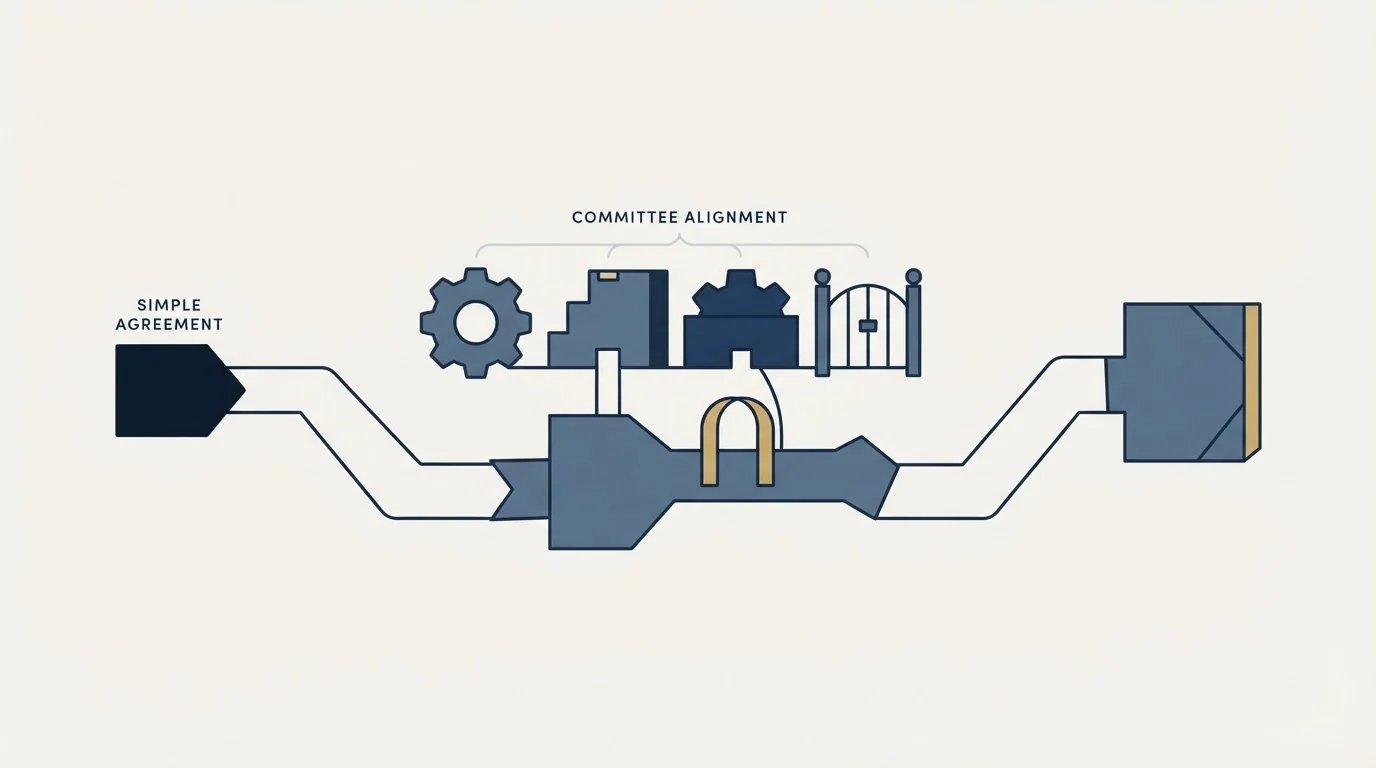
The steps themselves are less interesting than the evidence that completes them, and this is where a B2B process earns the right to be forecast from.
Because the steps only matter if they mirror reality, mapping how deals actually progress shows where the remembered process and the recorded one quietly diverge.
Write each step as something the buyer did, phrased so that two people reading the record agree on whether it happened. "Discovery call completed" is seller activity and is always achievable. "They described their current process, what it costs them and who else has a say, in their own words, on a call they attended" requires the other party, so it can be wrong about a deal, which is the property that makes it worth recording.
- Yes: At least one step requires evidence from somebody other than the first contact
- Yes: The paperwork route is asked about before the proposal is written
- Yes: Entry criteria exist in writing and predate the campaign that produced the meeting
- Yes: Every step names something the buyer did rather than something the seller performed
- Yes: Deals are allowed to move backwards when the evidence says they should
- No: A deal can reach the proposal stage on one person's enthusiasm
- No: Close dates are set by the decision date rather than by the signature route
Discovery carries more weight in a multi-party purchase than anywhere else, because the map of who is involved is produced there or not at all. Running a discovery call that disqualifies well covers how to get that map without turning the conversation into an interrogation, and the stage design that the process feeds is worked through in pipeline stages that earn their place.
Judging it before the revenue arrives
A B2B process cannot be evaluated on closed revenue for at least one cycle, and for a business with a median cycle of several months that is a long wait for a verdict. Two consequences follow, and both are commonly learned late.
Campaigns and process changes have to be judged on leading indicators in the meantime: replies from the right titles, meetings held, and how many of those an account executive judged real. Those arrive in weeks and are causally connected to what changed. And the pipeline has to be built a cycle ahead of the number it is meant to hit, which means a quarterly target with a four-month median cycle was decided last quarter. Sales cycle covers how to measure that length honestly, starting with the fact that the number means nothing without its start point.
Where we differ from standard practice

Much of the advice on the B2B process reflects how outbound is commonly run, and since this page sits on our site it is worth saying where we diverge and what it costs us.
Standard practice attaches a contact cadence to the front of the process: a series of messages to each prospect over several weeks, later ones landing in the same thread. We run one message per campaign, with no bumps and no thread replies. Where an audience does not respond, we build a new campaign with a genuinely different premise rather than sending a reminder of the old one. The reasoning is mechanical: a repeat contact is delivered to the people who already saw the message and chose not to answer, which is the population most likely to complain, and the cost of that lands on the sending domain across everything else it sends. What we accept in exchange is reaching each contact less often, which moves the work into targeting and into the single message. The full argument, including what it costs us, is in why we stopped using follow-ups.
The short version
A B2B sales process is designed around the fact that several people have to agree and most of the deciding happens without you. Three properties of the purchase set its shape: how many people must agree, whether the money crosses an approval threshold, and what breaks if the buyer switches.
At least one of the boxes should require evidence that a single enthusiastic contact cannot produce. Map the paperwork route early rather than late, and define the entry point as an acceptance test against criteria written down before anyone was contacted. Write every step as something the buyer did, so an uninvolved person can check it, and set close dates from the signature route rather than from the decision date.
Judge changes on leading indicators for the first cycle, and build the pipeline a cycle ahead of the target it has to hit.
Where the constraint is the supply of qualified conversations entering the process rather than what happens to them afterwards, that is the half we run: see what a first campaign produces.
Frequently asked questions.
Frequently asked questions- What makes a B2B sales process different?
- Several people have to agree, and most of that agreement forms in conversations the seller never attends. That single fact drives the rest: multi-threading, evidence from more than one contact, a mapped paperwork route, and close dates set by the signature path rather than by when the buyer says yes.
- Where should a B2B sales process start?
- At acceptance. A held conversation is checked against criteria written down before the campaign that produced it, and the deal enters the process only when it passes. Where meeting generation and closing sit with different teams, that test is the interface, and an unwritten one drifts with whichever number is short.
- How many stages should a B2B process have?
- Fewer than most CRMs end up carrying. The test is not a count: a step earns its place when the answer to it changes what happens next, and it earns a pipeline stage only when the forecast should change as a result. Everything else belongs in a field, a flag or activity reporting.
- How long before a B2B process change can be judged?
- On revenue, roughly one sales cycle, which for many businesses is several months. In the meantime, judge it on leading indicators that arrive in weeks: replies from the right titles, meetings held, and how many of those an account executive judged real enough to work.
About the author.

Ben Carden is CRO at RevenueFlow, which builds and operates outbound revenue engines for B2B companies. Previously at Gartner Enterprise. Studied at London School of Economics.
Ben Carden · CRO
Connect on LinkedIn →Explore more.
Ready to scale your outreach?
We build GTM engines that book real meetings. See the receipts.
Related articles.
The Seven-Step Sales Process: What Each Step Assumes
Prospecting through follow-up, walked one box at a time. Each of the seven steps carries an assumption about the buyer, and most of them have quietly stopped holding.
The Five-Step Sales Process: What You Stop Checking
Cutting a process to five steps is a decision about which checks you drop. Which deals the short version fits, and the two loss patterns that say it does not.
The Customer-Centric Sales Process: The Edit That Matters
Renaming the pitch achieves nothing. Writing every step as buyer evidence changes the forecast within a quarter, and three other things nobody warns you about.
The Sales Process: Writing Steps a Buyer Has to Complete
The seven-step template names things the seller does, so a process built on it advances in quarters where nothing is bought. What to write instead, and how.
The Managed Services Sales Process: Qualifying on the Estate
Selling an ongoing obligation at a fixed price changes what the process has to establish. The assessment step, the four signals that predict margin, and payback.
The Consultative Sales Process: What Diagnosis Costs
Diagnosis before prescription is easy to say and expensive to run. What the approach actually requires, and why proposal volume falls before close rate rises.