Buyer Journey Stages, and Where Outbound Enters
The B2B buyer journey stages as HubSpot, Infuse, Highspot and Qualtrics publish them, dated, and what an outbound seller can actually see of each stage from outside.
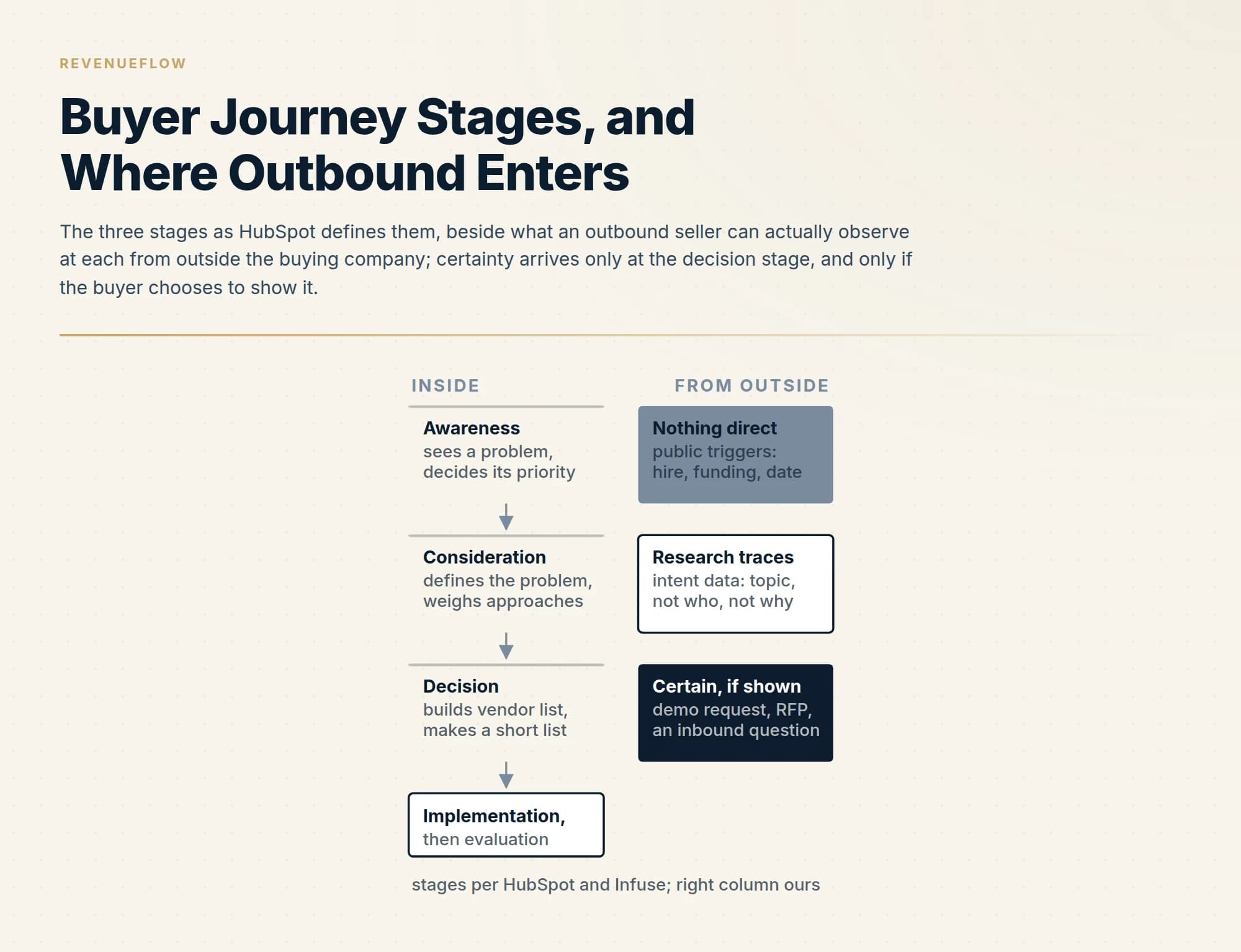
The published B2B buyer journey is a three-stage spine, awareness, consideration and decision in HubSpot's wording, with implementation and evaluation added by Infuse, a buying group rather than one buyer, and movement between stages. From outside, awareness is invisible except through public triggers, consideration shows as research, and decision is certain only when the buyer shows it.
Key takeaways
- HubSpot defines awareness as the buyer becoming aware of a problem and deciding whether it is a priority, consideration as evaluating approaches, and decision as building a vendor short list.
- Infuse adds implementation and evaluation to make five stages and describes non-linear progression, with buyers revisiting stages as stakeholders join; Highspot says buyers do not follow a tidy, linear path.
- From outside the company, awareness leaves no trace except public triggers, consideration leaves research traces that intent data records, and decision is visible only through a demo request, an RFP or an inbound question.
- A cold message lands in a stage it cannot know, so it carries one premise written for the most likely stage: start the awareness question, name the approach in consideration, or ask for the short list in decision.
Reviewed and updated September 19, 2026
The buyer journey has more published versions than any other model in B2B marketing, and almost all of them descend from one three-stage list. HubSpot names the stages awareness, consideration and decision; Infuse extends the list to five by adding implementation and evaluation; Highspot defines the whole thing as a process from recognising a need to implementing a solution. What none of the guides says is what a seller who was not invited can see of any of it from the outside, which is the question an outbound team actually has. This page takes the stages from their publishers, dated, and then answers that question.
One absence to declare. Gartner's own page on the B2B buying journey sits first in the search results for this term, and it returned HTTP 403 to every fetch this site's tooling made on 19 September 2026, including three headless renders spread over ten minutes. What Gartner names as buying jobs is therefore not reproduced here from second-hand summaries; the reader who wants Gartner's model should read it at gartner.com. The wider question of who decides inside a B2B purchase, and why nobody can decide alone, is on the B2B sales process.
The three stages, as HubSpot publishes them
HubSpot's guide to the buyer's journey (published 24 March 2025, fetched 19 September 2026) gives the three stages in one line each. "Awareness Stage: The buyer becomes aware that they have a problem." "Consideration Stage: The buyer defines their problem and considers options to solve it." "Decision Stage: The buyer evaluates and decides on the right provider to administer the solution."
The expansions on the same page are more useful than the labels, because they say what the buyer is doing. In awareness, "they recognize a challenge or opportunity that needs attention. They also decide whether the challenge or opportunity should be a priority." In consideration, "buyers have clearly defined the goal or challenge and have committed to addressing it. They are now evaluating different approaches or methods to pursue the goal or solve their challenge." In decision, the buyer's goal is "to compile a list of available vendors, make a short list, and ultimately make a final purchase decision." HubSpot's advice to sellers at the first stage is also on the page: approach buyers "with sensitivity, not sales pitches", and help them articulate the problem rather than push a product.
Two things in that wording matter for what follows. The second sentence of the awareness stage says the buyer decides whether the problem is a priority, which is a decision made entirely inside the company and invisible from outside. And the consideration stage is defined as evaluating approaches, not vendors; the vendor list belongs to the decision stage. A seller who enters a consideration-stage conversation with a vendor comparison has arrived one stage early.
The other published models, dated
The other publishers in the results keep HubSpot's three and add to them. Infuse's glossary entry (last modified 28 July 2026) defines the journey as "the process a business client follows to research, evaluate, and make a purchase decision for a product or service from another business." and names five stages: awareness, consideration, decision, implementation and evaluation. Its section on how the journey has changed carries a heading worth more than the stage count, non-linear progression, expanded as: "Buyers move between stages fluidly, revisiting earlier stages as new stakeholders join or requirements evolve, rather than following a strictly linear path."
Highspot's guide (published 26 August 2025, modified 24 June 2026) defines the journey as "the full process from recognizing a business need, to researching solutions, selecting, and implementing a solution from a preferred vendor." and says of today's buyers that "they don't follow a tidy, linear path." Its awareness stage is the one where "the typical B2B buyer knows that something is not working and is trying to figure out the scope of the problem." Qualtrics' guide keeps the three stages and adds the stakeholder point: a B2B customer "often includes multiple stakeholders. They may have varying interests, concerns, and goals."
| Publisher, dated | Stages it names | What it adds |
|---|---|---|
| HubSpot, 24 March 2025 | Awareness, consideration, decision | The buyer decides in awareness whether the problem is a priority |
| Qualtrics, undated | Awareness, consideration, decision | The customer is a group of stakeholders with varying interests |
| Infuse, 28 July 2026 | Awareness, consideration, decision, implementation, evaluation | Non-linear progression: buyers revisit stages as stakeholders join |
| Highspot, 24 June 2026 | Recognising a need, researching, selecting, implementing | Buyers do not follow a tidy, linear path |
So the published consensus is a three-stage spine, two optional post-purchase stages, a buying group rather than a buyer, and movement back and forth between stages. Every one of those is a statement about what happens inside the buying company.
What a seller can see from outside, stage by stage
An outbound team does not get told which stage an account is in. It has to infer the stage from what is visible, and seen from outside the honest summary is short: nothing direct in awareness, research traces in consideration, and certainty in decision only when the buyer has shown it. The journey happens inside the buying company, and the dark funnel is our name for the part of it that leaves no trace outside. Taking the three stages in turn:
Awareness is invisible, and its triggers are not. A buyer recognising a problem and deciding whether it is a priority leaves no trace a stranger can read. What can be read are the public events that tend to cause that recognition: a new leader in the role, a hiring pattern, a funding event, a regulation with a date, a system reaching end of support. None of these proves the stage; each raises the odds that somebody inside has started asking the awareness-stage question. A message built on one of them is a guess about the stage, and it should read like one.
Consideration shows as research, and research is what intent data records. HubSpot's definition of the stage is evaluating approaches, and evaluating approaches produces reading, downloads and comparisons on third-party sites. That is the signal intent data providers sell, and our glossary entry is careful about what the signal establishes: that somebody at the account is researching a topic, not who, not why, and not whether the approach being evaluated is yours.
Decision shows only when the buyer chooses to show it. A demo request, an inbound question, an RFP: these are decision-stage acts that arrive in the seller's inbox, and they are the only stage a seller sees with certainty. By then, on the publishers' own account, the approach has been chosen and the vendor list is being built, and a cold message to an account at this stage is competing with a short list it did not know existed.
Where written outbound enters, and what that decides
The publishers' models are written for a seller waiting to be found. An outbound message does not wait, and the stage it lands in decides what it can honestly say.
A message that lands in awareness is not meeting a stage; it is trying to start one. The recipient has not yet decided the problem is a priority, and may not have named it. The message therefore has one job, which is to put a specific, true observation about the recipient's own business in front of them and say what it usually means, so that the awareness-stage question gets asked. This is the premise a cold message is built on, and it is why one premise per message is the rule: a message trying to start two stages at once starts neither.
A message that lands in consideration meets a buyer who has defined the problem and is comparing approaches. The honest message names the approach, not the vendor, because that is the comparison the buyer is running, and it is the one place a trigger observed from outside can be stated as the reason for writing.
A message that lands in decision is late, and should say so or not be sent. If a short list exists, the useful message asks to be on it and states in one line why, and accepts that the answer is usually no.
If they are in awareness
Start the stage: one specific observation about their business and what it usually means, so the priority question gets asked.
If they are in consideration
Name the approach they are evaluating, not the vendor; the observed trigger is the reason for writing.
If they are in decision
Ask to be on the short list in one line, and accept that a list built without you usually stays that way.
The last point the models make, that the buyer is a group, cuts across all three stages. Infuse's non-linear progression is driven by stakeholders joining; Qualtrics names their varying interests. A message aimed at one person is aimed at one member of a committee whose composition the sender cannot see, and the buying committee entry sets out why that composition has to be inferred rather than looked up. The practical consequence for a stage read is that the account can be in two stages at once: the person who recognised the problem is in consideration while the person who will sign has not reached awareness.
- Yes: A public trigger exists that tends to precede the awareness question
- Yes: The message carries one premise, written for the most likely stage
- Yes: Any research trace is treated as a topic signal, not as a person or a reason
- Depends: The recipient's place in the buying group is treated as inferred
- No: The account's stage is stated as known
- No: A vendor comparison is sent to an account still evaluating approaches
Where our own practice differs
The published advice for each stage is a content programme: create awareness content, nurture through consideration, close in decision, with a sequence of touches to move the buyer along. We do not run sequences. One message per campaign, on one premise, sent once; a later approach is a separate campaign on a separate premise, never a reminder, and on LinkedIn there is no second message at all. The reasoning, and what it costs us, is set out where we take apart a published fifteen-touch cadence, the Agoge sequence. The cost is real: a buyer who moved from awareness to consideration in the month after our message does not hear from us again unless a new premise exists. What it buys is that every campaign result can be read against one premise and one stage guess.
The second difference is what we count. A meeting we book is qualified against criteria agreed in writing before launch: the company is in the agreed audience, the person has real responsibility for the area, they agreed to a relevant business conversation and they attended. Which stage they were in is something to learn on the call, and never a condition on whether the call counted, because the stage is exactly the thing nobody outside the company can verify.
The short version
The published buyer journey is a three-stage spine, awareness, consideration and decision in HubSpot's wording, with implementation and evaluation added by Infuse, a buying group rather than a single buyer, and movement back and forth between stages. Gartner's model is the one page in the results this site could not fetch, and it is not paraphrased here. From outside, awareness is invisible except through its public triggers, consideration shows as research that intent data records without saying who or why, and decision is certain only when the buyer chooses to show it. A cold message lands in a stage it cannot know, so it carries one premise, written for the most likely stage, and reads honestly if the guess is wrong.
If the question is what one message on one premise returns from your market before the stage is knowable, a first campaign is the cheapest way to find out.
Every quotation above is from the named page as fetched on 19 September 2026: HubSpot's guide to the buyer's journey (published 24 March 2025); Infuse's glossary entry (modified 28 July 2026); Highspot's guide (published 26 August 2025, modified 24 June 2026); Qualtrics' guide (undated on the page). Gartner's page returned HTTP 403 on every attempt that day and is not quoted. Publishers revise these pages; confirm the current text before relying on it.
Frequently asked questions.
Frequently asked questions- What are the stages of the B2B buyer journey?
- In HubSpot's published wording there are three: the awareness stage, where the buyer becomes aware they have a problem and decides whether it is a priority; the consideration stage, where the buyer defines the problem and evaluates approaches to solving it; and the decision stage, where the buyer compiles a vendor list, makes a short list and decides. Infuse adds implementation and evaluation after the purchase to make five.
- Is the B2B buyer journey linear?
- The publishers say no. Infuse describes non-linear progression, with buyers moving between stages fluidly and revisiting earlier ones as new stakeholders join or requirements evolve, and Highspot says today's buyers do not follow a tidy, linear path. Because the buyer is a group, one account can be in two stages at once: the person who recognised the problem may be evaluating approaches while the person who signs has not reached awareness.
- How can a seller tell which stage a buyer is in?
- From outside the company, mostly by inference. Awareness leaves no trace a stranger can read, only the public triggers that tend to cause it, such as a new leader, a hiring pattern or a regulation with a date. Consideration shows as research on third-party sites, which is what intent data records without saying who or why. Decision is certain only when the buyer shows it through a demo request, an RFP or an inbound question.
- What should a cold email say at each buyer journey stage?
- The stage cannot be known in advance, so the message is written for the most likely one. In awareness it tries to start the stage with one specific observation about the recipient's business and what it usually means. In consideration it names the approach being evaluated, not the vendor, with the observed trigger as the reason for writing. In decision it asks to be on the short list in one line and accepts that the answer is usually no.
About the author.

B2B cold email experts helping companies generate qualified leads through done-for-you outreach campaigns.
RevenueFlow Team
Explore more.
Ready to scale your outreach?
We build GTM engines that book real meetings. See the receipts.
Related articles.
SDR Outsourcing for Fintech Companies: Assessability Test
For the fintech weighing an outside setter: the three assessability sentences, the promotion rules that bind every message, the sponsor test and which model fits.
Appointment Setting for Manufacturers: Who a Setter May Call
For the manufacturer hiring a setter: the ranked titles to hand over, the rep and distributor map that decides which accounts may be called, and the meeting types.
Lead Generation for IoT Companies: A B2B Playbook
Written for the IoT vendor, not the agency: who decides an IoT purchase, why the pilot is a pipeline stage, the dated regulatory clocks and shows to write against.
Outbound Sales for Food and Beverage Companies: Who to Reach
Outbound sales for food and beverage brands: the four buyers behind a yes, the public show calendar, what a message may claim, and when outbound is the wrong play.
Outbound Sales for Higher Education Vendors: Which Door to Use
Outbound for higher education vendors, built on universities' own purchasing policies: three doors, the ask that fits each one, and a dated accessibility review.
Outbound Sales for Architecture Firms: The Two Roads
For the firm winning its own work: who commissions buildings, the private road and the public qualifications road, the six FAR criteria, and the wrong-play cases.