Inbound Marketing vs Outbound: Compared at the Wrong Level
Outbound in most planning docs bundles paid interruption with addressed outreach, and those two behave nothing alike. Three instruments, four axes, one decision.
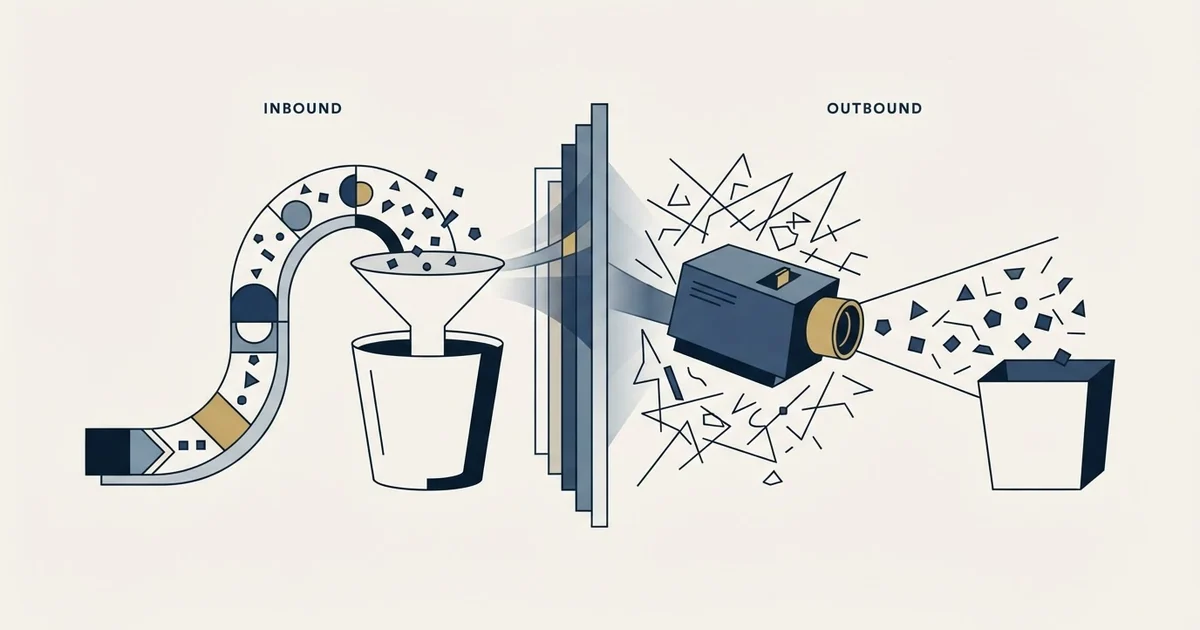
The usual comparison bundles two unlike things under outbound: paid interruption, which rents attention from a broad audience, and addressed outreach, which spends one chosen person's attention. Inbound accumulates and keeps working after you stop. Outreach stops within one sales cycle. Fund inbound for a topic you can own, outreach for accounts you can name.
Key takeaways
- Paid interruption and addressed outreach share the outbound label and differ on audience selection, marginal cost and failure mode.
- Inbound has high fixed cost and near-zero marginal cost; outreach costs more for every additional person contacted.
- Inbound keeps producing after you stop publishing, and outreach stops within one sales cycle of the last send.
- The widely quoted cost and conversion comparisons between the two channels trace back to no primary source that publishes its method.
Reviewed and updated September 2, 2026
Inbound Marketing vs Outbound: The Comparison Is Usually Run at the Wrong Level
A marketing lead opens a planning doc with two columns. Inbound on the left: SEO, content, webinars, organic social. Outbound on the right: display ads, sponsored posts, cold email, cold calls. Budget gets split down the middle and the year gets planned.
The doc is already broken, and the break is in the right-hand column. It contains two instruments that behave nothing alike. Paid interruption buys attention from a broad audience that did not ask for it. Addressed outreach spends one named person's attention, once, on a message written for them. They share the word outbound and almost nothing else: different unit economics, different failure modes, different reasons to stop.
So the useful comparison is not two columns. It is a question about which of three jobs you are funding, and what each one does when the money stops.
Under the label inbound vs outbound lead generation the answer is the same: compare the job each one does, what one more unit costs, and what each leaves behind when the spending stops.
What each one actually is
Inbound is the practice of publishing something a buyer is already looking for, so that the buyer arrives on their own schedule. Search, documentation, comparison pages, a podcast, a course. The defining property is that the buyer initiates. You do not know who is coming until they arrive.
B2B inbound marketing is that same practice aimed at a business buyer, and the only thing the qualifier changes is who has to be persuaded, since the person who arrives is rarely the person who signs.
Inbound email marketing is the name for email sent to people who asked to receive it, which is why the question of whether email marketing is inbound or outbound has no single answer: the channel sits in both columns and who initiated the contact decides which one a given send belongs to.
Paid interruption is buying placement in front of an audience defined by attributes rather than by intent. Display, paid social, sponsored newsletters. You choose the audience and you rent their attention for as long as you pay.
Addressed outreach is contacting a specific person you chose deliberately, through a channel that reaches them directly. Cold email, cold calls, LinkedIn messages. You know exactly who you contacted, because you picked them.
Most guides put the second and third in one bucket because both are things you do to somebody rather than things they do to you. That grouping hides the thing that matters most in planning, which is what one more unit costs and what happens when you stop.
- You publish, they arrive
- Audience is whoever your topic attracts
- Cost is mostly fixed and upfront
- Keeps working after you stop paying
- Slow to start, slow to stop
- You choose attributes, not people
- Audience is broad and mostly not in market
- Cost scales with impressions
- Stops the day the card is declined
- Fast to start, fast to stop
- You pick every recipient by name
- Audience is exactly your target list
- Cost scales with people contacted
- Stops when you stop sending
- Fast to start, fast to stop
The four axes that decide the argument
The question often arrives in a review as whether a given source was outbound or something else, and the axes above are what settle it without a definitional argument: who initiated the contact decides the category, and everything else about the two motions follows from that one fact.
Who chooses the audience. With inbound, your topic chooses it. Publish a good page about reducing warehouse pick times and you will attract warehouse operations people, including many at companies too small to buy from you and some who are students. That is the mechanism working exactly as designed. With addressed outreach you choose every single recipient, which means the quality of your thinking about who to contact sets the ceiling on everything downstream.
When it lands in the buying cycle. Inbound lands when the buyer decides it lands, which is usually the moment they start looking, which is usually late. That is inbound's biggest genuine advantage and it is underrated: a person searching for a comparison of two vendors has already done the hard internal work of deciding to buy something. Addressed outreach lands when you send it, which is almost always early, before the buyer has framed the problem. Early contact is harder to convert and it is also the only way to be in the conversation before a shortlist exists.
What one more unit costs. Inbound has high fixed cost and low marginal cost. The tenth thousand visitor to a page costs nothing. Addressed outreach is close to the opposite: every additional person contacted costs list-building, verification, sending infrastructure and someone's judgment. Paid interruption is purely marginal, which is why it is the easiest to start and the easiest to waste.
What happens when you stop. This is the axis most comparisons skip and it is the one that should decide a lot of budgets. Stop publishing and the pages you already published keep bringing people in for a long time. Stop sending and the pipeline stops within the length of one sales cycle. Inbound accumulates. Outreach does not, and anyone selling you outreach who implies otherwise is selling badly.
We run addressed outreach for a living and that last paragraph is still true. It is the honest cost of the instrument we sell.
Where each one genuinely fails
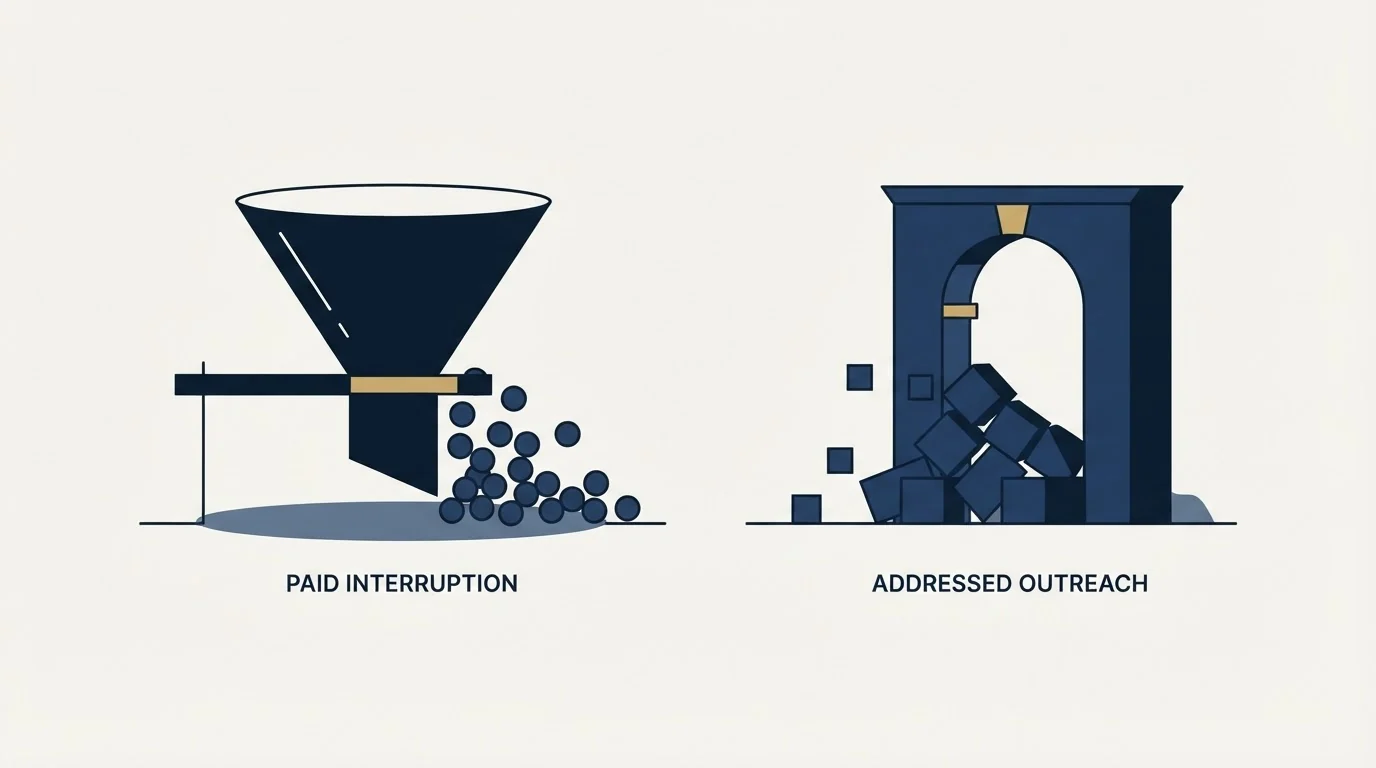
Inbound fails when there is no topic you can credibly own, when the buying committee does not search, or when the company needs pipeline this quarter. A category that nobody has named yet has no search volume by definition, which is why new categories are almost always sold before they are searched for. Inbound also fails quietly on attribution: the page that created the demand and the page that captured it are usually different pages, and most measurement gives all the credit to the second one.
Addressed outreach fails when you cannot name the accounts. If your buyer is defined by a behaviour you cannot see from the outside, a list is guesswork and no amount of copy fixes a guessed list. It also fails on volume thinking. A larger send to a worse list does not produce more meetings, it produces more people who now associate your name with something irrelevant.
Paid interruption fails most often on the arithmetic. It is the only one of the three where you can spend a large budget quickly with no signal that anything is wrong, because impressions always go up.
- Yes: You can name the companies you want, from public attributes
- Yes: The buying committee is small and its titles are stable
- Yes: A single customer is worth enough to justify researched contact
- Yes: You need pipeline inside one or two quarters
- No: Your category has meaningful search volume already
- No: Buyers self-educate for months before contacting anyone
- Depends: You have a topic your team can credibly own for two years
The number that gets quoted, and why we will not quote it
Search for this comparison and you will meet a familiar cluster of statistics: inbound leads cost some specific percentage less than outbound leads and convert at some specific multiple. The figures are quoted confidently across dozens of pages.
We have not been able to trace them to a primary source that publishes its method, its sample, or its definition of a lead. Each page cites another page. A cost-per-lead comparison is meaningless without a shared definition of a lead anyway, and the two channels do not share one: an inbound lead is often a content download, an outbound lead is often a booked meeting. Comparing their costs compares two different objects.
Circulated numbers behave the same way in adjacent categories, where the reach multipliers quoted in advocacy pitches turn out to be figures the vendors attribute to third parties.
Work out your own numbers instead. The method that survives scrutiny is in cost per lead B2B, and the fuller version that includes the people cost is in cost per customer acquisition.
How they actually compose
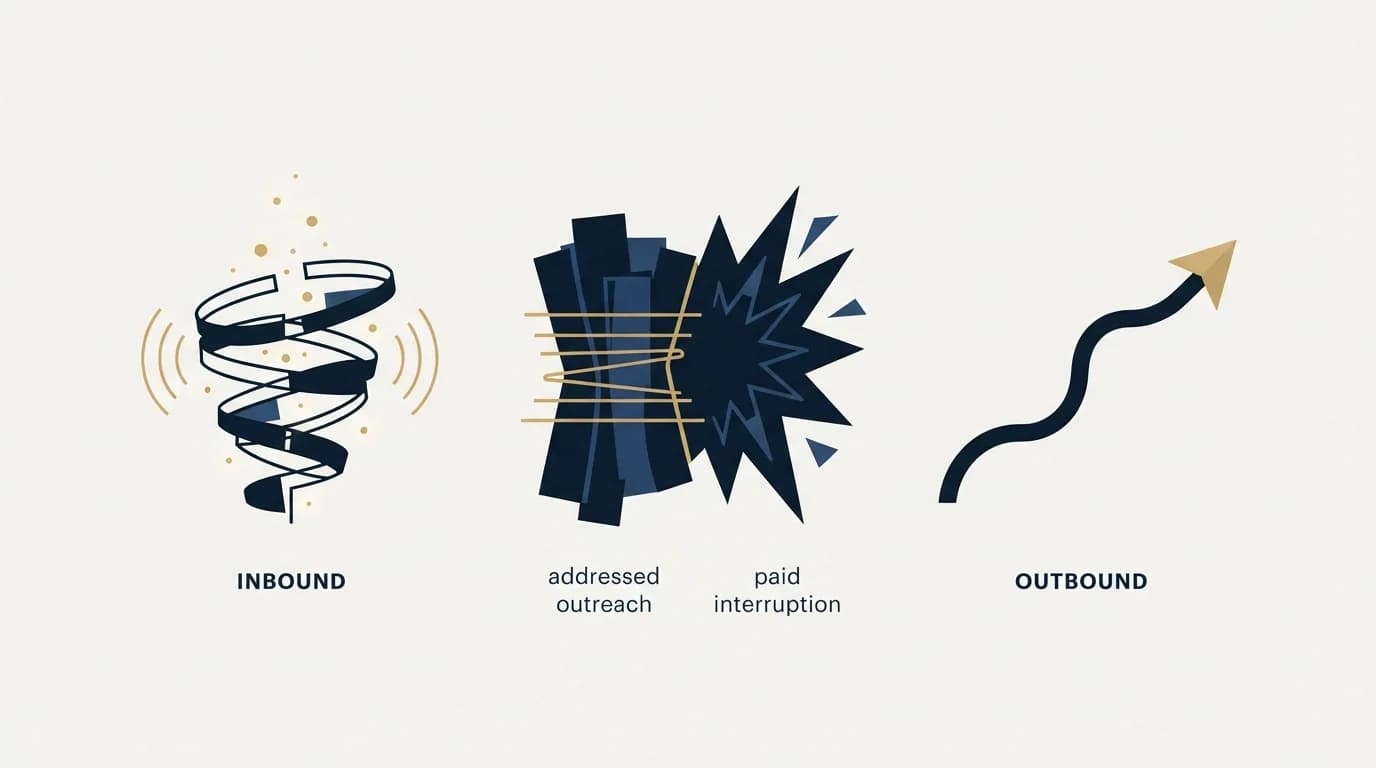
The two are not rivals for the same job. They serve buyers in different states, and the clean way to think about it is by state rather than by channel: some accounts do not know the problem has a name, some are shortlisting, some are ready. Each state takes a different play, which is laid out in demand creation, capture and conversion.
Inbound is unmatched at capture. When someone searches for the thing you sell, being there is worth more than any message you could have sent them cold. Addressed outreach is the only instrument that works on accounts in the first state, because a person who does not know the problem has a name will never search for your solution to it.
The most common ordering mistake is running outreach as though it were capture: sending a shortlisting-stage message, full of feature comparisons and pricing, to people who have not yet agreed there is a problem. The second most common is expecting inbound to reach accounts that have never searched for anything in your category.
If you are choosing between hiring for one or the other, the pricing and the decision rule are in demand generation agency vs cold outbound. If your team is still running the buy-a-list-and-hope version of outreach, what actually changed is described in old GTM vs new GTM.
Where we differ from standard practice
Most outbound programmes answer a quiet prospect by sending more messages into the thread they already ignored. We never add a second message into a thread like that. One message per campaign, sent once, with no scheduled reminder afterwards. A person who did not reply to a well-aimed message did not miss it, and a second attempt at a stranger reads as pressure rather than as information.
When we want to reach the same person again, it is a new campaign built on a different premise, which usually means we learned something about their business that makes a genuinely different message worth sending. The reasoning, and what happened to our meeting rate, is in we stopped using follow-up emails.
This matters for the comparison because it changes outreach's cost profile. A programme that sends one message per person needs a much better list than a programme that sends several, and the work moves from writing to choosing.
The version of this that fits on one line
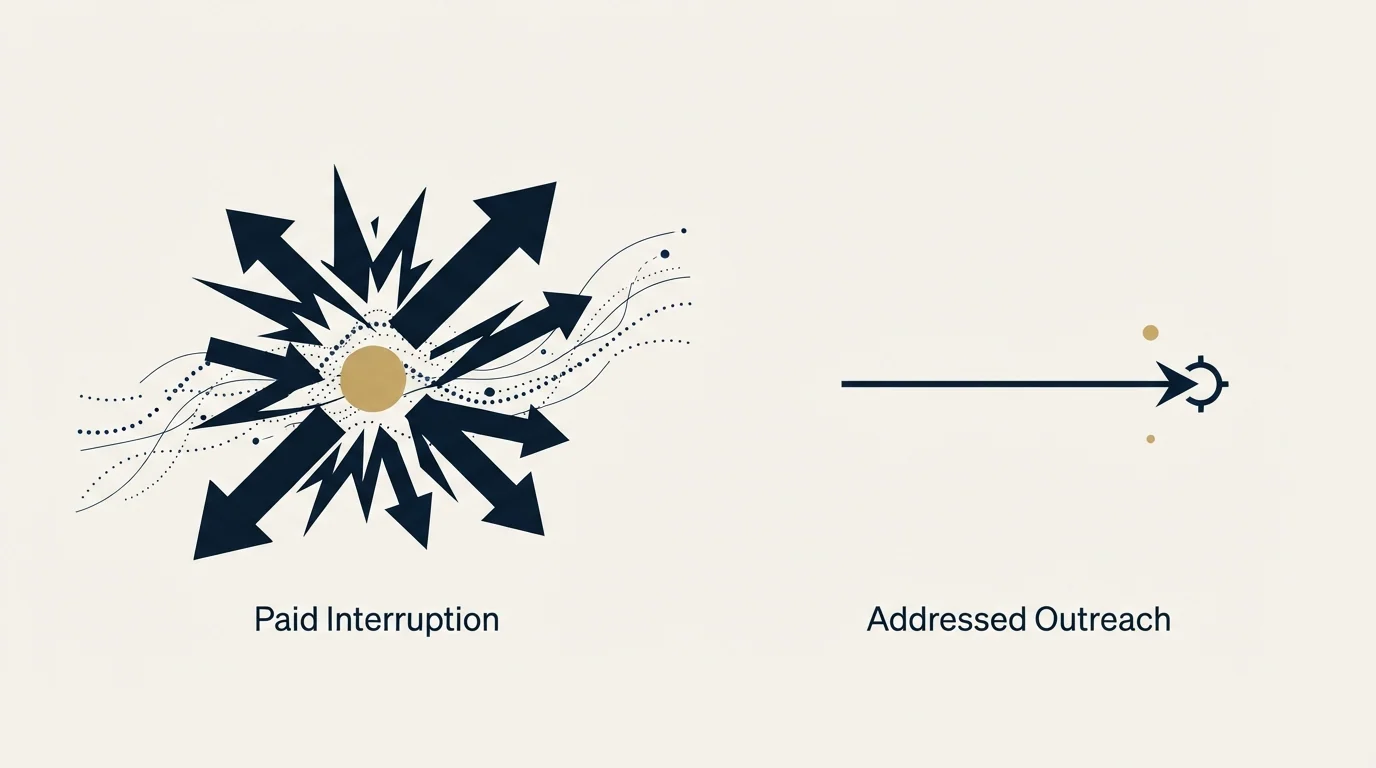
Inbound earns attention over time and keeps it after you stop paying. Addressed outreach spends attention you chose, immediately, and stops when you do. Paid interruption rents attention and is the easiest of the three to spend badly.
Fund inbound if you can name a topic you will still own in two years. Fund addressed outreach if you can name the accounts. Fund both if you can afford the wait and need the quarter, and keep their measurement separate, because the moment one number covers both you will stop being able to tell which one is working.
If you want to see what a researched, single-message campaign looks like against your own target accounts before committing budget to either column, we will build one: free campaign.
Frequently asked questions.
Frequently asked questions- Is inbound marketing cheaper than outbound?
- The comparison is usually made with figures nobody can trace to a primary source, and it compares two different objects: an inbound lead is often a content download while an outbound lead is often a booked meeting. Work out your own cost per outcome using one shared definition, otherwise the answer is decided by whichever definition you picked.
- Which should a company start with?
- Start with outreach if you can name the accounts you want and need pipeline inside two quarters. Start with inbound if your category already has search volume and you can commit to owning a topic for about two years. If your buyers do not search for your category at all, inbound cannot reach them yet.
- Can inbound and outbound run at the same time?
- Yes, and they serve buyers in different states rather than competing. Inbound is unmatched at capturing people already shortlisting. Outreach is the only instrument that reaches accounts who do not yet know the problem has a name. Keep their measurement separate, because a blended number hides which one is working.
- Why don't you send follow-up emails on outbound campaigns?
- Because we never add a second message into a thread somebody already chose to ignore. It reads as pressure rather than as information. We send one message per campaign, once, and nothing on a timer afterwards. When we want to reach someone again it is a new campaign built on a different premise, which usually means we learned something new about their business.
About the author.

B2B cold email experts helping companies generate qualified leads through done-for-you outreach campaigns.
RevenueFlow Team
Explore more.
Ready to scale your outreach?
We build GTM engines that book real meetings. See the receipts.
Related articles.
LinkedIn Outreach for Utilities: Selling to the Sector
How a vendor selling to utilities uses LinkedIn next to a published sourcing process: the three ownership models, the registration gate and what a message may ask.
SDR Outsourcing for Ecommerce Software Companies
Whether bought meetings can work for a company selling software to merchants: the app store as distribution, the billing model, the data rule and the agency.
SDR Outsourcing for Agriculture Companies
Whether an outside sales development team can work for a company selling into agriculture: who already covers the account, which weeks exist, and the show rule.
LinkedIn Outreach for Marketing Agencies
How a marketing agency wins its own clients on LinkedIn: the published agency search process, the platform rules aimed at how agencies work, and the expert buyer.
Lead Generation for Air Compressor Distributors
A compressor is bought once and its air is paid for over years. Where the accounts are published, what the buyer is told to ask, and the rule in the plant.
Appointment Setting for Manufacturers: Who a Setter May Call
For the manufacturer hiring a setter: the ranked titles to hand over, the rep and distributor map that decides which accounts may be called, and the meeting types.