Old GTM vs New GTM: What Changed in the Last Two Years
Most teams still run the 2019 playbook: buy a list, load a sequencer, hire BDRs. Here is the signal-based model that replaced it, and the honest cost of switching.
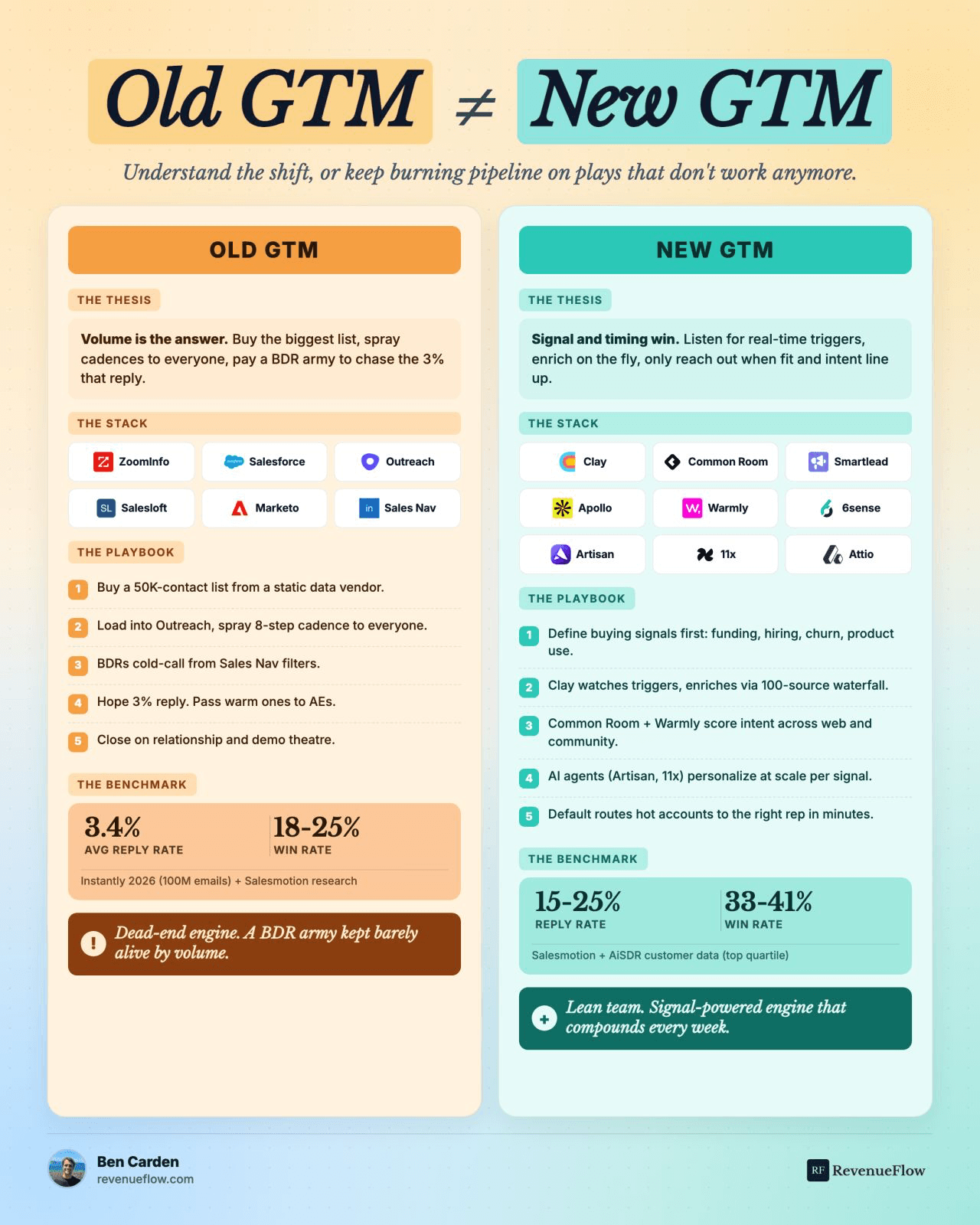
Signal-based GTM triggers outreach when an event fires at an account, a funding round or an executive hire, instead of sending templates to a static list on a cadence. The list is assembled in response to the event. The trade-offs are collapsed volume, a five-vendor stack, a precise ICP and harder attribution.
Key takeaways
- The whole inversion is one decision: old GTM chose the send date by cadence position, new GTM chooses it by something that happened at the account.
- A usable signal precedes a budget conversation, has a half-life you can name, and would make a competent seller want to call unprompted; anything failing those three tests is a vanity trigger.
- Detection-to-send is the operational metric this model lives on, because the advantage is arriving inside the window and a pipeline that detects on Monday and sends on Friday has spent most of it.
- Volume collapses by design: if 30 of your 2,000 target companies show a signal this month, that is the entire list, and widening the definition to hit legacy targets turns it back into templated outbound.
Reviewed and updated September 5, 2026
Old GTM vs New GTM
Go-to-market has changed more in the last two years than in the previous twenty. The rules flipped, and a lot of teams have not noticed because the old playbook still technically runs.
The 2019 Playbook
Buy a static list from a data vendor. Load 50,000 contacts into a sequencer. Hunt manually through LinkedIn Sales Navigator. Pay a team of BDRs to grind eight-step cadences. Hope 3% reply.
That motion worked when inboxes were less crowded and a well-written cold email was still unusual. It does not work now, and the benchmarks show it clearly.
Instantly's analysis of over 100 million emails puts the 2026 average cold email reply rate at around 3.4%. Legacy win rates sit in the 18 to 25% range.
Teams running signal-based outbound report reply rates in the 15 to 25% range and win rates of 33 to 41%. Same headcount, several times the output.
Those comparison figures come from vendors with an obvious interest in the answer, so treat the exact numbers with appropriate scepticism. The direction is consistent enough across sources to be real. The magnitude is probably flattered by selection effects, since teams sophisticated enough to run signal-based outbound tend to be better at everything else too.
What Actually Changed
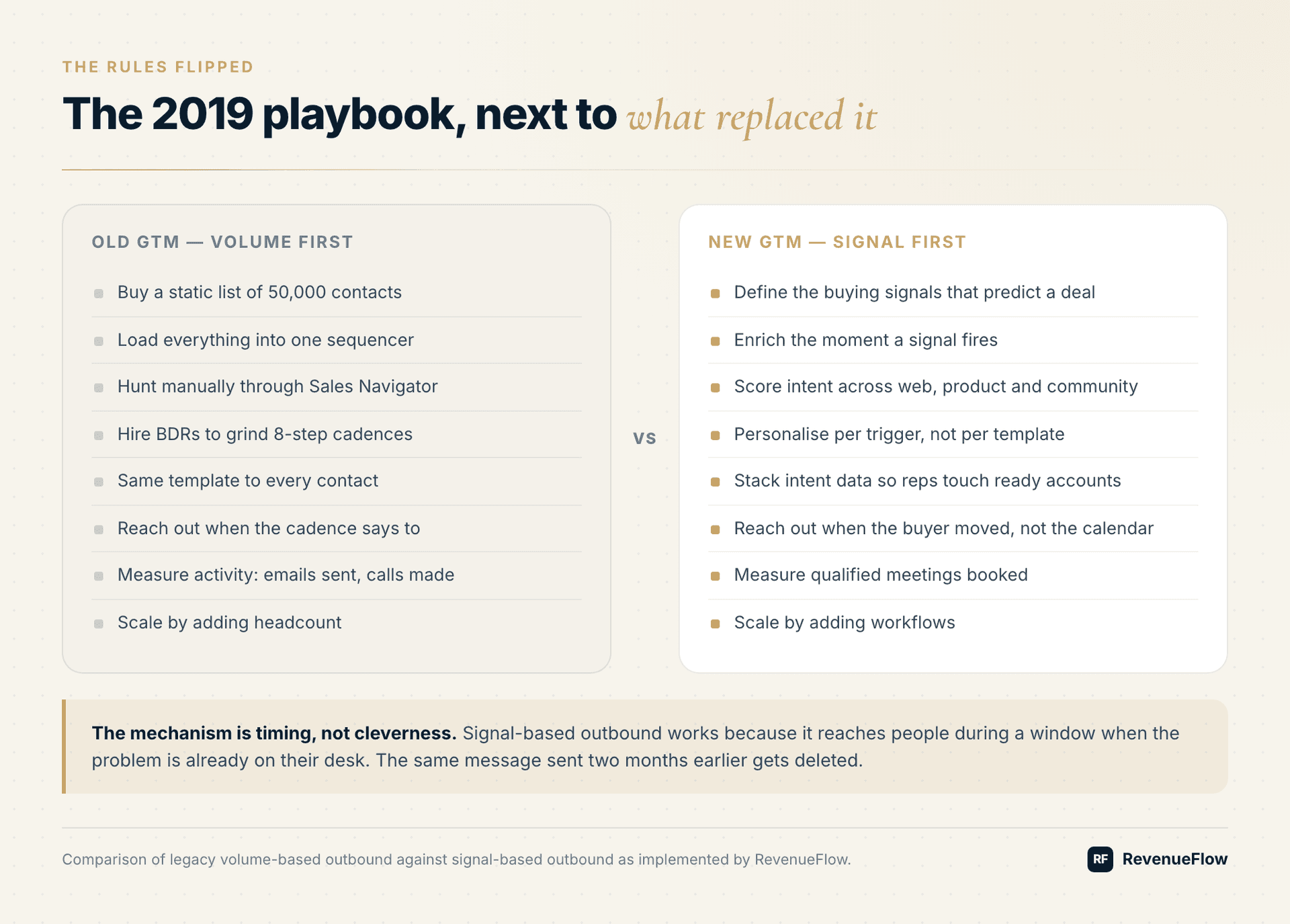
The mechanism is timing, not cleverness.
Signal-based outbound works because it reaches people during a window when the problem is already on their desk. A company that just hired its first CISO is thinking about security tooling this month in a way it was not thinking about it last month. The same message sent eight weeks earlier gets deleted without a thought.
Old GTM chose the send date by cadence position. New GTM chooses it by something that happened at the account.
Read the annual sales trends roundups against that inversion, because it is the one change that has altered what a seller does on a Monday morning rather than what a vendor says from a stage.
Everything else in the stack exists to support that one inversion.
- The list is bought in advance and decays from the day it arrives
- The send date is a cadence position
- The message references a persona
- Output scales by adding BDRs
- Coverage is the metric that gets managed
- The list is assembled when an event fires
- The send date is the event
- The message references what happened at the account
- Output scales by adding signals and automation
- Timing is the metric that gets managed
Read down the second column and the tooling almost falls out of it. Everything in the modern stack exists to detect an event, resolve it to people, and get a message out while the window is open.
The Five Steps
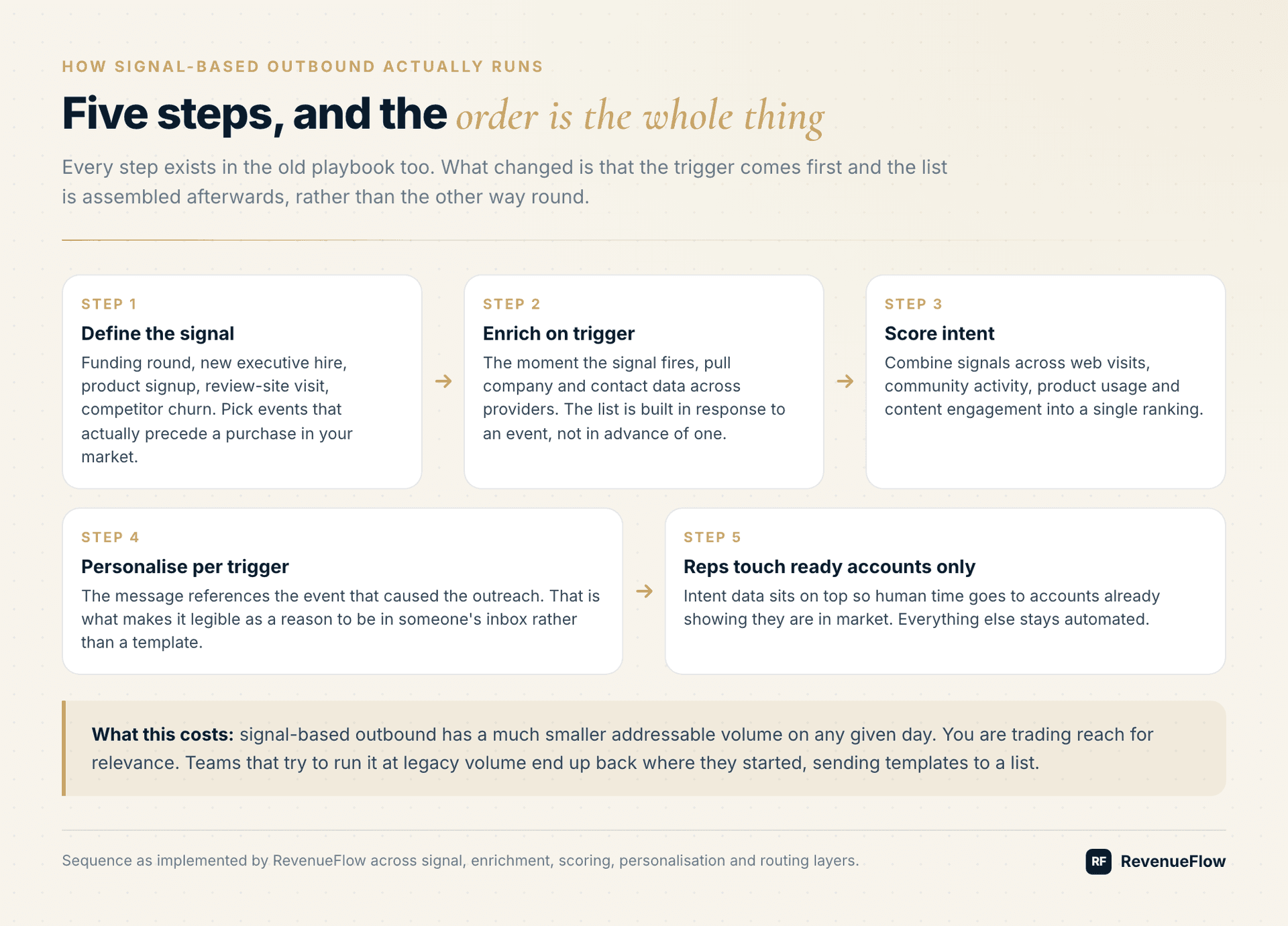
Define the buying signals first. Funding rounds. A new executive in a relevant seat. A product signup. A review-site visit. Competitor churn. The work here is choosing events that genuinely precede a purchase in your market, which is a judgment call nobody can make for you.
Enrich the moment the signal fires. Clay watches and enriches across a large provider network as soon as the trigger hits. The list gets assembled in response to an event rather than in advance of one.
Score intent across sources. Common Room and Warmly aggregate signals from web, community, and product usage. No single source sees enough on its own.
Personalise per trigger, not per template. The message references the event that caused the outreach. That is what makes it read as a reason to be in someone's inbox.
Stack intent so reps only touch ready accounts. 6sense and Apollo.io sit on top so human time goes where it converts. Everything else stays automated.
All of it plugs into a modern CRM like Attio or HubSpot. No twenty-BDR army required.
Telling a Real Signal From a Vanity One
Choosing the wrong events is where this model disappoints, and the failure is quiet: the automation runs perfectly against a trigger that predicts nothing.
Three tests separate the two.
Does it precede a budget conversation, or merely correlate with one? A funding round precedes spending. A company blog post about digital transformation correlates with nothing. Plenty of tools will happily alert you to the second.
Does it have a half-life you can name? A new executive in a relevant seat is a signal for roughly a quarter. A page visit is a signal for days. If you cannot say how long the window stays open, you cannot say when the outreach is late, and late outreach against a stale trigger is just cold email with extra steps.
Would a competent seller act on it unprompted? The useful test for a signal is whether a good rep, told the fact, would immediately want to call. If the answer is no, the automation is not going to rescue it.
The corollary is that a signal ages. The whole advantage is arriving inside the window, so a pipeline that detects an event on Monday and sends on Friday has spent the window it bought. Measure detection-to-send as a number, because it is the one operational metric this model lives or dies on.
The Costs Nobody Mentions
Switching is not free, and the case for it is weaker if you pretend otherwise.
- No: Volume collapses
- No: The stack is more complex
- No: It needs a real ICP
- No: Attribution gets harder
Volume collapses. Signal-based outbound has a far smaller addressable universe on any given day. If your total market is 2,000 companies and thirty of them show a signal this month, that is your list. Teams that try to hit legacy volume targets end up widening the signal definition until it means nothing, and then they are sending templates to a list again.
The stack is more complex. A signal tool, a data orchestration layer, an intent provider, a sequencer, and a CRM is five vendors with five integration points. Something has to operate that.
That stack sprawl mirrors a broader labeling problem, since AI GTM platforms cover many distinct product shapes that each solve a different job in the stack.
It needs a real ICP. Volume outbound tolerates a vague ICP because the maths carries it. Signal-based outbound does not work at all if you cannot say precisely which events matter, which requires knowing your market better than most teams do.
Attribution gets harder. When outreach is triggered by a buying signal, you are reaching people who were already moving. Separating "we created this deal" from "we caught this deal" is genuinely difficult, and it makes the reported win rates look better than the incremental impact.
There is a fifth cost that rarely gets named: the model demands a working message. Volume outbound hides a mediocre offer behind a large denominator. When the list is thirty accounts, every weakness in the positioning shows up immediately, and the honest response to a bad month is often to fix the offer rather than to buy another signal source.
Where To Start
Do not rebuild the stack. Pick one signal.
Choose the single event that most reliably precedes a purchase in your business. Set up a way to detect it, even if that is a manual weekly check. Write one sequence that references it specifically. Run it for a month against a small list.
If the reply rate on that small list beats your general outbound, you have evidence to justify the tooling. If it does not, you picked the wrong signal, and you have learned that for the cost of a month instead of a platform contract.
Two things make that first month worth more than it looks. Write down what you expect before you start, because a result you can rationalise afterwards teaches nothing. And keep the volume outbound running while you do it, since the signal motion is the investment and the existing programme is what pays for the month.
One caution on the message itself. A trigger is a reason to arrive, and it is not a licence to keep arriving. We send one message per campaign and no bump sequences, because a second message under one somebody ignored reads as a bump whatever triggered it, and a signal-based follow-up is still a follow-up. The reasoning is in why we stopped using follow-ups. If you want the assembly order rather than the philosophy, building an outbound engine from scratch covers it.
The winners of 2026 are not outworking old GTM. They are out-stacking it, one signal at a time.
Signals Worth Starting With
| Signal | Why it predicts a purchase | Where to detect it |
|---|---|---|
| New executive in a relevant seat | New leaders buy tools in their first 90 days | UserGems, LinkedIn, Common Room |
| Funding round closed | Budget exists and headcount is about to grow | Crunchbase, PredictLeads |
| Competitor page visit | Active evaluation, already in a buying process | G2, Bombora, Warmly |
| Hiring surge in a function | The team is scaling and its tooling will strain | PredictLeads, job boards, Apify |
| Product signup or trial | Direct expressed interest | Your own product data |
| Website visit from a target account | Someone is researching you already | RB2B, Warmly |
Read that table top to bottom and the windows shorten as you go. The first two are quarters, the last two are days. That ordering, rather than the tool names, is what should decide where a small team starts: a long-window signal is far more forgiving of a slow manual process, which is exactly what a first attempt will have.
Frequently Asked Questions
What is signal-based outbound?
Outreach triggered by something that happened at the account rather than by a position in a cadence. The list is assembled in response to an event instead of in advance of one, which means the message can reference a real reason for arriving now.
Does it really produce 15 to 25% reply rates?
Those figures are vendor-reported and almost certainly flattered by selection effects, since teams sophisticated enough to run signal-based outbound tend to be better at targeting, copy, and infrastructure too. The direction is well supported across sources. Treat the magnitude sceptically and measure your own.
What is the biggest hidden cost?
Volume collapses. If your total market is 2,000 companies and thirty show a signal this month, that is your list. Teams that keep legacy volume targets end up widening the signal definition until it means nothing, at which point they are sending templates to a list again.
Can you run signal-based outbound without Clay or 6sense?
Yes, to start. Pick one signal, detect it manually with a weekly check, and write one sequence that references it. If the reply rate beats your general outbound, you have justified the tooling. If not, you picked the wrong signal and learned it cheaply.
Should you turn off your existing outbound while you build this?
No. Signal-based outbound reaches fewer people and takes time to configure. Run both, with the signal motion as the investment and volume outbound paying the bills while it matures.
Related Reading
- B2B Intent Data: What It Actually Predicts and Which Providers Are Worth Paying For
- GTM Tools Worth Watching in 2026: The Full Market Map (27 Tools)
- The 7-Layer GTM AI Stack for 2026 (The Order Matters More Than the Tools)
We build AI-native pipeline systems and you pay per qualified meeting, not a retainer. No paying for activity. You only pay when we book you a qualified sales meeting. See if you qualify.
Reply rate benchmark: Instantly.ai analysis of 100M+ emails, 2026. Win rate ranges are vendor-reported and should be read as directional.
Frequently asked questions.
Frequently asked questions- What is signal-based outbound?
- Outreach triggered by something that happened at the account rather than by a position in a cadence. The list is assembled in response to an event instead of in advance of one, which means the message can reference a real reason for arriving now, and the timing does most of the work the copy used to be asked to do.
- How do you tell a real signal from a vanity one?
- Three tests. It should precede a budget conversation rather than merely correlate with one. It should have a half-life you can state, since that is what tells you when outreach is late. And a competent seller told the fact should immediately want to call. A trigger failing those will not be rescued by automation.
- What is the biggest hidden cost of switching?
- Volume collapses. If your total market is 2,000 companies and thirty show a signal this month, that is your list. Teams that keep legacy volume targets end up widening the signal definition until it means nothing. A smaller list also exposes a weak offer immediately, where volume outbound hid it behind a large denominator.
- Can you run signal-based outbound without Clay or 6sense?
- Yes, to start. Pick one signal, detect it manually with a weekly check, write one message that references it, and run it for a month against a small list. If the reply rate beats your general outbound you have justified the tooling. If not, you picked the wrong signal and learned it for the cost of a month.
About the author.

Ben Carden is CRO at RevenueFlow, which builds and operates outbound revenue engines for B2B companies. Previously at Gartner Enterprise. Studied at London School of Economics.
Ben Carden · CRO
Connect on LinkedIn →Explore more.
Ready to scale your outreach?
We build GTM engines that book real meetings. See the receipts.
Related articles.
B2B Intent Data: What It Predicts, Which Providers Pay Off
Intent data predicts that an account is researching a topic more than usual. That is the whole signal. What the providers cost, and why most programs disappoint.
How to Build an ICP That Changes Your Target List
Most ICPs never change the target list. Here is the count test, the five inputs, a worked TAM, SAM and SOM example with full arithmetic, and an eight-field worksheet.
GTM Tools Worth Watching in 2026: The Market Map
A founder asked what tools you actually need to run outbound in 2026. The honest answer depends on whether you want to look busy or book meetings. Here is the full map, organised by job rather than by category.
The 7-Layer GTM AI Stack for 2026 (The Order Matters)
Your outbound will plateau this year. Not because of the tools you picked, but because of the order you stacked them in. Each layer caps the performance of every layer above it.
The 20-Tool Sales Stack That Built a $50M Pipeline
We helped one FinTech founder secure meetings with a $3.25B CEO and build a $50M+ investment pipeline. Here's every tool in the stack, and how they work together.
What Is a GTM Engineer? The Role, the Stack, the Pay
A GTM engineer builds the systems that produce pipeline. The role, the day-to-day ownership, the stack by layer, verified salary ranges, and how to hire one.