Multi-Threading Email Templates: Ten Second-Person Emails
Ten multi-threading email templates for the second and third people in a live deal: the user, the blocker, the economic buyer, the sceptic and more.
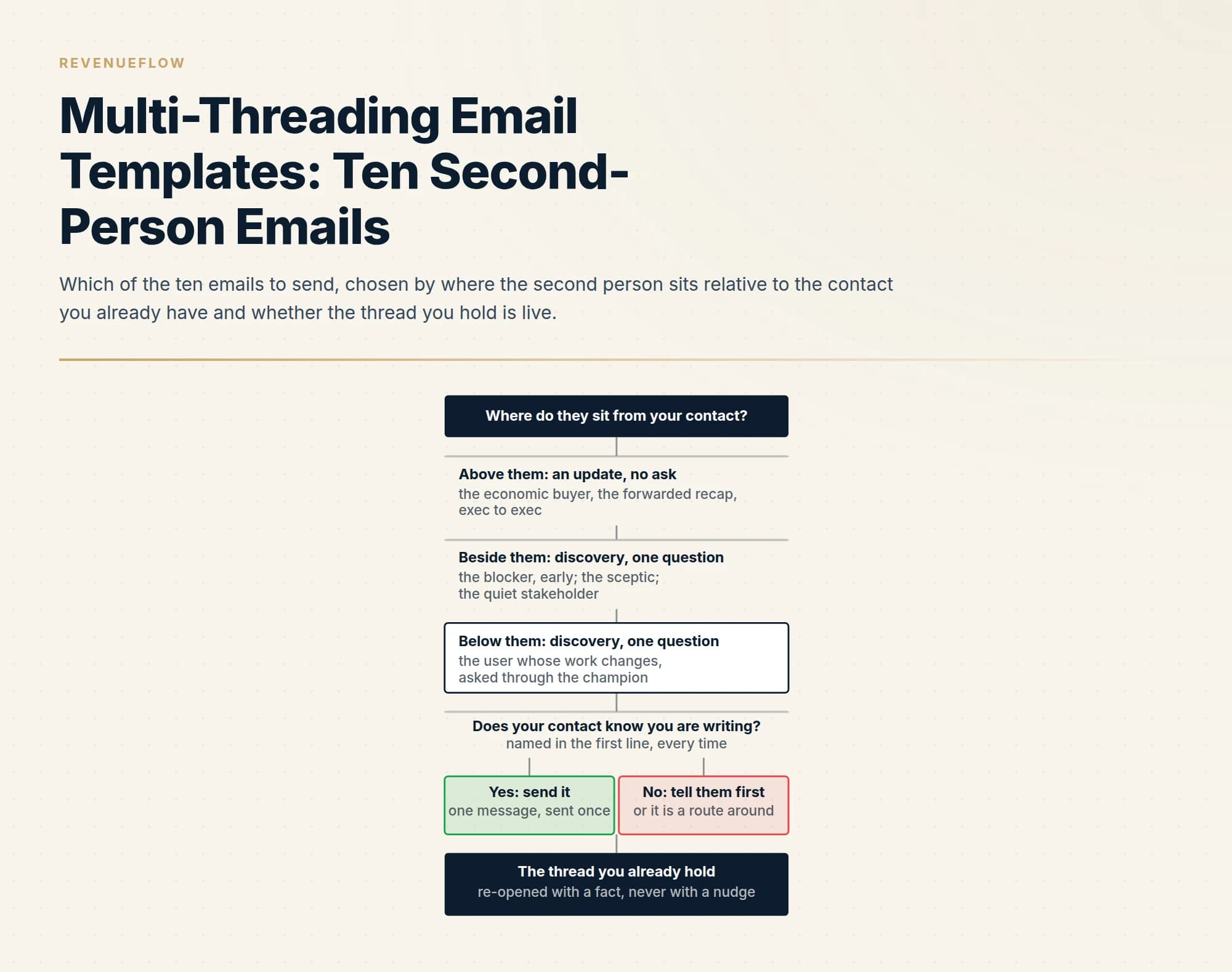
A multi-threading email is a message to a second or third person inside an account where a conversation already exists. It names your contact in the first line, calls the project what the company calls it, carries an update with no ask going up and one discovery question going across or down, and is sent once with the champion's knowledge.
Key takeaways
- Name the contact you already have, by full name, in the first line of every second-person email, so the reader knows why a stranger is writing and the message cannot read as a route around a colleague.
- Choose the shape by direction: to the contact's boss or the economic buyer, an update with no ask and a promised follow-on; to a peer or a report, one discovery question that only they can answer.
- Make sure the champion knows before any second-person email goes, and use the introduction template to ask them rather than inform them; the boss email the champion did not know about is the fastest way to lose them.
- Send one message per person, once, and never start a sequence at an account because the first thread has been quiet for a week; a quiet contact is written to again only when there is a fact to carry.
Reviewed and updated September 18, 2026
The deal has one contact. They like you, they answered every message for six weeks, then the thread went quiet, and nobody else at the company knows your name. Every guide to multi-threading says the same thing about that moment, and none shows you the emails. This page is the emails: ten messages to the second and third people inside an account where a conversation already exists.
It is not the account-based set, where every stakeholder is a stranger and each first message is cold (the account-based email templates page of this site), nor the customer-side set, where a champion has left a live account (the customer success manager templates page). The strategy, who to thread, in what order and whether it is working, is in multi-threading in sales and is not restated. Every template below is invented for this article, every person and company in a worked example is invented, and none reports a result.
What the second-person email has to carry
The published guides are long on why and short on words. Mixmax's guide, published 19 March 2025 and updated 19 November 2025, lists among its practices "Keep leadership in the loop with no-ask updates", with the templates behind a download. ZoomInfo's guide, read on 18 September 2026, splits the work by deal stage and says that when a main contact goes silent the seller should use the other relationships "rather than repeatedly following up with a silent contact". Caliber's guide, updated June 2026, puts it as a rule: "Mass threads kill accountability", so every message goes to one person. Will Allred's LinkedIn post of 8 February 2024 is the one source that shows two emails, and this page is built on its direction rule: going up, to a VP or the contact's boss, the job is to "Keep stakeholders up to date" with no ask; going across or down, to a peer or a report, it is discovery.
Both of Allred's emails name the existing contact in the first line, and that is the rule the whole page rests on: the second person is not a new prospect but somebody whose colleague is already talking to you, and the first sentence says so.
Three merge fields recur. {{contact}} is the person you already speak to, by first and last name, because the recipient knows them by both. {{the_project}} is what you are working on, in the words your contact uses for it internally. {{sender}} is a real person's first name and role. The worked example under template three is invented: Kai, an account lead, writes to Ottilie Brandvik, operations director at Ravensworth Foods, above his contact Elias Moreau, about a replacement for the plant's paper batch records, with a trial on the Leeds line in November and an update promised after it.
Ten emails, one per person
1. To the user whose work changes
Subject: {{contact}} and {{the_project}}: one question about your side of it
Hi {{first_name}},
{{contact}} and our team have been working through {{the_project}}, and your name came up as the person whose day changes if it goes ahead.
Before anything gets designed around you: what is the part of {{their_process}} that costs you the most time today? We would rather hear it from you than guess from the org chart.
{{sender}}
Why it works: the first line names the contact and the project, so the reader knows why a stranger is writing, and the one question is one only they can answer; going down the org chart, Allred's rule is discovery, and the user is the most honest judge of the problem.
2. To the blocker, brought forward
Subject: {{the_project}} at {{company}}: getting your questions in early
Hi {{first_name}},
{{contact}} mentioned that anything touching {{the_area}} goes through you, and we would rather meet your questions in week two than in week twelve.
Attached is the {{document}} you will want first. If there is a form or list you use, send it and we will fill it in before we speak, so the meeting is about the gaps.
{{sender}}
Why it works: security, procurement and legal are met early and on their own terms, so a late surprise becomes scheduled work, and offering to do their paperwork first shows you have been through the process before.
3. To the economic buyer, with the champion's knowledge
Subject: {{the_project}}: what {{contact}} and our team are doing, no action needed
Hi {{first_name}},
{{contact}} and our team are scoping {{the_project}} for {{the_team}}, with {{the_next_step}} planned for {{when}}. We wanted you to have it from us rather than second-hand.
The goal on your side is {{the_outcome_in_their_terms}}. We will send you a short update once {{the_next_step}} has run. Nothing needed from you now.
{{sender}}
Why it works: it is Allred's boss email and Mixmax's no-ask email in one shape: who, what, why, one line of context they care about, and no ask. The promised update is the only commitment in it.
To: Ottilie Brandvik, Ravensworth Foods. Subject: batch records: what Elias Moreau and our team are doing, no action needed
Elias Moreau and our team are scoping a replacement for the paper batch records on the Leeds line, with a trial planned for November. 1
We wanted you to have it from us rather than second-hand. 2
The goal on your side is a batch record that closes the same day the batch does. We will send you a short update once the trial has run. Nothing needed from you now. 3
Kai, account lead 4
- 1The champion by full name, the project in the company's own words, and the next step with its month.
- 2Why a stranger is writing to a director: so the news arrives first-hand.
- 3One line of context in the reader's terms, a promised update, and no ask.
- 4A named person with a role, whom the champion has already mentioned.
4. Asking the champion to make the introduction
Subject: Re: {{the_project}}, one introduction that would help
Hi {{contact_first_name}},
Before we go further we would like to hear from {{role}} directly, because {{the_reason_in_their_interest}}, and we would rather ask you than go around you.
Two ways that work: you forward this thread with a line of your own, or you tell us it is fine to write to {{name}} and we will, naming you.
{{sender}}
Why it works: the champion is asked, not informed, the reason is in the deal's interest rather than the seller's, and the two routes, a forward or a permission, leave them in control of how their colleague first hears of you.
5. The forward with context
Subject: Fwd: {{the_project}}, recap from {{day}}, no ask
Hi {{first_name}},
Forwarding the recap {{contact}} and our team agreed after {{day}}'s call, because {{the_line_that_concerns_them}} touches your area. No ask, only keeping you in the picture.
If anything in it is wrong from where you sit, tell us and we will correct it before it hardens into a plan.
{{sender}}
Why it works: the forwarded recap carries the whole context without a new pitch, the line above it says which sentence matters to this reader, and inviting a correction is a discovery question that does not look like one.
6. Re-opening a thread you already hold, with a fact
Subject: Re: {{the_project}}: {{the_fact}}
Hi {{first_name}},
Since we last spoke, {{the_fact}}: {{one_sentence_of_what_changed}}.
It changes {{the_specific_thing_in_the_deal}}, which is why we are writing rather than waiting for our next scheduled call. Nothing else has moved on our side.
{{sender}}
Why it works: it goes to somebody you already correspond with and carries something new, so it is correspondence rather than a nudge; a message to a quiet contact with no fact is the bump this page does not send.
7. To the sceptic who raised the objection
Subject: Your point on {{the_objection}} on {{day}}
Hi {{first_name}},
On {{day}}'s call you raised {{the_objection}}, and it was the sharpest question in the meeting. We did not answer it properly in the room.
The honest answer is {{the_answer_including_the_limit}}. If that closes it, good; if not, we would rather hear the second version of the question from you than have it decide things in a meeting we are not in.
{{sender}}
Why it works: the sceptic is treated as the most useful person in the room, the objection is repeated in their words, the answer includes its limit, and asking for the second version of the question turns a blocker into a participant.
8. When the champion has left mid-deal
Subject: {{the_project}} after {{contact}}'s move
Hi {{first_name}},
We met on {{day}} when {{contact}} was running {{the_project}}. With {{contact}} gone, we do not want to assume the work carries on, and we do not want to assume it stops.
Is there somebody picking it up, and is it you? Either answer is useful; if the honest one is that it has been shelved, say so and we will close it on our side.
{{sender}}
Why it works: it goes to a person you have met, states both possibilities and makes the shelved answer easy to give.
9. Executive to executive
Subject: {{their_company}} and {{our_company}}: {{the_project}}, a note from our side
Hi {{first_name}},
Our colleague {{sender_of_the_deal}} has been working with {{contact}} on {{the_project}}, and we wanted you to have a line from {{sender_role}} on what we are committing to: {{the_commitment}}.
If it would help to hear from us directly at any point, the number is below. No need to reply to this.
{{signature_with_role}}
Why it works: peers write to peers; the note carries one commitment in the senior person's own name, is sent by the executive, and asks for nothing.
10. The individual note to the quiet stakeholder after a group call
Subject: {{day}}'s call: the part that was about your team
Hi {{first_name}},
You were on {{day}}'s call and did not get much room to speak, which was the meeting's fault rather than yours. The part that touches {{their_team}} was {{the_specific_part}}.
If you have a view on it, we would rather have it now than in month three. A reply is fine, a call is fine, and silence is also an answer, which we will take as one.
{{sender}}
Why it works: Mixmax's guide advises following up individually with quiet stakeholders after a group call, and this message does it without pretending the silence went unnoticed. The last sentence names the exit, which makes it safe to receive.
| What it carries | The ask | |
|---|---|---|
| The user whose work changes | The contact, the project | What costs you the most time? |
| The blocker, early | The document they want first | Send us your form |
| The economic buyer | Who, what, why, a promised update | None |
| Through the champion | The reason in the deal's interest | Forward, or permission |
| The forwarded recap | The recap, the line that matters | Correct us if wrong |
| The thread you hold | A fact that changed | None |
| The sceptic | The answer, with its limit | The second version of the question |
| Champion left | Both possibilities | Is it you, or is it shelved? |
| Exec to exec | One commitment, in a senior name | None |
| The quiet stakeholder | The part about their team | A view, or silence |
Subject lines: the contact's name and the project's name
A second-person subject line carries the name of the person they already know and the project's name as it is called inside their company, the two things that make a stranger's email safe to open. The lines are grouped by what they assume.
They know your contact, so the subject names them:
- {{contact}} and {{the_project}}: one question about your side of it
- {{the_project}}: what {{contact}} and our team are doing, no action needed
- {{the_project}} after {{contact}}'s move
- Fwd: {{the_project}}, recap from {{day}}, no ask
They were in the room, so the subject names the day:
- Your point on {{the_objection}} on {{day}}
- {{day}}'s call: the part that was about your team
- Re: {{the_project}}: {{the_fact}}
They own a gate, so the subject names the gate:
- {{the_project}} at {{company}}: getting your questions in early
- {{their_company}} and {{our_company}}: {{the_project}}, a note from our side
The rule across all three: where there is no ask, the subject says so; a director who reads no action needed in the preview pane opens the message, and one who reads a stranger's question does not.
Cadence: one message per person, and the champion knows
Every email on this page is one message to one person, sent once. The order is the strategy question, and the multi-threading in sales page sets it out. This page adds that the champion knows before any of it is sent, which is why the introduction email is on the list.
After the message there are two outcomes and neither needs a timer. They reply, and the second thread is correspondence. They do not, and that person has answered for now; the deal carries on through the live threads, and the next message to them waits for a fact, which is template six.
- Yes: The contact you already have is named in the first line, by full name
- Yes: The project is called what the company calls it, not what your product calls it
- Yes: Going up, it carries an update and no ask; going across or down, one discovery question
- Yes: The champion knows the message is going, or asked you to send it
- Yes: It is one message to one person, and it will not be bumped
- No: It repeats the pitch as if the first conversation never happened
- No: It is going because the champion went quiet and a cadence says it is day seven
Where we differ from standard practice
The guides plan the second thread on a clock. ZoomInfo's advice is that "If seven days have passed since your initial meeting" with only one point of contact, the seller should run an automated email campaign to the other stakeholders. Caliber's guide recommends multichannel outreach across "email, LinkedIn, text, and voicemail", and the multi-threading in sales page records the published rule of contacting two stakeholders twice across two channels before moving on. That is the market's practice as of September 2026, described rather than recommended.
We send one message per person, once, and never a sequence at an account because the first thread has been quiet for a week. A second person is written to because they have a distinct reason to care, with the champion's knowledge, and if they do not reply they are not bumped, re-approached on LinkedIn or folded into a cadence. Silence from the champion is a reason to re-read the deal, not to write to their boss; a real fact goes to the person who already knows you, which is template six. The full argument, with the figures from our own campaigns, is in why we stopped using follow-ups. The cost is that a stakeholder who was busy and would have answered a nudge is lost until there is something new to say, and we accept that, because a deal threaded by surprise ends with the champion apologising for you internally.
What not to send
The pitch restarted from the top. Writing to a second person as though the first conversation never happened is visible to the whole company and reads as a route around a colleague. The first line names the contact, every time.
The email to the boss the champion did not know about. The fastest way to lose the champion, who will be asked about it before the boss replies. Template four exists so this one never has to.
The group email to five stakeholders. Caliber's rule holds: a mass thread has no owner, nobody answers it, and the people copied learn they are on a list. One message, one person.
The cadence started on day seven. An automated sequence to the rest of the buying committee because the first contact went quiet for a week tells the account its silence was noticed and punished. The quiet is information.
One thread at a time
Ten people, ten messages, each carrying the contact's name, the project's name and an update or a question, each sent once with the champion's knowledge; the strategy page decides the order. If there is no first thread to widen, because the right accounts have never replied, that is a different job, and a first campaign against those accounts is where it starts.
Frequently asked questions.
Frequently asked questions- How do you email a second stakeholder without going around your champion?
- Tell the champion first, or ask them to make the introduction. The introduction email offers two routes: they forward the thread with a line of their own, or they say it is fine for you to write and you do, naming them. The first line of the message to the new person names the champion by full name and the project by the company's own name, so nobody reads it as an approach behind a colleague's back.
- What should a no-ask email to an economic buyer say?
- Who you are working with, by name; what the project is, in the company's own words; the next step and when it happens; one line of context in the reader's terms; and a promise of an update once that step has run. Nothing is requested, and the subject line says no action needed, because a director who reads that in the preview pane opens the message and one who reads a question from a stranger does not.
- Should you email other stakeholders when your main contact goes quiet?
- Not because they went quiet. A second person is written to because they have a distinct reason to care about the project, with the champion's knowledge, and the order in which they are contacted is a strategy decision made before the first thread stalls. Silence from a champion is a reason to re-read the deal, and the next message to them waits for a real fact that changes something rather than a reminder.
- How is a multi-threading email different from an account-based email?
- In an account-based campaign every stakeholder is a stranger and the first message to each is cold, so it follows cold-email rules. A multi-threading email goes to a second or third person in an account where a conversation already exists, so it opens on the contact they already know and the project they have already heard of, and it is sent once, in one direction, with an update going up and a question going across or down.
About the author.

B2B cold email experts helping companies generate qualified leads through done-for-you outreach campaigns.
RevenueFlow Team
Explore more.
Ready to scale your outreach?
We build GTM engines that book real meetings. See the receipts.
Related articles.
Inbound Lead Reply Email Templates: Eleven First Replies
Eleven first-reply templates for an inbound lead, one per trigger: demo, pricing, form, download, trial, referral, event, chat, non-fit, out of hours, handover.
Roundtable Invitation Email Templates: Eight Invitations
Eight roundtable invitation templates by seat: the cold first invite, the invite via a member, the seat confirmation, the waitlist reply and the guest expert.
8 Meeting Reschedule Email Templates and When to Send Each
Eight meeting reschedule email templates for moving a booked sales meeting before it happens, from either side, each with the reasoning line by line.
9 Bump Email Templates and When to Send Each
Nine bump email templates for threads where the other side owes you something, the three checks that make a bump correspondence, and what never to send.
Customer Check-In Email Templates: Nine Check-Ins by Moment
Nine customer check-in templates for the account owner, one per moment: a closed escalation, a usage drop, a new leader, a release, pre-renewal, news and bad news.
Sample Cold Emails: Six Written to Be the Only One You Send
Most sample cold emails are step one of five, so they underperform alone. Six complete messages, what to change in each, and why the middle is the part to cut.